📜 LEGEND · EXP. Nº0270
ACTIVE
Saci-Pererê
The Saci is Brazil's most familiar folk figure, and one of the best documented: his shape changes in print decade by decade, from a bird's name in 1867 to Lobato's corked bottle of 1921.
Where does the legend of Saci-Pererê come from?
- Location
- São Luiz do Paraitinga, São Paulo, Brazil
- Kind of legend
- Folk tale
- Coordinates
- -23.222, -45.311
- Last updated
LOCATION
What is the legend of Saci-Pererê?
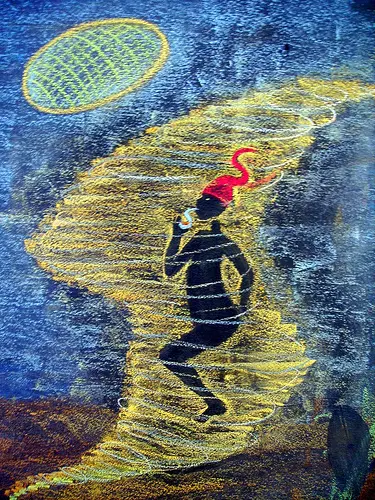
In 1867 the name belonged to a bird — Martius recorded that the Goyatacá believed the soul passed into «the crow-like bird Sacy». In 1876 Couto de Magalhães described a small Tapuio boy, lame in one foot, in a red cap, with a wound on each knee. Only in 1889 does Beaurepaire-Rohan's dictionary give the São Paulo version a little black boy, and assign the single leg to a Rio Grande do Sul variant credited to a named informant. The whirlwind, the pipe and the pranks were gathered in 1917, when Monteiro Lobato opened a public inquiry in a São Paulo evening paper and published the replies as his first book — planting in it, along the way, a testimony of his own signed by the Saci. The bottle corked with a scratched cross is younger still: it belongs to Lobato's 1921 children's novel. And Saci Day, 31 October, is a São Paulo state law of 2004, not a national one — the federal bills were archived in 2007.
What is the history of Saci-Pererê?
The bird came first. Before the Saci was a one-legged boy in a red cap, it was a bird, and not always the same one. In 1867 the Bavarian naturalist Carl Friedrich Philipp von Martius, writing on the Goyatacá of the Rio de Janeiro coast, recorded that they "believed in the immortality of the soul, or in a migration of the soul into the body of the crow-like bird Sacy", which he also calls Ganambuch and places in the genus Coracina. Twenty-seven years later the Swiss-Brazilian zoologist Emílio Goeldi gave the name to a cuckoo: in As Aves do Brasil (1894) he identifies "Diplopterus nevius (galeritus)" — today Tapera naevia, the striped cuckoo — as "o Sací, known throughout the country and of incredible ill fame in popular superstition", and quotes Prince Maximilian zu Wied's field notes on its habits.
The one-legged imp arrives in print in the 1870s, and it is not black yet. The first printed description cited by the later literature, Goeldi and Lobato included, is in Couto de Magalhães's O Selvagem (Rio de Janeiro, 1876). He lists the Saci Cerêrê among the Tupi spirits subordinate to Jaci, the moon, alongside the Mboitatá, the Urutau and the Curupira, and describes it thus: "the traditions represent him with the figure of a small Tapuio, lame in one foot, with a red cap, and with a wound on each knee." His Saci is a small Tapuio, an Indigenous boy, lame in one foot, and the passage has neither pipe nor whirlwind.
The black Saci appears thirteen years later, in the Diccionario de vocabulos brazileiros of the Viscount of Beaurepaire-Rohan (Rio de Janeiro: Imprensa Nacional, 1889), p. 127. His entry, marked "(S. Paulo)", reads: "a species of fantastic being, represented by a little black boy who, wearing a red cap on his head, haunts the marshes at night. If some horseman happens to pass nearby, the Saci plays him every sort of prank, with the aim — quite innocent, by the way — of amusing himself at another's expense. He pulls the horse's tail to stop its march; he sits himself on the rider's croup." And then the sentence that matters most, because it is the one everybody afterwards lost: "They also call him Saci-sêrêrê; and in Rio Grande do Sul, Saci-pêrê, and this one is one-legged (Cesimbra)." In 1889 one-leggedness was a regional variant, credited to a named informant.
How the chain broke. Goeldi reprinted Beaurepaire's entry in footnote 14 of As Aves do Brasil, immediately after a "Confer. Couto de Magalhães, «O Selvagem» (Rio de Janeiro, 1876, I p. 138)". In copying it he already dropped "in Rio Grande do Sul" and the informant's name, leaving "They also call him Saci-cereré and Saci-peré, and this one is one-legged". In 1917 a correspondent of Monteiro Lobato's, Guilherme Lund Netto of Belo Horizonte, reproduced that footnote almost word for word — down to its closing citation of the 1889 dictionary, page 127 — but re-headed it as "Couto de Magalhães, in his well-known work O Selvagem (1876, I, p. 188), says the following". The page had drifted from 138 to 188, and a note by an ornithologist had become a quotation from an ethnographer. The full text of the 1876 first edition, in the Internet Archive's scan, contains no "Beaurepaire", no "Rohan", no "brejos", no "diabruras" — and page 188 of that book is a Nheengatu folk tale about the tortoise and the jaguar.
The inquiry that manufactured the portrait. On 25 January 1917, in the words of the book itself, "the inquiry on the Sacy was opened, to get to the bottom of what was positive in our people's memory about the illustrious one-legged one". The forum was O Estadinho, the evening edition of O Estado de S. Paulo, under the heading "Mythologia Brasilica". Lobato put three questions to the paper's public: their personal conception of the Saci and from whom they had received it in childhood; the current form of the belief in their own district; and any stories they knew. In the opening article he set out a four-layer genealogy: the Saci "comes from the autochthon who gave it its present name… It suffered the influence of the African, passing from caboclinho to molecote. It was modified by the imposition of the Portuguese psyche. The mestizo put much of his own into it."
Letters arrived from Minas Gerais, Rio de Janeiro state and above all from the interior of São Paulo, many of them recalling stories told by formerly enslaved people working on the fazendas. And then, according to the historians of the 1998 facsimile edition, Lobato planted a testimony of his own, signed by the Saci itself, explaining that he was the legitimate son of a cabocla and had two legs with the heels facing forward, so that his footprints pointed the wrong way. The debut book, O Sacy Perêrê: resultado de um inquerito, appeared in early 1918 under the pseudonym "Um Demonólogo Amador", self-financed with a print run of two thousand copies and paid for with advertisements drawn by Voltolino in which the Saci recommends products.
The bottle is younger than the book. In the 1918 inquiry, the way to catch a Saci is a blessed rosary or a loop of grass thrown into the dust-devil, or a cross-braced sieve tipped over its core — and the point is to keep him: "sacis that were lassoed with a rosary, or caught with sieves in whirlwinds". The word garrafa appears twice in those three hundred pages, once about German garden gnomes and once about champagne; never about the Saci. The bottle enters with Lobato's children's novel O Saci (1921), where tio Barnabé instructs Pedrinho: throw the cross-braced sieve over the whirlwind, then "get him inside a bottle and cork it very well. Don't forget to scratch a little cross on the cork, because what holds the saci in the bottle is not the cork but the little cross scratched on it." In that book the rosary has disappeared entirely.
Timeline: the documented record of Saci-Pererê
- 1867 Carl Friedrich Philipp von Martius, writing on the Goyatacá of the Rio de Janeiro coast, records that they believed in the transmigration of the soul into the body of «the crow-like bird Sacy». It is the oldest printed use of the name we could read, and it is attached to a bird, not to an imp.
- 1876 Couto de Magalhães publishes O Selvagem. On page 138 he lists the Saci Cerêrê among the Tupi spirits subordinate to Jaci, the moon, and describes him as «a small Tapuio, lame in one foot, with a red cap, and with a wound on each knee». Lame, not one-legged; Indigenous, not black; no pipe and no whirlwind.
- 1889 The Viscount of Beaurepaire-Rohan's Diccionario de vocabulos brazileiros prints, on page 127, the São Paulo Saci: a «little black boy» in a red cap who haunts the marshes and torments horsemen. Its last line assigns one-leggedness to a specific regional variant: «in Rio Grande do Sul, Saci-pêrê, and this one is one-legged (Cesimbra)».
- 1894 Emílio Goeldi devotes a section of As Aves do Brasil to the «Lenda do Saci»: he identifies the Saci as the cuckoo Diplopterus nevius, explains the legend by the bird's unlocatable whistle, and reprints Beaurepaire-Rohan's entry in footnote 14 — already stripped of «in Rio Grande do Sul» and of the informant's name. This footnote is the link through which almost everyone afterwards read the two older sources.
- 25 January 1917 «The inquiry on the Sacy was opened, to get to the bottom of what was positive in our people's memory about the illustrious one-legged one.» Monteiro Lobato launches it in O Estadinho, the evening edition of O Estado de S. Paulo, under the heading «Mythologia Brasilica», with three questions to readers. The 1998 facsimile's historical essay dates the launch to 28 January; the book itself says the 25th.
- 1918 The book appears under the pseudonym «Um Demonólogo Amador», self-financed, two thousand copies, paid for with advertisements drawn by Voltolino. In it the Saci is caught with a blessed rosary or a cross-braced sieve thrown into a dust devil — and kept as a servant. The bottle does not appear: «garrafa» occurs twice in the whole volume, about German garden gnomes and about champagne.
- 1918 (during the inquiry) According to the historians of the 1998 facsimile, one of the testimonies that settled the Saci's physical description was written by Lobato himself and signed by the Saci: it declared him the legitimate son of a cabocla, with two legs whose heels faced forward so that his tracks pointed the wrong way. The call for evidence produced its own evidence.
- 1921 In Lobato's children's novel O Saci, tio Barnabé teaches Pedrinho the method that everyone now repeats: tip a cross-braced sieve over the whirlwind, then get the creature into a dark bottle and cork it with a small cross scratched on the cork, and hide his cap. The rosary of 1918 has vanished from the text.
- July–October 2003 A group of friends in São Luiz do Paraitinga, in the Paraíba valley, who call themselves saciólogos, found SOSACI, the Sociedade dos Observadores de Saci; the town hall backs them in September and the first Festa do Saci is held on 31 October.
- 12 November and 11 December 2003 Two bills reach the Chamber of Deputies: PL 2.479/2003 by Angela Guadagnin (PT/SP) and PL 2.762/2003 by Aldo Rebelo (PCdoB/SP), appended to the first. Both say the choice of 31 October is deliberate: Guadagnin's text calls the Saci «a synthesis of the three races at the origin of the Brazilian nation — the Indian, the black and the white»; Rebelo's quotes SOSACI's manifesto on a figure «born of Indigenous mythology, passing through an African mutation and a European one, when it gained the red cap».
- 13 January 2004 Governor Geraldo Alckmin sanctions Lei nº 11.669, which institutes the «Dia do Saci» on 31 October in the state of São Paulo. It comes from a state bill, PL 1128/2003, by deputy Afonso Lobato — not from either federal text.
- 25 August 2004 The Chamber's Education and Culture Committee unanimously approves both federal bills on a substitute text by rapporteur Chico Alencar, who writes that creating the date on the same day as Halloween offers Brazilian youth «the alternative of celebrating the manifestations of their own culture».
- 31 January 2007 PL 2.479/2003 is archived under Article 105 of the Chamber's standing orders, having never cleared the Constitution and Justice Committee. There is, to this day, no federal Saci Day: the legal date exists in the state of São Paulo and in individual municipalities.
Is there a rational explanation for Saci-Pererê?
There is a named, dated and printed rational explanation, and it is older than the modern versions of the legend. It is Emílio Goeldi's, in As Aves do Brasil (1894, pp. 162-163), and it is about acoustics. Describing the striped cuckoo he had followed on both banks of the Paraíba and up in the Serra dos Órgãos, Goeldi wrote that what most astonished him was "how one is deceived as to the place where it is perched: one hears the same characteristic whistle from afar for hours; but following that sound one is always either too far or too near, or too much to the right or too much to the left." His conclusion is explicit: "This enigmatic way of being, and together with it the sad call, perhaps gave rise to the whole crown of fables that haloes the name of the Saci." He adds that the bird's two-syllable cry was set down in musical notation by Prince zu Wied, and warns that another Brazilian bird, Ptilochloris chrysoptera, has a similar but three-syllable call.
In the 1918 book the whirlwind is a mechanical question, reasoned about by the people who report it: one passage explains, deadpan, that "the displacement of air produced by the gyroscope of a single leg is what makes the whirlwind", and then twits a physics textbook by name.
What cannot be verified. The Saci has no dated witnesses to test; what it has is a bibliography, and a bibliography can be dated. Its appearances in print can be placed in time, its traits followed from one region and one book to the next, and the late additions picked out. The belief itself has no such date. Câmara Cascudo is usually quoted as saying that the myth exists "at least since the end of the eighteenth or the beginning of the nineteenth century". His Dicionário do Folclore Brasileiro, in the entry «Saci», words it more cautiously and gives the reason: «Os cronistas do Brasil colonial não o mencionam. Parece ter nascido no séc. XIX ou finais do antecedente» — the chroniclers of colonial Brazil do not mention him, and he seems to have been born in the nineteenth century or at the end of the one before. It is an inference from silence, and the printed record agrees with it: the name appears in an ethnographic work of 1867 attached to a bird, the lame, red-capped boy in 1876, and the one-legged variant in 1889.
Two negative results, with their controls. Sílvio Romero's Contos populares do Brasil — some 400,000 characters of Brazilian folk tales in the 1897 edition — contains the word "saci" zero times; the same sweep returns eleven hits for "caipora/caapora". Couto de Magalhães had written in 1876 that the Saci Cererê «figura continuamente nas tradições do povo do sul do Império», figures continually in the traditions of the people of the south of the Empire, and the north-eastern collection bears him out. And the full text of Couto de Magalhães's O Selvagem (1876) contains zero occurrences of "Beaurepaire", "Rohan", "brejo", "negrinho", "phantastico", "diabruras" or "travessuras", against twenty-four for "tapuio", fourteen for "curupira" and seven for "saci" in the same pass — so the passage printed in Lobato's 1918 book as a quotation from O Selvagem is absent from O Selvagem. Both sweeps were rerun on the Internet Archive's text of each book on 28 September 2026.
Can you visit Saci-Pererê?
There is nowhere to visit a Saci, but there is a date and a town. Since 2003 the small colonial town of São Luiz do Paraitinga, in the Paraíba valley of interior São Paulo, has held its Festa do Saci on 31 October. It began in July 2003 as a private joke among friends who called themselves saciólogos, took municipal backing in September, and became SOSACI, the Sociedade dos Observadores de Saci — the body named in the justification of the federal bill filed a few weeks later. The programme is small-town and homemade: street theatre, music, storytelling, workshops, a bicycle ride, school activities. São Luiz do Paraitinga is reached from the city of São Paulo by the Tamoios and Oswaldo Cruz roads; the nearest large town is Taubaté. Check the town hall's programme before travelling, because the dates and the format change from year to year.
Do not expect a national holiday. This is the single most repeated error about the Saci in English-language sources, our own earlier file included. There is no federal Saci Day. Two bills were filed in the Chamber of Deputies in late 2003 — PL 2.479/2003 by Angela Guadagnin (PT/SP), presented on 12 November, and PL 2.762/2003 by Aldo Rebelo (PCdoB/SP), presented on 11 December and appended to the first. The Education and Culture Committee approved both unanimously on 25 August 2004, on a substitute text by Chico Alencar. They never cleared the Constitution and Justice Committee, and PL 2.479/2003 was archived on 31 January 2007 under Article 105 of the House's standing orders.
What does exist is a state law: Lei nº 11.669 of 13 January 2004, sanctioned by governor Geraldo Alckmin, which "institutes the 'Dia do Saci', to be celebrated annually on 31 October" in the state of São Paulo. It came from a state bill, PL 1128/2003, by deputy Afonso Lobato — not from either of the federal texts. Many Brazilian municipalities and schools mark the date anyway, and the calendar of the Colecionador de Sacis and the local press in the Paraíba valley are the practical guides.
Reading the sources yourself is free. The 1918 inquiry, the 1921 novel, Couto de Magalhães's O Selvagem, Beaurepaire-Rohan's dictionary and Goeldi's As Aves do Brasil are all out of copyright and all downloadable in full from the Internet Archive; the links are in the references below. The 1918 book is worth opening for its own sake: it is a facsimile, advertisements included, and the Saci in Voltolino's drawings is selling typewriters.
A note on what we could not consult. The Hemeroteca Digital Brasileira of the National Library, which holds the digitised run of O Estado de S. Paulo and would let anyone read the 1917 instalments in their original columns, did not respond during this review (repeated attempts, connection refused). Everything dated to the inquiry here therefore comes from the book itself and from the historical essay printed in its 1998 facsimile, not from the newspaper pages.
Sources consulted
- José Vieira Couto de Magalhães, «O Selvagem» — Typ. da Reforma, Rio de Janeiro, 1876 book
- Henrique de Beaurepaire-Rohan, Visconde de Beaurepaire-Rohan, «Diccionario de vocabulos brazileiros (entry «Sací», p. 127)» — Imprensa Nacional, Rio de Janeiro, 1889 book
- Emílio Augusto Goeldi, «As Aves do Brasil, 1.ª parte («Lenda do Saci», pp. 162-164, incl. footnote 14)» — Alves & C., Rio de Janeiro, 1894 book
- Monteiro Lobato, as «Um Demonólogo Amador», «O Sacy Perêrê: resultado de um inquerito (facsimile of the 1918 first edition)» — Secção de Obras d'O Estado de S. Paulo, 1918; fac-símile Gráfica JB, Rio de Janeiro, 1918 book
- Carmen Lucia de Azevedo, Marcia Camargos and Vladimir Sacchetta, «Um duende lobatiano (historical essay printed in the 1998 facsimile)» — in O Sacy Perêrê: resultado de um inquerito, ed. fac-similar, Gráfica JB, Rio de Janeiro, 1998 book
- Monteiro Lobato, «O Saci» — São Paulo, 1921 book
- Carl Friedrich Philipp von Martius, «Beiträge zur Ethnographie und Sprachenkunde Amerikas, zumal Brasiliens. I. Zur Ethnographie» — Friedrich Fleischer, Leipzig, 1867 book
- Sílvio Romero, «Contos populares do Brasil (negative control: zero occurrences of «saci»)» — Lisbon/Rio de Janeiro, 1897 book
- Angela Guadagnin, Aldo Rebelo and Chico Alencar (rapporteur), «Projeto de Lei n.º 2.479-A, de 2003 (with PL 2.762/2003 appended, and the opinion of the Education and Culture Committee); archived 31 January 2007» — Câmara dos Deputados, Brasília, 2003 report
- Assembleia Legislativa do Estado de São Paulo (PL 1128/2003, dep. Afonso Lobato), «Lei n.º 11.669, de 13 de janeiro de 2004 — institutes the «Dia do Saci» in the state of São Paulo» — Diário Oficial do Estado de São Paulo, 2004 report
- Luís da Câmara Cascudo, «Dicionário do Folclore Brasileiro, entry «Saci»: «Os cronistas do Brasil colonial não o mencionam. Parece ter nascido no séc. XIX ou finais do antecedente» (first edition 1954)» — Itatiaia / Editora da Universidade de São Paulo, Belo Horizonte and São Paulo, 1988 book
Reviewed by V. Serrano on 2026-08-16 · How we verify our content
📎 Source: Enigma Atlas
💬 Field testimonies (0)
No testimonies yet. Add the first.
Add your testimony
🔒 Log in to add a testimony