👻 HAUNTED PLACE · EXP. Nº9474
ACTIVE
Joelma Building fire
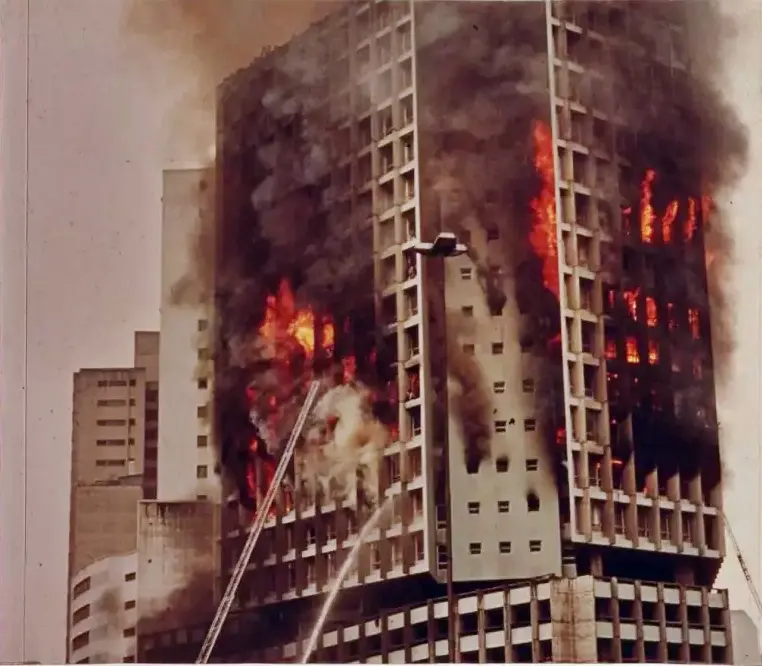
On the rainy morning of Friday 1 February 1974, an air-conditioning unit on the twelfth floor of the Joelma building, at Avenida 9 de Julho 225 in central São Paulo, caught fire.
Where is Joelma Building fire?
- Location
- São Paulo, Brazil
- Type
- Memorial / disaster site
- Coordinates
- -23.549, -46.641
- Last updated
LOCATION
Why is Joelma Building fire said to be haunted?
The twenty-five-storey block had a concrete frame that held, and an interior of wood, carpet and combustible ceiling panels that did not. It had one ordinary staircase, no alarm, no sprinklers, no emergency lighting and no helipad, all of it legal under a building code dating from 1934. The fire burned itself out by mid-morning. Newspapers reported about seventy dead by five that afternoon; by the Sunday edition the count from the city morgue stood at 187, the figure the Brazilian press has used ever since, though English-language accounts say 179 and Rede Globo's files say 189. What followed mattered more than the arguing over numbers: a new São Paulo building code in 1975 that finally required protected stairs, sprinklers, alarms and reachable roofs. The building still stands, in daily use under another name. Its reputation as a haunted place came later, and can be dated.
What is the history of Joelma Building fire?
The Joelma was almost new. Completed in 1971 at Avenida 9 de Julho 225, in central São Paulo, it was built by Joelma S/A Importadora, Comercial e Construtora and leased almost immediately to Banco Crefisul de Investimentos. It had twenty-five floors: document storage in the basement and at street level, ten floors of car park above that, and offices from the eleventh to the twenty-fifth, divided into two blocks — one facing the avenue, the other facing Rua Santo Antônio at the rear.
The reinforced concrete frame was sound, and it survived the fire; engineers found no structural damage afterwards. Almost everything inside the frame was combustible. Partitions and furniture were wood. The ceilings were combustible fibre panels fixed to wooden battens. There was carpet on the floors and fabric curtains at the windows. For the whole building there was a single ordinary staircase — not a fire-isolated one — and no alarm system, manual or automatic, no sprinklers, no emergency lighting, no exit signage and no helipad. The building code then in force in São Paulo was the consolidation approved by Ato nº 663 of 10 August 1934, drafted for a city of some 700,000 people and buildings of a few storeys.
Two years earlier, on 24 February 1972, the Edifício Andraus had burned on Avenida São João. Sixteen people died there, and helicopters lifted hundreds of others from its rooftop helipad. That rescue was fresh in the city's memory on the rainy Friday morning of 1 February 1974, when an air-conditioning unit on the Joelma's twelfth floor caught fire shortly before nine o'clock. An employee who went to investigate found the unit burning, cut the power at the floor panel, and returned to find the fire already running along exposed wiring; the curtains caught, then the ceiling panels. He climbed to the thirteenth floor to warn the people there and could not get back down.
The fire brigade logged the first call at 09:03, sent engines from the nearest stations at 09:05 and reached the building at 09:10, delayed by traffic. The 40-metre Magirus ladders did not reach the upper floors. The building's own hydrants failed. People who could not get down went up, expecting the Andraus outcome; the Joelma's roof was asbestos-cement tiles on a timber frame, cluttered and blisteringly hot, and no helicopter could put down on it. By about 10:30 the fire had consumed the combustible material between the twelfth and twenty-fifth floors and began to die back on its own. The eleventh floor was not damaged. The last survivors were brought out at about 13:30.
Then came the counting, and it is worth following it exactly, because the disagreement that survives today began here. Folha de S.Paulo's own edition of 1 February, closing during the afternoon, reported about seventy bodies at the Instituto Médico Legal by five o'clock and 83 injured people being treated. Its edition of 3 February reported that two more bodies had reached the IML on the Saturday, taking the count from 185 to 187, of whom 135 had so far been identified. The vice-president of Crefisul, Garrett Bouton, told reporters that 1,016 people worked in the building, 861 of them above the garage floors, and that about 600 had already arrived when the fire started.
The forensic report of the Instituto de Polícia Técnica was completed in March 1974 and reopened the argument about the 1934 code. On 20 June 1975 the mayor, Olavo Egydio Setubal, promulgated Lei nº 8.266, the new Código de Edificações, drawn from a bill filed with the city council in 1974. Its text repeals dozens of articles of the 1934 consolidation and writes the two fires into law almost line by line. Article 34 defines a stair of safety as one proof against fire and smoke, reached only through a ventilated antechamber. Article 92 requires the structure and that stair to resist fire for at least four hours. Article 113 requires hydrant networks with their own reservoirs, sprinklers, smoke detectors, alarm and exit signage, emergency lighting and extinguishers. Article 41 requires anti-panic hardware on the doors of rooms holding more than 200 people. And article 45 requires every building over 35 metres tall to have a roof slab connected to the common stair, dimensioned both to shield people from the heat rising from the floors below and to bear the landing of a helicopter in extreme emergency, kept clear of signs, masts and chimneys that might obstruct it. That article is the Joelma and the Andraus in a single sentence.
The building itself was shut for about four years of reconstruction, acquired the emergency stair it had never had, and was later renamed Edifício Praça da Bandeira. In February 2013 Folha de S.Paulo asked the fire-prevention consultant Sérgio Ceccarelli to inspect both buildings against the rules the fires had produced. The Andraus failed, on signage and on fire doors propped open. The former Joelma passed, and exceeded the requirements: signed hydrants, extinguishers and escape routes on its fifteen office floors, two entrances, maintenance reports fixed to the extinguishers, and tactile paving for blind users on the emergency stair, which is not compulsory.
Timeline: the documented record of Joelma Building fire
- 10 August 1934 São Paulo consolidates its building code by Ato nº 663, written for a city of some 700,000 people. It is still the code in force forty years later, and it requires neither fire-fighting equipment nor emergency stairs.
- 4–23 November 1948 Paulo Ferreira de Camargo kills his mother Benedita and his sisters Maria Antonieta and Cordélia at the family house on Rua Santo Antônio and hides them in a well. Police uncover it on 23 November; he takes his own life as they dig. Whether the house stood on the Joelma's later plot is disputed.
- 1971 The Joelma is completed at Avenida 9 de Julho 225 and leased to Banco Crefisul de Investimentos: twenty-five floors, ten of them parking, a single ordinary staircase, no alarm, no sprinklers and no helipad.
- 24 February 1972 The Edifício Andraus burns on Avenida São João. Sixteen people die and helicopters lift hundreds from its rooftop helipad — the rescue the Joelma's occupants will expect two years later.
- 1 February 1974 An air-conditioning unit on the twelfth floor catches fire shortly before nine on a rainy Friday morning. The brigade is called at 09:03 and arrives at 09:10; the 40-metre ladders do not reach the upper floors and the building's hydrants fail. The fire burns itself out by about 10:30 and the last survivors are brought down around 13:30.
- 1 February 1974, evening edition Folha de S.Paulo, closing that afternoon, reports about seventy bodies at the Instituto Médico Legal by five o'clock and 83 injured under treatment, and gives the address as Avenida Nove de Julho 225, with the rear at Rua Santo Antônio 184.
- 3 February 1974 Folha reports that two more bodies reached the IML on the Saturday, taking the count from 185 to 187, of whom 135 have been identified. 187 becomes the figure the Brazilian press has used ever since.
- March 1974 The forensic report of the Instituto de Polícia Técnica is completed and reopens the public argument over the 1934 building code, which had never been revised to fit the city that had grown around it.
- 20 June 1975 Mayor Olavo Egydio Setubal promulgates Lei nº 8.266, the new building code, from a bill filed in 1974. It requires fire-isolated stairs with ventilated antechambers, four-hour fire resistance, hydrants, sprinklers, smoke detectors, alarms, exit signage and emergency lighting — and, in article 45, roofs above 35 metres able to shelter people from the heat below and to take a helicopter.
- 12 April 1980 The film Joelma 23º Andar is released, directed by Clery Cunha and based on Somos seis, a book of letters attributed by the medium Chico Xavier to the dead. The Cinemateca Brasileira records its opening titles: the characters 'are fictitious and any resemblance to persons living or dead is mere coincidence'.
- 14 October 2005 Folha de S.Paulo, reporting on a nightclub opened on the ground floor, records that 'urban legend websites' say the ground once held a pelourinho and that ghosts walk the corridors. The owner says the mystery is good publicity and that he does not believe in wandering souls.
- 29 February 2008 In G1, the former car-park manager José Roberto Viestel, then 71, calls the hauntings nonsense and admits he used to drop coffins left behind by the firefighters from an upper floor to scare the sightseers who came to look at the building.
- 17 February 2013 At Folha's request the fire-prevention consultant Sérgio Ceccarelli inspects both buildings. The Andraus fails on signage and propped-open fire doors; the former Joelma passes and exceeds the rules, with tactile paving on the emergency stair built after the fire.
- 1 November 2018 Folha reports on the devotion at the graves of the thirteen unidentified dead in Vila Alpina. The ESPM researcher Fábio Mariano Borges explains that where the historical record is silent about such dead, 'popular faith takes on the job of creating its own narratives'.
Is there a rational explanation for Joelma Building fire?
Start with the number of dead, because it is the clearest measure of how this story travels. The count published by the newspapers in the days after the fire, taken from the Instituto Médico Legal, was 187; that is the figure Folha de S.Paulo reported on 3 February 1974 and the one the Estadão archive still uses. English-language fire-safety manuals give 179 — it appears, for example, in William Dailey's A Guide to Fire Safety Management. Rede Globo's Linha Direta case file gives 189 dead and 345 injured. A Folha photo caption in 2005 said 188. By 2008 G1 was writing 'almost 200', and by 2018 Folha used the same round phrase. No reconciled official total appears in any of the sources consulted here, and every figure above is offered as what a named source says, not as a fact. Where our earlier entry printed a single confident number, the honest answer is a range with names attached to it.
The curse story has two ingredients, and they are not of equal quality. The first is a pillory: the claim that the ground held a pelourinho where enslaved and condemned people were punished. Folha de S.Paulo reported this in 2005, but reported it precisely as something that 'urban legend websites' say, and no historical source consulted here places a pillory on this block. It stays in this entry as an attributed claim and nothing more.
The second ingredient is real, and it deserves better than its use as a curse. On 4 November 1948 Paulo Ferreira de Camargo, a 26-year-old chemistry teacher and assistant at the University of São Paulo, killed his mother, Benedita Ferreira de Camargo, 56, and his sisters Maria Antonieta, 23, and Cordélia, 19, and hid their bodies in a well in the yard of the family house on Rua Santo Antônio. Police uncovered the well on 23 November; he took his own life while they were digging. It became known as the Crime do Poço. Three named women were murdered by a relative, which is a crime, not an omen — and turning them into the first act of a haunting is the point at which this kind of storytelling stops being harmless.
Whether that house stood on the ground the Joelma later occupied is genuinely disputed, and the dispute is instructive. Rede Globo's Linha Direta states flatly that 'in 1948 there was a house where the Edifício Joelma stands today', and adds that the street numbering was later changed — a claim that conveniently disposes of any address that fails to match. The same Linha Direta page also says the Joelma was a twenty-storey building put up in 1972; it had twenty-five floors and was finished in 1971. Accounts of the case place the house at Rua Santo Antônio 104, citing the São Paulo papers of November 1948; the digitised originals are held by the National Library and could not be opened for this entry, so that address is reported here at second hand. Folha de S.Paulo, describing the burning building on 1 February 1974, placed the Joelma's rear façade at Rua Santo Antônio 184. Those are different numbers on the same street, which is consistent with the account that the house stood a block away; it is not proof, and this entry does not claim it as proof.
On the ghosts themselves there is something better than a debunking: a named man on the record explaining where some of the fear came from. José Roberto Viestel managed the Joelma's car park and was one of the people who fought the fire with the garage hoses when the brigade's failed. Interviewed by Carolina Iskandarian for G1 in 2008, at the age of 71, he said he thought the hauntings were nonsense and then admitted his own hand in them: after the fire, sightseers kept coming to look at the building, and because the firefighters had left some coffins behind, he used to drop them from an upper floor to watch the crowd scatter. He found it funny.
It is also possible to date the supernatural reading of the Joelma, and it does not start in 1974. The earliest fixed point traced here is Somos seis, a book of letters attributed by the medium Chico Xavier to the dead, published by the Grupo Espírita Emmanuel in the mid-1970s, two of whose correspondents are presented as young people killed in the fire. From it came the film Joelma 23º Andar, produced in 1980 and released on 12 April of that year — by the Cinemateca Brasileira's record the first Brazilian feature with a spiritist theme, with Chico Xavier himself appearing in it. The Cinemateca's transcription of the film's own opening titles is the most useful sceptical document in the whole file: 'Starting from a real event (the fire), this film presents a story based on a book. The film's characters are fictitious and any resemblance to persons living or dead is mere coincidence.' The founding work of the Joelma's ghost story says on screen that its people are invented.
The rest arrives later and commercially. A paid ghost route through São Paulo, 'São Paulo de Outro Mundo', has run monthly since 1999 and passes the building; its organiser, the guide Carlos Roberto Silvério, told G1 he had noticed the city 'had this attraction of legends and myths'. In 2005 the owner of a nightclub that had opened on the ground floor told Folha that the mystery was good for business — 'I have never had so much free publicity' — while saying he did not believe in wandering souls himself.
One strand is different, and this entry treats it differently. Thirteen people died in a lift and were never identified; they were buried side by side at the Cemitério São Pedro in Vila Alpina, and a popular devotion grew around the graves, with water poured to ease burns and milk to ease the smoke. Folha de S.Paulo reported in 2018 on Rosemere Alencar, a gardener at the cemetery who has tended the graves every Sunday since a vow made when her daughter was not expected to live. The researcher Fábio Mariano Borges, of the ESPM, explained the mechanism to the same newspaper: most such shrines hold 'simple, unknown people whose death was for some reason wrapped in mystery', and where the historical record is silent 'popular faith takes on the job of creating its own narratives'. That is as good an account of how the Joelma became haunted as any this entry could offer, and it comes from someone who studies it.
Can you visit Joelma Building fire?
The building stands at Avenida Nove de Julho 225, in the Bela Vista district of central São Paulo; the postcode Correios gives for the odd-numbered side of the avenue up to no. 1299 is 01313-000. Two further façades face the Praça da Bandeira at the side and Rua Santo Antônio at the rear. Reconstruction kept it shut for about four years and it reopened in September 1978 with the emergency stair it had never had. The name Edifício Praça da Bandeira dates from the middle 2000s, and the old one is still spoken in the city. Ten of its twenty-five floors are car park, and when Folha de S.Paulo had the fire-prevention consultant Sérgio Ceccarelli inspect the building in February 2013 there were fifteen office floors in use above them.
This is private commercial property whose tenants come to work every weekday, and the entrances are theirs. Nothing inside is open to the public, so the site holds no museum and no memorial exhibit. The fire of 1 February 1974 falls inside living memory: people who got out of it are alive, and so are the relatives of the dead. What is public here is the pavement of Avenida Nove de Julho and the square the building is now named after. The closest station is Anhangabaú, on Line 3-Vermelha of the Metro at Rua Formosa in the República district; a walkway joins it to the Terminal Bandeira.
The thirteen dead who were never identified lie at the Cemitério São Pedro, opened in 1972 at Avenida Francisco Falconi 837, Vila Alpina, in the Vila Prudente district on the east side of the city. It remains a working municipal cemetery, and Folha de S.Paulo counted that grave in 2018 among the anonymous tombs of São Paulo that receive popular devotion.
Sources consulted
- Folha de S.Paulo, «De novo, e muito pior — Até 17h: 70 mortos» — Folha de S.Paulo (edición del 1 de febrero de 1974, reproducida en el Almanaque Folha), 1974 newspaper archive
- Folha de S.Paulo, «1974: Número de mortes no incêndio do edifício Joelma sobe a 187» — Folha de S.Paulo, Banco de Dados (reproducción de la edición del 3 de febrero de 1974), 1974 newspaper archive
- Liz Batista, «Joelma e Andraus: fogo e tragédia em SP» — O Estado de S. Paulo / Acervo Estadão (página sin fecha; primera captura archivada en mayo de 2018) newspaper archive
- Prefeitura do Município de São Paulo, «Lei nº 8.266 de 20 de junho de 1975 — Aprova o Código de Edificações» — Catálogo de Legislação Municipal de São Paulo, 1975 archive
- Luiz Caversan, «Tragédia do Joelma foi a pior da cidade» — Folha de S.Paulo, 2003 newspaper archive
- Folha de S.Paulo, «Após 41 anos, edifício Andraus falha em segurança contra fogo» — Folha de S.Paulo, Cotidiano, 2013 newspaper archive
- Carolina Iskandarian, «Lugares 'mal-assombrados' viram lenda em SP» — G1, Edição São Paulo, 2008 newspaper archive
- Sérgio Ripardo, «Boate do Joelma vai 'espantar' superstição com forró e axé» — Folha Online, Ilustrada, 2005 newspaper archive
- Folha de S.Paulo, «Túmulos de anônimos ganham devoção popular e são reverenciados em SP» — Folha de S.Paulo, Cotidiano, 2018 newspaper archive
- Cinemateca Brasileira, «Joelma 23º Andar — ficha de la Filmografia Brasileira» — Base de datos Filmografia Brasileira, Cinemateca Brasileira, 1980 archive
- Rede Globo, «O Enigma do Edifício Joelma» — Linha Direta — Mistério, Rede Globo, 2005 web
- William Dailey, «A Guide to Fire Safety Management» — Perpetuity Press (pasaje localizado mediante la búsqueda de texto completo de Open Library), 2000 book
- Bombeiros Emergência, «Incêndio Edifício Joelma — resumen técnico del siniestro» — bombeirosemergencia.com.br (copia archivada de 2010 en la Wayback Machine), 2010 web
Reviewed by V. Serrano on 2026-08-12 · How we verify our content
💬 Field testimonies (0)
No testimonies yet. Add the first.
Add your testimony
🔒 Log in to add a testimony