📜 LEGEND · EXP. Nº0270
ACTIVE
Boitatá, the Fire Serpent
The Boitatá is the fire that runs across the fields at night, and it is one of the oldest things anybody wrote down about Brazil.
Where does the legend of Boitatá, the Fire Serpent come from?
- Location
- São Vicente (São Paulo), Brazil
- Kind of legend
- Creature legend
- Coordinates
- -23.966, -46.386
- Last updated
LOCATION
What is the legend of Boitatá, the Fire Serpent?
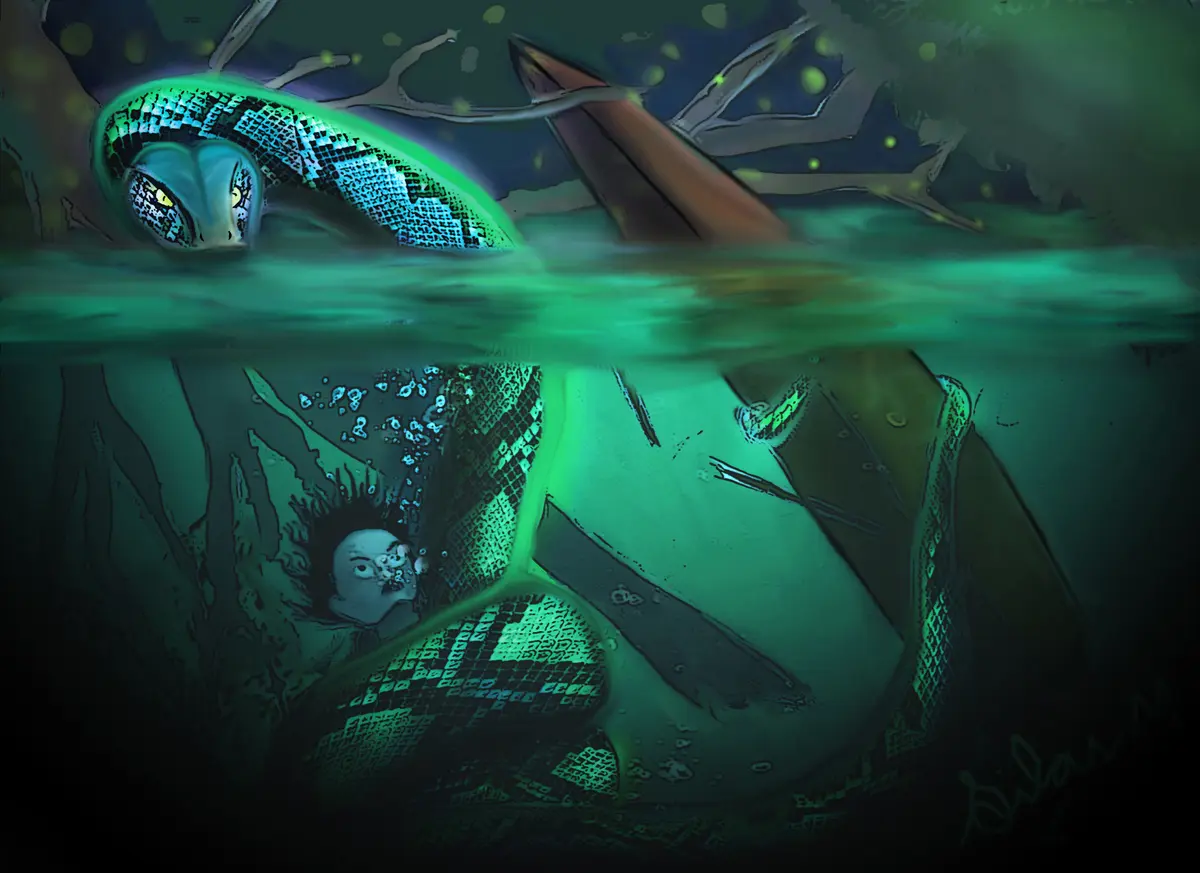
At the end of May 1560, in a Latin letter sent from São Vicente, the Jesuit José de Anchieta reported that along the shores, near the sea and the rivers, there were beings the Brasis called Baêtatâ — res ignis, a thing of fire. By night, he wrote, nothing appears but a sparkling fire darting here and there; it attacks the Indians and kills them, as the Corupira does, "and what this may be is not yet established". There is no snake in that paragraph, and nothing is being protected. The serpent arrives three centuries later, through books: a novelist gave it burning eyes in 1874, and in 1876 an army general turned it into cobra de fogo, the spirit that guards the open grassland against those who set fire to it. The version retold today — the endless night, the eyes of the dead animals, the light trapped inside the body — was written by a named author in Rio Grande do Sul in 1913, and it ends with the Boitatá dead.
What is the history of Boitatá, the Fire Serpent?
Almost everything about the Boitatá can be dated, which is rare in folklore, and the dates do not run the way the legend says they do.
The oldest record is a letter: at the end of May 1560 the Jesuit José de Anchieta wrote from São Vicente — "the last settlement of the Portuguese in Brazilian India facing south", as he signs off — a long naturalist's report to his superior: ants, manatees, anteaters, stones, a storm at sea. He wrote it in Latin and it stayed in manuscript for two and a half centuries. At the very end comes a short section on "nocturnal apparitions, or rather demons, with which the Indians are accustomed to terrify themselves", and in it three beings in a row: the Corupira of the woods, the Igpupiara of the rivers, and then this, in the 1812 Lisbon printing, with the long s normalised:
"Sunt et alii in litoribus maxime, secus mare et flumina versantes, qui Baêtatâ, hoc est res ignis appellantur, quod idem est, ac si dicas, aliquid quod totum est ignis. Apparet noctu nihil aliud, quam ignis scintillans huc illuc discurrens, celerrime invadit Indos, et necat, sicut et Corupira: quid hoc sit, adhuc non constat."
There are others as well, chiefly on the shores, keeping near the sea and the rivers, who are called Baêtatâ, that is, a thing of fire, which is the same as saying something that is entirely fire. By night nothing appears but a sparkling fire running this way and that; it attacks the Indians very swiftly and kills them, just as the Corupira does: what this may be is not yet established.
The sentence has no snake in it, and no field, no forest and nothing guarded; the thing kills, and that is all it does. And the man writing, who translates every other Tupi name he uses, ends by saying he does not know what this one is.
The name carries the argument, and it can be checked without leaving the letter. Anchieta glosses it himself — res ignis, a thing of fire — and he is scrupulous with these compounds. Seventeen printed pages earlier he runs through the snakes of the province and translates every name: Bóicininga, "id est coluber tinniens", the rattling snake; Bóiquatiára, "id est colubri picti"; Bóipéba, "hoc est colubri plani"; Bóiroiçanga, "id est colubri frigidi"; and further on Bóiquíba, "hoc est colubri pediculos", snake-lice. Five times boi, and five times coluber. His annotator spelled the rule out in 1812: "Boi, seu Boia inter Brasiliae Indigenas nomen est appellativum Serpentium" — among the natives of Brazil, boi or boia is the general name for snakes. For the fire on the shore Anchieta does not use it: in 1560 the word is baê.
The Latin went to press in Lisbon in 1812, in the first volume of the Academia Real das Sciencias' Collecção de noticias para a historia e geografia das nações ultramarinas, annotated by Diogo de Toledo Lara Ordonez. The Portuguese text came decades later. The translation everyone quotes, made by Teixeira de Melo with Martinho Corrêa de Sá, ran first in the first volume of the Anais da Biblioteca Nacional, pages 275-305, and then, corrected, in the Diário Oficial of Rio de Janeiro on 22, 24 and 26 December 1887 and 2 and 7 January 1888. That chain comes from the editorial note 1 of the 1933 Rio edition, which does not date the Anais printing; the dated appearance is the Diário Oficial one.
By then the snake had already arrived, and it arrived through literature. In 1872 the word is in a gaucho ballad inside Apolinário Porto-Alegre's novel O Vaqueano, used as a figure for a man worn to a shadow. In 1874 José de Alencar, in Ubirajara, has an elder name a guest Boitatá "because he has the eyes of the great fire serpent that flies like the lightning of Tupã". Two years later, in 1876, General Couto de Magalhães printed in O Selvagem, page 138, the sentence the whole country has repeated since: "O Mboitatá é o gênio que protege os campos contra aquelles que os incendeiam; como a palavra o diz mboitatá é: cobra de fogo; as tradições figuram-n'a como uma pequena serpente de fogo que de ordinário reside n'agua. Às vezes transforma-se em um grosso madeiro em brasa, denominado méuan, que faz morrer por combustão aquelle que incendeia inutilmente os campos."
The sentence stops at the campos, the open grassland. Seven lines further down the same page Couto hands the forest to somebody else: "O Curupira é o deus que protege as florestas", who punishes whoever fells or needlessly spoils trees. The two paragraphs are on one page of one book. In many modern retellings there is nothing between them at all, and the Boitatá has quietly inherited the Curupira's job. The size changes too: Couto's fire serpent is pequena, small, and lives in the water, while the great serpent is Alencar's.
The version most Brazilians can recite is younger still and has an author. In 1913, in Pelotas, João Simões Lopes Neto opened his Lendas do Sul with "A M'boi-tátá". It begins with a night so long it seemed daylight would never come, and the downpour that follows only floods the burrow of the boiguaçu, the great snake, and drives it out. It eats the eyes of the carrion and nothing else. Having no hair, no scales, no feathers, no shell and no thick hide, it turns transparent, lit from inside by the last of the daylight the dead animals had kept in their eyes, and the men who see it fail to recognise it and rename it: boitatá, cobra de fogo. The tale then ends with the snake's death: the boitatá starves — light is not food — and it dies among the carcasses, its body rots, the trapped light is loosed across the fields, and the sun comes back. What runs over the summer grassland afterwards, cold and yellow-blue, is the light the snake was carrying.
Timeline: the documented record of Boitatá, the Fire Serpent
- end of May 1560 The Jesuit José de Anchieta signs at São Vicente a Latin letter describing the natural things of the province. In its last section, on nocturnal apparitions, he records beings called Baêtatâ, 'res ignis', a thing of fire, seen on the shores near the sea and the rivers: nothing appears at night but a sparkling fire darting about, which attacks and kills the Indians as the Corupira does. He adds that what it may be is not yet established. It is the oldest record of the name, and it contains no snake.
- 1812 The Academia Real das Sciencias prints the letter for the first time, in Lisbon, in the first volume of the Collecção de noticias para a historia e geografia das nações ultramarinas, annotated by Diogo de Toledo Lara Ordonez. His note 86 disposes of the Baêtatâ as an atmospheric phenomenon — 'these fiery meteors, whose nature the physicists explain, today terrify only the illiterate' — and a second note argues that Anchieta himself had not been entirely persuaded they were demons. The scepticism about the Boitatá is two centuries old and it is signed.
- 1872 Apolinário Porto-Alegre serialises O Vaqueano in the Revista do Partenon Literário of Porto Alegre. In chapter XXIII a gaucho ballad uses the word as a figure of speech — a man so wasted that his sweetheart would swear he had turned boitatá. The name is already common currency in Rio Grande do Sul, forty-one years before the story everyone now tells was written there.
- 1874 José de Alencar publishes the novel Ubirajara. In chapter IV an elder proposes a name for a guest: 'Chama ao hóspede Boitatá, porque ele tem os olhos da grande serpente de fogo, que voa como o raio de Tupã.' The great fire serpent, and its eyes, are in a work of romantic fiction two years before they appear in a book of folklore.
- 1876 General Couto de Magalhães prints in O Selvagem, page 138, the sentence the country has repeated ever since: the Mboitatá is the spirit that protects the campos against those who set fire to them; the word means cobra de fogo; tradition pictures it as a small fire snake that usually lives in the water and sometimes turns into a great burning log, méuan, which kills by combustion whoever needlessly burns the fields. Seven lines below, on the same page, the forests are given to somebody else: 'O Curupira é o deus que protege as florestas.'
- 22 December 1887 – 7 January 1888 Anchieta's letter is printed in Portuguese, in the version by Teixeira de Melo with Martinho Corrêa de Sá, across five issues of the Diário Oficial of Rio de Janeiro. Note 1 of the 1933 Rio edition records an earlier printing of the same translation in the first volume of the Anais da Biblioteca Nacional, pages 275-305, without dating it. From here on the learned gloss, thing of fire, and the popular one, cobra de fogo, run side by side.
- 1913 João Simões Lopes Neto opens his Lendas do Sul, published at Pelotas, with 'A M'boi-tátá': the night that would not end, the flood that drives the boiguaçu out of its burrow, the eyes of the carrion, the body turned transparent by the daylight stored in them, and the men who fail to recognise the snake and rename it. It is the oldest printed version of this plot in the Portuguese Wikisource corpus, and it ends with the boitatá starving to death and rotting, leaving its light loose over the fields.
Is there a rational explanation for Boitatá, the Fire Serpent?
The sceptic here is not modern, and he is not anonymous: he is the man who first got the letter into print.
In the 1812 Lisbon edition, Diogo de Toledo Lara Ordonez hung note 86 on the Baêtatâ paragraph and wrote: "Haec ignea Meteora, quorum naturam Physici explicant, hodie tantummodo illiteratos, ac superstitione imbutos perterrent" — these fiery meteors, whose nature the physicists explain, today terrify only the illiterate and those steeped in superstition. He then adds the mechanism, which is the one still used today: "Indis terrore atque metu affectis, non propriis viribus, non nunquam Baêtatá interitum afferret" — the Indians being struck with terror and fear, the Baêtatá has more than once brought about their death not by its own strength. A second note on the same page, also numbered 86, goes further and defends Anchieta from the people who would quote him: "Ex his tamen verbis, credo, facile concluditur Anchietam haec Meteora esse daemones non omnino sibi persuasisse" — from these words, I believe, it is easily concluded that Anchieta had not entirely persuaded himself that these meteors were demons. The editor even set the section heading in the past tense: at the time these things were written, it was believed that the demons inflicted death and wounds.
The best physical description of the thing, though, is inside the legend, and it was written by a man who was not arguing. Lopes Neto's boitatá is "um fogo amarelo azulado, que não queima a macega seca nem aquenta a água dos manantiais", a yellow-blue fire that does not burn the dry grass or warm the water of the springs. In winter it does not appear and sleeps "de entanguida", curled up with cold; it comes out in summer "depois da quentura dos mormaços", after the muggy heat; it haunts hardest "nos lugares onde quanta mais carniça houve", where the most carrion lay. Whoever meets it has two ways out: to stand quite still "de olhos fechados apertados e sem respirar", eyes screwed shut and not breathing, or, on horseback, to throw the lasso over it and gallop off dragging it, until the light catches on a tuft of grass and falls apart. A cold light, seasonal, over rotting matter in wet ground: Lopes Neto describes from close up what Lara Ordonez filed among the meteors, and in 1812 Lara Ordonez left it to the physicists.
The datable question can be answered. A plain full-text search of the Portuguese Wikisource for boitatá, run on 1 October 2026, returns fourteen pages. The ones printed before 1913 use the word as a name already in circulation. In Apolinário Porto-Alegre's O Vaqueano (1872) a ballad ends a verse with "E tornei-me boitatá?", and fugitives cross the country "fugindo aos olhos azuis dos boitatás"; in Taunay's novel Inocência (1872) a character's fright runs to "algum currupira... ou boitatá"; Alencar's elder in Ubirajara (1874) speaks of the eyes of "the great fire serpent"; Couto de Magalhães writes in O Selvagem (1876) that in Goiás and Mato Grosso one constantly hears stories of the Boitatá; and Taunay's Ciganinha, in a collection of 1901, has someone who goes carousing "com currupiras e boitatás". None of them tells the story of the long night, the flood and the eaten eyes. That story first appears in the tale Lopes Neto signed and dated in 1913, and the other pages, Monteiro Lobato's O Saci and Mário de Andrade's Macunaíma (1928), come after it. The control in the same corpus works: "batatão" returns one page, a Potiguar chief whom Frei Vicente do Salvador lists among the men who marched to the Jaguaribe in 1603. A stricter search with the insource operator, first run on 16 August 2026 and repeated with the same result on 1 October, finds only three of the fourteen pages, because it matches the exact string in each page's source, which leaves out plurals and the books whose text is drawn in from scanned pages. The search does not show that nobody told the story before 1913. It shows that the oldest printed version in the corpus is a literary composition by a named author, and that the sentence about the Boitatá guarding the fields against arsonists is older, printed in 1876, and never mentions the forest.
Can you visit Boitatá, the Fire Serpent?
The Boitatá is a light seen on wet ground at night, and the stories attach it to no building. The pin on this file is on São Vicente, on the coast of São Paulo state, the settlement from which José de Anchieta dated the letter of 1560 that first names it.
The documents are all free to read online. The Latin original is in the first volume of the Collecção de noticias para a historia e geografia das nações ultramarinas (Lisbon, 1812), which the Biblioteca Digital da Câmara dos Deputados in Brasília serves as a single PDF of 105 MB; the Baêtatâ paragraph is at the end of §XLVI, printed page 162, and Lara Ordonez's notes are on printed page 178, where two consecutive and contradictory notes are both numbered 86. The automatic text layer of that scan renders the long s as f, so a search for "sunt" finds nothing while "funt" finds every occurrence; the page images, or a search in the old spelling, get round it.
A faithful Portuguese translation, with useful notes, is Caderno nº 7 of the Série Documentos Históricos of the Conselho Nacional da Reserva da Biosfera da Mata Atlântica, "Carta de São Vicente 1560", published in the spring of 1997 and downloadable free; it reprints the 1933 Civilização Brasileira text edited by Afrânio Peixoto, and its note 78 is the one on the Baetatá. Couto de Magalhães's O Selvagem (Rio de Janeiro, 1876) is a free PDF of 123 MB at the Biblioteca Brasiliana Guita e José Mindlin of the University of São Paulo; page 138 has the Mboitatá and the Curupira, one above the other. O Vaqueano and Ubirajara are transcribed on Portuguese Wikisource, and Lopes Neto's Lendas do Sul circulates freely in a digitisation of the Globo edition.
The nearest building with a claim on the story is the Museu Anchieta at the Pateo do Collegio, Praça Pátio do Colégio 2, in the historic centre of São Paulo — the Jesuit house of the man who wrote the word down. Its website, consulted on 23 September 2026, gives the hours as Tuesday to Saturday, 09:00 to 16:45, and admission as R$26, with R$13 for private-school and university students and teachers, R$6 for state-school pupils, the elderly and pensioners, and free entry for children up to seven and for disabled visitors. São Vicente, where the letter was written, is a separate town on the coast, about 53 km (33 miles) south-east of the Pateo in a straight line.
The thing itself, where Lopes Neto put it, is flat wet pasture after dark in summer, over ground where animals have died. Lara Ordonez's note of 1812 says that the Indians who died of the Baêtatá were struck down by terror and fear, and that it killed them "non propriis viribus", without strength of its own.
Sources consulted
- José de Anchieta; notes by Diogo de Toledo Lara Ordonez, «Epistola quamplurimarum rerum naturalium, quae S. Vincentii (nunc S. Pauli) provinciam incolunt, sistens descriptionem — the Baêtatâ paragraph at the end of §XLVI, printed p. 162, with the annotator's two contradictory notes, both numbered 86, on printed p. 178» — Collecção de noticias para a historia e geografia das nações ultramarinas, tomo I, num. III. Lisbon: Academia Real das Sciencias. Read in the Biblioteca Digital da Câmara dos Deputados scan (vol. 1 PDF, c. 105 MB); the automatic text layer renders the long s as f, 1812 book
- José de Anchieta; edition of the Conselho Nacional da Reserva da Biosfera da Mata Atlântica, reprinting the 1933 Civilização Brasileira text edited by Afrânio Peixoto, «Carta de São Vicente 1560 — Portuguese translation, with note 78 on the Baetatá and note 1 on the transmission of the text (Venice, 1812/1799, Diário Oficial 1887-88, São Paulo 1900, Rio 1933)» — Caderno nº 7, Série Documentos Históricos, Conselho Nacional da Reserva da Biosfera da Mata Atlântica / UNESCO MaB, spring 1997, 1997 book
- José Vieira Couto de Magalhães, «O Selvagem, part II ('Origens, costumes, região selvagem'), p. 138: the Mboitatá and, seven lines below, the Curupira» — Rio de Janeiro: Typographia da Reforma. Read in the Biblioteca Brasiliana Guita e José Mindlin (USP) digitisation, 1876 book
- João Simões Lopes Neto, «'A M'boi-tátá', in Lendas do Sul» — First published Pelotas, 1913. Read in the digitisation of Contos gauchescos e lendas do sul, 3rd ed., Porto Alegre: Globo, 1965, made by the Biblioteca Virtual do Estudante Brasileiro (USP), 1913 book
- José de Alencar, «Ubirajara: lenda tupi, chapter IV» — Rio de Janeiro, 1874. Read in the Portuguese Wikisource transcription, 1874 book
- Apolinário Porto-Alegre, «O Vaqueano, chapter XXIII ('A cabeça de um anjo')» — Revista do Partenon Literário, Porto Alegre, 1872. Read in the Portuguese Wikisource transcription, 1872 book
- Frei Vicente do Salvador, «História do Brasil, book IV, ch. XXXIII — 'Batatão' as the name of a Potiguar leader on the 1603 march to the Jaguaribe (the false positive of our corpus search)» — Written 1627. Read in the Portuguese Wikisource transcription, 1627 book
- Enigma Atlas, «Full-text search of the Portuguese Wikisource corpus for insource:"boitatá", "mboitatá", "batatão", "baetatá" and "curupira", run on 16 August 2026 and repeated with the same result on 1 October 2026; and a plain search for boitatá on 1 October 2026, which returns 14 pages, including plurals and transcluded books that the insource operator misses» — pt.wikisource.org search API (action=query&list=search), 2026 web
- Pateo do Collegio, «Museu Anchieta — Pateo do Collegio: address, opening hours and admission prices» — pateodocollegio.com.br, consulted 16 August 2026, 2026 web
- Visconde de Taunay, «Inocência, chapter VIII ('Os hóspedes da meia-noite'): 'algum currupira... ou boitatá'» — Rio de Janeiro, 1872. Read in the Portuguese Wikisource transcription, 1872 book
- Visconde de Taunay, «Ciganinha, chapter VI, in Ao entardecer: contos vários: 'com currupiras e boitatás'» — Rio de Janeiro: Garnier, 1901. Read in the Portuguese Wikisource transcription, 1901 book
Reviewed by V. Serrano on 2026-08-16 · How we verify our content
📎 Source: Enigma Atlas
💬 Field testimonies (0)
No testimonies yet. Add the first.
Add your testimony
🔒 Log in to add a testimony