🦶 CRYPTID SIGHTING · EXP. Nº6501
ACTIVE
Grootslang
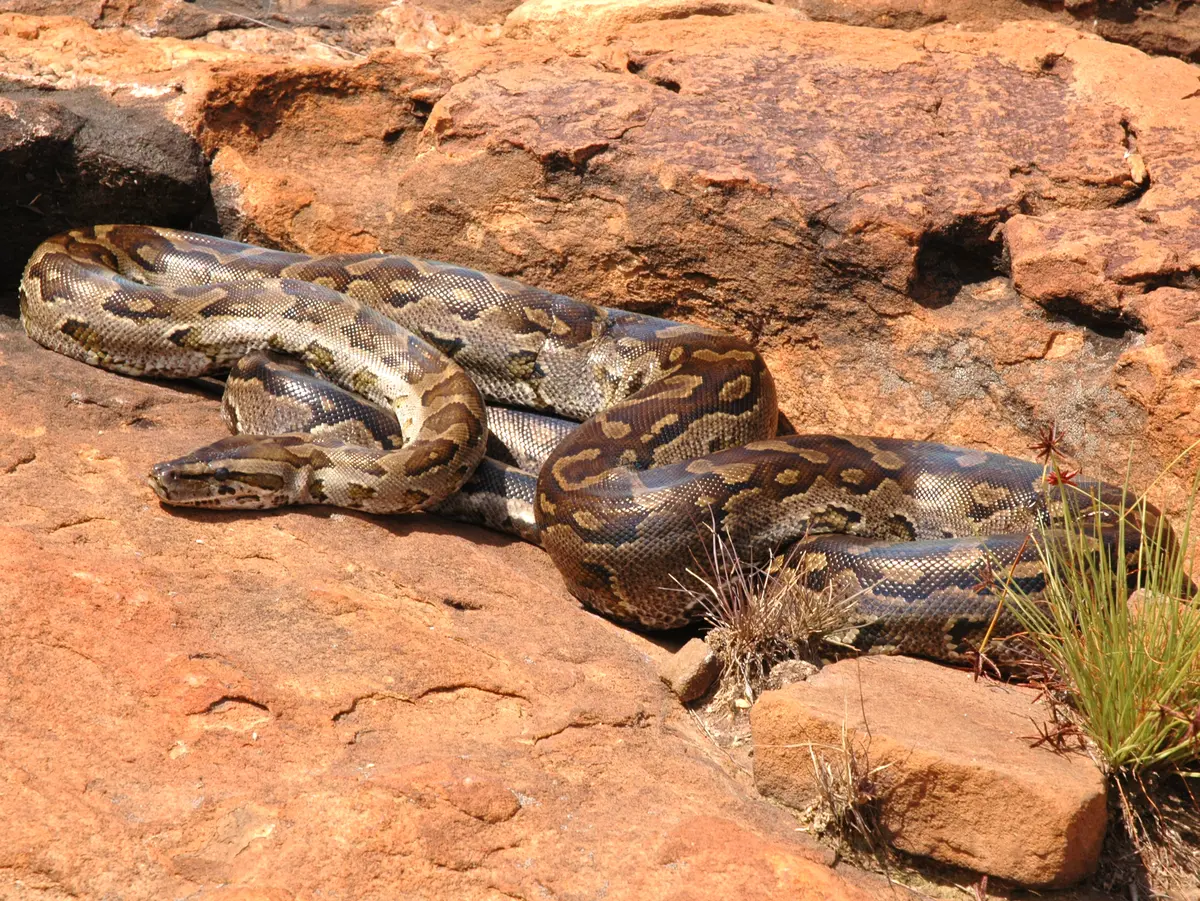
Grootslang is Afrikaans for "big snake", and a big snake is what the earliest records describe: a very large serpent in the lower Orange River, on the border between South Africa and Namibia.
Where and when was Grootslang sighted?
- Location
- Sudáfrica, South Africa
- Date sighted
- Unknown
- Coordinates
- -28.5, 21.0
- Last updated
LOCATION
What is Grootslang?
The oldest account that can be dated is from 1838, when Sir James Edward Alexander wrote down what Khoekhoe informants told him at the river mouth — a snake whose track on the sand was a foot broad, and whose appearance meant a good rainy season was on the way. In 1920 the prospector Fred C. Cornell printed the Afrikaans name, recorded a local one, "Ki-man", and pointed to a rock in the river where the animal was said to live; he threw dynamite at it and flushed out a wild duck. The cave now called the Wonder Hole was given that name only in 1948, by the journalist Lawrence G. Green. Cornell knew it by a Nama name, Hadje Aibeep, "The Unknown Place". The famous elephant-headed version, and the story of gods splitting the first Grootslang into elephants and snakes, appear in none of these sources. Both are recent, and both came from the internet.
What is the history of Grootslang?
The oldest datable printed record of a giant snake in the lower Orange River is not a cryptozoology page. It is a Royal Geographical Society travel narrative from 1838.
Sir James Edward Alexander reached the mouth of the Gariep — the river Europeans call the Orange — on an expedition backed by the British government, and published his account in 1838. Between a note on hares and one on the eland he wrote: "an immense snake is occasionally seen whose trace on the sand is a foot broad. The natives say, that when coiled up, the circumference of this snake is equal to that of a waggon wheel; and when it visits the Orange river mouth it is a sign of a good season for rain." Two things in that sentence are worth holding on to. The information comes from Khoekhoe informants, and the animal is a good omen — rain, in a country that receives between 5 and 200 mm of it a year. The bay Alexander was surveying is the one that now carries his name: Alexander Bay.
Forty-three years later the philologist Theophilus Hahn placed that snake inside a coherent religious system. In Tsuni-ǁGoam: The Supreme Being of the Khoi-Khoi (1881) he reports that "throughout Great Namaqualand it is believed that in each fountain lives a snake, and if that snake leave the fountain or be killed, the fountain will dry up", a being he glosses as "the one which lives in a hole". He gives the Khoekhoe word for snake as ǀau-b and for spring as ǀau-s, both from ǀau, to flow — the same root as ǀau-b, blood. In Hahn's reading the snake is not a monster at all. It is water, personified. He quotes Alexander's paragraph in full.
The Afrikaans name reaches print in 1920, in the memoirs of a working prospector. Fred C. Cornell landed at Port Nolloth in August 1910 to peg copper and diamond claims, and in The Glamour of Prospecting he describes a night on the river when his guide Ezaak asked to move camp: opposite them stood a rock in which lived "the huge snake (the 'Groot Slang,' in which every Richtersfeldt Hottentot firmly believes)". Cornell's summary is still the most useful description anyone has left. "Many reputable Hottentots and a few white men claim to have seen it, many more have seen its huge spoor in the sand or mud — a foot and a half wide. It is believed to take cattle from the banks, and the natives fear it mightily. There are no crocodiles in the Orange, and, besides, there are never any traces of feet with the spoor." He also records a local name: "the Hottentot name for this huge python — or whatever it may be — is 'Ki-man'". The word Cornell uses for the Nama is a slur today and is kept here only inside his quotations. He and his partner Ransson threw dynamite into the pool and emptied a magazine into a cleft in the rock; what came out was an indignant wild duck. They tried once more on the return leg, with the same result. Cornell also notes what the belief cost in daily life: people crossing the river at night did so shouting and splashing, pushing a dry log ahead of them, for fear of the Groot Slang.
Cornell visited the pit that later writers would call the Wonder Hole, and he gives it another name. Camped at Annisfontein, he walked half a mile to "the so-called 'Cave of Hadje Aibeep'", a nearly vertical shaft about fifteen feet across, dropping straight into the ground; white visitors called it the Bottomless Pit. His most fluent guide translated Hadje Aibeep as "The Unknown Place", and told him that long ago men had gone down the hole and come out on the bank of the Gariep many miles away, passing through a cavern where they found many "bright stones". Cornell heard a competing etymology from "students of the Hottentot language" tying the name to a funerary cairn custom, and noted the obvious objection: there are no such cairns near the pit. A third account connected the shaft to "the fabulous dragon-like monster" said to emerge at night to ravage the country between the Gariep and the Buffels rivers. Cornell kept the three apart, and so did his informants — old Klaas, deeper in the mountains, described a man-eating snake with a goat's head that "is in no way to be confounded with the Ki-man of the 'Groot Rivier'".
The welding happened in 1948. In Where Men Still Dream the Cape Town journalist Lawrence G. Green named the shaft the "Wonder Hole", and in a single paragraph made it both the Grootslang's home and the source of Namaqualand's diamonds. The cavern, he wrote, was believed to connect with the sea forty miles away: lean over the edge and "there comes at intervals a deep boom like surf on a distant shore". He describes one prospector who went down on a winch and cable, touched a ledge far below, saw tunnels leading off it and smelled sulphur, dropped his torch when bats flew into his face, and never descended again. Green also stretched the animal — forty feet long, a track three feet wide, against Cornell's foot and a half — and passed on, in order to dismiss it, the claim that it carried diamonds in its eye sockets. And he supplied the explanation still quoted today: "The truth probably is that exceptionally large pythons have been seen in the river from time to time, and their sizes exaggerated."
Green wrote that in the middle of the boom he describes on the facing pages: the barbed wire at Alexander Bay, the X-ray plant installed to catch smugglers, stolen stones reaching Amsterdam and Antwerp. That part of the story needs no legend. Diamonds were found along the Namaqualand coast in the mid-1920s — T. E. Gregory's 1962 study of Ernest Oppenheimer dates J. E. Carstens's find to August 1925, while other accounts put the first strike in 1926 — and Hans Merensky's syndicate bought the claims that made the fortune at Alexander Bay. The people already living there received none of it. The Richtersveld Nama, transhumant herders whose families had used these mountains for generations, lost the ground; they went to court, and on 14 October 2003 the Constitutional Court of South Africa held in Alexkor Ltd v Richtersveld Community that the community's rights in that land had included its minerals and precious stones. In 2007 UNESCO inscribed the Richtersveld Cultural and Botanical Landscape as a World Heritage site under the cultural criteria: a living landscape belonging to a community, not an empty one.
Timeline: the documented record of Grootslang
- 1838 Sir James Edward Alexander publishes the earliest record I have been able to date: at the mouth of the Orange, "an immense snake is occasionally seen whose trace on the sand is a foot broad", and its arrival is a sign of a good rainy season. His informants are Khoekhoe. The bay he was surveying later takes his name.
- 1881 Theophilus Hahn reports the Khoekhoe belief that a snake lives in every spring and that the spring dries up if it is killed, gives the words ǀau-b (snake) and ǀau-s (spring) from ǀau, to flow, and quotes Alexander's 1838 paragraph in full.
- 1920 Fred C. Cornell prints the Afrikaans name for the first time. His guide Ezaak points out the rock in the Orange where the "Groot Slang" lives; Cornell records a local name, "Ki-man", a spoor a foot and a half wide with no footprints, and the habit of crossing the river at night shouting for fear of it. He dynamites the pool twice and flushes out a wild duck.
- 1920 (same book) Cornell describes the pit half a mile from Annisfontein under a Nama name, "the Cave of Hadje Aibeep", translated for him as "The Unknown Place", with the story of men who went down it and emerged on the Gariep having passed a cavern full of "bright stones". He keeps it separate from the Groot Slang and from a goat-headed snake described by his guide Klaas.
- August 1925 T. E. Gregory's history of Ernest Oppenheimer dates J. E. Carstens's Namaqualand diamond find to this month; other accounts put the first strike in 1926. Hans Merensky's syndicate went on to buy the claims at Alexander Bay. Every version of these dates is later than the whole legend.
- 1948 Lawrence G. Green names the shaft the "Wonder Hole", makes it at once the Grootslang's lair and the source of Namaqualand's diamonds, stretches the animal to forty feet with a three-foot track, and proposes the explanation still repeated today: exaggerated sightings of large pythons.
- 1964 Cornell's toponym crosses into fiction: Geoffrey Jenkins's thriller The River of Diamonds puts "Hadje Aibeep!" in a character's mouth. Open Library's full-text search finds the phrase in only four books — three of them Jenkins's novel, and the fourth Cornell's original.
- 14 October 2003 The Constitutional Court of South Africa decides Alexkor Ltd v Richtersveld Community, holding that the community's rights in the land had included its minerals and precious stones. (I was unable to read the judgment itself: the South African case-law sites blocked automated access.)
- 2007 UNESCO inscribes the Richtersveld Cultural and Botanical Landscape as a World Heritage site under the cultural criteria, for the transhumant pastoralism of the Nama communities who own and manage it. The same year the Sendelingsdrift facilities and border crossing open.
- 21 May 2021 A Book of Creatures traces the elephant-headed version to a misreading of Carol Rose's encyclopedia, which compares the animal's size to an elephant, and states of the "gods split it into elephants and snakes" origin story: "I haven't found any evidence for this one, it appears to be made up."
- 11 August 2026 Checked for this article: iNaturalist holds no research-grade record of Python natalensis in the lower Orange and Richtersveld box, against 584 research-grade reptile records and twelve of the Nile monitor there. OpenStreetMap has no "Wonder Hole" or "Aibeep" in South Africa, but does have Annisfontein.
Is there a rational explanation for Grootslang?
Start with the part of our own earlier text that was simply wrong: the trunk.
No elephant appears in any of the early sources. Alexander (1838) and Hahn (1881) describe a snake. Cornell's 1920 book runs to roughly 800 KB of transcribed text, names the creature eleven times, and does not contain the word "elephant" once. Green's 1948 book uses "elephant" forty-nine times — so the word is perfectly legible to a full-text search of that scan — and not one of those forty-nine falls in the four pages about the Grootslang. The hybrid with an elephant's head and trunk cannot be traced to any of them.
Where it does come from has been worked out. The folklore site A Book of Creatures, reviewing the same sources in 2021, attributes the elephant to a misreading of Carol Rose's encyclopedia entry, which compares the creature's size to an elephant rather than its anatomy, compounded by a wish among cryptozoologists to link it to Mokele-mbembe. Of the popular origin story in which gods make a creature too powerful and split it into elephants and snakes, the same author writes: "I haven't found any evidence for this one, it appears to be made up." It is not in Alexander, Hahn, Cornell or Green. As far as I can date it, it is an invention of the internet era, and Wikipedia's own article now labels it "one unverified myth spread online".
The 1926 framing fails in the same direction. Enigma Atlas previously said the tale "sharpened" after Hans Merensky's diamond discoveries sent prospectors into the Richtersveld. The legend was in print eighty-eight years before that date, describing the same few kilometres of river, and Cornell had already published the shaft, the men who went down it and the "bright stones" in 1920 — six years before any date anyone gives for Merensky. No source I have read makes the connection our text made.
What was actually being seen is unresolved, and Green's python does not survive a check. SANBI places the southern African python (Python natalensis) in the Lowveld, KwaZulu-Natal and up the Limpopo valley. A search of iNaturalist on 11 August 2026, restricted to a rectangle covering the lower Orange and the Richtersveld (16.4°–18.2°E, 28.0°–29.2°S), returned no research-grade record of that python at all. The same rectangle holds 584 research-grade reptile records, so the area is not simply unsurveyed. What it does hold is twelve research-grade records of the Nile monitor (Varanus niloticus), all on the river around Vioolsdrif — a large semi-aquatic lizard that swims well and drags its tail behind it. That is a better fit for a continuous trace in wet mud, though it runs straight into Cornell's own objection: the spoor, he said, never showed feet. No identification is settled, and the honest position is that none of the usual candidates accounts for every reported detail.
The most useful piece of scepticism here is also the oldest. Cornell tested the claim twice with the crudest instrument he had, blowing up the water beside the Kiman Klip to flush the animal out, and got a duck and a few barbel. He was clear that he had found nothing, and equally clear that the belief itself was real and universal among the people who lived on that river. No animal, a genuine tradition: that is still the state of the evidence.
One loose thread is worth flagging rather than resolving. Cornell wrote the local name as "Ki-man" and thought it "very like the Eastern name for an alligator". Kaaiman is ordinary Afrikaans and Dutch for a caiman, which raises the possibility that what he took down was a settler word rather than a Khoekhoe one. He does not say how he elicited it, so his text cannot settle it.
Finally, the framing. In 1838 the snake's arrival meant rain was on the way. The version in which it kills treasure hunters and hoards diamonds appears only once diamonds do, and it was written by outsiders, in English, about people whose land was being taken. Green dismissed the diamond-eyed serpent as a "native story" on the same page on which he entertained, in his own voice, the theory that the pit was the source of the diamonds.
Can you visit Grootslang?
Queried on 22 September 2026, the Nominatim index of OpenStreetMap returned no place called "Wonder Hole" anywhere in South Africa. The same index returned exactly one match for Annisfontein: an isolated dwelling in Richtersveld Ward 2, Namakwa District, at 28.4159° S, 16.8940° E. That dwelling is the bearing Fred Cornell used in 1920, when he placed the shaft about half a mile from it.
What Cornell described was a nearly vertical hole some fifteen feet across whose depth he could not establish. When a companion asked to be lowered into it on a clothes-line, Cornell sent a man back to the wagon to hide the rope.
The ground around Annisfontein is owned and lived on. The Richtersveld Cultural and Botanical Landscape was inscribed on the UNESCO World Heritage list in June 2007 for the transhumant herding that Nama communities still practise there, and the inscribed area is a community conservancy lying south of the national park. The Richtersveld National Park itself was proclaimed in 1991 and covers 1,624 km². It belongs to the Richtersveld community and is run by South African National Parks under contract with them, with elected representatives drawn from Kuboes, Sendelingsdrift, Lekkersing and Eksteenfontein. Since 2003 the park has formed the South African half of the ǀAi-ǀAis/Richtersveld Transfrontier Park, shared with Namibia. The tourist facilities and the border post at Sendelingsdrift, on the Orange River, opened in 2007; the Octha cable ferry carries vehicles across to the Namibian side. Accommodation inside the park is at Sendelingsdrift, Hakkiesdoring, Gannakouriep and Tatasberg, with campsites at Pootjiespram, De Hoop, Richtersberg and Kokerboomkloof.
Lawrence Green, who wrote the Wonder Hole story down in 1948, also placed a Grootslang in the pool below the King George Cataract at Augrabies Falls. That national park was proclaimed in 1966, covers 820 km² and lies about 120 km west of Upington by road. The falls drop some 60 m into a gorge that runs 18 km and averages about 240 m deep. The Khoekhoe name of the place, Ankoerebis, means "place of great noise".
Sources consulted
- Alexander, James Edward, «An Expedition of Discovery into the Interior of Africa, through the hitherto undescribed countries of the Great Namaquas, Boschmans, and Hill Damaras — vol. I, p. 115 (the immense snake at the mouth of the Orange, read directly in the scan)» — Henry Colburn, London, 1838 book
- Hahn, Theophilus, «Tsuni-ǁGoam: The Supreme Being of the Khoi-Khoi — pp. 77-78 (the snake in every fountain, the words ǀau-b and ǀau-s, and the quotation of Alexander)» — Trübner & Co., London, 1881 book
- Cornell, Fred C., «The Glamour of Prospecting: wanderings of a South African prospector in search of copper, gold, emeralds, and diamonds — pp. 113-115 (Hadje Aibeep) and pp. 142-144 (the "Groot Slang", the name "Ki-man" and the dynamite)» — T. Fisher Unwin Ltd., London, 1920 book
- Green, Lawrence G., «Where Men Still Dream — pp. 124-127 (the "Wonder Hole", the Grootslang, the diamonds in the eye sockets and the python explanation)» — Standard Press Ltd., Cape Town, 1948 book
- Jenkins, Geoffrey, «The River of Diamonds — the novel that carries "Hadje Aibeep" into adventure fiction (phrase located through Open Library's full-text search; the book itself was not read)» — Collins, London, 1964 book
- Gregory, T. E., «Ernest Oppenheimer and the Economic Development of Southern Africa — dates J. E. Carstens's Namaqualand diamond find to August 1925 (passage located through Open Library's full-text search)» — Oxford University Press, 1962 book
- A Book of Creatures, «Grootslang» — abookofcreatures.com, 2021 web
- South African National Biodiversity Institute (SANBI), «Animal of the week: Southern African python (Python natalensis) — distribution and protection status» — sanbi.org, 2020 web
- Enigma Atlas, «Open-data checks run for this article on 11 August 2026: iNaturalist observation counts for Python natalensis, Varanus niloticus and all Reptilia in the box 16.4°-18.2°E / 28.0°-29.2°S, and OpenStreetMap Nominatim place-name queries for "Wonder Hole", "Aibeep", "Annisfontein" and "Richtersveld" in South Africa» — iNaturalist API and OpenStreetMap Nominatim, 2026 report
Reviewed by V. Serrano on 2026-08-11 · How we verify our content
📎 Source: Enigma Atlas
💬 Field testimonies (0)
No testimonies yet. Add the first.
Add your testimony
🔒 Log in to add a testimony