👻 HAUNTED PLACE · EXP. Nº9475
ACTIVE
New Somerset Hospital
Somerset Hospital in Green Point has been treating Cape Town's poor since Dr Samuel Bailey built the first one at his own expense in 1818, and its documented history is stranger than the ghost story attached to it.
Where is New Somerset Hospital?
- Location
- Cape Town, Western Cape, South Africa
- Type
- Hospital / asylum
- Coordinates
- -33.905, 18.417
- Last updated
LOCATION
Why is New Somerset Hospital said to be haunted?
Sir George Grey laid the foundation stone of the present building on 18 August 1859, on a public holiday, before 12,000 people, as his last act at the Cape before sailing for London; the first patient was admitted three years to the day later. Sister Helen Bowden became its first fully qualified matron in 1877, brought in to train women to replace the male nurses — yet the colonial civil service list for 1889 still pays those two men more than any woman nursing in the building. After 1939 it served Cape Town's "non-European" population, and in 1973 apartheid named its two halves the West Wing and the North Wing: W for white, N for non-white. The hauntings, by contrast, trace to a single anonymous blog post of 2019 and a Wikipedia category added in 2021 with no source at all.
What is the history of New Somerset Hospital?
Somerset Hospital began as one man's private debt.
Dr Samuel Bailey had served as a surgeon in the Royal Navy and retired to Cape Town, setting up practice at 57 Long Street. He became convinced the town needed a civil hospital: the only hospitals then at the Cape were for military, naval and government personnel, and ordinary townspeople had nowhere to go. In 1816 he approached the Governor, Lord Charles Somerset, for official backing. Somerset gave him the land and his wholehearted support and not one penny of money — but as patron he was entitled to have the place named after him. Bailey built it in 1818 at his own expense, in the block bounded by what are now Prestwich, Alfred, Hospital and Chiappini streets. By 1821 the debt had beaten him and, under the terms of the land grant, the hospital passed to the Burgher Senate. Leopold Wehr and Louis Liesching ran it as a stopgap until 1832, when Dr Henry Bickersteth succeeded Bailey.
It matters who those wards were for. The people admitted were, in the words of one account of the hospital's founding, "paupers of the former slave or apprentice class and those really destitute". This was the hospital of Cape Town's poor, in a port city built on slavery, and it stayed that for most of its history.
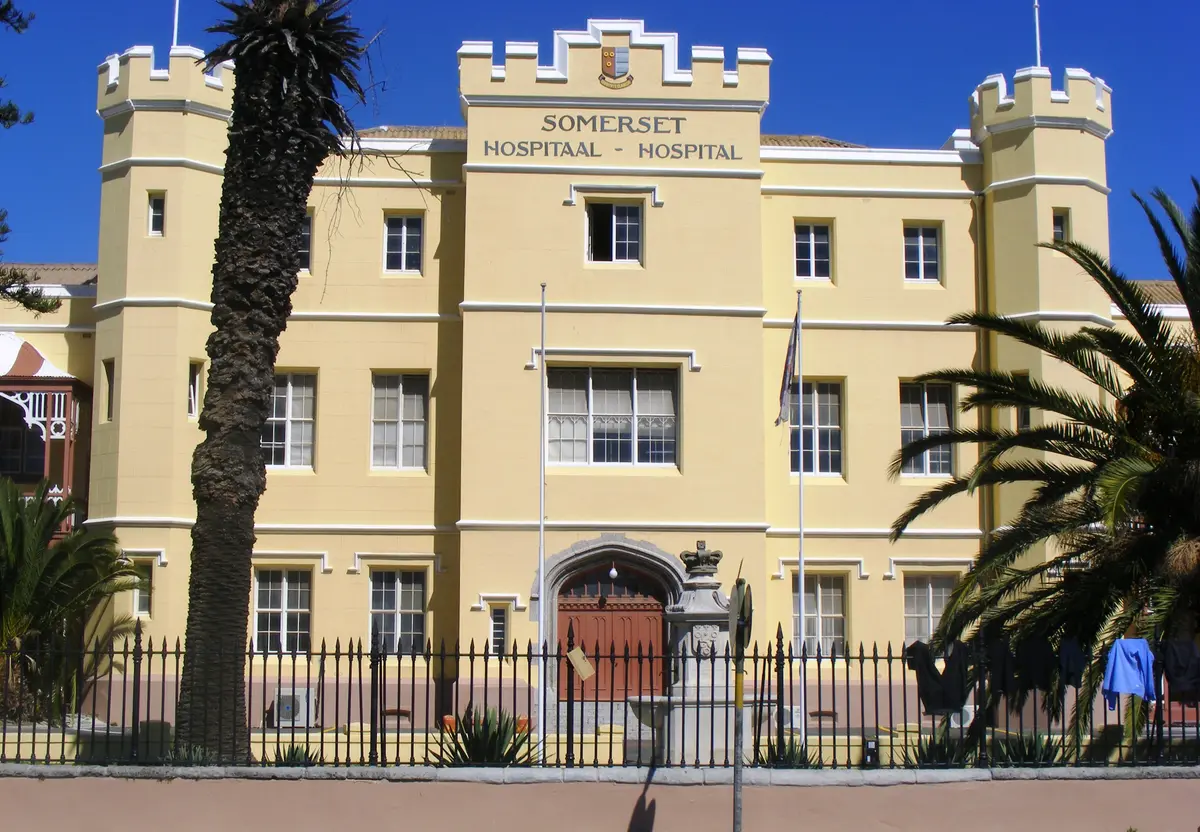
Bickersteth judged the building unfit and began campaigning for a new one in 1845. He did not live to see it. On 18 August 1859 the Governor, Sir George Grey, laid the foundation stone of the "New" Somerset Hospital on a site at Green Point between the Chavonnes Battery and the town. The day was declared a public holiday and around 12,000 people came. It was the last public duty Grey performed at the Cape: he had been recalled to London over his scheme for federating the South African colonies, and the passenger liner waiting in the bay was held back so that he and his party could embark after the ceremony. He also chose the style — the crenellated Tudor-revival front that still faces the sea today.
Bickersteth died on 1 August 1862, aged 49. Seventeen days later, on 18 August 1862 — three years to the day after the stone was laid — the New Somerset admitted its first patient. Dr John Laing became its first Resident Surgeon and superintendent.
The nursing history is the part most often told and most often garbled. Florence Nightingale's training school in London sent nurses out to the colonies, and some reached the Cape. Sister Helen Bowden, who according to Norman Levy's history of the hospital had trained at University College London and knew the Nightingale system well, was appointed Matron in 1877 — the first fully qualified nurse to hold the post. In her five years she trained up a body of female nurses to replace the men who until then had worked the wards as male nurses. She was recalled to London and succeeded by Sister Mary Agatha, and it was Sister Mary Agatha, not Bowden, who founded the hospital's formal nurses' training school in 1886. Her contemporary Sister Henrietta Stockdale was doing the same work in Kimberley; between them they pushed through the Cape's first Nurses Registration Act in 1891.
The Cape of Good Hope Civil Service List for 1889 shows what that replacement actually looked like on the payroll, twelve years after Bowden arrived. The New Somerset establishment lists a Resident Surgeon, P. J. Parson, on £300; a dispenser, T. C. Usherwood, on £250; a matron, ward sisters, and female nurses ranging from about £48 down to £31 a year. It also still lists, under "Nurses (male)", two men — one at £75 and one at £60. The two male nurses the reform was meant to replace were better paid than every woman nursing in the building. The same volume shows that the old hospital had not gone anywhere either: "Old Somerset Hospital" keeps its own separate establishment, with a surgeon-in-charge named Landsberg, a superintendent and matron both named Needham, three wardsmen at £50 each and eight nurses at £40. And on the pension roll, one line: "Fowler, Eliza. 18 9 9. Nurse, New Somerset Hospital", aged 62.
In 1918 Somerset became the first centre for the teaching of clinical medicine in South Africa. Its first three clinical professors were appointed in 1920 — A. W. Falconer in medicine, C. F. M. Saint in surgery, E. C. Crichton in obstetrics and gynaecology — and in 1922 Louis Mirvish and Jacob Benjamin Solomon became the first doctors to complete their training entirely in Cape Town.
Then apartheid wrote itself into the floor plan. Groote Schuur opened in 1938 and took the teaching role; Somerset closed for refurbishment and reopened in March 1939 as a hospital for the "non-European" population of Cape Town and for the training of non-white nurses. When a gynaecology ward was opened for the medical school in 1954, Dr Harry Jordaan was allocated to it — the first coloured registrar the UCT Medical School appointed, and later its first coloured honorary consultant in gynaecology. Professor Mark Horwitz deliberately based himself at Somerset rather than at Groote Schuur so that his teaching would reach the students who were sent there.
The clearest sign of all was put up in 1973, when a new building opened next door. It was designated for white patients; the old building was restricted to "coloured" patients. The two were called the West Wing and the North Wing. Neither name had anything to do with the compass. W stood for white and N for non-white.
From the late 1980s the hospital became one of South Africa's front lines against HIV. Professor Frank Spracklen followed the new syndrome; Dr Robin Wood opened the first AIDS research unit there, funded by the Diana, Princess of Wales Trust; and in 2005 the country's first antiretroviral distribution centre was established at Somerset.
Timeline: the documented record of New Somerset Hospital
- 1818 Dr Samuel Bailey, a retired Royal Navy surgeon, builds the first Somerset Hospital at his own expense on land given by Governor Lord Charles Somerset, who gave no money but was entitled as patron to have it named after him. It is Cape Town's first civil hospital; until then the only hospitals served military, naval and government personnel.
- 1821 Bailey's debts force him out and, under the terms of the land grant, the hospital passes to the Burgher Senate. Leopold Wehr and Louis Liesching manage it until 1832, when Dr Henry Bickersteth succeeds Bailey.
- 18 August 1859 Governor Sir George Grey lays the foundation stone of the New Somerset Hospital at Green Point. The day is declared a public holiday and about 12,000 people attend. It is Grey's last public duty at the Cape — he had been recalled to London over his federation scheme — and the passenger liner waiting in the bay is held back so that he and his party can embark after the ceremony.
- 1 and 18 August 1862 Dr Henry Bickersteth, who had campaigned for the new hospital since 1845, dies on 1 August aged 49. Seventeen days later, on 18 August 1862 — three years to the day after the stone was laid — the New Somerset admits its first patient. Dr John Laing becomes its first Resident Surgeon and superintendent.
- 1877 Sister Helen Bowden becomes the first fully qualified nurse appointed Matron of Somerset Hospital. Norman Levy's history records that she trained at University College London and knew the Nightingale system; over five years she trains a body of female nurses to replace the men who had until then worked the wards as male nurses. She is recalled to London in 1882.
- 1886 Sister Mary Agatha, Bowden's successor, reorganises the nursing department and founds the hospital's formal nurses' training school — the school is hers, not Bowden's. With her contemporary Sister Henrietta Stockdale in Kimberley she helps bring about the Cape's first Nurses Registration Act in 1891.
- 1889 The Cape of Good Hope Civil Service List shows the reform on the payroll twelve years on. The New Somerset establishment pays its female nurses between about £48 and £31 a year — and still carries two "Nurses (male)", at £75 and £60. The two men the reform was meant to replace out-earn every woman nursing in the building. The same volume lists a separate "Old Somerset Hospital" establishment, and, on the pension roll, one line: "Fowler, Eliza. 18 9 9. Nurse, New Somerset Hospital", aged 62.
- 1918 Somerset Hospital becomes the first centre for the teaching of clinical medicine in South Africa. Its first three clinical professors are appointed in 1920 and, in 1922, Louis Mirvish and Jacob Benjamin Solomon become the first doctors trained entirely in Cape Town.
- March 1939 After Groote Schuur opens in 1938 and takes over the teaching role, Somerset closes for refurbishment and reopens as a hospital for the "non-European" population of Cape Town and for the training of non-white nursing staff.
- 1954 A gynaecology ward is opened for the medical school and Dr Harry Jordaan is allocated to it — the first coloured registrar appointed by the UCT Medical School and later its first coloured honorary consultant in gynaecology.
- 1973 A new building opens next to the old one, designated for white patients while the old building is restricted to "coloured" patients. They are called the West Wing and the North Wing. The names have nothing to do with the compass: W for white, N for non-white.
- 1 June 2019 An anonymous South African blogger who describes herself as "a sensitive" publishes the post that is the oldest datable print appearance of the hospital's named ghosts: one of the nursing sisters on her rounds, an Indian man in a ward, a man singing Schubert, and a girl combing her hair on the nursing home stairs. Its history section is copied almost word for word from Levy's 2010 paper — including one alteration, moving Bowden's training from University College London to the Florence Nightingale School.
- 19 September 2021 A single Wikipedia editor adds the category "Reportedly haunted locations in South Africa" to the article, with no edit summary and no source. The revision is 58 bytes larger than the one before it — exactly a newline plus that category name. The article's text has never contained a ghost story.
Is there a rational explanation for New Somerset Hospital?
Nothing in this hospital's documented history says "haunted", and it is worth being precise about where the word does appear.
The English Wikipedia article on Somerset Hospital runs to 7,874 bytes and contains the string "haunt" exactly once. It is not in a sentence. It is a category tag at the foot of the page: "Reportedly haunted locations in South Africa". It was added on 19 September 2021 by a single editor who left no edit summary and cited nothing. The difference between that revision and the one before it is 58 bytes — precisely the length of a newline plus that category name. And the text itself has never carried a ghost: sweeping all 67 revisions of the article from its creation on 24 September 2010 to today, with the category tags discounted, the number containing any of ghost, haunt, apparition, paranormal, spook, spectre or spirit is zero. In the same sweep, "nurse" appears in 62 of the 67 and "hospital" in all 67, so the search was working. Nor was anything deleted: the largest single loss of bytes in the article's whole history is 528, an edit tidying dead citations.
The named apparitions come from one page. On 1 June 2019 an anonymous South African blogger who describes herself as "a sensitive" published "The ghosts' of Somerset Hospital" and listed four: one of the nursing sisters — "Sister Henrietta Stockdale or could it be Sister Bowden" — still helping the nurses on their rounds; an Indian man walking in a ward; the songs of Schubert sung by a man long gone; and, on the stairs of the nursing home, a little girl combing her hair, "maybe one of the nurse's children still waiting for her Mommy". No dates, no witnesses, no sources. That post is the oldest print appearance of these figures that can be fixed to a day.
It is also, demonstrably, a rewrite of the hospital's own history. The sentence "During her 5 years as Matron she oversaw the training of an efficient body of nurses to replace the men who had previously acted as male nurses" appears word for word in Norman Levy's 2010 paper in the South African Medical Journal. The blogger took her history from Levy and her ghosts from nowhere in particular — and in the copying she changed one fact: Levy says Bowden trained at University College London, and the blog has her coming from the Florence Nightingale School. Anyone repeating the ghost story inherits that error along with it.
A second figure needs separating out. The nurse with blank white eyes who tends patients and vanishes is attributed to Somerset by the travel operator Travelstart, but Cape Town ETC (17 June 2024) and Secret Cape Town attribute the same set — the sister with "white eyes" who took her own life, the friendly "Sister Fatima" handing out drinks on the rounds, the patient who fell to his death trying to escape — to Groote Schuur Hospital instead. Since Groote Schuur is the hospital that took over Somerset's teaching role in 1938, the two are easy to confuse, and there is no way to establish which building the story started in. It should not be told as Somerset's.
The usual commercial explanation does not apply here either. No ghost tour sells this building: Mystery Ghost Productions runs a ghost bus in Cape Town at around R299 a seat, but Somerset is not on its published itinerary. The hospital is a free public facility of the Western Cape Department of Health and Wellness, and the Cape Medical Museum beside it asks only for a donation. Nobody is taking money at the door.
What the site does have, and what no ghost story is needed to explain, is the ground it stands on. The blocks around Green Point and Somerset Road were the burial grounds of colonial Cape Town: the regulated cemeteries of the Dutch Reformed Church, and beside them the informal graves of enslaved people, paupers, executed criminals and smallpox victims who were excluded from them. Archaeologists have been recovering those burials since the 1990s — Cobern Street in 1995, an Anglican cemetery in 1996, Prestwich Street in 2002 — as property development moved in. The hospital that stands there was, for a century and a half, the place the same city sent its poor. That is not a haunting. It is a record, and it is on paper.
Can you visit New Somerset Hospital?
New Somerset Hospital is a working public hospital. The Western Cape Government's facility directory, read on 23 September 2026, lists it at Portswood Road, Green Point, 8005, in the City of Cape Town district, open 24 hours on all seven days of the week. The hospital did open its doors to the public on Friday 17 April 2009, for its 150th anniversary: the event listing announced an open day from 11am to 3pm at which "various units will be open to visit" and staff would offer free blood pressure, blood glucose and cholesterol tests.
The Cape Medical Museum stands beside the hospital, in the Old City Hospital Complex on Portswood Road, in the residence of the Medical Superintendent of the City Hospital, built in 1904. It was established as a provincial museum in 1986, and its own page ties its history to the New Somerset Hospital and the City Hospital for Infectious Diseases. On 23 September 2026 that page gave its hours as Monday to Friday, 09:00 to 16:00, closed at weekends and on public holidays, with entry by donation and school group bookings at R5 per learner.
The seafront building is the one whose foundation stone Sir George Grey laid on 18 August 1859, and its crenellated Tudor-revival front is the style he chose. When a new West Wing opened for white patients in 1973, the old building was renamed the North Wing, N for non-white. The hospital's coat of arms is recorded as registered with the Bureau of Heraldry in 1970.
South African History Online gives the date of its declaration as a National Monument, under the old National Monuments Council legislation, as 2 April 1971. The National Heritage Resources Act of 1999 turned the old national monuments into provincial heritage sites, and the hospital's Wikipedia article gives it that status. The hospital is about 550 metres east of Cape Town Stadium in a straight line.
Development of the grounds has been announced more than once, with hotels, offices and housing among the uses proposed, and in 2010 plans were announced to move the hospital to a new site in the northern part of the city to serve the West Coast. The provincial directory of 23 September 2026 still lists the hospital at Portswood Road and open around the clock.
Sources consulted
- Norman Levy, «Somerset Hospital: South Africa's oldest hospital» — South African Medical Journal, 100(6), 358-360, 2010 academic
- Cape of Good Hope colonial government, «The Cape of Good Hope Civil Service List, 1889 (establishment of the New Somerset Hospital and the Old Somerset Hospital; civil pension roll)» — Cape Town, 1889 archive
- WhatsOn SA, «New Somerset Hospital Celebrates 150 years - Open Day (17 April)» — whatsonsa.co.za, archived by the Internet Archive, 2009 report
- Ancestors Research South Africa, «Somerset Hospital» — ancestors.co.za, 2020 web
- Haunted History of South Africa, «The ghosts' of Somerset Hospital - Cape Town, South Africa» — hauntedhistory.blog, 2019 web
- Wikipedia contributors, «Somerset Hospital (Cape Town): revision history and the diff of 19 September 2021 adding the category 'Reportedly haunted locations in South Africa'» — English Wikipedia, 2021 archive
- Cape Town Museum, «The Cape Medical Museum» — capetownmuseum.org.za, 2025 web
- South African History Online, «New Somerset Hospital, Beach Road, Green Point» — sahistory.org.za, 2019 web
- Cape Town ETC, «4 spooky stories about Cape Town's haunted landmarks (attributes the white-eyed sister, 'Sister Fatima' and the falling patient to Groote Schuur Hospital)» — capetownetc.com, 2024 web
- Travelstart, «10 Of The Most Haunted Places Around South Africa (attributes the white-eyed nurse to Somerset Hospital)» — travelstart.co.za, 2019 web
- Archaeology Contracts Office, University of Cape Town, «The Archaeology of the Green Point Burial Grounds Project (Cobern Street 1995, Anglican cemetery 1996, Prestwich Street 2002)» — greenpointburialgrounds.co.za, 2010 academic
Reviewed by V. Serrano on 2026-08-18 · How we verify our content
💬 Field testimonies (0)
No testimonies yet. Add the first.
Add your testimony
🔒 Log in to add a testimony