👻 HAUNTED PLACE · EXP. Nº1190
ACTIVE
Erasmus Castle
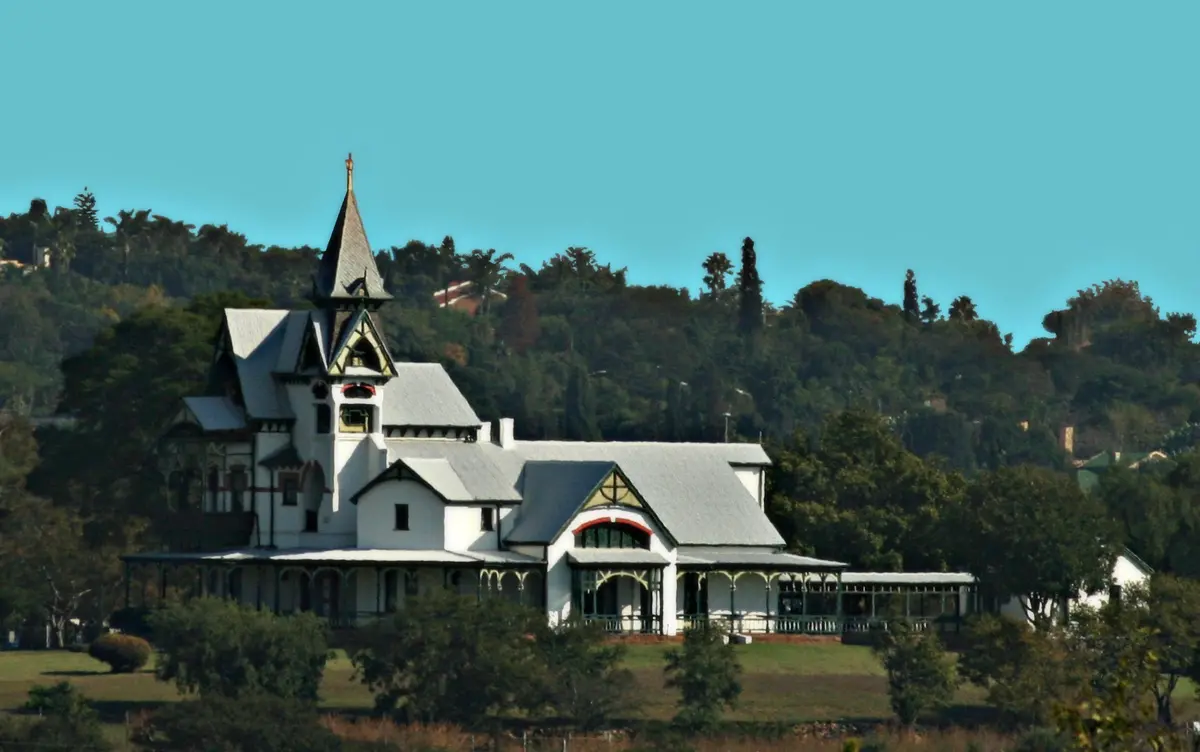
Erasmus Castle, known in Pretoria as Die Spookhuis, is the mansion that Jochemus Erasmus built on his family's farm Garsfontein, in what is now Erasmuskloof.
Where is Erasmus Castle?
- Location
- Pretoria, South Africa
- Type
- Castle
- Coordinates
- -25.816, 28.262
- Last updated
LOCATION
Why is Erasmus Castle said to be haunted?
The Boksburg Historical Association dates it to 1903; Anton Jansen, who restored it in 1989, says it was finished in 1904 at a cost of £6,800 and named Bella Vista, on a design simplified from an American pattern book. Armscor, the state-owned defence company, bought the farm for its head office and restored the house from 1975. The ghost stories have a short paper trail: the lit windows and night moans entered Wikipedia in 2015, and the name of the ghost, George Dean Erasmus, was added there anonymously in 2020. The 2004 newsletter cited for both says neither, and attributes the nickname, "probably", to an Al Debbo film of 1949. In February 2026 the house was closed, held up by scaffolding while Armscor looked for a heritage architect.
What is the history of Erasmus Castle?
Erasmus Castle stands on a rise in Erasmuskloof, on the eastern side of Pretoria, on land that was once the Erasmus farm Garsfontein. The Boksburg Historical Association toured the house in August 2004 with Billy Nel, environmental and media manager for the owner, Armscor, and its newsletter BHA News (no. 118) summarised the family history he gave them. In 1855 Carl Erasmus left the Drakenstein district of the Cape with his wife Johanna and trekked north to the Transvaal. He acquired the Rademeyer farm at Garsfontein when, in the family story, Rademeyer "agreed to swop his property for a horse and a pair of corduroy breeches". The first farmhouse was built in 1860 and a second about thirty years later. Carl had eleven sons, and the eldest, Jochemus, took over the farm.
The mansion was built for Jochemus, and its two published accounts disagree on dates and designers. The newsletter says it was "Completed in 1903" and that Jochemus commissioned "a Dutch architect, Van Der Benn, to design the home in 1896", with an English assistant, St Clair, and an Italian builder, Monte Bello, "who imported most of the building materials". The second account is by Anton Jansen, whose firm A J Konstruksie restored the house in 1989. In a letter of 1 June 2015 to the architectural historian Nicholas Clarke, published on the artefacts.co.za register of South African buildings, Jansen writes that Jochemus approached the Pretoria architect J. W. Leslie Simmonds in 1903, at his father's insistence, because his house of 1890 no longer matched "his status as a farmer, merchant and entrepreneur". Simmonds showed him an American book of house designs. Jochemus wanted the Carson Mansion, which was beyond his budget, and F. van der Ben, a Dutch architect dismissed from the public service for refusing the oath of allegiance to the British government after the South African War, simplified it as Simmonds's draughtsman. "The house was built in 1904 at a cost of £6 800 and christened Bella Vista." Asked who the architect was, Jansen answers "None by name": the design is "a conglomeration of Samuel and Joseph Cather Newsom, JW Leslie SIMMONDS and F VAN DER BEN".
At the end of the 1960s the Erasmus heirs sold Garsfontein to the Pretoria Municipality for a road scheme that was never built, and Armscor, the state-owned defence company, then bought the farm for a new head office complex. From 1975, according to the newsletter, Billy Nel, Dr Elise Labuschagne, Hannes Meiring and Anton Janson restored the mansion. The two original farmhouses were taken down and rebuilt stone by stone closer to it to make way for the offices and roads, and the vandalised family cemetery was moved into the old cattle kraal. The artefacts.co.za record names Meiring van der Lecq Thomas and Ronga as the restoration architects of 1989.
The house has since decayed. In 2022 Karlien Thomashoff, quoted in an update to the same record, found that "no maintenance has been done for years", that scaffolding was "holding parts of the house and roofs in place" and that the graveyard "shows signs of vandalism and neglect". In February 2026 the Pretoria paper Rekord, as reported by Getaway magazine on 18 February, said that a restoration expected to begin in 2024 had stalled for want of a qualified heritage architect. Armscor's spokesperson Stephens Ledwaba said a service provider had since been appointed and that the work would take about six months once it started.
Timeline: the documented record of Erasmus Castle
- 1855 Carl Erasmus leaves the Drakenstein district of the Cape with his wife Johanna and treks north to the Transvaal, where he acquires the Rademeyer farm at Garsfontein, according to the family history told to the Boksburg Historical Association in 2004.
- 1903-1904 Jochemus Erasmus approaches the Pretoria architect J. W. Leslie Simmonds in 1903 for a new house; it is completed in 1904 at a cost of £6,800 and named Bella Vista, according to the restorer Anton Jansen. The Boksburg Historical Association newsletter gives 1896 for the commission and 1903 for completion.
- 1975 After the Erasmus heirs sell Garsfontein at the end of the 1960s, Armscor acquires the farm for its head office complex; from 1975 Billy Nel, Elise Labuschagne, Hannes Meiring and Anton Janson restore the mansion and rebuild the two farmhouses stone by stone nearer to it.
- 1989 Anton Jansen's firm A J Konstruksie restores the house, with Meiring van der Lecq Thomas and Ronga as restoration architects.
- 27 February 2020 An anonymous Wikipedia edit introduces the name 'George Dean Erasmus' as the original owner and 'encounters with Dean Erasmus' among the phenomena, without a new source.
- February 2026 Armscor says the restoration, expected to start in 2024, stalled for lack of a heritage architect; the house is closed to visitors behind barricades and scaffolding.
Is there a rational explanation for Erasmus Castle?
The ghost stories have a short paper trail. The Wikipedia article on the house, created on 26 September 2015, said from its first version that "Paranormal activity includes lit windows in the uninhabited mansion, and hearing moans at night", with a footnote to the Boksburg Historical Association newsletter of August 2004. That newsletter, read in the Internet Archive copy of 4 March 2016, describes the house and the family and contains neither the lit windows nor the moans. What it does say about the house's reputation points elsewhere. The ceiling, it explains, is made of stretched white linen and "there is rather a lot of movement when the wind blows – an eerie sensation", and it asks whether this gave the building its name: "No! The nick-name was probably the result of an old Al Debbo movie". The film it names, Kom saam vanaand, is an Afrikaans musical released in 1949, directed by Pierre de Wet, with Al Debbo in the cast. The newsletter gives no scene or source for the link, so the explanation rests on its own "probably".
The ghost with a name is later still. On 27 February 2020 an anonymous editor changed the Wikipedia article to say the house was "Originally owned by George Dean Erasmus" and added "encounters with Dean Erasmus" to the list of phenomena. The edit added no source; the footnote remained the 2004 newsletter, which names the man who commissioned the house as Jochemus Erasmus, as does the restorer Anton Jansen. Since its first version the article's infobox has given a start of construction in 1892, footnoted to the newsletter, and a cost of "£7,500 (in 1892)"; the newsletter prints neither figure.
The newsletter is also the only source for the archaeology that circulates with the house. It reports, from Billy Nel's tour, a cave on the property with artefacts "from over 150,000 years ago" and "turquoise beads dating back to the traders from ancient Phoenicia", and names no excavation, finder or report. The Wikipedia article repeats both claims with the newsletter as its only citation, and Getaway's 2026 piece, through a resident, mentions San artefacts and "evidence of early Phoenician trade" as "reportedly discovered".
In that 2026 report the statements attributed to Armscor deal only with the building's condition, the scaffolding and the restoration. The hauntings enter through a resident, Helga Roper, to whom Getaway attributes the view that stories of hauntings and of secret past uses have become part of the house's folklore.
Can you visit Erasmus Castle?
Erasmus Castle is on Armscor property in Erasmuskloof, Pretoria; the artefacts.co.za record gives its street as Nossob Street, and the Wikipedia article places it at 25°48′56″S 28°15′43″E, the point used for this entry's map pin. The first version of that article captioned its photograph "The Castle seen from Delmas road, Erasmuskloof".
Getaway reported on 18 February 2026 that the house is closed to visitors and that barricades and scaffolding have been put up to stabilise the structure and deter vandalism. Broken windows have been boarded up and roof leaks temporarily sealed. Floors and the veranda are unsafe; photoshoots and site visits are "currently off the table". Armscor said that once the building is restored and deemed safe it is open to ways for the public to enjoy it. Older sources describe visits arranged with the owner: the Boksburg Historical Association was shown round in August 2004, and Wikipedia still says that public tours or cultural gatherings "can be arranged", arrangements that predate the closure reported in 2026.
The two farmhouses rebuilt near the mansion and the relocated family cemetery are inside the same property. In 2022 the outbuildings were in "relatively good condition" and the graveyard showed vandalism and neglect, according to the update on artefacts.co.za.
Sources consulted
- artefacts.co.za (record submitted by Nicholas Clarke), «House CJ Erasmus - Bella Vista - Erasmus Castle (architects J. W. Leslie Simmonds and F. van der Ben; restoration architects 1989; letter of Anton Jansen to Nicholas Clarke, 1 June 2015: Jochemus Erasmus approached Simmonds in 1903, the Carson Mansion as model, completed in 1904 at £6,800 and named Bella Vista; update of 2022 on the house's disrepair and scaffolding)» — artefacts.co.za, register of South African buildings, 2022 web
- Boksburg Historical Association, «A Spookhuis, A Fort & A Nature Reserve! (tour of August 2004 guided by Billy Nel of Armscor: Carl Erasmus's trek of 1855 and the Garsfontein farm; house 'Completed in 1903', commissioned from 'Van Der Benn' in 1896; the linen ceiling and the Al Debbo film as origin of the nickname; Armscor's restoration from 1975; the cave artefacts)» — BHA News, no. 118 (Internet Archive copy of 4 March 2016), 2004 newspaper archive
- Lee-Ann Steyn, «Erasmus Castle restoration hits pause as specialist skills prove hard to find (citing Rekord: restoration expected in 2024 stalled for lack of a heritage architect; property closed to visitors with barricades and scaffolding; Armscor spokesperson Stephens Ledwaba)» — Getaway, 2026 newspaper archive
- Wikipedia contributors, «Erasmus Castle, revision of 27 February 2020 (an anonymous edit adds 'Originally owned by George Dean Erasmus' and 'encounters with Dean Erasmus', with no new source)» — Wikipedia (revision history), 2020 web
- Wikipedia contributors, «Kom saam vanaand (Afrikaans musical film released in 1949, directed by Pierre de Wet, with Al Debbo in the cast)» — Wikipedia (Afrikaans), 2026 web
Reviewed by V. Serrano on 2026-10-04 · How we verify our content
💬 Field testimonies (0)
No testimonies yet. Add the first.
Add your testimony
🔒 Log in to add a testimony