👻 HAUNTED PLACE · EXP. Nº9475
ACTIVE
Castle of Good Hope
The Castle of Good Hope has a ghost story, and it is not the one usually told about it.
Where is Castle of Good Hope?
- Location
- Cape Town, Western Cape, South Africa
- Type
- Castle
- Coordinates
- -33.926, 18.428
- Last updated
LOCATION
Why is Castle of Good Hope said to be haunted?
On the morning of Saturday 23 April 1729, four soldiers were hanged at the Cape for desertion. That same afternoon the governor who had signed their sentence, Pieter Gysbert van Noodt, was found dead. In 1784 a German writer named O. F. Mentzel published the version that still circulates: a condemned man turning on the ladder to summon van Noodt "before the judgment seat of the Omniscient God", and the governor dropping dead in his chair as the court came to report the execution. The Council of Justice records, which survive, tell it differently on almost every point, including where and when he died and how many men were hanged. The pentagonal Dutch East India Company fortress runs from the first stone of the Leerdam bastion in 1666, through the Donker Gat where Adam Tas and Etienne Barbier were chained, to the limpet mine that went off in the courtyard in 1988; the archive and the gossip are two different things.
What is the history of Castle of Good Hope?
The Castle of Good Hope exists because the first one dissolved. Jan van Riebeeck's Fort de Goede Hoop, thrown up in 1652 out of clay and timber, was finished within a year and was unsatisfactory almost immediately: Cape rain washed the breastworks away faster than the garrison could rebuild them. The outbreak of the Second Anglo-Dutch War in 1664 settled the argument, and the Dutch East India Company (VOC) approved a proper pentagonal fortress east of the settlement, on the model of Dutch bastioned design going back to Sebastiaan van Noijen in the 1550s.
The site was cleared in 1665 and the first foundation stones of the Leerdam bastion were laid in early 1666. Progress was slow and uneven. By the end of 1671 Leerdam stood complete with a curtain wall on either side; Catzenellenbogen followed in 1672, Oranje and Nassau in 1673, and Buuren in 1674. The five bastions carry the titles of the Prince of Orange. The Castle was finished in 1679 — and Leerdam, the first one built, collapsed almost at once and had to be rebuilt. Simon van der Stel moved into the completed commander's quarters in 1680.
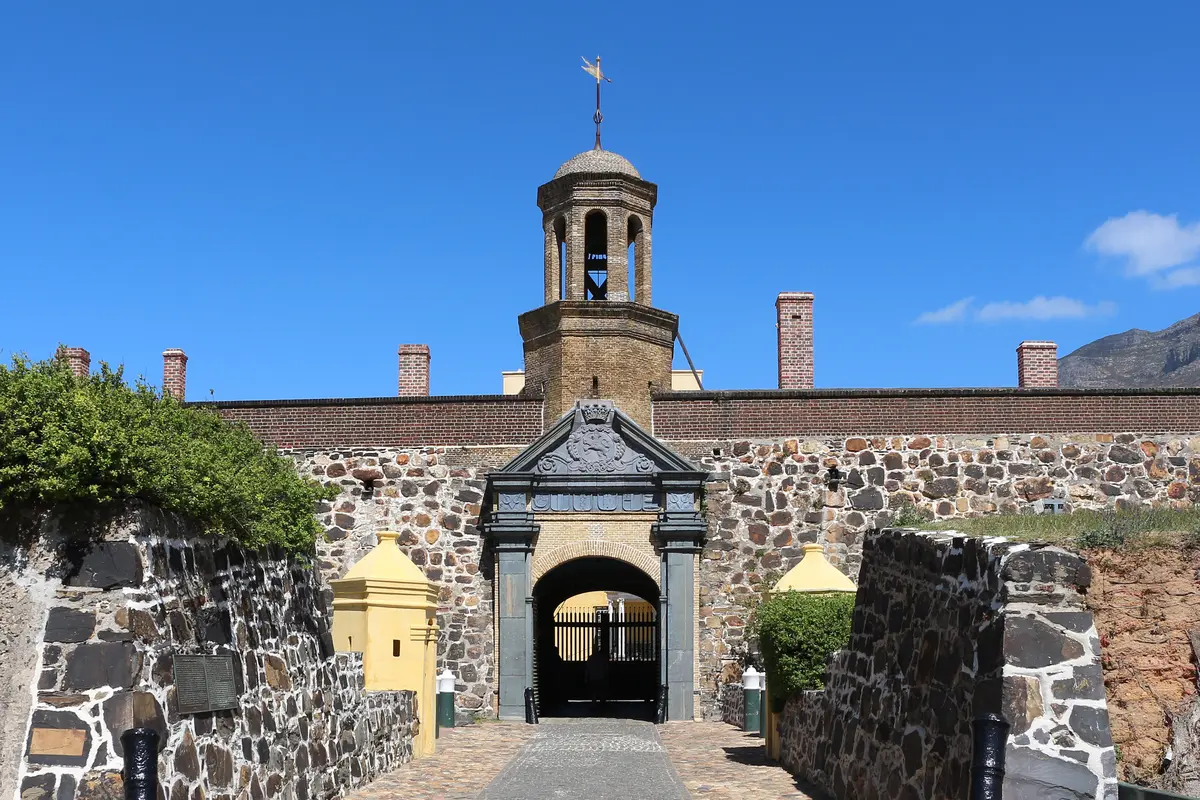
The gate most visitors photograph is not the original one. Between 1682 and 1684 the entrance was shifted from the sea-facing curtain wall, between Buuren and Catzenellenbogen, to the landward wall between Leerdam and Buuren, where it stands today under the bell tower. The bell itself went up in 1697; one of the garrison's duties was simply to keep time, with two rondegangers watching an hour-glass and ringing the hours by hand. A cross wall was thrown across the old bailey after a VOC commissioner's recommendation in 1685, to reduce the area an enemy could fire into, and in 1703 the moat was deepened and carried right around the walls.
Who built it is a question the Castle's own managers answer with unusual bluntness. The Castle Control Board's Integrated Conservation Management Plan states that "the Castle is not known for having been built by slaves and it is inaccurate to assign the Castle as a quintessential 'slave site'. However, slaves did play a role in its construction." Enslaved people were held at the old fort and contributed to some of the building work; once the Castle was finished they were mostly domestic servants inside it. The larger truth runs the other way round. The VOC's own slaves were housed in the Slave Lodge at the foot of the Company's Garden, and that labour pool was administered from the Castle; and the Council of Justice that judged enslaved people — often, the same plan concedes, unjustly — sat inside these walls. O. F. Mentzel, who lived at the Cape from 1733, recorded the daily timetable: labourers and enslaved workers began at six in the morning and stopped at six in the evening, while Company officials worked from nine to eleven and from two to four.
The Castle's dungeon has a name, Donker Gat — dark hole — and Mentzel, who saw it in use, is the best guide to it. It was, he wrote, "a dungeon in which ordinarily none but prisoners condemned to death were confined". Prisoners were not merely locked in but put with their feet in the stocks or fastened to an iron chain, and stubborn ones were left there four to six weeks before the first hearing of their trial, on the reasoning that they would grow "weary of life under these conditions" and confess. Adam Tas, one of the burghers who secretly petitioned Holland against Governor Willem Adriaan van der Stel, was held in it from March 1706 until May of the following year. So was Etienne Barbier, the deserter sergeant who on Sunday 1 March 1739 rode into Drakenstein with an armed rabble and nailed a seditious document to the church door; he hid for months, was taken, and in November 1739 was tried, condemned and executed, his body cut into portions and fixed to posts around the colony. The Donker Gat under the Nassau bastion is shown to visitors today as the torture chamber, and was archaeologically excavated in 1988.
That is the setting for the one event the Castle is still famous for. In 1729 fourteen soldiers planned to desert the garrison and walk overland to the Portuguese possessions beyond Delagoa Bay. On the night of Saturday 2 April two of them were on guard; they left with their arms and helped the others rob the guardhouse of nine muskets and ammunition. One man could not get away. The remaining thirteen marched towards Stellenbosch and were fed at the farms of Andries Schutte and Izaak Nel. Governor Pieter Gysbert van Noodt instructed Pieter Lourens, landdrost of Stellenbosch, to raise a party of burghers; early on Monday 4 April they were overtaken at Hottentots Holland kloof. Only two surrendered. The rest kept up a running fight for three hours until their leader was shot and eight were captured; one more was taken days later and the last three walked back to the Castle and gave themselves up.
Sentence was passed on Thursday 21 April 1729. Four were to hang, five to be flogged, branded and set to fifteen years' labour in chains, three to be flogged and set to ten years, and one to be flogged and set to three. The signatures at the foot of that sentence can still be read, and two of them belong to men who would later govern the Cape themselves: Hendrik Swellengrebel and Ryk Tulbagh. The four were hanged on the morning of Saturday 23 April. The only intervention by van Noodt that the records preserve is that he used his power of mitigation to let the bodies be buried instead of left exposed to the air and the birds. That same afternoon, between three and four o'clock, the governor was found dead in the pleasure house in the Company's Garden. A few hours earlier, apparently in perfect health, he had signed documents that still survive. His body was carried to the Castle late that evening, and on 30 April it was buried with state under the pavement of the church. The historian George McCall Theal, who worked from the court records, added the detail that gives the whole affair its temperature: "in the records there is no trace of regret shown by any one for his death."
The Castle went on being a working military headquarters long after the VOC. It passed to the Union Defence Force after 1910 and served as a command headquarters during the Second World War. For much of the twentieth century, and through the apartheid years, it was — in the conservation plan's phrase — "one of the most accessible faces of the South African Defence Force", its five-pointed star reproduced in the SADF insignia, with protests, pickets and graffiti against conscription outside the walls and official celebrations inside them. On 19 August 1988, while an archaeological team was excavating the central well, a mini-limpet mine exploded in the courtyard. Nobody was hurt, and the action was later listed in the African National Congress's 1997 further submissions to the Truth and Reconciliation Commission. The conservation plan draws the conclusion: the Castle "has never fired, nor been fired upon in anger, except for the Limpet Mine incident."
Its prisoners were not only Dutchmen. The Zulu king Cetshwayo was held here after his capture in the Ngome forest, and so was Sekhukhune of the Pedi. In August 2016 a memorial to Krotoa, the Khoi interpreter buried at the Castle, was placed beside the chapel. The building was the first site in South Africa ever declared a National Monument, in 1936; under the National Heritage Resources Act it was reclassified as a former national monument and treated as a provincial heritage site from 2000; and on 14 October 2016 the South African Heritage Resources Agency declared it a National Heritage Site. The proclamation is cautious: it calls the Castle "arguably the oldest fortress and building in South Africa" and "currently the oldest functioning Dutch colonial building of the period".
Timeline: the documented record of Castle of Good Hope
- 1652 Jan van Riebeeck's expedition builds Fort de Goede Hoop out of clay and timber on the site of the present Grand Parade. It is finished within a year and is washing away almost as fast as it is repaired.
- Early 1666 The first foundation stones of the Leerdam bastion are laid, after the site east of the settlement is cleared in 1665. The design is the Dutch pentagonal bastioned plan.
- 1674 Buuren is completed, the last of the five bastions after Leerdam (1671), Catzenellenbogen (1672), Oranje and Nassau (1673). All five carry titles of the Prince of Orange.
- 1679 The Castle is completed. Leerdam, the first bastion built, collapses almost immediately and has to be rebuilt; Simon van der Stel moves into the commander's quarters the following year.
- 1697 The bell is installed in the bell tower over the new landward gate, which had been moved between 1682 and 1684 from the sea-facing wall. Ringing the hours by hand is one of the garrison's duties.
- March 1706 Adam Tas, one of the burghers who petitioned Holland in secret against Governor Willem Adriaan van der Stel, is shut in the Donker Gat. He is held there until May of the following year.
- 2 April 1729 Fourteen soldiers plot to desert overland to the Portuguese territory beyond Delagoa Bay. Two on guard leave with their arms and help rob the guardhouse of nine muskets; thirteen march for Stellenbosch.
- 21 April 1729 Sentence is passed on the thirteen: four to hang, five to fifteen years in chains, three to ten years, one to three. Hendrik Swellengrebel and Ryk Tulbagh, both future governors of the Cape, sign it.
- 23 April 1729 The four are hanged in the morning; van Noodt's only recorded intervention is to allow their burial rather than leave the bodies exposed. Between three and four that afternoon he is found dead in the summer house in the Company's Garden.
- 30 April 1729 Van Noodt is buried with state under the pavement of the church. Theal, working from the records, notes that no one is recorded as having expressed regret at his death.
- 1 March 1739 Etienne Barbier, a deserter sergeant, nails a seditious document to the Drakenstein church door. Mentzel describes his arrival at the Donker Gat; he is tried, condemned and executed in November, his body quartered and displayed.
- 1784 O. F. Mentzel, who reached the Cape in 1733, publishes his life of Rudolf Siegfried Allemann with a chapter on van Noodt's death. It is the earliest printed version of the curse, fifty-five years after the event.
- 1888 George McCall Theal sets Mentzel against the surviving Council of Justice records and calls his account "almost entirely ideal", noting it had already been copied into many books and made into a popular drama.
- 1919 The Van Riebeeck Society publishes Margaret Greenlees's translation of Mentzel with footnotes correcting him point by point, while defending the text as evidence of the gossip circulating at the Cape.
- 1936 The Castle becomes the first site in South Africa ever declared a National Monument, after nineteenth-century proposals to demolish it were rejected.
- 19 August 1988 A mini-limpet mine explodes in the courtyard while an archaeological team excavates the central well. No one is hurt; the ANC lists the action in its 1997 submissions to the Truth and Reconciliation Commission.
- 14 October 2016 SAHRA declares the Castle a National Heritage Site. The proclamation calls it "arguably the oldest fortress and building in South Africa" — a superlative the state itself hedges.
- 5 November 2018 The Castle publishes an Independent Media piece on its own site headed "Discover Castle's Ghostly Past". The only ghost in it is van Noodt, in Mentzel's seven-men version. The page has since been removed.
Is there a rational explanation for Castle of Good Hope?
The van Noodt story has a first printed source, a date and an author, and all three can be checked against the court records.
The source is O. F. Mentzel, a German tutor who reached the Cape in 1733 — four years after the execution — and published his life of Rudolf Siegfried Allemann in 1784, with the preface dated at Glogau in 1781. His chapter is headed "The Sudden and Terrible End of Governor van Noot". In it, seven prisoners are condemned; the last man to climb the ladder turns towards the governor's house and cries, in the Van Riebeeck Society's 1919 translation, "Thou Governor van Noot! I summon thee at this very moment before the judgment seat of the Omniscient God, that thou mayest there answer for my soul and for the souls of my companions." The Council of Justice then walks back to the Castle to report and finds van Noodt dead in his chair in the audience hall, with an expression of despair on his face. A surviving prisoner named Winkelman starts shouting a pun that the whole garrison takes up — "Noot is dood, nu is er geen nood!", Noot is dead, now there is no distress. Slaves carry the body out at midnight through a sally-gate and bury it secretly, possibly on Paarden Eiland, while a handsome empty coffin is given a full state funeral.
The Council of Justice records survive, and Theal worked from them. They condemn four men to hang where Mentzel has seven. Van Noodt died some hours after the execution, between three and four in the afternoon, in the summer house in the Company's Garden, and his body was moved to the Castle late that evening; on 30 April he was buried with state under the pavement of the church. The 1919 editors suggest that the evening removal of the body "may have given rise to the story of secret burial at night by slaves". And the one recorded act of his in the whole affair points the opposite way from the legend: he used his power of mitigation to spare the four bodies from being left exposed. The 1919 editors printed Theal's verdict in a footnote — "The only recorded interference by Van Noodt was extremely trifling and in the direction of leniency" — and added their own: Mentzel's account "though so inaccurate, is valuable as giving the general tone of the gossip about Van Noodt that circulated at the Cape after his death." Theal was blunter, calling it "almost entirely ideal, being nothing more than a tale by a man who had no other means of obtaining information than gossip upon a past event", and noting that it had already been "copied in many modern books" and turned into a popular drama he does not name.
One detail of Mentzel's survives the check. He says the condemned were told on a Friday and hanged at nine the next morning. 23 April 1729 was indeed a Saturday, and 21 April, the date of sentence in the records, was a Thursday. The man got the calendar right and the death scene wrong, which is roughly what one would expect of accurate hearsay about a public execution and inaccurate hearsay about what happened behind a closed door.
Two other figures, a "Lady in Grey" and a black dog "of enormous proportions", circulate in the popular ghost literature: the Castle appears in Charles A. Coulombe's Haunted Castles of the World (2004) and heads the list in Leo Ruickbie's A Brief Guide to Ghost Hunting (2013), and the Lady in Grey is named in Jay Heale's African Myths and Legends.
The Castle Control Board sells no ghost tour. Its guided tours run in daylight, and on 6 October 2026 none of its five visitor pages (home, visitor information, guided tours, layout and parking) used the words ghost, haunted or spirit. In November 2018 the Castle did publish, on its own website, an Independent Media piece headed "Discover Castle's Ghostly Past" — and the only ghost in it is van Noodt. No Lady in Grey, no dog. That page has since been taken down and now returns a 404; it survives in the Internet Archive. This retelling by the Castle itself follows Mentzel, saying the governor was cursed by "one of seven men he had condemned to death", rather than the four the court records name. The legend has outlived the archive even in the house it happened in.
Can you visit Castle of Good Hope?
The Castle of Good Hope stands on the corner of Castle and Darling Streets, Cape Town 8001, beside the Grand Parade. Its parking page asks visitors not to leave cars on the Parade and sends them to the Castle's own car park, whose entrance is in Darling Street opposite the CCMA building. The site is run by the Castle Control Board, which its 2022/23 annual report describes as "a Schedule 3A Public Entity of the Department of Defence and Military Veterans"; the telephone number on every page of the website is +27 (0) 21 461 4673/6.
The Castle's two visitor pages, read on 24 September 2026, agree on opening from 09:00 to 16:00 and on the prices, and disagree on two points. The homepage lists an "International Fee" of R50 for adults, with R25 for children aged 5 to 17, R25 for pensioners and R8 per learner in school groups; it gives the last ticket sale as 15:45 and the closing days as Christmas Day and Workers' Day. The visitor information page gives the same prices, with the pensioner rate marked "SA Pensioners", puts the last ticket sale at 15:15, and says the Castle is open 363 days a year and closed on Christmas Day and New Year's Day. Both pages say online purchase is "Coming Soon". The guided-tours page lists tours at 11:00, 12:00, 14:00, 15:00 and 16:00, "seven days a week". The Castle describes itself as wheelchair- and visually-impaired-friendly, and as family- and pet-friendly.
The layout map on the website names the museums inside the walls: the Spanish Circumnavigation Museum with the Adam Kok Kitchen, the Cape Heritage Museum, "Rethinking the William Fehr Collections", Secunde's House, the Military Museum, an exhibition of South African ceramics called FIRED!, the Camissa Museum and the Koena Art Institute. The same map marks the Krotoa Memorial, the restaurant and, beside the Nassau Bastion, the "Torture Chamber & Dark Hole", the Donker Gat in which the conservation management plan records Adam Tas held from March 1706 until May of the following year. The gift shop trades as "Die Afrikaaner Handelhuis".
The visitor information page captured by the Internet Archive in 2019 gave opening until 17:00 and added that the Key Ceremony ran from Monday to Friday and that the cannon firing did not take place on Sundays, both depending on the weather. The current page keeps the line "These ceremonies are weather-dependent" but no longer names either ceremony, while the layout map still labels the front courtyard "Canon Firing".
The one page the Castle published about its ghost, an Independent Media article of 5 November 2018 headed "Discover Castle's Ghostly Past", returned a 404 error when requested on 24 September 2026 and survives in the Internet Archive. None of the visitor pages read that day mentions an evening or night opening.
The Castle Control Board's annual report for 2022/23, the latest on its reports page on 24 September 2026, counts 73,765 visitors of all kinds, "scholars, learners, tourists, event attendees, cultural groups", against a target of 120,000. It names 200,000 a year, the level before the pandemic, as the benchmark it is working to reach again.
Sources consulted
- O. F. Mentzel, trans. Margaret Greenlees, «Life at the Cape in Mid-Eighteenth Century: Being the Biography of Rudolf Siegfried Allemann, Captain of the Military Forces and Commander of the Castle in the Service of the Dutch East India Company at the Cape of Good Hope» — The Van Riebeeck Society, Cape Town (German original 1784), 1919 book
- George McCall Theal, «History of South Africa, 1691–1795» — Swan Sonnenschein, London, 1888 book
- Castle Control Board, «Castle of Good Hope Integrated Conservation Management Plan» — Castle Control Board / Department of Defence and Military Veterans, 2018 report
- Cape Times / Independent Media, «Discover Castle's Ghostly Past» — Published on the Castle of Good Hope website; page since removed, archived by the Internet Archive, 2018 newspaper archive
- Castle Control Board, «Castle Control Board Annual Report 2022/23» — Castle Control Board, 2023 report
- Castle of Good Hope, «Visitors Info» — Official visitor information, 2026 web
- Castle of Good Hope, «Visitor Info (archived version, with Key Ceremony and cannon firing)» — Official visitor information, captured by the Internet Archive, 2019 archive
- Charles A. Coulombe, «Haunted Castles of the World: Ghostly Legends and Phenomena from Keeps and Fortresses around the Globe» — Lyons Press, Guilford (Connecticut), 2004 book
- Leo Ruickbie, «A Brief Guide to Ghost Hunting: How to Identify and Investigate Spirits, Poltergeists and Hauntings» — Robinson, 2013 book
- Castle of Good Hope, «Castle of Good Hope — homepage visitor information box (International Fee, last ticket 15:45, closed Christmas Day and Workers' Day)» — castleofgoodhope.co.za, 2026 web
- Castle of Good Hope, «Guided Tours — tour times 11:00, 12:00, 14:00, 15:00 and 16:00, seven days a week» — castleofgoodhope.co.za, 2026 web
- Castle of Good Hope, «Castle Layout — museums within the Castle and numbered site plan (Krotoa Memorial, Torture Chamber & Dark Hole, Front Courtyard (Canon Firing))» — castleofgoodhope.co.za, 2026 web
- Castle of Good Hope, «Parking Information — dedicated Castle parking, entrance in Darling Street opposite the CCMA building» — castleofgoodhope.co.za, 2026 web
Reviewed by V. Serrano on 2026-08-11 · How we verify our content
💬 Field testimonies (0)
No testimonies yet. Add the first.
Add your testimony
🔒 Log in to add a testimony