📜 LEGEND · EXP. Nº0270
ACTIVE
The Tokoloshe
In the folklore of the Xhosa, Mpondo and Zulu peoples of southern Africa, the tokoloshe - also tikoloshe, thikoloshe or uHili - is a small, hairy, water-dwelling being who is said to be kept and sent by a person.
Where does the legend of The Tokoloshe come from?
- Location
- Pondoland, Eastern Cape (Mpondo, Xhosa and Zulu tradition), South Africa
- Kind of legend
- Spirit or familiar
- Coordinates
- -31.22, 29.62
- Last updated
LOCATION
What is the legend of The Tokoloshe?
That last part is usually left out. From the first printed mention, by the missionary Stephen Kay in 1833, to focus groups run in the Eastern Cape in 2022, the sources agree on what he is for: he is a witch's familiar, the alleged instrument of an accusation, and the accusation is usually made against a woman. He is knee-high, bearded, with a face like a baboon; he lives in rivers and eroded gullies, plays with children on the veld, steals sour milk, and his best-known activity in the older records is not murder but sex - night visits, experienced as a dream. The famous details are shakier than the belief. Kropf's 1915 dictionary says he carries a round stone in his closed fist to go unseen, not in his stomach; and the story that beds are raised on bricks to keep him off appears in no ethnography we could find, but does appear, unsourced, in an anonymous Wikipedia edit of December 2005.
What is the history of The Tokoloshe?
The tokoloshe is not an undiscovered animal, and nobody who wrote it down in the nineteenth or early twentieth century thought it was one. In every source we have been able to read, from a missionary's journal of the 1830s to a doctoral thesis of 2014, it belongs to a system of witchcraft accusation: it is a familiar, a thing a person is said to keep and to send.
The earliest printed mention we have been able to date is by the Wesleyan missionary Stephen Kay, in Travels and Researches in Caffraria (London: John Mason, 1833), p. 339. Kay is writing from Mpondo country, and what he records is a word already in ordinary circulation: "Tikaloshi also is much more frequently and familiarly talked about than amongst the more southern tribes. This is an appellation that seems to be given to some invisible and indescribable being, whom they sometimes personify as a little ugly, malignant fellow, capable of doing them much harm, of inflicting pain, and of effecting their ruin." He adds the part that every later source repeats and our own file had lost: "They likewise imagine that he is able to disturb their happiness by a kind of amorous intercourse with their women; by inducing the wife to play the harlot, and the husband to go astray. The men, I was told, sometimes pretend to wage war with him, and, after storming the hut in which he is supposed to be carrying on his mal-practices, loudly boast of victory."
It is worth being plain about what Kay was doing there, because it shapes everything written after him. His next sentence is: "How affectingly do such indisputable evidences of gross darkness call for the enlightening influences of the Gospel!" The record of this belief is, from its first page, a record made by people who wanted the belief to stop.
The second attestation says the important thing outright. William Shaw, in The Story of My Mission in South-Eastern Africa (1860), p. 445, writes that "bad persons may enter into league with wolves, baboons, jackals, and particularly with an imaginary amphibious creature, mostly abiding in the deep portions of the rivers, and called by the Border Kaffirs utikoloshe. By the mysterious intercourse said to be maintained with these and other detested or imaginary creatures, the evil-minded wizards and witches are supposed to obtain their supernatural powers for doing harm." The tikoloshe is the instrument; the accused person is the subject. Shaw also noticed, with some exasperation, that he and his congregation were talking past each other: when a missionary said witchcraft ought to be stopped, "the Kaffirs are thinking solely of the supposed witches and wizards", while he meant the witch-finders who identified them.
The dictionaries pin down the names. In the second edition of Albert Kropf's A Kafir-English Dictionary, revised by the Rev. Robert Godfrey (Lovedale Mission Press, 1915), the being is not in the main word-list at all: run down the H page and you get isi-Hiba, uku-Hibaza, uku-Hila, ukuti-HILI, i-Hilihili, uku-Hiliteka, isi-Hilito, uku-Hiliza — a whole family of words for silliness, confusion and aimlessness, and no goblin among them. He is in Appendix I, with the proper names: "u-Hili, According to Kafir superstition a mischievous being, living usually in the water, whereto he was banned for his love intrigues. He is represented as a dwarf, having a tail and sometimes thick set hair, who goes about playing tricks on people. Hili's other names are Gahe and Tikoloshe. Women are said to be fond of him, because he acts as a philtre for them, i.e. procures love for them." Two pages of appendix later: "u-Tikoloshe, = u Hili." The same dictionary records that he has a beard, and — under the verb uku-Fumbata, to clench the fist — exactly how he disappears: "u-Tikoloshe lo'litye eliNgqukuva alifumbatayo; lilo eli limbangela ukuba angabonakali", "Tikoloshe has in his closed hand a round stone which renders him invisible."
On the Zulu side, Alfred Bryant's A Zulu-English Dictionary (Mariannhill, 1905) gives the base form as u-Tokolo, with Tokoloshe as the rarer variant: "Fabulous water-baby or Kelpy, supposed to haunt certain rivers and to be very fond of women, though fearful of men", derived, he suggests, from a root meaning "to love". He also records a saying used to cheer up a child — "tokolo, temba: amatunzi ayehla", cheer up, tokolo, the shades of evening are falling — and a note on the market that had grown around the name: "Every description of clarified oil is being regularly palmed off on credulous Natives as amafuta ka'tokoloshe (tokoloshe fat) ... as a love-charm of wondrous power, at fabulous prices, sometimes at a sovereign for a small bottle!"
Matthew Hewat, a colonial doctor, put him in company in Bantu Folk Lore (Medical and General) (Cape Town, 1906): the i'canti, the u-hili or Tikoloshe and the im-pundulu are "three distinct bodies" whose combined action is blamed for hereditary illness, "handed down from mother to daughter". Of the tokoloshe specifically he writes only that he is "a short stumpy creature living in water, half man, half animal", and that "if a woman be fond of her husband and children, she is credited with having been tempted by the Tikoloshe and having resisted his importunities".
The fullest field record is Monica Hunter's, in Reaction to Conquest (Oxford University Press, 1936), from her fieldwork in Pondoland. She files him under witchcraft, as "the familiar most widely believed in, and most commonly adduced as the means of witchcraft ... Thikoloshe or Hili or Gilikango", and describes him from her informants: "a small hairy being, having the form of a man, but so small that he only reaches to a man's knee. He has hair all over his face and coming out of his ears, and his face is squashed up like a baboon ... All Thikoloshe speak with a lisp ... they live in 'dongas', and on the banks of rivers." He is made invisible by an ikhubalo, a charm. By himself, Hunter says, "Thikoloshe is mischievous, but not really harmful" — children play with him on the veld, and one man told her about it in detail. When she once admitted to her informants that she had had imaginary playmates as a child, "they leapt up and shouted joyfully, 'You can't say we are spinning yarns now, you have seen him yourself.'"
The danger is not the creature. It is the charge. "A woman always gives her Thikoloshe to her daughter. He kills the daughter if she will not have him"; "The accusations of possessing Thikoloshe are usually against women." Hunter records a man named Mpengu accusing his own wife of killing a child with her Thikoloshe.
The most uncomfortable source is also the most detailed. B. J. F. Laubscher, a psychiatrist working in the Eastern Cape, published Sex, Custom and Psychopathology: A Study of South African Pagan Natives in 1937. His interpretive frame is period colonial psychiatry and reads badly today; his data does not. He describes the tikoloshe as "a mischievous little fellow with aggressive sexual proclivities" whose "most outstanding activity ... is his promiscuous sexual intercourse with women", performed at night while the husband sleeps, experienced "more often in the form of a dream". He notes that killing is not what he is for: "It is said to be rare for the Tikoloshe to kill anyone, apart from choking the person in his sleep, unless that person is guilty of sexual relations with one of his paramours." And he reports a survey: "Close on a hundred girls, with ages ranging from sixteen to eighteen, were interviewed in various parts of the Transkei for the purpose of ascertaining the nature and content of their dreams. Practically every one of them mentioned dreams in which the Tikoloshe figured prominently and sexually. Whenever in the dream they resisted his advances, he choked them and they woke up in terror, and at times screamed in their sleep."
Timeline: the documented record of The Tokoloshe
- 1833 The Wesleyan missionary Stephen Kay publishes Travels and Researches in Caffraria. On p. 339, writing from Mpondo country, he records "Tikaloshi" as "an appellation that seems to be given to some invisible and indescribable being, whom they sometimes personify as a little ugly, malignant fellow", who disturbs households "by a kind of amorous intercourse with their women". It is the earliest printed mention of the tokoloshe we have been able to date, and it describes a word already in familiar use.
- 1860 William Shaw's The Story of My Mission in South-Eastern Africa places the being squarely inside witchcraft at p. 445: bad persons "may enter into league with wolves, baboons, jackals, and particularly with an imaginary amphibious creature ... called by the Border Kaffirs utikoloshe", and it is through that league that "wizards and witches are supposed to obtain their supernatural powers".
- 1905 Alfred Bryant's A Zulu-English Dictionary gives the Zulu form as u-Tokolo, with Tokoloshe as the rarer variant: a "fabulous water-baby or Kelpy ... very fond of women, though fearful of men". He appends a note that clarified oil is being sold to buyers as amafuta ka'tokoloshe, tokoloshe fat, "as a love-charm of wondrous power, at fabulous prices, sometimes at a sovereign for a small bottle".
- 1906 The colonial doctor Matthew Hewat publishes Bantu Folk Lore (Medical and General) in Cape Town, listing the u-hili or Tikoloshe with the i'canti and the im-pundulu as "three distinct bodies" blamed together for hereditary illness and "handed down from mother to daughter".
- 1915 The second edition of Kropf's A Kafir-English Dictionary, revised by the Rev. Robert Godfrey, defines u-Hili in Appendix I as "a mischievous being, living usually in the water, whereto he was banned for his love intrigues", notes that "Hili's other names are Gahe and Tikoloshe", and records under uku-Fumbata that "Tikoloshe has in his closed hand a round stone which renders him invisible".
- 1933 In R v Mbombela 1933 AD 269 a young man described by the court as "rather below normal intelligence" hacks to death a shape he believes to be a tokoloshe; it is his nephew. The Appellate Division measures him against a standard of reasonableness that ignores "the race or the idiosyncrasies, or the superstitions, or the intelligence of the person accused". The case is a fixture of South African criminal law teaching.
- 1936 Monica Hunter publishes Reaction to Conquest. She files Thikoloshe under witchcraft as "the familiar most widely believed in, and most commonly adduced as the means of witchcraft", records that he is made invisible by a charm, and notes what the belief costs: "A woman always gives her Thikoloshe to her daughter", and "the accusations of possessing Thikoloshe are usually against women".
- 1937 B. J. F. Laubscher publishes Sex, Custom and Psychopathology. He reports interviewing "close on a hundred girls, with ages ranging from sixteen to eighteen" across the Transkei about their dreams: "Practically every one of them mentioned dreams in which the Tikoloshe figured prominently and sexually. Whenever in the dream they resisted his advances, he choked them and they woke up in terror." He also states that it is "rare for the Tikoloshe to kill anyone, apart from choking the person in his sleep".
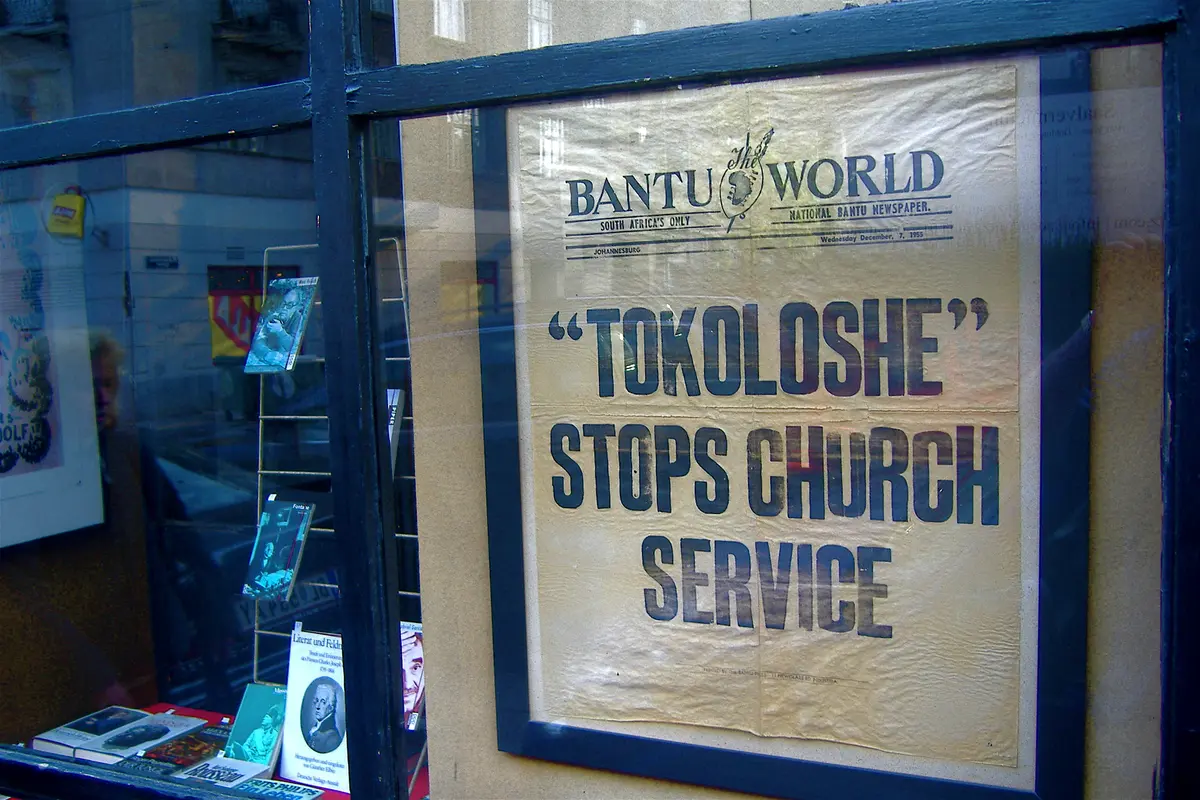
- 7 December 1955 The Bantu World of Johannesburg, "South Africa's Only National Bantu Newspaper", runs the street placard photographed on this page: "TOKOLOSHE" STOPS CHURCH SERVICE. The date on the placard, Wednesday, is correct for 7 December 1955. The paper was renamed The World the following month, so this is one of the last placards to carry the old title.
- 10 February 1956 Elifasi Msomi, convicted in 1955 of fifteen murders in the Umkomaas and Umzimkulu valleys of Natal, is hanged at Pretoria Central Prison. Drum would recall in September 1968 that "at his trial Msomi confessed to all the murders and rapes but swore to high heaven that he was forced by a tikoloshi to do the deeds".
- 1960 In R v Ngang 1960 (3) SA 363 (T) a sleeping man dreams he is being attacked by a tokoloshe, gets up and stabs at the "thing" — in fact the complainant. On appeal Bresler J holds that he acted "involuntarily or automatically" and he escapes criminal liability.
- 1992 In S v Ngema 1992 (2) SACR 651 (D) a man dreams that a tokoloshe is "throttling" him, wakes, takes up a cane knife leaning against his leg and strikes three fatal blows at what he believes to be the creature. It is a two-year-old child. The court convicts him of culpable homicide rather than murder, holding that he "acted unreasonably in warding off the perceived danger in the way that he did".
- 20 November 1993 G. P. Hadley, A. T. Bosenberg, R. Wiersma and H. Grant, of the departments of paediatric surgery and anaesthetics at the University of Natal in Durban, publish a letter in The Lancet titled "Needle implantation ascribed to 'tikoloshe'".
- 3-4 September 1996 Nhlanhla Mkhize, of the University of Natal in Pietermaritzburg, presents a paper at the second Qualitative Methods Conference in Johannesburg on tokoloshe "sightings" among prepubescent girls in KwaZulu-Natal, which come with "fainting spells, deterioration from previous level of (scholastic) performance, fearfulness, and other psychosomatic type symptoms". He reads them as "a culturally-situated gender discourse" and, possibly, "an appeal for justice".
- 11 June 2004, 01:17 UTC Three weeks after the English Wikipedia article is created, an editor adds the sentence "He can become invisible by swallowing a pebble", without a source. The oldest source on the point, Kropf and Godfrey in 1915, says the stone is held in his closed fist. The swallowed version is the one our own file inherited.
- 6 December 2005, 10:55 UTC An anonymous editor adds to the same article: "Most black Africans place their beds on bricks to prevent the Tokoloshe from hiding." It is unsourced. In July 2006 a citation is attached to a student page on library.thinkquest.org, a site offline since 2013; it remains the only citation the claim has.
- May 2009 The neurologist A. Moodley (Greys Hospital, Pietermaritzburg) and the psychologist N. M. Fournier (University of Saskatchewan) publish a letter in the South African Medical Journal asking whether the tokoloshe could be "the experience of a stimulated indusium griseum". They flag the raised-bed claim itself as merely alleged, and end on three open questions.
- 19 April 2017, 09:17 UTC An anonymous editor adds to Wikipedia the "practical explanation" now repeated everywhere: that carbon monoxide from an unventilated indoor fire pooled at floor level and that sleepers raised on bricks survived. No source is given. The passage has carried a "citation needed" tag since September 2021 and is still in the article.
- 2022 Zimkhitha Sibam-Twalo and Yaseen Ally, of Nelson Mandela University, publish in Indilinga the results of four focus groups in rural amaXhosa communities of the Eastern Cape. Their participants trace the tokoloshe to witchcraft — the same placement Shaw recorded in 1860.
Is there a rational explanation for The Tokoloshe?
Our own file made three specific claims about the tokoloshe. All three can be tested, and the results are not the same for each.
"People raise their beds on bricks." We could not find this in any of the primary sources. It is not in Kay (1833), Shaw (1860), Bryant (1905), Hewat (1906), Kropf and Godfrey (1915), Hunter (1936) or Laubscher (1937), and it is not in any of the fifteen dated quotations, running from 1833 to 1990, in the Dictionary of South African English on Historical Principles. Those are absences, so they need a control. Hunter's book uses the word "brick" nine times — Kimberley bricks for building huts, a policeman's brick house, half-bricks thrown at a man — and mentions Thikoloshe on more than a hundred lines, in a section that runs for a dozen pages and describes sleeping arrangements. She never joins the two. Laubscher mentions the tikoloshe on 68 lines and the word "brick" on none. The DSAE, for its part, is fine-grained enough to have caught a 1972 thriller using "tokoloshe" as slang for a policeman and a 1989 newspaper column applying it to a Washington politician; if raised beds had been a common printed motif before 1990, it would very likely have them.
Where the claim does appear, we can date it to the minute. The English Wikipedia article on the tokoloshe was created on 19 May 2004. On 6 December 2005 at 10:55 UTC an anonymous editor added a single unsourced sentence: "Most black Africans place their beds on bricks to prevent the Tokoloshe from hiding" — note the reason, which is that he might hide under the bed, not that he is too short to reach you. In July 2006 a reference was attached: a page called "Modern Zulu" on library.thinkquest.org, a student web-page competition site that has been offline since 2013 and survives only in the Internet Archive. It is still the only citation the claim has, twenty years on. The explanation now most often repeated — that the beds were raised because carbon monoxide from an indoor fire pools at floor level, and sleepers higher up survived — was added on 19 April 2017 at 09:17 UTC, also by an anonymous editor, also without a source; Wikipedia has carried a "citation needed" tag on it since September 2021. None of this shows that South Africans do not raise their beds. It shows that we asserted a reason for it that nobody has ever sourced.
"It swallows a stone to become invisible." There is a stone, and the oldest source gets it the other way round. Kropf and Godfrey's 1915 dictionary, illustrating the verb for clenching the fist, records that "Tikoloshe has in his closed hand a round stone which renders him invisible". Hunter's informants in 1936 gave him a charm, an ikhubalo, instead; Laubscher in 1937 simply says he makes himself invisible. Swallowing appears on Wikipedia on 11 June 2004 — "He can become invisible by swallowing a pebble" — unsourced, and that is the version we inherited. A stone held in a closed fist became a stone in a stomach.
"It strangles sleepers." This one is real, and our mistake was to strip it of everything that explains it. Laubscher's 1937 formulation is careful: it is rare for the tikoloshe to kill at all, and choking a sleeper is the exception, tied to sexual jealousy. What his Transkei survey actually describes — a figure that arrives at night, is felt rather than seen, presses or chokes, and is resisted until the sleeper wakes in terror and sometimes screams — is a recognisable nocturnal experience, and it has an established place in South African law reports. In R v Ngang 1960 (3) SA 363 (T) a man asleep dreamt he was being attacked by a tokoloshe, got up and stabbed at the "thing"; on appeal Bresler J held he had acted "involuntarily or automatically" and he escaped liability. In S v Ngema 1992 (2) SACR 651 (D) a man dreamt a tokoloshe was "throttling" him, woke, seized a cane knife leaning against his leg and struck three fatal blows at what he took to be the creature. It was a two-year-old child. He was convicted of culpable homicide, the court holding that he "acted unreasonably in warding off the perceived danger in the way that he did". Twenty-seven years earlier, in R v Mbombela 1933 AD 269, a young man of "rather below normal intelligence" hacked to death a shape he believed to be a tokoloshe and which was his nephew; the Appellate Division judged him against a standard of reasonableness that expressly ignored "the race or the idiosyncrasies, or the superstitions, or the intelligence of the person accused". The case is still taught, and Gavin Hood's 1999 film A Reasonable Man is built on it.
As for explanations, we would rather name people than write "scholars believe". Nhlanhla Mkhize, of the University of Natal in Pietermaritzburg, gave a paper at the Qualitative Methods Conference in Johannesburg on 3-4 September 1996 on tokoloshe "sightings" among prepubescent and early-adolescent girls in KwaZulu-Natal, which he says are "quite common" and come with "fainting spells, deterioration from previous level of (scholastic) performance, fearfulness, and other psychosomatic type symptoms". He reads the experience as "a culturally-situated gender discourse" — a narrative available to girls by virtue of their position, and possibly, he says, "an appeal for justice" — and argues that reading it only in traditional terms risks feeding the same authority it protests against. In 2009 the neurologist A. Moodley, of Greys Hospital in Pietermaritzburg, and the psychologist N. M. Fournier, of the University of Saskatchewan, published a letter in the South African Medical Journal asking whether the tokoloshe could be the experience of a stimulated indusium griseum, a vestigial strip of grey matter over the corpus callosum theorised to hold a sensory map of the foetus; stimulate it, they suggest, and you might get "visual hallucinations of a small humanoid with a large head, big eyes and a small body". It should be read for what it is: a page of correspondence that ends in three unanswered questions, not a study. In 2022 Zimkhitha Sibam-Twalo and Yaseen Ally, of Nelson Mandela University, ran four focus groups in rural amaXhosa communities in the Eastern Cape and published the results in Indilinga; their participants described the tokoloshe as originating in witchcraft, which is exactly where the sources of 1833 and 1860 put it.
There has been money in it for a long time, which is its own kind of evidence. Bryant was already complaining in 1905 that clarified oil was being sold as "tokoloshe fat" at a sovereign a bottle. Eighty-one years later, the DSAE records a City Press advertisement of 20 April 1986 listing services for "Lucky charms, business problems, sores, .. nightmares, tokoloshe problems, bladder, kidney and heart ailments."
And the accusation still costs people. The DSAE quotes Post of 7 March 1971: "Soon a huge crowd gathered threatening to stone the hag because she was a tokoloshe." Naming someone as a witch has been a criminal offence in South Africa since the Witchcraft Suppression Act 3 of 1957, and the South African Law Reform Commission, reviewing that Act in 2022, recorded that those most often accused are older women. In 1993 four clinicians from the University of Natal — G. P. Hadley, A. T. Bösenberg, R. Wiersma and H. Grant — published a letter in The Lancet of 20 November under the title "Needle implantation ascribed to 'tikoloshe'": the harm that reaches a hospital is done by people, and blamed on him.
Can you visit The Tokoloshe?
Nothing on the ground commemorates the tokoloshe. The documentary record is unusually complete and almost all of it is free to read.
The primary sources are digitised in full on the Internet Archive. Kay's Travels and Researches in Caffraria (1833) carries the passage at page 339 [1]; Shaw's The Story of My Mission in South-Eastern Africa (1860) at page 445 [2]; Bryant's A Zulu-English Dictionary (1905) has it under u-Tokolo [3]; Hewat's Bantu Folk Lore is of 1906 [4]; in Kropf and Godfrey's A Kafir-English Dictionary (1915) the entry u-Hili sits in Appendix I, outside the main word-list [5]; Hunter's Reaction to Conquest (1936) treats him at pages 275-278 [6]; and the whole first chapter of Laubscher's Sex, Custom and Psychopathology (1937) is given over to him [7]. The optical character recognition on several of those scans turns the long s into an f: a search for "Thikoloshe" in Hunter returns nothing while the text reads "Thikolofe" on more than a hundred lines. The Dictionary of South African English on Historical Principles publishes its dated entry free at dsae.co.za, with quotations from 1833 to 1990 [8].
The photograph on this page is a document rather than an illustration. It shows a framed street placard of The Bantu World of Johannesburg for Wednesday 7 December 1955, headed "TOKOLOSHE" STOPS CHURCH SERVICE; 7 December 1955 was indeed a Wednesday. Bertram Paver founded The Bantu World in 1932 and Selope Thema edited it first, with Jacob Nhlapo from 1953. In January 1956 it was renamed The World, so the placard belongs to the last weeks of the old title. Runs of the paper are held at Historical Papers, University of the Witwatersrand. The photograph itself was taken in a bookshop window in the 19th district of Vienna and uploaded to Wikimedia Commons in April 2010 [15].
The map pin sits in Ingquza Hill, in Pondoland, because that is the district where Monica Hunter collected the fullest field record of the tokoloshe in the early 1930s. The belief is documented far beyond it: Kay in Mpondo country in the 1830s, Laubscher in the Transkei of the 1930s, Bryant's Zulu lexicon in Natal in 1905. Lusikisiki is reached off the N2 between Mthatha and Kokstad; Flagstaff and Libode are on the same road. The Cory Library at Rhodes University in Makhanda holds the missionary and Lovedale material; the Killie Campbell Africana Library in Durban holds the Natal side. Both are working research libraries that require prior registration and keep fixed hours.
This is a live belief held by people now living. An accusation of keeping a tokoloshe is an allegation of witchcraft, making such an accusation is an offence under the Witchcraft Suppression Act 3 of 1957 and the accusation still precedes violence, most often against older women [12].
Sources consulted
- Stephen Kay, «Travels and Researches in Caffraria» — John Mason, London, 1833 book
- William Shaw, «The Story of My Mission in South-Eastern Africa» — Hamilton, Adams & Co., London, 1860 book
- Alfred T. Bryant, «A Zulu-English Dictionary» — Mariannhill Mission Press, 1905 book
- Matthew L. Hewat, «Bantu Folk Lore (Medical and General)» — T. Maskew Miller, Cape Town, 1906 book
- Albert Kropf, revised by Rev. Robert Godfrey, «A Kafir-English Dictionary, second edition» — Lovedale Mission Press, 1915 book
- Monica Hunter, «Reaction to Conquest: Effects of Contact with Europeans on the Pondo of South Africa» — Oxford University Press, 1936 book
- B. J. F. Laubscher, «Sex, Custom and Psychopathology: A Study of South African Pagan Natives» — George Routledge & Sons, London, 1937 book
- Dictionary of South African English on Historical Principles, «Entry for 'tokoloshe, tikoloshe, n.' (dated quotations 1833-1990)» — Dictionary Unit for South African English, Rhodes University, 2025 book
- Nhlanhla Mkhize, «Mind, gender, and culture: A critical evaluation of the phenomenon of Tokoloshe 'sightings' among prepubescent girls in KwaZulu-Natal» — Proceedings of the 2nd Annual Qualitative Methods Conference 'The Body Politic', Johannesburg, 3-4 September 1996, 1996 academic
- G. P. Hadley, A. T. Bosenberg, R. Wiersma and H. Grant, «Needle implantation ascribed to 'tikoloshe'» — The Lancet 342(8882), p. 1304, 20 November 1993, 1993 academic
- A. Moodley and N. M. Fournier, «The tokoloshe homunculus (Correspondence)» — South African Medical Journal 99(5), May 2009, 2009 academic
- J. L. Matthee, «One Person's Culture is another Person's Crime: A Cultural Defence in South African Law? (doctoral thesis; discusses R v Mbombela, R v Ngang and S v Ngema)» — North-West University, Potchefstroom, 2014 academic
- Zimkhitha Sibam-Twalo and Yaseen Ally, «'I will not lie to you. The tokoloshe exists': mythical creatures and their influence on mental health amongst a sample of amaXhosa in the Eastern Cape, South Africa» — Indilinga: African Journal of Indigenous Knowledge Systems 21(1), 2022 academic
- English Wikipedia contributors, «Tokoloshe: full revision history, 2004-2026 (MediaWiki API)» — Wikimedia Foundation, 2026 archive
- Photograph by the Wikimedia Commons user Toanke; placard published by the Bantu Press, Johannesburg, «File:TikolosheNewspaperHeadline.jpg - photograph of a framed street placard of The Bantu World, Johannesburg, Wednesday 7 December 1955» — Wikimedia Commons, 2010 newspaper archive
Reviewed by V. Serrano on 2026-08-15 · How we verify our content
📎 Source: Enigma Atlas
💬 Field testimonies (0)
No testimonies yet. Add the first.
Add your testimony
🔒 Log in to add a testimony