👻 HAUNTED PLACE · EXP. Nº9476
ACTIVE
Cumberland College, Otago
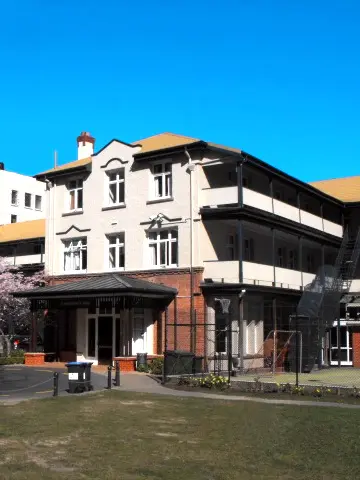
Cumberland College is a University of Otago hall of residence in North Dunedin, opposite Dunedin Hospital, in a building that was a nurses' home before the university took it over in 1989.
Where is Cumberland College, Otago?
- Location
- Otago, New Zealand
- Type
- School / university
- Coordinates
- -45.87, 170.51
- Last updated
LOCATION
Why is Cumberland College, Otago said to be haunted?
Its ghost, the Grey Lady, is one of the best-documented pieces of student folklore in New Zealand — and one of the easiest to date. In May 2012 two students reported a smell, a chill and a dark figure in a night-time corridor; the college called in the university chaplain for a blessing, and both Critic Te Ārohi and the Otago Daily Times ran the story within a fortnight. The legend attached to her says a young mother whose newborn was taken from her at the maternity hospital next door died soon after, and followed the nurse responsible home. That maternity hospital, Queen Mary, opened in November 1937 and admitted nobody until January 1938, so no telling set in 1918 or the 1920s can be describing it. The Dunedin ghost-tour operator quoted in 2012 said plainly that Grey Lady was a fashionable Victorian name for any ghost, applied here to a figure nobody has identified.
What is the history of Cumberland College, Otago?
Cumberland College is a University of Otago hall of residence in North Dunedin, on the block between Castle and Cumberland streets, across the road from Dunedin Hospital. Before the university took it over it was a nurses' home attached to that hospital, and its building history can be followed in the hospital board's reports and in a heritage assessment prepared for the Dunedin City Council in 2023-2025.
The construction date usually quoted, 1916, holds. According to the council's assessment of 490 Cumberland Street, the hospital board had decided by late 1913 to build a new nurses' home across Cumberland Street from its first one, which dated from 1892. The new home was designed by Mason & Wales, the board's architects, and built by Fletcher Bros on a tender of £15,957; its first stage was officially opened by the Minister of Public Health, G. W. Russell, on 17 June 1916, when a memorial tablet to the British nurse Edith Cavell was unveiled. The board's reports in the Otago Daily Times were already referring in November 1915 to "the new Nurses' Home in Cumberland street" and to fencing it "in Castle and Cumberland streets". The home was extended to the east in 1925-26 and along the Castle Street frontage in the 1940s. It has no entry on the New Zealand Heritage List / Rārangi Kōrero, where the assessment gives its List reference as "N/A", but in July 2025 the panel hearing the council's Plan Change 1 added it to the district plan's heritage schedule as item BX060, with the University of Otago's agreement.
The neighbourhood, by contrast, can be dated precisely, and the dates matter. Dunedin's hospital moved to the site it still occupies in 1865 and now fills the block bounded by Great King, Hanover, Cumberland and Frederick streets. The maternity hospital that appears in every telling of the college's ghost story is Queen Mary. It opened in November 1937 and did not admit patients until January 1938, when the old Batchelor Hospital — earlier the Forth Street Maternity Hospital — closed. The Otago Daily Times set that out in September 2012, when Queen Mary staff past and present gathered for a 75th-anniversary ball. Queen Mary's building is today Hayward College, another Otago hall: the student magazine Critic Te Ārohi reported in 2019 that it was stripped and rebuilt as a residential college in 1992. The name outlived the building — a Queen Mary Maternity Centre still operates inside Dunedin Hospital.
The building's documented link with the 1918 influenza pandemic is a memorial. At the end of 1920, according to the council's assessment, two tablets were unveiled in its vestibule: one to Sister Margaret James, night sister at the hospital for more than twenty years, and one to nurses who died on active service and during the influenza epidemic. New Zealand lost about 9,000 people between October and December 1918, some 2,500 of them Māori, and the Ministry for Culture and Heritage stresses that the deaths fell very unevenly: some communities were devastated, others came through almost untouched. The district figures compiled by Geoffrey Rice in Black November (Canterbury University Press, 2005) put Dunedin among the lighter-hit cities. Dunedin registered 273 deaths in a population of 68,716 — 3.9 per 1,000 — and Central Dunedin only 2.9. Auckland's rate was 7.6, Invercargill's 10.7, Christchurch's 4.9. None of the student-press and newspaper accounts of the ghost published between 2012 and 2025 and cited here mentions the flu.
What the college era looks like is more modest. The hall opened in February 1989 as Cumberland Hall — the Hocken Collections still catalogue University of Otago photographs under that name into the mid-2000s — and houses somewhere over three hundred first-year students. An affiliated flatting annexe, Cumberland Courts, was part of the college until 2015. The frequently repeated figure of "over 7,000" residents since 1989 traces to the same dead college web page as the 1916 date.
The ghost story itself is younger than any of that, and it can be dated to the week it broke. In May 2012 two students at the college reported an encounter in a corridor at night; within a fortnight the college had asked the University chaplain to hold a blessing, and both Critic Te Ārohi and the Otago Daily Times had reported it. The figure was named the Grey Lady, and the legend attached to her, in every account, is the same: a young mother whose newborn was taken from her at the maternity hospital next door died soon afterwards, and her ghost followed the nurse responsible back to the nurses' home where that nurse lived. In Critic's 2025 telling, the rumour among residents was of her "still out seeking her child".
Timeline: the documented record of Cumberland College, Otago
- 1865 Dunedin's public hospital moves from The Octagon to the site it still occupies, the block bounded by Great King, Hanover, Cumberland and Frederick streets — directly opposite the future Cumberland College.
- 17 June 1916 The first stage of the new Dunedin Hospital Nurses' Home, designed by Mason & Wales and built by Fletcher Bros across Cumberland Street from the hospital, is officially opened by the Minister of Public Health, G. W. Russell; a tablet to Edith Cavell is unveiled the same day. The building is not on the New Zealand Heritage List, and in July 2025 it enters the Dunedin district plan's heritage schedule as item BX060.
- October–December 1918 The influenza pandemic kills about 9,000 New Zealanders, some 2,500 of them Māori. Geoffrey Rice's district figures put Dunedin at 273 deaths in 68,716 people — 3.9 per 1,000, and 2.9 in the central city — against 7.6 in Auckland, 10.7 in Invercargill and 4.9 in Christchurch. Dunedin was among the least affected cities in the country.
- November 1937 Queen Mary Hospital, the maternity hospital that features in every version of the college's ghost story, is officially opened.
- January 1938 Queen Mary admits its first patients, as the old Batchelor Hospital — earlier the Forth Street Maternity Hospital — closes. Charge midwife manager Caroline Folland gave the Otago Daily Times this sequence at the hospital's 75th-anniversary celebrations in 2012.
- 1989 The University of Otago opens the former nurses' home as a hall of residence under the name Cumberland Hall; Hocken Collections photographs are still catalogued under that name into the mid-2000s.
- 1992 The Queen Mary Maternity Hospital building is stripped and rebuilt as Hayward College, a second Otago hall of residence. The maternity service keeps the Queen Mary name inside Dunedin Hospital.
- 5 or 8 May 2012 Two female health-science students report an encounter in a college corridor: a bad smell, a sudden chill and a dark figure. The two contemporary accounts disagree about when. The Otago Daily Times says the night of Saturday 5 May, coming back from studying, with the figure beside a fire hydrant; Critic Te Ārohi says 1 a.m. on Tuesday 8 May, on the way to a first-floor laundry, the shape "dark, and glowing at the bottom".
- 10 May 2012 University chaplain the Rev Greg Hughson and a local kaumātua hold a blessing at the college after what Hughson called a "genuinely frightening experience" for the students. He told Critic it was explicitly not an exorcism, and asked that the matter be treated sensitively rather than sensationalised.
- 20 May 2012 Critic Te Ārohi publishes "Cumberland College Terrorised by Ghost" by Callum Fredric — the earliest datable appearance in print of the Grey Lady at Cumberland that I have been able to fix. It reports multiple sightings, including by kitchen staff and at least one residential assistant, and residents pranking each other with pillowcases over their heads.
- 21 May 2012 The Otago Daily Times carries Vaughan Elder's report. Andrew Smith of the Dunedin ghost-tour firm Hair Raiser tells the paper it was "very fashionable" to name ghosts the Grey Lady in Victorian times, and that such ghosts were believed to start bright white and fade to grey with repeated sightings — and that Grey Ladies had also been reported at Dunedin Hospital's psychiatric unit and at the site of the city's first hospital.
- 28 March 2019 Critic Te Ārohi investigates the ghost stories of neighbouring Hayward College and finds that every encounter it collected was reported by residents who had been drinking. Its best case dissolves entirely: the strange old lady reported wandering the halls was a real woman, caught taking a bath in a fourth-floor bathroom and shown out.
- 2 March 2021 Asia Martusia King's survey of Otago campus folklore for Critic treats the Grey Lady as one urban legend among many — alongside the lucky archway, wartime bunkers under the Geology building and a squatter in the Allen Hall ceiling who turned out to be the actress Miranda Harcourt. It also states that Cumberland and Hayward are linked to each other and to Dunedin Hospital by an underground network.
- 2 March 2025 A second outbreak, again during O-Week: a resident's 4.08 a.m. message to the college-wide Snapchat sets off a fresh round of sightings. Critic notes the accumulated contradictions — Hair Raiser now says the original Cumberland sighting was of a male ghost, a veteran former staff member says he heard nothing about any of it before 2012, and one resident insists the figure is a nurse, "contradicting every other account".
Is there a rational explanation for Cumberland College, Otago?
The story does not survive its own calendar: every printed version places the tragedy at the maternity hospital next door, and that hospital — Queen Mary — did not open until November 1937 and took no patients until January 1938. Any telling set in 1918, or in "the 1920s" as Critic had it in 2025, is describing a building that was not there yet.
The second problem is the name: Andrew Smith, who runs the Dunedin ghost-tour company Hair Raiser, told the Otago Daily Times in 2012 that it was "very fashionable" to call ghosts the Grey Lady in Victorian times, and that the convention held a new ghost to be bright white, fading to grey as it was seen more often. He also said Grey Ladies had been reported at Dunedin Hospital's psychiatric unit and at the site of the city's first hospital.
The third is that the accounts do not agree with each other, and the drift runs in one direction — outward from 2012. The ODT dated the encounter to Saturday 5 May and put a black figure beside a fire hydrant; Critic, posted online two days earlier, dated it to 1 a.m. on Tuesday 8 May and placed the students on their way to a first-floor laundry, seeing something "dark, and glowing at the bottom". By 2025 Critic was describing the same 2012 apparition as racing at the students "like a train", a detail in neither original. Critic also reported that Hair Raiser said the original Cumberland sighting was of a male ghost, and that a veteran former staff member had heard nothing about any of it before 2012.
Critic itself has done the most useful debunking. Investigating the neighbouring hall in 2019, it noted that every ghostly encounter it collected had been experienced by residents who were drinking, and resolved its best case outright: the strange old lady students had reported wandering the halls turned out to be an actual woman, found taking a bath in a fourth-floor bathroom and shown out. Colleges are ideal incubators for this material — hundreds of seventeen- and eighteen-year-olds, new to the city, sharing one building and one group chat during O-Week — and both major outbreaks, 2012 and 2025, began in exactly that setting.
None of this requires anyone to be lying: two people startled in a dark corridor at 1 a.m. are reliable witnesses to being startled and nothing more, and the university's response was a blessing, led by the chaplain and a local kaumātua. The first datable appearance of the legend in print is Critic's report, posted on 20 May 2012, and the veteran former staff member Critic spoke to in 2025 had heard nothing of a ghost until that year.
Can you visit Cumberland College, Otago?
Cumberland College stands at 250 Castle Street, Dunedin Central, a block from Dunedin Hospital. The main building went up in 1916 as the Dunedin Hospital Nurses' Home and, according to the Wikipedia article on the college consulted on 9 September 2026, now "houses 328 students". They are mostly first-year University of Otago students, a cohort that includes residents under eighteen, and the address is their home during term.
That single fact settles what a visit can be. The college is private property run by the university with a duty of care over minor residents. There is no visitor entrance and no public access to the interior. Hayward College next door stands in the same position.
The tunnels are the question that always comes up. The same Wikipedia article states that "Cumberland College is linked by tunnels to both Dunedin Hospital and Hayward College (formerly the maternity hospital)", and Critic Te Ārohi repeated the claim in 2021. No engineering or hospital document has been located describing what exists underground today or whether any of it is passable, and whatever is down there is service infrastructure inside locked buildings.
The documentary record of the haunting is public and free. The Otago Daily Times report of May 2012 remains on the paper's site, and Critic Te Ārohi keeps open in its online archive the pieces it published in 2012 and 2019 and again in 2021 and 2025, which together hold the fullest account of the story.
Dunedin does have a ghost walk that runs on public ground. Hair Raiser Tours has traded since 1999 and described itself on 9 September 2026 as "New Zealand's Original ghost tour experience", and it was still advertising a Dunedin Ghost Tour through the city centre that day.
Sources consulted
- Vaughan Elder, «'Ghost' frightens college students» — Otago Daily Times, 2012 newspaper archive
- Callum Fredric, «Cumberland College Terrorised by Ghost» — Critic Te Ārohi, Issue 12, 2012, 2012 newspaper archive
- Wyatt Ryder, «Is Hayward Haunted? An Investigation Based Purely on Rumour and Speculation» — Critic Te Ārohi, Issue 6, 2019, 2019 newspaper archive
- Asia Martusia King, «Scary Stories to Tell in the Dorm: Investigating Campus Superstitions» — Critic Te Ārohi, Issue 1, 2021, 2021 newspaper archive
- Harry Almey, «The Ghosts of Cumby Past» — Critic Te Ārohi, Issue 2, 2025, 2025 newspaper archive
- Eileen Goodwin, «Queen Mary celebrating 75 years» — Otago Daily Times, 2012 newspaper archive
- Manatū Taonga — Ministry for Culture and Heritage, «The 1918 influenza pandemic: South Island influenza death rates (figures from Geoffrey Rice, Black November, Canterbury University Press, 2005)» — NZHistory, 2020 report
- Manatū Taonga — Ministry for Culture and Heritage, «The 1918 influenza pandemic» — NZHistory, 2024 report
- Heritage New Zealand Pouhere Taonga, «New Zealand Heritage List / Rārangi Kōrero (searched for Cumberland College and for a Dunedin Hospital nurses' home: no entry; control entries returned include Southland Hospital Nurses' Home (Former), List No. 2510, and Ewart Hospital Nurses' Home (Former), List No. 5375)» — Statutory heritage register, 2026 archive
- Wikipedia contributors, «Cumberland College, Otago» — Wikipedia, 2026 web
- Wikipedia contributors, «Dunedin Hospital» — Wikipedia, 2026 web
- Dunedin City Council (initial assessment 8 February 2023, revised 15 April 2025), «Heritage assessment for scheduled heritage building: Former Dunedin Hospital Nurses' Home, 490 Cumberland Street (built 1915-16 and 1925-26, Castle Street wing 1941 and 1947-49; Mason & Wales, architects; Fletcher Bros, tender £15,957; first stage opened by the Hon G. W. Russell on 17 June 1916; tablets of 1920 including one to nurses who died in the influenza epidemic; HNZPT List reference N/A; Cumberland College opened in the building in February 1989)» — Plan Change 1, Heritage topic, Evidence of DCC, Appendix H. Read in the Internet Archive capture of 14 August 2025, 2025 report
- Dunedin City Council hearings panel, «Plan Change 1 – Minor Improvements (PC-2024-1), Decision 1: Heritage. Section 5.2.11: BX060 Dunedin Hospital Nurses' Home (former) at 490 Cumberland Street included in the Heritage Schedule» — Dunedin City Council, decision report dated 17 July 2025. Read in the Internet Archive capture of 5 February 2026, 2025 report
- Otago Daily Times, «Hospital Board reports (sketch plan for fencing "the Nurses' Home in Castle and Cumberland streets"; proposed subway "to the new Nurses' Home in Cumberland street")» — Otago Daily Times, 24 November 1915. Papers Past, full text read through the DigitalNZ API, 1915 newspaper archive
Reviewed by V. Serrano on 2026-08-11 · How we verify our content
💬 Field testimonies (0)
No testimonies yet. Add the first.
Add your testimony
🔒 Log in to add a testimony