👻 HAUNTED PLACE · EXP. Nº0482
ACTIVE
Igorchem Bandh
Igorchem Bandh is a location reputed to be haunted in Goa, IN. Its reputation comes from reported apparitions, unexplained phenomena and eyewitness accounts gathered over time.
Where is Igorchem Bandh?
- Location
- Goa, IN
- Type
- Road / bridge
- Coordinates
- 15.315, 73.989
- Testimonies
- 0
- Last updated
LOCATION
Why is Igorchem Bandh said to be haunted?
Igorchem Bandh is the embankment lane that runs behind the church of Our Lady of the Snows at Raia, in Salcete taluka, South Goa. In Goan usage a bandh is the outer embankment of a khazan, the reclaimed rice land held back from the tide by laterite and clay, and the gloss that circulates in English, "Church Road", keeps the traffic while losing the earthwork. The story attached to the lane is a daylight one: crossing at two in the afternoon is said to bring giddiness and speech nobody can follow. The oldest datable account in print is a Goan newspaper piece of 3 November 2012 by Fernando Monte da Silva, who supplied the rational reading in the same breath, calling it "a severe case of sunstroke". Everything after that is derivative, a chain of travel lists from 2017 and 2018, a podcast in 2021 and an English Wikipedia article written in October 2023 by a single editor, whose uncited infobox is the origin of the road's much-repeated measurements.
What is the history of Igorchem Bandh?
The Konkani word bandh names an embankment, and in Goa it names a very particular one. Ranjita Sawaiker and her co-authors, surveying khazan farmland in Ponda taluka for the International Journal of Ecology and Environmental Sciences in 2023, label the parts of the system in the caption to their second figure: "Outer embankment (bandh)" and "Inner embankment (mero)". The outer ones, they write, "were found to be protective in nature, built using locally available laterite stones, mud, and clay from the khazan farms", with mangroves planted along them "because they act as wave breakers". Upkeep fell to village associations called Bous, whose members "had to be alert on the bunds for which it was responsible". Igorchem Bandh carries that word, and it runs behind the church of Our Lady of the Snows at Raia, in Salcete taluka. The English gloss that circulates for it, "Church Road", keeps the traffic and drops the earthwork.
The parish it is named after arrived late in the history of the area. Fr Nascimento Mascarenhas told The Goan in 2012 that "The Church was built some 100 years after the Our Lady of Snows Church in Rachol - the first church in Salcete", and the same article records that the Raia church "was built to cater to the religious needs of the people outside the fort of Rachol". The two stand about three kilometres apart, and José Nicolau da Fonseca, writing in 1878, dates the Rachol parochial church to 1576 and its dedication to "Nossa Senhora de Neves", adding that, "being of weak construction", it was rebuilt in 1696 with the foundation-stone of the new building laid twelve years earlier.
One of the fields the bandh crosses belongs to the parish and has a name of its own: Saibinichi Conngi, the Lady's field. The Goan set out the routine on 30 July 2012. "The field belongs to the church and the land is used only for cultivation for the Konsachem Fest and this is where the priest blesses the crop and cuts the stalks of paddy with a sickle that has a golden handle", and because the feast falls on 5 August, "the cultivation of this small land is started in April so the crop gets ready in August". The confraternities walk out to it in white embroidered capes called Opa e Murça. Rozino Pereira, a former member of the Confraria, told Neshwin Almeida in 2013 that after the cutting "a small portion is send across the Zuari River in a ferry to the Kamaxi Temple in Shiroda, as legend points out that the Our Lady of Snows was a once a deity of the temple". Eduardo Faleiro, a son of Raia and a former Indian union minister, gives the other half of that sentence in O Heraldo: the village temple of Kamakshi "was destroyed during the colonial rule and the image of the deity was shifted across the river to Rai Shiroda".
A second strand has lapsed since then: Isidore Domnick Mendis wrote in the Times of India in January 2017 that the Raia priest once cut the first sheaves "only after receiving konsam (sheaves) of rice grown in the fields of Camurlim comunidade", the neighbouring village whose comunidade shared the cost of the church with Raia's. The village's documented catastrophe stands a few hundred metres from the bandh, at the cemetery. Roque Dias reported for The Navhind Times in September 2020 that "as many as 319 innocent people had become victim of the flu in the year 1918", that the cemetery of the day "was filled to capacity" so another had to be opened, and that a tombstone nearly nine feet tall went up in 1919 bearing the words "E M DAS VICTAMAS De GRIPE De 1918".
Timeline: the documented record of Igorchem Bandh
- 1576 The parochial church of Rachol is built and dedicated to Nossa Senhora de Neves, according to José Nicolau da Fonseca, who records that it was rebuilt in 1696 after proving to be of weak construction. Raia's church of the same dedication, three kilometres away, comes about a century later.
- 1904 The Code of Communidades abolishes the Camara Geral do Concelho, the taluka assembly in which Raia sat with eleven other Salcete villages, and replaces it with government-appointed administrators. Eduardo Faleiro dates from here the decline of the institution that had managed the village's khazan land.
- 1918 Influenza kills 319 people in Raia, according to the records cited by Roque Dias in The Navhind Times. The cemetery of the day is filled to capacity and another has to be opened.
- 1919 A tombstone nearly nine feet tall is raised outside the new cemetery, inscribed "E M DAS VICTAMAS De GRIPE De 1918". Villagers were still praying at it in September 2020, during the first Covid outbreak in the village.
- 30 July 2012 The Goan describes the Konsachem Fest at Raia: the procession out to Saibinichi Conngi, the church field sown in April for an August crop, the golden-handled sickle, and the sheaf ferried across the Zuari to the Kamaxi temple at Shiroda.
- 3 November 2012 Fernando Monte da Silva publishes the earliest datable printed account of the road, in the same newspaper and the same year. Ninety-four words, the hour given as 2 pm, and the rational reading supplied in the closing sentence: "a severe case of sunstroke".
- 3 January 2017 Isidore Domnick Mendis records a lapsed custom in the Times of India: the Raia priest formerly cut the first sheaves only after receiving konsam grown in the fields of the Camurlim comunidade.
- 29 May 2017 The Times of India travel list "The spookiest places in Goa", by Hengul J Das and Shikha Gautam, carries the road to a national audience, reproducing Monte da Silva's Goan selection and adding four sites of its own.
- 6 October 2017 Karina Pinto repeats the story in ItsGoa, keeping the window of 2 to 3 pm. The article carries no death and no date earlier than itself.
- 20 March 2018 The aggregator mysteriesrunsolved.com, signed "MRU.INK", adds the element that no Goan source contains: victims who "have met their unusual deaths within a few days after being possessed". The same page calls the site "Igorchem Dam or Igorchem Bandh".
- 16 November 2021 Episode 385 of The Ectoplasm Show, recorded by Jason Kupzyk and Brad Heim, runs through thirty-six Indian sites. Its nine Goan stops appear in the exact order of the Times of India page.
- 23-29 October 2023 A single Wikipedia editor, Rejoy2003, creates the English article across two days, adds the unsourced Ghostlight claim at 08:26:23 on 23 October, appends a bare Google Books link seventeen seconds later, fills the infobox with uncited measurements on 24 October, and uploads his own photograph of the lane on 29 October.
Is there a rational explanation for Igorchem Bandh?
The oldest datable account of the road in print carries its own explanation inside it. On 3 November 2012 The Goan ran a piece by Fernando Monte da Silva, framed as a look at Goan places "rumoured to send chills down one's spine" after Halloween and All Souls. Its Raia entry runs to ninety-four words and ends like this: "Legend has it that the crossing of the bandh at 2 pm in the afternoon leads to giddy spells followed by 'talking in tongues'. Though logic dictates that it could be a severe case of sunstroke." The newspaper closed the article with a disclaimer of its own, saying the material came "through folklore, stories passed down for generations and village hearsay" and that The Goan "cannot certifiably endorse these stories as true, and limits their possibilities to being merely entertaining stories".
Everything after that is a chain of lists whose first link is the Times of India travel page by Hengul J Das and Shikha Gautam, last updated 29 May 2017, which reproduces Monte da Silva's Goan selection and adds four more sites. Karina Pinto kept the hour in ItsGoa on 6 October 2017. Incredible Goa signed off its own version with the line "SOURCE: VARIOUS SOURCES". Episode 385 of The Ectoplasm Show, published 16 November 2021, lists its Goan stops in the exact order of the Times of India page: Borim Bridge, Saligao, NH 17, Baytakhol, Igorchem Bandh, Seminary Arch, The Rodrigues Home, D'Mello House, Jakni Bandh.
One element travelled without a source. The claim that people possessed on the lane afterwards died is absent from every Goan account. In the Igorchem passages of Monte da Silva (94 words), the Times of India (105), ItsGoa (149) and Incredible Goa (212), the strings death, died, kill, murder and execut appear zero times, while possess appears in three of the four. The deaths enter on 20 March 2018 with mysteriesrunsolved.com, an aggregator signed "MRU.INK", which writes that "people have witnessed a number of victims who have met their unusual deaths within a few days after being possessed".
The English Wikipedia article that made the lane quotable was written on 23 and 24 October 2023 by one editor, Rejoy2003, who also took the photograph on this page and uploaded it on 29 October. The article's cultural claim went in at 08:26:23 with no citation at all, and a bare Google Books link with no page number followed seventeen seconds later. Ghostlight is a Toronto novel; its publisher's synopsis opens with Rebecca Strand, who "was just sixteen when she and her father fell to their deaths from the top of the Gibraltar Point Lighthouse in 1839". Google Books offers no preview of the volume, so its full text cannot be searched, and the Books API answered every request with HTTP 429 and "Quota exceeded" on 9 September 2026, so its silence proves nothing either. Nothing published supports the claim, and it has been dropped here. The same run of uncited infobox edits on 24 October 2023 produced the figures that then travelled everywhere: 340 metres, "dirt road", "Pedestrianised", maintained by the Raia panchayat.
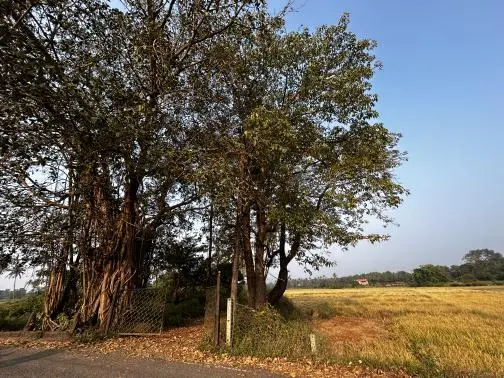
An earlier version of this page went further than any of its sources and announced that no Portuguese colonial archive links the lane to an eighteenth- or nineteenth-century death. Nobody had ever claimed one. The documented mortality of Raia is the influenza of 1918, and it is remembered at the cemetery rather than on the bandh. Monte da Silva's sunstroke remains the only explanation anyone has put in print, and the photograph here fits it: the shade stops at the verge, and the paddy beside the path lies open to the sun at the hour the legend names.
Can you visit Igorchem Bandh?
Igorchem Bandh is a public village lane behind the church of Our Lady of the Snows at Raia, in Salcete taluka, South Goa, some four kilometres east of Margão. No gate, ticket or guide governs it, and none of the published accounts from 2012 onward mentions an admission charge, a paid walk or a tour operator, and no ghost business appears to sell the site.
The land on either side is worked ground: OpenStreetMap carries a node named "Holy Paddy Field Of Raia", placed on 1 September 2023 at 15.3157 N, 73.9861 E, about 330 metres from the point this page maps and about 460 metres from the church node. That is Saibinichi Conngi, the parish field described above: private church land, sown in April and cut on 5 August.
The date that brings the village out is that feast. Evelyn Siqueira published the 2023 timetable in Gomantak Times: masses at 5.30, 6.45, 8.15, 9.45 for the high mass and noon, all of them in Konkani. O Heraldo's notice for 2025 put the blessing of the banner on 26 July and the novenas from 27 July, with Fr Saude Pereira presiding over "the blessing and ceremonial cutting of the first corn" at "Saibinichi Kongi". Early August in Goa is monsoon, and the khazan fields the bandh crosses are under water for much of it.
Walking the lane at the hour the legend names, between two and three in the afternoon, means walking it in the open. The trees stand on one side and the paddy on the other, and the nearest shade and drinking water are at the church.
Sources consulted
- Fernando Monte da Silva, «Jeepers Creepers» — The Goan EveryDay, 2012 newspaper archive
- The Goan Network, «Harvest and snow» — The Goan EveryDay, 2012 newspaper archive
- Neshwin Almeida, «A spiritual harvest in Raia» — The Goan (text circulated on the Goanet mailing list, 3 August 2013), 2013 newspaper archive
- Isidore Domnick Mendis, «Small, But Special» — The Times of India (Goa), 2017 newspaper archive
- Hengul J Das and Shikha Gautam, «The spookiest places in Goa» — The Times of India (Times Travel), updated 29 May 2017, 2017 newspaper archive
- Karina Pinto, «5 of The Most Haunted Places In Goa That Will Freak You Out» — ItsGoa, 2017 web
- Incredible Goa staff, «The Ten Most Haunted Places in Goa, That You May Never Want to Visit» — Incredible Goa, 2018 web
- MRU.INK, «Legend of haunted Igorchem Road in Goa, India» — Mysteries Run Solved, 2018 web
- Jason Kupzyk and Brad Heim, «Most Haunted Places In India, Ectoplasm Show episode 385» — The Ectoplasm Show (podcast), published 16 November 2021, 2021 web
- Rejoy2003 and others, «Revision history of the article Igorchem Bandh, 23 October 2023 to 30 July 2026» — English Wikipedia, 2023 archive
- Ranjita Sawaiker, Suraj Gaude, Samiksha Naik, Simran Chari, Antima Gaude and Nischya Padwalkar, «A Study of Traditionally Managed Khazan Ecosystems of Ponda Taluka, Goa» — International Journal of Ecology and Environmental Sciences 49(3), pp. 247-252, 2023 academic
- José Nicolau da Fonseca, «An Historical and Archaeological Sketch of the City of Goa, preceded by a Short Statistical Account of the Territory of Goa (p. 47)» — Thacker & Co., Bombay, 1878 book
- Eduardo Faleiro, «Raia, my village» — O Heraldo, 13 January 2020, 2020 newspaper archive
- Roque Dias, «COVID cases in Raia remind locals of Spanish flu episode» — The Navhind Times, 18 September 2020, 2020 newspaper archive
- Evelyn Siqueira, «Schedule of novena and feast masses for Konnsanchem fest in Raia» — Gomantak Times, 1 August 2023, 2023 web
- Team Herald, «Raia to Celebrate Konsachem Fest on August 5, Marks Goa's First Corn Harvest with Solemn Mass» — O Heraldo, 4 August 2025, 2025 newspaper archive
- OpenStreetMap contributor Caravan8602, «Node 11160196871, Holy Paddy Field Of Raia, created 1 September 2023» — OpenStreetMap, 2023 web
Reviewed by V. Serrano on 2026-09-09 · How we verify our content
📎 Source: Wikipedia (CC BY-SA)
💬 Field testimonies (0)
No testimonies yet. Add the first.
Add your testimony
🔒 Log in to add a testimony