👻 HAUNTED PLACE · EXP. Nº1189
ACTIVE
Waitomo Caves Hotel
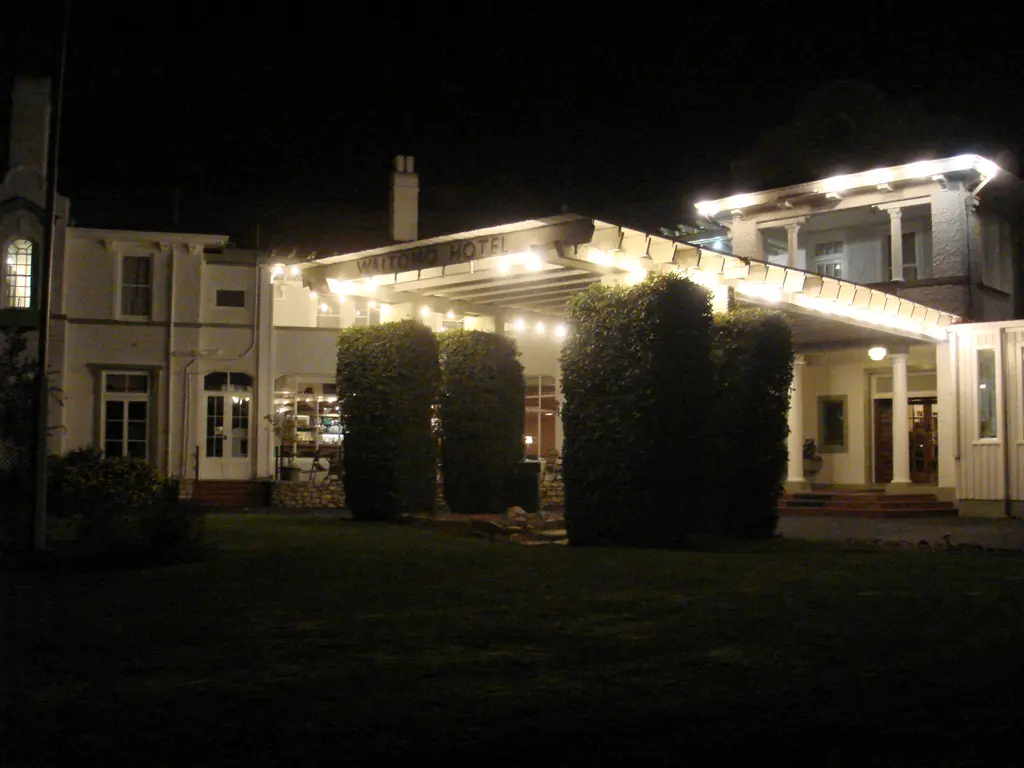
The hotel above the Waitomo Caves is two buildings joined at the hip: a timber Edwardian block with an octagonal turret, and a white concrete Spanish Mission wing added twenty years later.
Where is Waitomo Caves Hotel?
- Location
- Waitomo, New Zealand
- Type
- Hotel / inn
- Coordinates
- -38.261, 175.107
- Last updated
LOCATION
Why is Waitomo Caves Hotel said to be haunted?
It is often said to have opened in 1908 as Waitomo House. It did not. Waitomo House was the accommodation house that Tāne Tinorau and his wife Whāriki Huti opened to tourists in 1904 and the Crown bought in 1905; the building that stands here was still "almost finished" in April 1909, cost £2,500, and opened as the Government Hostel at Waitomo with six guest bedrooms. It is a Category 2 historic place, it has been closed since 2020, and it is now housing ironsands workers. Staff and guests have described a woman in a full-length white dress crossing the reception at night, a cold dining room and a waiter who turned out not to be on duty; Guillermo del Toro spent a famously bad night here in 2009, though he later traced the sounds to a cellar vent. Two ghost-hunting groups have gone looking for the deaths behind the legends, and neither has found them.
What is the history of Waitomo Caves Hotel?
The building above the Waitomo Caves is not one hotel but two, bolted together, and the seam between them is visible from the lawn.
Its story starts with the caves, and with the people who owned them. On 28 December 1887 the surveyor Fred Mace and Tāne Tinorau, a prominent local Māori man living in the village below, took a flax raft into the place where the Waitomo Stream disappears underground and lit their way with burning torches. They went back in February 1888 with Mace's brother and two more surveyors. By October 1889 Tinorau and the Māori of the village were guiding visitors themselves — the Crown Lands Department appointed its own caretaker that month expressly to supplement them — and his second wife, Whāriki Huti, with whom he had sixteen children, became a well-known guide in her own right. The couple built a house on the hill and in 1904 opened it to tourists as Waitomo House.
The Crown wanted the traffic. Using the Scenery Preservation Act 1903 and the Public Works Act 1905 it took the Glowworm Cave in 1905, and in the same year the Tourist and Health Resorts Department bought Waitomo House. What followed is documented land by land in the Waitangi Tribunal's research on tourism in Te Rohe Pōtae: 97 acres of Māori land taken for scenic purposes on 20 October 1906; 67 acres taken on 27 December 1906 expressly "for the expansion of the accommodation house"; about 100 acres more on 5 February 1908; and, on 27 April 1911, eighteen acres taken from Hauturu East 1A5B and Hauturu East 3B for the "Use, Convenience, and Enjoyment of the Waitomo Caves House". Between November 1906 and March 1907, 297 people slept at Waitomo House.
It was not enough, so the Department commissioned a replacement from John Campbell, then in charge of the Public Buildings Division of the Public Works Department and, from 1909, the country's first Government Architect. Campbell was designing in the Edwardian period and looked back a century for his manner: a two-storey shiplap weatherboard block with no two façades alike, verandahs running the length of two of them, and a two-storey bay on the rounded corner carried up past the corrugated-iron roof into an octagonal turret. Timber came in by horse-drawn cart. There was no town water and no town power, so water was pumped up from the Waitomo Stream and a petrol engine drove a dynamo for the lights.
The dates that circulate for the opening are wrong by a year, and the correction is in the newspapers. On 14 April 1909 the Otago Witness reported that "the new accommodation house at Waitomo is almost finished", costing £2,500, and that it would have hot and cold water and electric light throughout. On 31 May 1909 the New Zealand Herald quoted Thomas Mackenzie, the Minister in charge of Tourist Resorts, saying the Department was "now completing the erection of a very fine building on a beautiful site" and that "the new accommodation house is now about completed". Despite its size it held only six guest bedrooms; the rest was office, kitchen, dining room and staff quarters, and overflow guests slept in tents. It opened as the Government Hostel at Waitomo. It is that 1908–09 block, not the whole hotel, that people mean when they say "the Victorian wing".
By the mid-1920s the hostel was too small again. Between 1927 and 1928 John Mair, Campbell's successor as Government Architect, added a two-storey plastered reinforced-concrete wing with a tiled roof, a colonnaded verandah and shaped gables — Spanish Mission, and a deliberate contrast with the timber building beside it. It brought twenty-four more bedrooms, a large kitchen and a dining room, and lifted capacity to a hundred guests. None of the new rooms had a bathroom and most were very small.
The rest is state ownership and its unwinding. Between 1910 and 1955 Waitomo was one of the most profitable operations the Tourist Department ran, though local Māori held almost none of the jobs above the lowest grades. Queen Elizabeth II and the Duke of Edinburgh spent the night of 31 December 1953 there during the royal tour. In 1957 the business passed to the state-owned Tourist Hotel Corporation. In 1989 the land and the Glowworm Cave went back to the owners' descendants, and in 1990 the Crown settled the Wai 51 claim; the same year the THC hotels were sold off. The hotel itself is owned by the Tanetinorau Opatai Trust — sources put the transfer in the 1980s, though the Waitomo settlement itself is dated 1990 — and Heritage New Zealand entered it as a Category 2 historic place on 28 June 1990.
One more chapter belongs here because it is often told badly. From about 2007 the tourism income was frozen: Norman Tane, a descendant of Tanetinorau Opatai, and Adrian Martin, descended from one of the area's original landowners, applied to the Māori Land Court to have the Waitomo tourism proceeds paid to individual descendants rather than to trusts. Until then the Ruapuha Uekaha Hapū Trust had been distributing between $700,000 and $800,000 a year among four whānau trusts, of which the Tanetinorau Opatai Trust — the hotel's owner — received 51 per cent. A court order held the money while the case ran. On a reserved judgment reported on 11 September 2015, Judge Stephanie Milroy dismissed the application and ordered the Ruapuha Uekaha Hapū Trust to draft a new ahu whenua trust order within six months, with "no amendment to the class of beneficiary or beneficial entitlement", which released eight years of accumulated proceeds. Refurbishment of the hotel had already begun in June 2014 under Taharoa Tourism.
Timeline: the documented record of Waitomo Caves Hotel
- 28 December 1887 The surveyor Fred Mace and Tāne Tinorau explore the Waitomo Glowworm Cave on a flax raft, lighting their way with burning torches; they return with others in February 1888. Tinorau's second wife, Whāriki Huti, becomes a well-known guide in the cave.
- 1904 Tāne Tinorau and his wife open the house they had built on the hill in 1901 to tourists as Waitomo House. The same year the Crown moves to nationalise the caves as a tourist attraction.
- 1905 The Tourist and Health Resorts Department buys Waitomo House. Heritage New Zealand records that its success persuaded the Department to build something better.
- 27 December 1906 The government takes the whole of Hauturu East 1A5C — about 67 acres of Māori-owned land — under the Public Works Act 1905, expressly for the expansion of the accommodation house. Between November 1906 and March 1907, 297 visitors sleep at Waitomo House.
- 14 April 1909 The Otago Witness reports that the new accommodation house at Waitomo is "almost finished", is costing £2,500 and will have hot and cold water and electric light throughout.
- 31 May 1909 Thomas Mackenzie, Minister in charge of Tourist Resorts, tells the New Zealand Herald that the Department is "now completing the erection of a very fine building" and that "the new accommodation house is now about completed". It opens as the Government Hostel at Waitomo, with six guest bedrooms.
- 27 April 1911 About eighteen acres are taken from Hauturu East 1A5B and Hauturu East 3B under the Public Works Act 1908 for the "Use, Convenience, and Enjoyment of the Waitomo Caves House".
- 1927–1928 Government Architect John Mair adds a plastered reinforced-concrete Spanish Mission wing with twenty-four more bedrooms, a large kitchen and a dining room, raising capacity to a hundred guests. None of the new rooms has a bathroom.
- 31 December 1953 Queen Elizabeth II and the Duke of Edinburgh spend New Year's Eve at the hotel during the royal tour of New Zealand.
- 1957 The Tourist Department hands the Waitomo operation to the state-owned Tourist Hotel Corporation. Between 1910 and 1955 it had been one of the Department's most profitable concerns, though local Māori held almost no positions above the lowest grades.
- 28 June 1990 Heritage New Zealand enters the building as List No. 4176, Historic Place Category 2, because it represents two different eras of government architecture. In the same year the Crown settles the Wai 51 Waitomo claim and the Tourist Hotel Corporation's hotels are sold off.
- 10 December 2011 The Waikato Times publishes "Waikato's most haunted", in which Tracey Royce of the Quantum Foundation describes a time slip at the hotel. The same article quotes David Riddell of the NZ Skeptics on electromagnetic meters, overnight audio and the habit of reaching for the supernatural — a named source no later version of the story keeps.
- 12 December 2011 Two days later an editor calling himself Haunt of the featherbird creates the English Wikipedia article; the ghost section and the category "Reportedly haunted locations in New Zealand" are added within half an hour. The building's documented history is not added until October 2020.
- 17 March 2012 Haunted Auckland and Strange Occurrences investigate overnight and review some 2,000 photographs, more than twenty hours of audio and over ten hours of video. Their report concludes they "were unable to document any conclusive evidence to prove the existence of a ghost, or ghosts".
- 11 September 2015 Māori Land Court Judge Stephanie Milroy dismisses the application by Norman Tane and Adrian Martin to have Waitomo's tourism proceeds paid to individual descendants rather than to trusts, releasing eight years of held income; the hotel's owner, the Tanetinorau Opatai Trust, had been receiving 51 per cent of the distribution.
- 10 October 2015 Guillermo del Toro tells AAP about the night he spent in the empty hotel in 2009, asking for a haunted room after hearing from "other ghost aficionados" that the place had a reputation. He later said he traced the sounds to a vent leading to the cellar.
- 2020 The Wellesley Group stops running the hotel and it closes to guests. It has not reopened; in September 2021 it was recorded as closed for refurbishment.
- 9 October 2025 The King Country News reports that the building is being used to house transitional workers from Taharoa Ironsands. Asked about its future, Brent Coffey says only: "We will say what we are doing with the hotel when we know what we are doing."
Is there a rational explanation for Waitomo Caves Hotel?
Everything printed about the ghosts of the Waitomo hotel is younger than the hotel by most of a century, and the people best placed to confirm it are the ones who keep reporting that they cannot.
Start with what is not there. Papers Past, the National Library's digitised newspaper collection, returns 1,855 records for "Waitomo caves" and 139 for the phrase "haunted hotel". It returns none that joins the two: "Waitomo Hotel" together with ghost gives zero, so does "Waitomo" with "haunted hotel", and a nonsense word gives zero as well, so on the day of the search both the collection and the query were working. The building spent its first fifty years as one of the most publicised tourist properties the government owned, and nobody in that press wrote a ghost story about it.
What people do report is recent, and the best of it comes with a name on it. Brett Muir, who worked as a barman and night porter at the hotel in 1981, wrote in 2015 that while vacuuming the café one night he saw a woman in a full-length white dress walk past the glass doors on the reception side; he was through those doors within about five seconds and reception was empty, with the restaurant locked and nobody on the driveway. The Quantum Foundation's case manager and a companion say they both watched a waiter in gloves, waistcoat and tails working the tables, and were told by the receptionist that no waiter was on duty and the restaurant was shut until the weekend; only afterwards did they compare notes and find they had seen the same figure down to how he held his tray. Quantum print those accounts with their own caveat attached: "none of the above reports can be verified as they were personal experiences."
Then look at the story itself. Two of the fullest published versions — Mark Wallbank's page for Haunted Auckland and the Quantum Foundation's file — both open on a Māori woman shot by a British sentry while going to meet a soldier at a fort or camp at Waitomo during the wars against the Kīngitanga. The two versions disagree about where the fort was: Haunted Auckland puts it under the hotel, Quantum puts the camp in the valley and the Māori village on the hotel's hill. Neither can be right, because there was no British post at Waitomo to walk to. Waitomo lies inside Te Rohe Pōtae, and after 1864 the Crown did not cross the aukati: as Te Ara puts it, the lands "were largely off-limits to the government and settlers until the early 1880s" and Europeans who entered unauthorised "were expelled or killed". Quantum, who believe the hotel is haunted, say as much in their own words — "we are yet to find conclusive evidence of this" — and note that the hotel was not built until some thirty years after the woman is supposed to have died.
Quantum keep going, and this is the useful part. On the guest said to have killed himself in Room 14 after meeting her: no evidence, only a record that on 25 March 1930 an Alfred Kennedy was charged with attempting suicide at Waitomo — an attempt, which he survived. On the child scalded to death in the kitchen passage called Cat Alley: after "extensive research" they found no such death at the hotel between 1920 and 1940, only scaldings of children in their own homes elsewhere in the district. On the Victorian woman identified by a former staff member as "Mrs Rutherford, the wife of the original owner", whose dress caught fire: the original owner was Tāne Tinorau, neither of whose wives was called Rutherford, and the person running the place when the Crown bought it in 1905 was a W. Rattan. A long-serving Māori employee interviewed by Quantum in 2006 added that the television programme Ghost Hunt had got all but one of the room numbers wrong.
The one full field investigation says the same. On 17 March 2012 Haunted Auckland and Wellington's Strange Occurrences spent a night in the hotel and afterwards reviewed roughly 2,000 photographs, more than twenty hours of audio and over ten hours of static video. Their conclusion: "we were unable to document any conclusive evidence to prove the existence of a ghost, or ghosts". They also supplied the mundane readings themselves — a mist in a wardrobe that could be light bleeding on the camera sensor, a window that knocked because it was loose in its frame.
That leaves the hotel's most famous witness, and he explains himself. Guillermo del Toro stayed the night in 2009 while scouting locations for The Hobbit; he told the Australian Associated Press in 2015 that he is an amateur ghost hunter, that he had heard from "other ghost aficionados" that the place was haunted, that he asked for a haunted room, and that the hotel was closed and empty apart from his crew. He heard shrieking and then sobbing, did not sleep, and put the sound into Crimson Peak. In 2025 the King Country News, summarising a 2015 interview he gave Kjersti Flaa, reported the part that rarely travels with the story: he tracked the noises to a vent leading down to the cellar.
And then there is the name that everyone downstream dropped. The article that started all of this ran in the Waikato Times on 10 December 2011 under the headline "Waikato's most haunted". It introduced the Quantum Foundation, founded in Hamilton in 2009 by Lisa Austen and Tracey Royce, and it was Royce who told the paper she had experienced a time slip at the Waitomo Caves Hotel — the claim that has been recycled ever since as "a paranormal investigator". But that same piece is balanced, and it carries a second named source that no version of the story has kept: David Riddell, journalist and member of the NZ Skeptics. On the electromagnetic-field meters: "We are awash with them from all sorts of sources, like cellphones, radio signals, that sort of thing." On the voices recorded overnight: "Unless you are in a vacuum then nowhere is completely silent. A tape recorder is always going to pick up all sorts of different things, especially if it is left on overnight." And on the whole habit of mind: "A lot of people, when faced with something they can't explain, automatically say must be something supernatural. But sometimes it is OK to say you simply don't know what it is." The article even quotes Quantum conceding that most of what they find is mundane, and that orbs "are actually just airborne particles reflecting light into the camera lens".
Two days after that piece appeared, on 12 December 2011, an editor calling himself Haunt of the featherbird created the English Wikipedia article; the ghost section and the category "Reportedly haunted locations in New Zealand" went in within half an hour of the first save. In January 2018 another editor deleted the section outright with the summary "There's no such thing as ghosts."; in September 2019 an anonymous editor put it back, retitled "Claimed hauntings". The building's documented history was not added until October 2020. The haunting came first, the history second, and the skeptic who was in the original article never made it out of it.
Can you visit Waitomo Caves Hotel?
The Waitomo Caves Hotel stands on the crest of the hill above Waitomo village, at the address its heritage listing gives as 27D Waitomo Village Road and Access Road, Waitomo Caves. Heritage New Zealand Pouhere Taonga entered it on 28 June 1990 as List No. 4176, Historic Place Category 2, and the entry calls it "the central and pivotal building in the Waitomo Village complex", adding that it "commands good views and is also visible from quite long distances". The same entry describes the two structures that make up the building: the 1908 timber building with its balustraded verandahs and octagonal turret, and the 1928 Spanish Mission addition in plastered concrete, with a colonnaded verandah and shaped gables. The pin of this file falls on the building as OpenStreetMap maps it, reached by Hotel Access Road off Waitomo Village Road.
The Quantum Foundation's page on it says that it was operated by the Wellesley Hotel group until 2020 and that, as of September 2021, it was closed for refurbishment. On 9 October 2025 the King Country News described it as having "been closed for a while" and reported that the Wellesley Group, owned by the Taharoa Ironsands managing director Wayne Coffey, was leasing it from its owners, the Tanetinorau Opatai Trust, to accommodate transitional workers from the ironsands company. Residents had taken the comings and goings of tradespeople as a sign that it was being prepared for tourists; Brent Coffey, his son, said only: "We will say what we are doing with the hotel when we know what we are doing." A search of the King Country News site for the phrase "Waitomo Caves Hotel" on 24 September 2026 returned three items, the most recent of them that article. The land is private, recorded on the list entry as Hauturu East 20 and Hauturu East 21, and in October 2025 the building was in use as workers' accommodation.
The list entry still links to www.waitomocaveshotel.co.nz. On 24 September 2026 that address served a blog headed "Welcome to This Blog about Waitomo Caves Hotels and Sights Info", with posts signed "Josh" and dated between April 2024 and July 2025; its home page, read that day, had no booking form or reservation link.
Discover Waitomo, at 39 Waitomo Village Road, runs tours of the Waitomo Glowworm Caves and of the Ruakuri and Aranui caves. The Glowworm Cave as OpenStreetMap maps it is about 270 m west of the hotel, and the Ruakuri and Aranui cave entrances lie about 2.6 km west-south-west and 2.4 km west. The Waitomo Caves Museum & Discovery Centre, at 21 Waitomo Village Road, gave its hours on 24 September 2026 as 10:00 am to 3:30 pm, Monday to Sunday, with admission at NZD 10 for adults and NZD 7 for seniors; children aged 4 to 14 enter free with a paying adult. The 2025 report placed the Waitomo Tavern in the village as well, where residents said the workers staying at the hotel drank.
The village is reached by Waitomo Caves Road, State Highway 37, which leaves State Highway 3 at Hangatiki, about 6.4 km east of the hotel in a straight line. Te Kūiti lies about 9.6 km south-south-east of it and Ōtorohanga about 12.4 km north-east. A route request to the public OSRM service on 24 September 2026 gave road distances from the hotel of 19.5 km to Te Kūiti and 16.3 km to Ōtorohanga.
Sources consulted
- Heritage New Zealand Pouhere Taonga, «Waitomo Hotel — New Zealand Heritage List / Rārangi Kōrero, List No. 4176 (Historic Place Category 2)» — New Zealand Heritage List, 1990 report
- New Zealand Herald, «Waitomo Caves. Surprisingly Beautiful.» — New Zealand Herald, Vol. XLVI, Issue 14074, p. 6, 1909 newspaper archive
- Otago Witness, «[Untitled: the new accommodation house at Waitomo is almost finished]» — Otago Witness, Issue 2874, 14 April 1909, p. 18, 1909 newspaper archive
- Philip Cleaver, «Māori and the Forestry, Mining, Fishing, and Tourism Industries of the Rohe Pōtae Inquiry District, 1880–2000 (Wai 898, #A025)» — Waitangi Tribunal, 2011 report
- Chris Gardner, «Waitomo tourism bid dismissed» — Waikato Times, 11 September 2015, 2015 newspaper archive
- Chris Gardner, «New life for old haunt?» — King Country News (Good Local Media), 9 October 2025, 2025 newspaper archive
- Peter Mitchell (AAP), «Guillermo del Toro's ghostly encounter» — New Zealand Herald, 10 October 2015, 2015 newspaper archive
- Matthew Tyler, «Waitomo Caves Hotel — investigation report, 17 March 2012» — Haunted Auckland with Strange Occurrences, 2012 report
- Mark Wallbank, «Waitomo Caves Hotel — location file» — Haunted Auckland, 2014 web
- The Quantum Foundation, «Waitomo Hotel — Haunted NZ» — The Quantum Foundation (Waikato), 2021 web
- Kerryn Pollock, «King Country region — Te Rohe Pōtae» — Te Ara — the Encyclopedia of New Zealand, 2011 web
- Teacher Traveler / Wikimedia Commons, «File:Waitomo Hotel - Flickr - Teacher Traveler.jpg (photograph taken 21 June 2008, uploaded 26 June 2014)» — Wikimedia Commons, 2014 archive
- English Wikipedia, «Waitomo Caves Hotel — revision history (93 revisions, 2011–2026)» — Wikipedia, 2026 archive
- Jonathan Carson and Angela Cumming, «Waikato's most haunted» — Waikato Times, 10 December 2011, 2011 newspaper archive
- Carl Walrond, «Tāne Tinorau (Caving — Caving tourism)» — Te Ara — the Encyclopedia of New Zealand, 2007 web
- OpenStreetMap contributors, «OpenStreetMap map data queried through Nominatim and the public OSRM routing service on 24 September 2026 — Waitomo Caves Hotel (way 288582714), Waitomo Glowworm Caves, Ruakuri and Aranui cave entrances, Hangatiki, Te Kūiti and Ōtorohanga» — OpenStreetMap / OSRM, 2026 web
- Discover Waitomo, «Discover Waitomo — Waitomo Glowworm Caves, Ruakuri Cave and Aranui Cave (consulted 24 September 2026)» — waitomo.com, 2026 web
- Waitomo Caves Museum & Discovery Centre, «Plan Your Visit — address, opening hours and admission (consulted 24 September 2026)» — waitomocavesmuseum.nz, 2026 web
Reviewed by V. Serrano on 2026-08-21 · How we verify our content
💬 Field testimonies (0)
No testimonies yet. Add the first.
Add your testimony
🔒 Log in to add a testimony