🛸 UFO CASE · EXP. Nº5672
ACTIVE
The Varginha incident (the “ET de Varginha”)
On the afternoon of 20 January 1996, in the Jardim Andere district of Varginha, a city in the south of Minas Gerais, Brazil, two sisters aged 16 and 14 and a 22-year-old friend said they had seen a strange being crouching on a vacant lot: small, with oily skin, red eyes and three bumps on its head.
The Varginha incident (the “ET de Varginha”): where and when did it happen?
- Location
- Minas Gerais, Brazil
- Date of the event
- What was reported
- Close encounter
- What the evidence says
- Probable explanation According to: Inquérito Policial Militar nº 18/97 (Escola de Sargentos das Armas), vol. 2
- Coordinates
- -21.567, -45.434
- Last updated
LOCATION
What is known about the Varginha incident (the “ET de Varginha”)?
Within months local ufologists claimed that firemen and soldiers from the Army's sergeants' school at Três Corações had captured one or two creatures and driven them to Campinas, and a book, Incidente em Varginha, named the soldiers. The Army answered with an internal inquiry in May 1996 and a formal military police inquiry in 1997. Its report, signed on 11 April 1997, found no capture and no transport, explained the trucks as routine maintenance trips, and judged it more probable that the girls had seen a local man known as “mudinho”, crouched against a wall. A military judge closed the file in July 1997. The scanned file, some 600 pages, has been public since January 2026; the three women still stand by what they saw.
What is the history of the Varginha incident (the “ET de Varginha”)?
The first account that can still be read comes from the press cuttings that the Army itself filed in its 1997 inquiry. One of them, signed by Jorge Fernando dos Santos, says that on 20 January, “por volta das 15h” (around 3 p.m.), Valquíria Aparecida Silva, 14, her sister Liliane Fátima Silva, 16, and their friend Kátia Andrade Xavier, 22, were crossing a vacant lot when they saw “um estranho ser, de baixa estatura, pele oleosa, olhos vermelhos e três protuberâncias na cabeça” (a strange being, short, with oily skin, red eyes and three bumps on its head). The same piece gives the voice of their mother, Luíza Helena Silva, who went to the spot, felt “um cheiro forte, enjoativo” (a strong, sickly smell) and saw two odd footprints that were then washed away by “uma forte chuva que caiu sobre Varginha na tarde do mesmo dia” (a heavy rain that fell on Varginha that same afternoon). A 2023 Folhapress report quotes Liliane as having said at the time that the being “estava agachado, parecia se proteger do sol forte” (was crouching, and seemed to be shielding itself from the strong sun).
The story grew from there. The ufologists Ubirajara Rodrigues, a lawyer, and Vitório Pacaccini began collecting testimony, and by May 1996 they were telling the press that the fire brigade of Varginha and men from the Escola de Sargentos das Armas (EsSA), the Army's sergeants' school at Três Corações, had captured the creatures. The weekly Folha do Sul, in its issue of 12 to 18 May 1996, reported that at a meeting of “mais de 30 ufólogos” (more than 30 ufologists) they had named “o tenente coronel Olímpio Vanderley, capitão Ramires, tenente Tibério e sargento Pedrosa” as participants in the capture. The school's commander, General Sérgio Pedro Coelho Lima, called the press to read a note: according to the paper, he said that “nenhum elemento ou material da Escola teve qualquer ligação com os aludidos acontecimentos” (no member or equipment of the School had any connection with the events in question).
That same month the general had ordered an internal inquiry. Its file shows an order dated 10 May 1996 and a colonel of cavalry, René Jairo Fagundes, taking statements from the soldiers whose names were circulating; on 14 May Sergeant Valdir Cabral Pedrosa described a normal working day at the barracks on 22 and 23 January and said he did not know Rodrigues or Pacaccini. Fagundes sent his report to the commander on 20 May 1996.
A second strand concerned a military policeman, Marco Eli Chereze, who died in February 1996 and whom the ufologists linked to the capture. A pathology report filed in the inquiry, requested on 16 February 1996, gives as its conclusion “trombo-embolia séptica pulmonar” (septic pulmonary thromboembolism), incipient myocarditis and acute liver congestion. Before the investigating officer, the commander of the 24th Military Police Battalion, Lieutenant Colonel Maurício Antônio Santos, said that Chereze had a lump under his left armpit, had been operated on, and that the death followed “uma forte infecção hospitalar após a operação” (a severe hospital infection after the operation).
The book Incidente em Varginha: criaturas do espaço no sul de Minas, by Pacaccini and the writer Maxs Portes, came out in 1996. The formal inquiry was opened over the book: on 27 January 1997 the head of the school's 2nd/3rd section reported on its contents, and on 29 January the commander signed Portaria 009, appointing Lieutenant Colonel Lúcio Carlos Finholdt Pereira to investigate. Pereira heard the two ufologists, police and fire officers and the soldiers named in the book, between 10 March and 5 April 1997. He signed his report at Três Corações on 11 April 1997, and the commander, now General Marco Antônio Tilscher Saraiva, endorsed it on 18 April. In Juiz de Fora the military prosecutor, Antônio Antero dos Santos, asked on 18 June for the file to be closed, and on 4 July 1997 the substitute judge Telma Queiroz ordered it archived. The file then went to the Superior Tribunal Militar in Brasília, where IstoÉ read it in 2010 and where it stayed until the scans were published in January 2026.
Timeline: the documented record of the Varginha incident (the “ET de Varginha”)
- 20 January 1996, about 3 p.m. Liliane Fátima Silva, 16, Valquíria Aparecida Silva, 14, and Kátia Andrade Xavier, 22, say they saw a short being with oily skin, red eyes and three bumps on its head on a vacant lot in Varginha, according to a 1996 press cutting filed in the Army inquiry.
- 16 February 1996 A necropsy is requested on the military policeman Marco Eli Chereze; the pathology report filed in the inquiry concludes septic pulmonary thromboembolism, incipient myocarditis and acute liver congestion.
- 10–20 May 1996 The Army's sergeants' school opens an internal inquiry; Colonel René Jairo Fagundes questions the soldiers named by ufologists and sends his report to the commander on 20 May.
- 12–18 May 1996 The weekly Folha do Sul reports that ufologists named four soldiers of the school as captors and that General Sérgio Pedro Coelho Lima read a note denying any link.
- 29 January 1997 Portaria 009 opens a military police inquiry into the book Incidente em Varginha, by Vitório Pacaccini and Maxs Portes, under Lieutenant Colonel Lúcio Carlos Finholdt Pereira.
- 11 March 1997 The Military Police commander in Varginha testifies and hands over photographs of a local man known as “mudinho”; the photographs are annotated as taken that day.
- 11 April 1997 Pereira signs his report: no capture, no transport, routine vehicle movements, and the man known as “mudinho” as the more probable explanation of the sighting.
- 4 July 1997 At the prosecutor's request of 18 June, the substitute military judge Telma Queiroz orders the file archived in Juiz de Fora under article 397 of the Code of Military Criminal Procedure.
- 15 October 2010 IstoÉ publishes the inquiry's conclusions; the ufologist Ubirajara Rodrigues tells the magazine there is no proof that an extraterrestrial was captured.
- September 2025 The city of Varginha acquires the vacant lot of the sighting by an exchange, according to the Estado de Minas; in January 2026 it was still empty.
- 7 January 2026 Migalhas publishes the two scanned volumes of the inquiry, about 600 pages held by the Superior Tribunal Militar.
Is there a rational explanation for the Varginha incident (the “ET de Varginha”)?
The official explanation rests on one page. In his report, Lieutenant Colonel Pereira records that the police commander showed him photographs “de um cidadão conhecido como ‘mudinho’, que provavelmente apresenta algum desvio mental” (of a citizen known as “mudinho”, who probably has some mental deviation), and that a photographic simulation made by the school's IT section brought out his physical features. He concludes: “Tais evidências tornam, portanto, mais provável a hipótese de que este cidadão, estando provavelmente sujo, em decorrência das fortes chuvas, visto agachado junto a um muro, tenha sido confundido, por três meninas aterrorizadas, com uma ‘criatura do espaço’” (Such evidence therefore makes it more probable that this citizen, probably dirty because of the heavy rain and seen crouching by a wall, was mistaken by three terrified girls for a “creature from space”). The idea comes from the police commander's own statement of 11 March 1997, which speaks of “uma confusão decorrente da situação de chuva, ventania e relâmpagos, num local pouco iluminado” (a confusion caused by rain, wind and lightning in a poorly lit place). On the rest, the report is firmer: the firemen in Jardim Andere, the Army trucks parked near a dealership for “manutenção periódica” and the school's vehicles sent to Jaguariúna for horse fodder were “fatos reais” that the author had read as a capture and a transfer to Campinas.
That explanation has weak points of its own, and they are in the same file. The two photographs of the man, crouching on a pavement in daylight, carry the handwritten note “Fotos tiradas em 11 Mar 97”: they were taken fourteen months after the sighting. The police commander placed the storm “provavelmente no dia 19 de janeiro”, the day before; the earliest cutting in the file has the girls out around 3 p.m. and the rain arriving later that afternoon, and the quotation Folhapress attributes to Liliane speaks of strong sun. The report itself only names the man by his nickname; later press accounts give him a full name, and the ufologist Vitório Pacaccini told the Estado de Minas in January 2026 that “as meninas conheciam o Mudinho” (the girls knew Mudinho). None of that brings back a creature. The inquiry looked for the capture, the convoy and the hidden soldiers and found none, and the military prosecutor wrote that “os fatos atribuídos às Instituições Militares foram, a toda evidência, inverídicos” (the facts attributed to the military institutions were, by every evidence, untrue).
It also matters what the inquiry was for. Its stated purpose was to establish whether the book had committed a crime against the Army, and its conclusion is about the book: “à obra não se pode atribuir cunho científico, restando apenas delegar-lhe o caráter de ficção” (no scientific character can be attributed to the work, which can only be given the character of fiction). Its list of witnesses, set out in the report, is made up of officers, soldiers, one other civilian and the two ufologists; the three girls were not heard, and appear in the file only through the book and the cuttings.
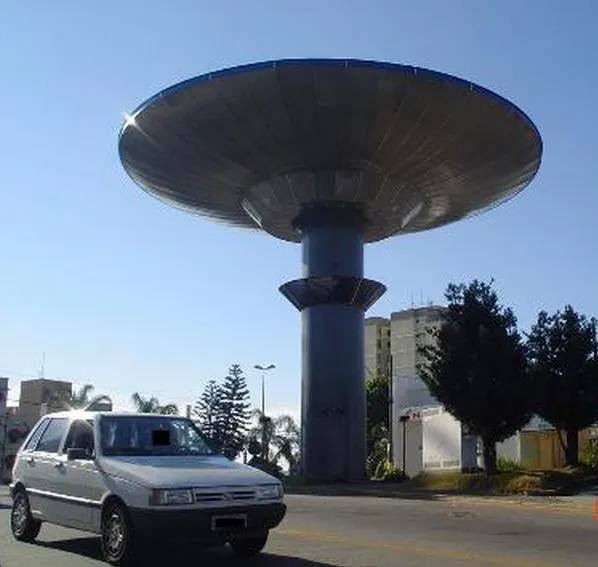
The second main source of the case moved, too. In 2010 Ubirajara Rodrigues, the lawyer who first gathered the testimony, told IstoÉ: “Não há prova de que foi capturado um ser extraterrestre em Varginha” (There is no proof that an extraterrestrial being was captured in Varginha). He said that people had told of seeing and touching a creature, “mas isso não serve de comprovação científica” (but that is no scientific proof). In the same article IstoÉ already noted the water tower in the shape of a spaceship and the bus stops shaped like flying saucers; the city's tourist office now calls the case, in the words of its secretary Rosana Carvalho in 2024, “o segundo caso ufológico mais relevante do mundo” (the second most relevant UFO case in the world). That ranking is the municipality's promotional claim, and it cites no measurement.
Can you visit the Varginha incident (the “ET de Varginha”)?
Varginha has made the case a tourist route, and the pieces are in the city centre. The Memorial do ET, opened by the city in November 2022, is at Rua Maria Paiva Pinto, 105, in the Vila Paiva district; when it reopened after seven months of works on 14 June 2024, the Estado de Minas published its hours as “segunda-feira à domingo (incluindo feriados): 9h às 19h, com a entrada permitida até 18h45”, planetarium sessions included, and “A entrada é gratuita”. Those are the 2024 hours; no later timetable was found on 20 November 2026.
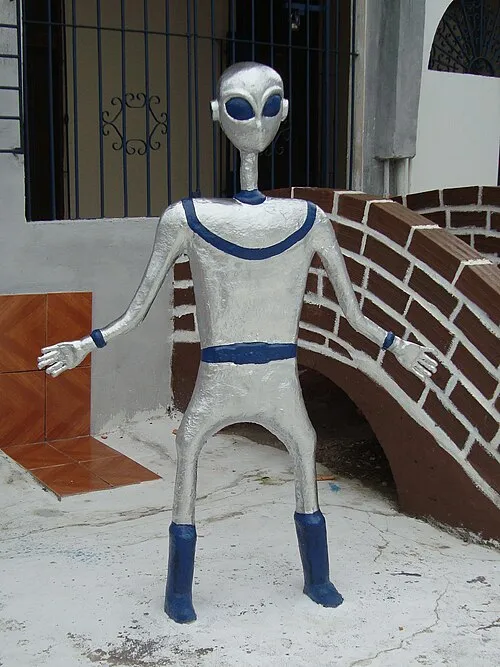
The water tower with a disc-shaped tank, the “nave”, stands in Praça Marechal Floriano, which the Estado de Minas called “conhecida como Praça da Nave” in January 2026, next to a green, winking ET statue; a few metres away, in Praça Getúlio Vargas, two more statues follow the girls' description, with brown, oily skin and red eyes.
The lot where the girls said they saw the being is on Rua Dr. Benevenuto Braz Vieira, in Vila Andere. According to the same January 2026 report, the city acquired it by an exchange in September 2025, and “Atualmente, o terreno continua baldio” (the lot is still vacant). There was nothing on it to visit at that date. The pin on this file marks a segment of that street from OpenStreetMap; the exact lot is unmarked.
The documents can be read without travelling: the two scanned volumes of the 1997 military inquiry are free PDF files, linked from the references below.
Sources consulted
- Brasil. Ministério do Exército, Escola de Sargentos das Armas; Auditoria da 4ª Circunscrição Judiciária Militar, «Inquérito Policial Militar nº 18/97 (Escola de Sargentos das Armas), vol. 2 — scanned file: statements of March 1997, Chereze pathology report, photographs of 11 March 1997, investigating officer's report of 11 April 1997, commander's solution of 18 April, prosecutor's request of 18 June and judge's archiving decision of 4 July 1997» — Superior Tribunal Militar (scan published by Migalhas, January 2026), 1997 archive
- Brasil. Ministério do Exército, Escola de Sargentos das Armas, «Inquérito Policial Militar nº 18/97 (Escola de Sargentos das Armas), vol. 1 — scanned file: opening order of 29 January 1997, internal inquiry of May 1996 and 1996 press cuttings (Folha do Sul, 12–18 May 1996; “Pesadelo que vem do céu”, by Jorge Fernando dos Santos)» — Superior Tribunal Militar (scan published by Migalhas, January 2026), 1997 archive
- Redação Migalhas, «“ET de Varginha”: Relato foi apurado pelo Exército e virou caso judicial — summary of the inquiry with links to both volumes» — Migalhas, 2026 web
- Rodrigo Cardoso, «A história oficial do ET de Varginha (Wayback Machine capture)» — IstoÉ, 2010 newspaper archive
- Folhapress, «Terreno onde ET de Varginha supostamente apareceu deve virar ponto turístico — Folhapress report, with a quotation attributed to Liliane at the time» — A Gazeta, 2023 newspaper archive
- Laura Scardua, Mannu Meg and Alexandre Guzanshe (Estado de Minas), «Artista transforma ET de Varginha em versão lúdica — Praça da Nave, statues and the status of the lot» — Correio Braziliense, 2026 newspaper archive
- Matheus Brum, «Memorial do ET de Varginha é reaberto após sete meses — address, hours and free entry» — Estado de Minas, 2024 newspaper archive
- Estado de Minas, «Versão oficial vs alternativas: o que não foi explicado no caso Varginha — includes Vitório Pacaccini's objection to the “Mudinho” explanation» — Estado de Minas, 2026 newspaper archive
Reviewed by V. Serrano on 2026-11-20 · How we verify our content



💬 Field testimonies (0)
No testimonies yet. Add the first.
Add your testimony
🔒 Log in to add a testimony