🦶 CRYPTID SIGHTING · EXP. Nº6501
ACTIVE
Beast of Gévaudan
Between 1764 and 1767, in the former province of Gévaudan in France's Massif Central, around a hundred people were killed in attacks attributed to a single creature — men, women and above all children and adolescents, most of them herders minding livestock alone because the region was too poor to send an adult with them.
Where and when was Beast of Gévaudan sighted?
- Location
- Occitanie, France
- Date sighted
- Unknown
- Coordinates
- 44.833, 3.5
- Last updated
LOCATION
What is Beast of Gévaudan?
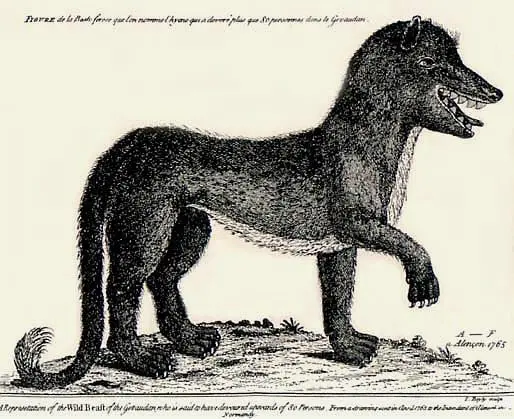
The case reached a national scale extraordinary for its time: Louis XV offered rewards, dispatched his own gun-bearers, and the Paris press supplied the descriptions that made the Beast famous. Jean Chastel shot a wolf on Mont Mouchet in June 1767 and the attacks stopped. The historian Jay M. Smith, in a book published by Harvard in 2011, places the deaths where the authorities eventually placed them — a wolf, or a pack of them — and asks the question that the legend buries: why contemporaries refused to see it that way. The Public Domain Review calls Chastel's kill the last of the Beasts of the Gévaudan, in the plural, because François Antoine had already shot a large wolf, its mate and a cub in 1765 and the attacks had gone on.
What is the history of Beast of Gévaudan?
Of all the famous cryptids, the Beast of Gévaudan is the one that admits least argument on a single point: people really died. And they died in numbers that are still hard to absorb.
Between 1764 and 1767, in the former province of Gévaudan — which largely corresponds to today's department of Lozère, in France's Massif Central — around a hundred people were killed in attacks attributed to a creature. Men, women and above all children and adolescents, most of them herders minding livestock alone in open country.
Eighteenth-century Gévaudan was upland plateau country with hard winters, thinly populated and extremely poor. Families sent children out to watch cattle and sheep because there was nobody else to send. That is what explains the victim profile: there were no armed adults accompanying the herds, there were ten-year-olds with a stick.
The case reached a national dimension extraordinary for its time. Louis XV became involved, rewards were offered and professional hunters were dispatched, including the king's own gun-bearers. The Paris press followed the affair, and with it came the descriptions that made the Beast famous: an animal larger than a wolf, reddish in colour, with a dark stripe along its back and an enormous tail.
The end came on 19 June 1767, when a local hunter named Jean Chastel shot a wolf on the slopes of Mont Mouchet. The attacks stopped.
Timeline: the documented record of Beast of Gévaudan
- 1764 The attacks begin in the former province of Gévaudan, today Lozère. The victims are above all children and adolescents minding livestock alone in open country, because there was nobody else to send.
- 1765 The case reaches national scale. Louis XV becomes involved, rewards are offered and professional hunters are sent, including the king's own gun-bearers. The Paris press spreads the descriptions that make the Beast famous.
- 19 June 1767 The local hunter Jean Chastel shoots a wolf on the slopes of Mont Mouchet. The attacks stop, after three years and around a hundred dead, and after the professionals sent by the court had failed.
- Historical research Harvard University Press publishes Jay M. Smith's Monsters of the Gévaudan, which places the attacks where the authorities eventually did — a wolf, or a pack of wolves — and explains why contemporaries refused to see it that way: the beast coincided with the emergence of modernity and was bound to be perceived as anomalous.
Is there a rational explanation for Beast of Gévaudan?
The historian Jay M. Smith, author of Monsters of the Gévaudan (Harvard University Press, 2011), puts the killings where the authorities eventually put them, on "a wolf, or a pack of wolves", and spends the book on why contemporaries refused to accept that answer. In the publisher's summary, the beast "was bound to be perceived as strange and anomalous because its ravages coincided with the emergence of modernity itself". Speaking to Smithsonian Magazine in 2017 he was blunter: "The best and most likely explanation is Gévaudan had a serious wolf infestation." The Public Domain Review quotes Graham Robb for the same picture of a region "infested with wolves", and the history page of a guesthouse at La Bastide-Puylaurent says that the majority of historians attribute the deaths to a pack of wolves.
The record of the hunts points to more than one animal. In September 1765 François Antoine, the king's gun-bearer, shot a large wolf near the abbey of Chazes; according to the Public Domain Review he also killed the wolf's "similarly enormous mate and cub", and the attacks went on, with Smithsonian counting "a reported 30 to 35 fatalities" in the following eighteen months. National Geographic writes that more than a hundred wolves were killed in the Gévaudan between 1764 and 1767, and that by early 1765 the deaths attributed to the Beast were spread over 700 square miles, which "may indicate that there was more than one beast at work—perhaps even a pack". That is why the Public Domain Review describes Jean Chastel's kill of June 1767 as "the last of what had turned out to be the Beasts of the Gévaudan".
The victims explain much of the toll: the first recognised one, Jeanne Boulet, was a fourteen-year-old girl killed while she watched her sheep in 1764; National Geographic notes that children often minded sheep or cattle by themselves and that many people in the region were "extremely poor and subsisted by herding livestock". The count of the dead depends on the source: the guesthouse page gives between 88 and 124, National Geographic "as many as 100", and Smithsonian and the Public Domain Review nearly 300 victims. Wolf attacks occurred throughout France in that period, and the historian Jean-Marc Moriceau, quoted by Smithsonian, estimates as many as 9,000 deaths from wolves in the country between the end of the sixteenth century and the beginning of the nineteenth, and what set the Gévaudan apart, in Smithsonian's account, was the violence of the attacks and their toll together with the way the press told them.
The extravagant descriptions came through that press. With political news mostly censored by the king, Smithsonian writes, François Morénas, editor of the Courrier d'Avignon, told the tale through faits divers, stories of everyday incidents in small villages, and his reportage turned the beast from a backwater calamity into a national affair; National Geographic adds that the end of the Seven Years' War in 1763 had left him short of news. A poster of 1764 reproduced by the Public Domain Review describes an animal "big as a donkey" with a "dark ridged stripe down the back" and a tail that "can knock you over", and the dragoon captain Jean-Baptiste Duhamel decided that it was a hybrid "the father of which is a lion". Between the pastures and the printed page the accounts passed through witnesses, officials and editors, over the nearly 500 kilometres (about 300 miles) that separate Mende from Paris.
Other explanations remain in circulation: National Geographic reports that the biologist Karl-Hans Taake has argued for an escaped juvenile male lion and that most experts find the theory of a human killer using an animal too far-fetched; the werewolf survives in the rumour that Chastel loaded a silver bullet. The ending came from inside the region, since Chastel, a local farmer whom Antoine had earlier jailed for leading his men into a bog, shot the animal on 19 June 1767 during a hunt organised by a local nobleman, the Marquis d'Apcher, and Smithsonian notes that the hunters sent from outside had been "unfamiliar with the landscape and had trouble communicating with locals".
Can you visit Beast of Gévaudan?
The former province of Gévaudan corresponds broadly to the present department of Lozère, in the Massif Central, one of the least populated areas in France, and the attacks of 1764–1767 also spread into southern Auvergne. The places now tied to the Beast sit on both sides of the boundary between Lozère and Haute-Loire. The pin for this entry, at 44.8333, 3.5, falls at Le Sauvage, in the commune of Chanaleilles, Haute-Loire. The Haute-Loire departmental council, which has owned the estate since 1971, describes it as 750 hectares in one piece on the edge of Lozère, on the GR 65 long-distance path to Santiago de Compostela, with two walkers' hostels and an inn; about 30,000 walkers passed through in 2023. The pin stands for the Margeride upland in which the attacks took place and marks no documented attack.
In Saugues, 14.6 km (9.1 miles) north-north-east of the pin, the Musée fantastique de la Bête du Gévaudan, on rue de la Tour, tells the story in a route of 22 scenes; the Haute-Loire tourist board puts the average visit at 35 minutes. On 23 September 2026 the museum's own site gave admission as €6 for adults and €4 for children, and its current opening as every day from 16 September to 15 October at 17:00, closed on 7 October, with groups received all year by appointment. French Wikipedia's article on the case records a wooden sculpture of the Beast in Saugues and a statue of it by Emmanuel Auricoste in Marvejols, in Lozère, although the Beast never reached that commune.
Jean Chastel fired his shot of 19 June 1767 at a place called the Sogne d'Auvers, on the flanks of Mont Mouchet (1,497 m), a summit on the border of Haute-Loire and Lozère. In the village of Auvers, 18.9 km (11.7 miles) north-north-west of the pin, Philippe Kaeppelin's statue of Marie-Jeanne Vallet fighting the Beast was unveiled in 1995. Beside it the Maison de la Bête holds a themed exhibition each year, for which the Margeride en Gévaudan tourist office lists adult entry at up to €3.50. Chastel's own village, La Besseyre-Saint-Mary, has a stele to his memory.
Mont Mouchet carries a second history. In June 1944 German forces attacked the maquis based there, and a memorial and the Musée de la Résistance du Mont-Mouchet now stand at Le Mont-Mouchet, 43300 Auvers. The Haute-Loire tourist board gives the museum's hours from 1 to 27 September 2026 as Tuesday 14:00–17:00 and Wednesday to Sunday 10:30–12:30 and 14:00–17:00, with adult admission at €6 and €3 for ages 10 to 15.
The forest on the summit is recent. According to French Wikipedia, the mountain was once farmed as pasture around a farmstead, and its beech and fir state forest was planted, in part, between 1902 and 1955 under the restoration of mountain land; the same article records abundant snow from November to May.
Sources consulted
- The Public Domain Review, «The Beast of Gévaudan (1764-1767) — documentación y grabados de época» — Public Domain Review, 2020 archive
- Lorraine Boissoneault, «When the Beast of Gévaudan terrorized France» — Smithsonian Magazine, 2017 newspaper archive
- Jay M. Smith, «Monsters of the Gévaudan: The Making of a Beast — la tesis del lobo (o la manada) y por qué los contemporáneos la descartaron» — Harvard University Press, 2011 book
- National Geographic, «Did a 'werewolf' really terrorize France in the 1700s?» — National Geographic History Magazine, 2022 newspaper archive
- L'Etoile Guest House (La Bastide-Puylaurent), «The Beast of Gévaudan in Lozère — geografía de los ataques en Lozère» — etoile.fr, web de una casa de huéspedes; consultada en 2026, 2026 web
Reviewed by V. Serrano on 2026-07-28 · How we verify our content
📎 Source: Enigma Atlas
💬 Field testimonies (0)
No testimonies yet. Add the first.
Add your testimony
🔒 Log in to add a testimony