🦶 CRYPTID SIGHTING · EXP. Nº0555
ACTIVE
Dahu
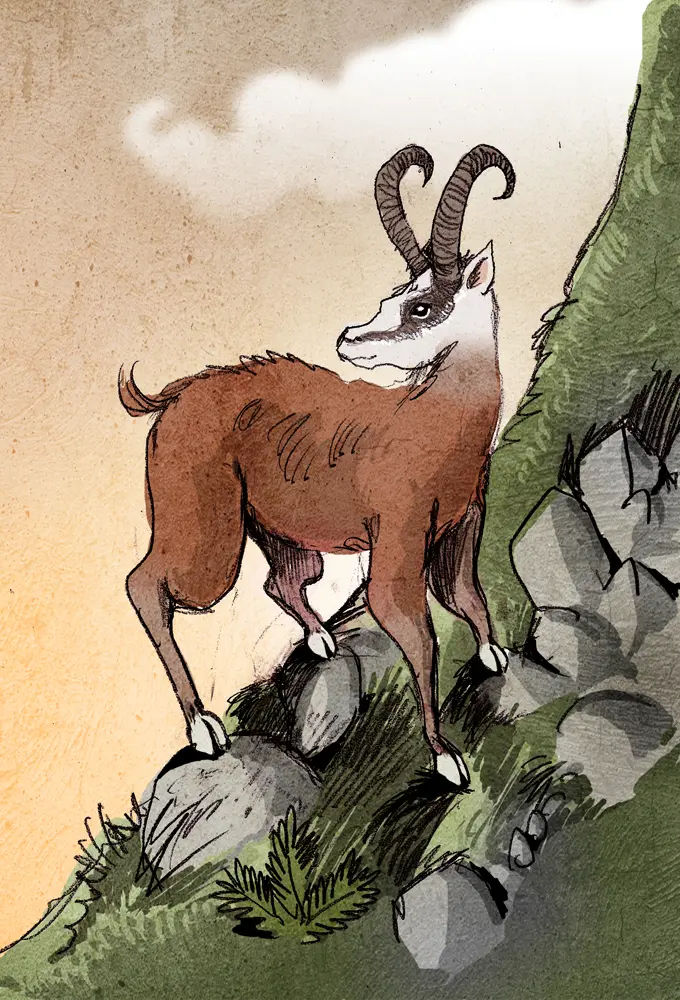
The dahu is the animal at the end of a French practical joke: a newcomer is taken out after dark, posted with an open sack between his knees, and left there while the rest of the party goes off, supposedly to drive the beast towards him.
Where and when was Dahu sighted?
- Location
- Forêt de Fontainebleau, France, France
- Date sighted
- Unknown
- Coordinates
- 48.4, 2.66
- Last updated
LOCATION
What is Dahu?
Nobody presents it as real, so the question worth asking is not whether it exists but where the story comes from — and the paper trail does not begin in the Alps. The oldest dated printed account we have been able to find is an article headed “La chasse au Dahu” in L'Abeille de Fontainebleau of Sunday 27 October 1867: the scene is a village on the edge of the forest of Fontainebleau, the victim is a grocer up from Paris, and no animal is described at all. The word first reaches a dictionary in 1882, in four villages of the Yonne, meaning “a fantastic, imaginary being; a thing impossible to find” — while the two reference dictionaries of Savoyard patois, of 1883 and 1902, do not record it, and keep only its cousin dâro, “simpleton”. The goat with uneven legs, its Latin name and its two mirror subspecies came much later, and came from a museum.
What is the history of Dahu?
The dahu is not a cryptid with witnesses. It is the animal at the end of a practical joke, and the joke is the part that can be documented.
The oldest dated printed account of it we have been able to find is not alpine. On Sunday 27 October 1867, page three of L'Abeille de Fontainebleau — the local paper of a town on the edge of a royal forest 60 km from Paris — carried an unsigned piece headed "LA CHASSE AU DAHU". It begins: "Si vous ne connaissez pas la chasse au Dahu, permettez-moi de vous narrer une histoire qui vous instruira plus à ce sujet que toutes les explications techniques que je pourrais donner." A Paris grocer comes to visit two childhood friends in a village on the edge of the forest of Fontainebleau — "Marlotte, Barbizon, ou By, si vous le désirez" — and after a good deal of wine they offer him a dahu hunt in the woods, promising a splendid haul of rabbits, pheasants and hares. The article explains the equipment with a straight face: "la seule arme offensive dans ce genre de chasse est un sac en bonne et solide toile." At eleven at night, in the dark, they post their victim almost on his knees with the sack gaping between his legs so that the rabbits will pour into it, then leave him "soi-disant pour faire le rabat" — supposedly to drive the game towards him — and walk home laughing. The whole modern prank is there. What is not there is the animal: the piece never describes a dahu at all.
The word reaches a dictionary fifteen years later, and again nowhere near a mountain. In 1882 the Bulletin de la Société des sciences historiques et naturelles de l'Yonne printed S. Jossier's Dictionnaire des patois de l'Yonne, compiled by a commission of five members from lists sent in by village schoolmasters. On page 72 the entry reads in full: "DAHU. s. m. Être fantastique, imaginaire; chose impossible à trouver. Chercher le dahu. Aller à la chasse au dahu. (Bléneau, Rogny, Champcevrais, Sommecaise)." Jossier adds that the word looks to him like the Berry dâlu, the personification of numbed fingers used to frighten children in winter — "V'là le dâlu qui vient, cachez ben vous mains" — and that is the whole of it. The four villages are in the Puisaye, low wooded country in the north of Burgundy, some 400 km from Mont Blanc.
Search where the alpine dahu ought to be and it is not there. Two dictionaries cover the Savoyard patois of exactly the region this file is filed under: François Brachet's Dictionnaire du patois savoyard for the canton of Albertville (1883) and the Dictionnaire savoyard published under the auspices of the Société florimontane by Aimé Constantin and Joseph Désormaux (Paris and Annecy, 1902). Full-text searches of both return nothing for dahu, dahut or daru, twice over, while control searches in the same volumes return chamois in both and 48 hits for chèvre in the 1902. What the 1902 dictionary does record is the cognate: on page 283, under the headword Nénŏ, "nigaud" — simpleton — the synonyms listed include dâro and dârou. In Savoy the word named the man who was fooled, not the beast he was sent to catch.
Behind all of this stands a poem that has been badly summarised for a century. Claude Gauchet, chaplain to Charles IX and Henri III, published Le Plaisir des champs in 1583; its winter section contains a passage titled "La Darue ou le Boullot". It describes a real hunt: a black winter night, limed branches called brilloërs whose glue is warmed with goose grease or walnut oil, a lantern, a fire of straw, and blackbirds, thrushes and greenfinches beaten out of the bushes and into the lime. The party is named — Gauchet himself, Chambonnière, Popot, Jean Thibault beating the bushes, Jean Loys, Beaurepas carrying "un petit sac / Pour par compte y serrer les oiseaux mis à sac", and Jessé, who carries a pot of embers and is terrified of being left behind: "Jessé qui meurt de peur qu'aux champs on ne le laisse". So they finish the evening at his expense. "Nous luy mettons en main la lanterne escleirante / Pour l'oster de soupçon" — they put the lit lantern into his hand precisely so that he will suspect nothing — and then, in the wood, "chacun en un moment / Luy tourne aussy le cul et fuit legierement." He shouts; nobody answers; he blunders about in the cold while the rest walk on laughing "à gorge pleine". The mechanism of the chasse au dahu — the object pressed into the victim's hands to keep him still, the silent withdrawal, the laughter — is in print in 1583. The imaginary animal is not.
The animal, with its Latin name and its two mirror subspecies, is recent and its most institutional moment can be dated to the day. On 1 April 1995 the Musée d'histoire naturelle de La Chaux-de-Fonds, in the Swiss Jura, opened an exhibition devoted to Dahutus montanus and published Marcel S. Jacquat's monograph as Cahiers du MHN no 2. By the museum's own account the exhibition and the correspondence it attracted produced a substantial documentary collection and gave rise to a "Laboratoire international de dahutologie". The museum is now called MUZOO, and its postal address is Replat du Dahu 1. The folklorist Fabio Armand, writing in La Beidana in 2020, reads the current alpine dahu as a tourist revival that fixes a fluid oral joke into a marketable image: a "Dahù" cheese with a deliberately slanted shape made in the val Chisone and val Germanasca, "Les crottes du Dahu" biscuits at Mont-Dauphin.
Timeline: the documented record of Dahu
- 1583 Claude Gauchet, chaplain to Charles IX and Henri III, publishes Le Plaisir des champs. Its winter section, "La Darue ou le Boullot", describes a real night hunt for blackbirds and thrushes taken with birdlime — and ends with the party pressing a lit lantern into Jessé's hands so he will suspect nothing, then slipping away and leaving him alone in the wood.
- 27 October 1867 L'Abeille de Fontainebleau prints an unsigned article headed "La chasse au Dahu": a Paris grocer is posted at night on the edge of the forest of Fontainebleau with an open sack between his knees, and the friends who brought him leave "soi-disant pour faire le rabat". This is the oldest dated printed account of the prank we have been able to find; it describes no animal.
- 1882 S. Jossier's Dictionnaire des patois de l'Yonne, printed in the bulletin of the department's learned society, gives the entry "DAHU. s. m. Être fantastique, imaginaire; chose impossible à trouver", recorded at Bléneau, Rogny, Champcevrais and Sommecaise — four villages of the Puisaye, in lowland Burgundy.
- 1883 François Brachet publishes his dictionary of the Savoyard patois of the canton of Albertville. A full-text search of the volume returns no dahu, dahut or daru; the control term chamois is there.
- 1902 The Dictionnaire savoyard of Aimé Constantin and Joseph Désormaux, printed at Annecy for the Société florimontane, likewise has no dahu. On page 283 it lists dâro and dârou among the synonyms of nénŏ, "nigaud" — simpleton. In Savoy the word named the dupe, not the beast.
- 1 April 1995 The Musée d'histoire naturelle de La Chaux-de-Fonds opens an exhibition devoted to Dahutus montanus and publishes Marcel S. Jacquat's monograph as Cahiers du MHN no 2. The museum credits the exhibition with creating its dahu archive and the "Laboratoire international de dahutologie".
- 2020 The folklorist Fabio Armand publishes "Le dahu: imaginaire narratif d'un animal chimérique" in La Beidana, reading the creature's return in the francophone Alps as a tourist revival that turns a fluid oral joke into a fixed marketable image — a slanted "Dahu" cheese in the val Chisone and val Germanasca, "Les crottes du Dahu" biscuits at Mont-Dauphin.
- August 2026 Checked on the institutions' own sites: the Museo delle Alpi at the Forte di Bard shows a reconstruction of the dahu in the biodiversity section of its permanent exhibition, and the museum at La Chaux-de-Fonds, now MUZOO, has its postal address at Replat du Dahu 1 while listing no dahu among its collections.
Is there a rational explanation for Dahu?
There is nothing to debunk here: nobody claims the dahu is a real animal, and the museums that display it say so. The claim worth testing is the historical one — that this is an old alpine tradition — and it does not survive the archive.
What can be dated points the other way. The oldest printed account of the hunt we could find is from the Île-de-France in 1867; the oldest dictionary entry is from the Yonne in 1882; and in Savoy itself the word is missing from the two reference dictionaries of the patois, Brachet (1883) and Constantin & Désormaux (1902), where its cognate dâro/dârou survives only as a word for a simpleton. Those are negative results, so here are the controls: the same searches that return zero for dahu, dahut and daru return chamois in both dictionaries and 48 hits for chèvre in the 1902 volume; and in the Revue des traditions populaires, the main French folklore journal from 1886 to 1919, a full-text search for "le dahu" returns nothing while "loup-garou" returns nineteen records.
The date that circulates as the earliest deserves a second look. Reference answers online — including the answer given by the Guichet du Savoir of the municipal library of Lyon, which relays a note by Marie-Rose Simoni-Aurembou reprinted in the Revue Savoisienne — state that the first known description of a dahu hunt is from 1583, in Claude Gauchet's Le Plaisir des champs. Read the poem and the claim narrows: the hunt Gauchet describes is a real one, for blackbirds and thrushes taken with birdlime, and no imaginary animal appears in it. What is genuinely there, and is remarkable enough on its own, is the mechanism — the lantern put into Jessé's hands so that he will stand still, and the silent desertion that follows.
Two much-repeated items are left out of this file because they could not be verified. The first is a survey, usually given as Swiss and dated 2009, said to show that some percentage of adults believe the dahu exists; no institution, sample or publication could be traced for it. The second is a prefectural order said to have created a dahu reserve at Reignier, in Haute-Savoie: it appears only on hobby pages that copy one another, all of them dating it 1 April.
The motif of the mountain animal with legs shorter on one side has close relatives elsewhere — the sidehill gouger of the northern Pennsylvania hills, collected by James York Glimm in Flatlanders and Ridgerunners (1983), is told in the same deadpan register. We have found no published work establishing a relationship between them, which is not the same as saying there is none.
Finally, two negations worth dating. As of August 2026 there is no biological specimen of a dahu anywhere, and nobody presents one as such; what museums display is openly a construction — the Museo delle Alpi at the Forte di Bard, in the Aosta Valley, includes a reconstruction of the dahu in the section of its permanent exhibition devoted to biodiversity, precisely to talk about slopes.
Can you visit Dahu?
MUZOO, the natural history museum of La Chaux-de-Fonds in the Swiss Jura, keeps a page on a "Laboratoire international de Dahutologie". Its postal address is Replat du Dahu 1, CH-2300 La Chaux-de-Fonds, telephone +41 (0)32 967 65 00. Its history page dates to 17–18 December 2022 the opening of the present site in the renovated Ancien-Stand building, where the museum shares grounds with the town zoo. That page says that in 1995, "after several years of research", it mounted an exhibition on Dahutus montanus with a monograph from its own imprint, the Éditions de la Girafe.
The opening-hours page, consulted on 24 September 2026, gives the museum with its vivarium as open from Tuesday to Sunday, 10:00 to 17:45 in summer time and 10:00 to 16:45 in winter time, with last entry 30 minutes before closing. It closes on Mondays except Easter Monday and Whit Monday, and on 24, 25, 31 December plus 1 January. The zoo is free. Admission to the museum and vivarium costs CHF 12 at full price and CHF 8 reduced; young people aged 12 to 15 pay CHF 6 while children under 12 enter free. A family ticket for up to two adults with five children costs CHF 24. The practical-information page lists buses 304 and 310 (the 352 on Sundays and holidays), all stopping at "MUZOO", and names the covered car parks of Espacité (10 minutes on foot) and Métropole-Centre (15 minutes). The parking space for visitors with reduced mobility is east of the building; the ramp at Replat du Dahu 1a opens on request through an intercom on the left, or after a call to +41 (0)32 967 65 01.
The museum owns a naturalised dahu in two versions: a skeleton and a furred one, first shown to the public in 1995. Le Matin reported on 3 January 2018 that it had just come back from a loan of more than four months to the château of Champlitte, in Haute-Saône. The collections page, read on 24 September 2026, does not list it; nor does the site say whether it is on display.
The Museo delle Alpi occupies the first floor of the Opera Carlo Alberto inside the Forte di Bard, 11020 Bard, in the Aosta Valley, telephone +39 0125 833811. The regional tourist database says that in the section on the seasons "il mitico Dahu, l'animale leggendario con due zampe più corte per adattarsi ai pendii montani" welcomes the visitor into the biodiversity of the Alps. The same entry, consulted on 24 September 2026, gives Tuesday to Friday from 10:00 to 18:00; weekends and holidays from 10:00 to 19:00; entry is possible until 45 minutes before closing. Tickets cost 15 euros; the reduced price of 12 euros applies to visitors over 65 and to university students aged 19 to 25; the "All Forte" ticket covering every museum and exhibition in the fort costs 24 euros. Admission is free up to the age of 18 inclusive, and for a disabled visitor with a companion.
The pin of this file, 48.4000° N 2.6600° E, lies in the forest of Fontainebleau about 3.3 km west-south-west of the centre of Fontainebleau. The 1867 article in L'Abeille de Fontainebleau set the prank in "Marlotte, Barbizon, ou By, si vous le désirez". Measured from the pin between coordinates, Barbizon is 6.6 km to the north-west, Bourron-Marlotte 7.6 km to the south-south-east and Thomery, the commune that includes the hamlet of By, 9.2 km to the east.
Sources consulted
- Claude Gauchet, «Le plaisir des champs, avec la vénerie, volerie et pescherie — « La Darue ou le Boullot » (pp. 304-311)» — 1583; ed. Prosper Blanchemain, Paris, 1869 (Gallica), 1583 book
- Unsigned, «La chasse au Dahu (p. 3)» — L'Abeille de Fontainebleau, 27 October 1867 (Gallica), 1867 newspaper archive
- S. Jossier, «Dictionnaire des patois de l'Yonne — entry DAHU (p. 72)» — Bulletin de la Société des sciences historiques et naturelles de l'Yonne, 1882 (Gallica), 1882 book
- François Brachet, «Dictionnaire du patois savoyard tel qu'il est parlé dans le canton d'Albertville» — Impr. J.-M. Hodoyer, Albertville (Gallica), 1883 book
- Aimé Constantin and Joseph Désormaux, «Dictionnaire savoyard — entry Nénŏ (p. 283)» — Société florimontane; E. Bouillon, Paris / impr. Abry, Annecy (Gallica), 1902 book
- MUZOO / Musée d'histoire naturelle de La Chaux-de-Fonds, «Laboratoire international de dahutologie» — Institutional page, 2026 web
- MUZOO, La Chaux-de-Fonds, «Horaires et tarifs / Infos pratiques» — Official visitor information, 2026 web
- Région autonome Vallée d'Aoste, «Museo delle Alpi, Forte di Bard» — Official tourist database (lovevda.it), 2026 web
- Fabio Armand, «Le dahu : imaginaire narratif d'un animal chimérique» — La Beidana, no 98, pp. 51-66, 2020 academic
- Guichet du Savoir, «Expression « Chasse au dahu » (question 46127)» — Bibliothèque municipale de Lyon, 2014 web
- James York Glimm, «Flatlanders and Ridgerunners: Folktales from the Mountains of Northern Pennsylvania (tales 6-7, Sidehill Gouger and Sidehill Mooties)» — University of Pittsburgh Press, 1983 book
- Guichet linguistique, Région autonome Vallée d'Aoste, «Le mot du mois : le dahu» — patoisvda.org, 2026 web
- Vincent Donzé, «Tous les musées veulent le dahu — the naturalised dahu of La Chaux-de-Fonds (skeleton and furred versions, first shown in 1995) back from a loan to Champlitte» — Le Matin (Lausanne), 3 January 2018, 2018 newspaper archive
- MUZOO, La Chaux-de-Fonds, «Infos pratiques — access, buses, parking and reduced-mobility entrance» — Official visitor information (consulted 24 September 2026), 2026 web
- MUZOO, La Chaux-de-Fonds, «Notre histoire — timeline of the museum and zoo, including the opening of the MUZOO site on 17-18 December 2022» — Institutional page (consulted 24 September 2026), 2026 web
Reviewed by V. Serrano on 2026-08-14 · How we verify our content
📎 Source: Enigma Atlas
💬 Field testimonies (0)
No testimonies yet. Add the first.
Add your testimony
🔒 Log in to add a testimony