🦶 CRYPTID SIGHTING · EXP. Nº6501
ACTIVE
Tarasque
The Tarasque is the dragon of Tarascon, on the Rhône between Arles and Avignon, subdued by Saint Martha in a medieval saint's life.
Where and when was Tarasque sighted?
- Location
- Bouches-du-Rhône, France
- Date sighted
- Unknown
- Coordinates
- 43.806, 4.66
- Last updated
LOCATION
What is Tarasque?
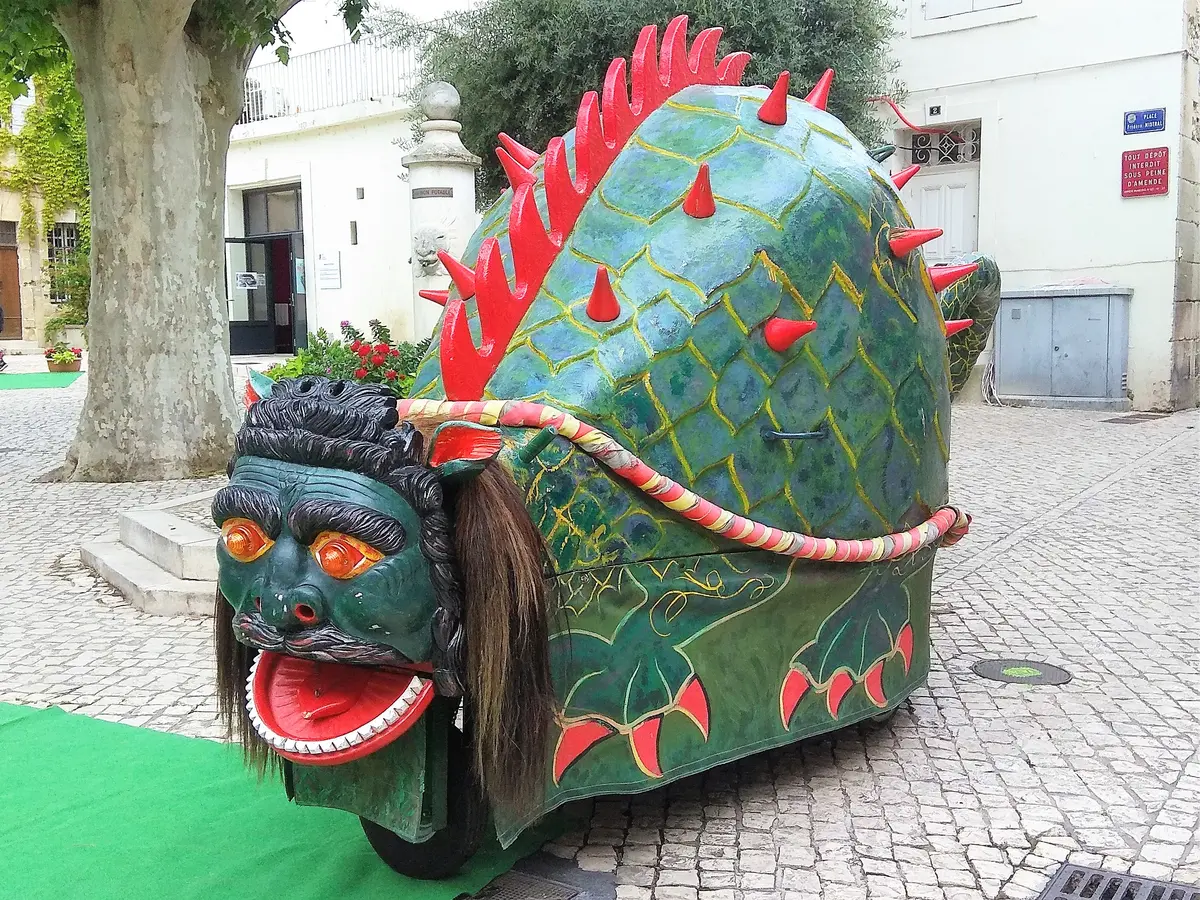
The six bear-clawed feet and the tortoise-like shell usually dismissed as later folklore are the opposite of that: they belong to the oldest text there is. The Vita attributed to Marcella, dated between 1174 and 1210 and edited by Véronique Olivier, gives the beast six feet with bear's claws, a lion's head, a horse's mane, a viper's tail and two bucklers on each side like a tortoise. Around 1260 the Golden Legend cut most of the description and kept the armour; in 1483 William Caxton's English turned that armour into "two wings on either side". The town's name did not come from the beast either: Strabo lists Tarusco as a road station in the first century AD, eleven centuries earlier. What did happen at Tarascon is 1187, when a sarcophagus was opened and declared to hold Martha's body, and the story explaining why it was there dates from exactly that moment. The festival is younger still: codified in 1474 by tradition, first documented in 1564, and held today on the last weekend of June.
What is the history of Tarasque?
The town came first. Strabo, writing in the first century of our era, lists Tarusco twice as a plain road station in Narbonese Gaul: the highway ran "from Nemausus through Ugernum and Tarusco to the hot waters that are called Sextian", and elsewhere he measures a distance "from a point opposite the town of Tarusco, on the other side of the river". Nîmes, Beaucaire, Tarascon. No monster, no saint — just a crossing of the Rhône with a name already fixed some eleven centuries before anyone wrote the legend that claims to explain it.
What happened at Tarascon happened in 1187. During work on the church of Sainte-Marthe, a sarcophagus was opened and declared to hold the body of Martha of Bethany. Inside lay a marble slab reading BEATA MARTHA JACET HIC — "blessed Martha lies here" — cut, as L. H. Labande noted in 1910, in letters of the twelfth or thirteenth century. The rebuilt church was consecrated on 1 June 1197 by Imbert d'Eyguières, archbishop of Arles, and Rostang de Marguerite, bishop of Avignon; the consecration plaque is still on the wall.
The oldest text that puts the Tarasque into Martha's life belongs to exactly that moment. Véronique Olivier, who edited and translated it for her 2010 thesis at the Université du Québec à Montréal, dates the Vita attributed to Marcella — Martha's servant, the supposed author, hence pseudo-Marcella — to between 1174 and 1210, and reads it as an attempt to explain why a Palestinian saint's body was lying in Provence. Her edition gives the beast in full: "grossior boue, longior equo, os et caput habens leoninum, dentes ut spata acutos, comas equinas, dorsum acutum ut dolabrum, squamas irsutas ut artauos scindentes, senos pedes et ungues ursinos, caudam uiperam, binis parmis ut tortua utraque parte munitus". Fatter than an ox, longer than a horse, the mouth and head of a lion, teeth sharp as a sword, a horse's mane, a back keen as a hatchet, bristling scales that cut like augers, six feet and bear's claws, a viper's tail, and armoured on each side with two bucklers like a tortoise.
Everything that is usually called a modern accretion is therefore in the very first text. What happened next is subtraction. Around 1260 the Dominican Jacobus de Voragine put Martha into the Golden Legend, and — as María Ángeles Llorca Tonda showed in 2021, collating seven medieval versions — "the Dominican abridges the physical description of the beast". His Latin keeps only the size, the teeth and the armour: "binis parmis ex utraque parte munitus". The six feet, the bear claws, the lion's head, the horse's mane and the hatchet back are gone. And the Golden Legend is what Europe read: hundreds of manuscripts, then print, then translation.
The last link is the one that reaches English. In William Caxton's version of 1483 the dragon is "greater than an ox, longer than an horse, having teeth sharp as a sword, and horned on either side, head like a lion, tail like a serpent, and defended him with two wings on either side". The armour has become wings. Where the Latin has bucklers — William Granger Ryan translates "a pair of bucklers on either side of his body", and the French Ministry of Culture's own inventory sheet renders it "armé de chaque côté de deux boucliers" — the English has flight. In the same paragraph Galatia becomes Galicia and the bonnacon becomes "a beast called Bonacho". Caxton also carries a lion's head and a serpent's tail that Voragine had cut, which means his English does not descend from Voragine's Latin alone; he worked from the French of Jean de Vignay and an earlier English Gilte Legende as well, and this ficha has not collated those, so at which stage the shell turned into wings is not settled here.
The festival is a separate story with a separate clock. The Archives départementales des Bouches-du-Rhône, which hold the papers, put it carefully: a brief mention suggests an effigy was already being run in 1466; "in 1474 King René codifies the festival"; but "the first genuine outing of the Tarasque clearly attested by a document goes back to 1564". The precise date everyone repeats — 14 April 1474, with René of Anjou founding the Jeux de la Tarasque and the order of the Chevaliers — is sourced, in the Ministry's own inventory sheet, to the comte de Villeneuve, prefect of the Bouches-du-Rhône, writing in his departmental Statistique in the 1820s: three and a half centuries after the fact. Small arithmetic goes with it. The games were run at Pentecost, as Villeneuve and the archives both say; in 1474 Easter fell on 10 April and Pentecost on 29 May, so 14 April was four days after Easter, not Pentecost.
After that the record is visible and intermittent. Frédéric Mistral published Les fêtes de la tarasque en 1861 the same year Le Monde illustré printed a sketch of it. Jean-Paul Clébert lists the runs: 1861, 1864, 1891, then nothing until 1946 — "few Provençaux have seen it more than once in their lives". Since 1946 the festival has been held every last weekend of June. Louis Dumont observed the 1946 revival and published La Tarasque in 1951; reviewing it for the Revue belge de Philologie et d'Histoire, Fernand Benoit described the effigy he found there: 6.4 metres long, with a human face.
Timeline: the documented record of Tarasque
- First century AD Strabo lists Tarusco twice in his Geography as a road station of Narbonese Gaul, on the highway running from Nemausus through Ugernum to the Sextian waters. The town's name is fixed some eleven centuries before the legend that claims to explain it.
- Between 1174 and 1210 The Vita attributed to Marcella (pseudo-Marcella) is written, the oldest text to put the Tarasque into Martha's life. Its beast has six feet and bear's claws, a lion's head, a horse's mane, a viper's tail and two bucklers on each side like a tortoise. Véronique Olivier dates and edits it, and reads it as written to explain why a Palestinian saint's body lay in Provence.
- 1187 During work on the church at Tarascon a sarcophagus is opened and declared to contain the body of Martha of Bethany. Inside is a marble slab reading BEATA MARTHA JACET HIC, cut in twelfth- or thirteenth-century lettering — contemporary with the finding, not with the burial.
- 1 June 1197 The rebuilt church is consecrated by Imbert d'Eyguières, archbishop of Arles, and Rostang de Marguerite, bishop of Avignon. The consecration plaque is still on the wall; Martha appears with the Tarasque on the south portal.
- c. 1260 Jacobus de Voragine abridges the description for the Golden Legend, keeping the size, the teeth and the tortoise-like armour and dropping the six feet, the bear claws, the lion's head and the horse's mane. As María Ángeles Llorca Tonda puts it after collating seven medieval versions, "the Dominican abridges the physical description of the beast".
- 1466 A brief mention in the Tarascon archives suggests an effigy was already being run, according to the Archives départementales des Bouches-du-Rhône, which record it as a possibility rather than a fact.
- 14 April 1474 The traditional foundation date of the Jeux de la Tarasque and the order of the Chevaliers by René of Anjou. The source the French Ministry of Culture cites for the date is the comte de Villeneuve, prefect of the Bouches-du-Rhône, writing in the 1820s. The games were run at Pentecost, but in 1474 Easter fell on 10 April and Pentecost on 29 May.
- 1483 William Caxton's English Golden Legend renders the armour as flight: the dragon "defended him with two wings on either side". In the same paragraph Galatia becomes Galicia. The English also restores a lion's head and a serpent's tail that Voragine had cut, so it does not descend from his Latin alone.
- 1564 "The first genuine outing of the Tarasque clearly attested by a document", in the words of the departmental archives — three centuries and a half after the earliest text of the legend, and ninety-eight years after the possible mention of 1466.
- 1861 Frédéric Mistral publishes Les fêtes de la tarasque en 1861, with the traditional tunes of the games; the same year Le Monde illustré prints a sketch of the festival. Jean-Paul Clébert lists the runs as 1861, 1864, 1891 and then nothing until 1946.
- 1946 The festival is revived after fifty-five years and settles on the last weekend of June. Louis Dumont observes this edition and publishes La Tarasque in 1951; reviewing it, Fernand Benoit describes an effigy 6.4 metres long with a human face.
- 2005 UNESCO proclaims "Processional giants and dragons in Belgium and France" a Masterpiece of the Oral and Intangible Heritage of Humanity. Tarascon is named among the French towns; the Tarasque itself is not named in the description.
- 2008 The element, file number 00153, is incorporated into UNESCO's Representative List of the Intangible Cultural Heritage of Humanity.
- 2019 "Les fêtes de la Tarasque" enter the French national inventory of intangible cultural heritage as file 2019_67717_INV_PCI_FRANCE_00425, on the basis of Marie Gaspa's 2014 fieldwork at the festival.
- 26–29 June 2026 The town of Tarascon gives these as the dates of the 2026 festival on its official page. Checked on 14 August 2026, no dates had yet been published for 2027.
Is there a rational explanation for Tarasque?
There are no sightings here to explain. Nobody claims to have seen a Tarasque; what exists is a saint's life, a civic festival and a chain of texts. The honest sceptical question is not whether the animal was real but what the story was for, and when each piece of it appears.
The dating answers most of it. Véronique Olivier's argument in her 2010 UQAM edition is that a saint's Life is normally written to justify the presence of relics, and that this one was: the body was "found" at Tarascon in 1187, the church was reconsecrated in 1197, Martha appears with the Tarasque on the church's south portal, and the Vita is datable between 1174 and 1210. The slab inside the sarcophagus is the tell. The coffin is a fifth-century Christian marble sarcophagus; the plaque naming Martha inside it is lettered in twelfth- or thirteenth-century characters. The label is contemporary with the finding, not with the burial.
The episode itself is a genre requirement rather than a local memory. Alain Boureau, quoted by Llorca Tonda, notes that most preaching saints "defeat serpents or dragons, images of the evil they master"; Diane Peters, whose 1990 Wilfrid Laurier thesis collated the four early Latin lives, goes further, and is quoted by Natalie Van Deusen observing that for the bishops of Gaul a confrontation between saint and monster "seems to have been almost a prerequisite". What is unusual at Tarascon is not the fight but the beast's length of description and its anchoring to one town.
For the festival, the explanation most often printed is the Rhône. Jean-Paul Clébert, in Les Fêtes en Provence, put it as an opinion rather than a finding, and the French Ministry of Culture quotes him in full: "the easiest and most plausible interpretation is the collective exorcism of the Rhône's riverside dwellers against the flooding of the river". The beast, on this reading, was accused of eating women and children but also of shoving aside the dykes and breaking the barrages with its tail. It is a plausible reading and it is labelled as one; it is not a documented origin.
Two things circulate as evidence that will not carry weight. The first is the toponym: the legend has the town named after the beast, and Strabo settles it the other way round, since Tarusco is a road station on the Nîmes road in the first century. The second is the so-called Tarasque de Noves, a scaled androphagous monster unearthed at Noves in 1849 and dated between about 50 BC and the first years of our era, routinely offered as "the first known representation of the Tarasque". The Ministry's own sheet writes that in the conditional, and the archaeologist Patrice Arcelin reads the sculpture within a set of Celtic funerary beliefs about the dead swallowing the living, alongside the lions of Les Baux, Arcoule and Servanes. It is a Celtic monster that acquired the name Tarasque in the nineteenth century, which is not the same as being one.
One detail this ficha could not verify at all: the scorpion sting. The tail is a viper's in the pseudo-Marcella Vita, a serpent's in Caxton, and nothing in particular in Voragine. No text read here gives it a sting.
Can you visit Tarasque?
Tarascon is in the Bouches-du-Rhône, on the left bank of the Rhône facing Beaucaire, between Arles and Avignon — the stretch of wood the medieval texts assign to the beast. The old town sits about 400 m east of the castle.
The Fêtes de la Tarasque run over four days on the last weekend of June. The town hall's own page gives the 2026 dates as 26 to 29 June, so the 2026 edition had already taken place when this ficha was checked on 14 August 2026; no 2027 dates were published at that date. The programme is largely free and includes the course de la Tarasque, in which the wheeled effigy is driven through the crowd by the Tarascaïres, a Sunday parade, medieval reenactment at the castle and Camargue bull events.
The Château de Tarascon, Boulevard du roi René, 13150 Tarascon (telephone 04 90 91 01 93), is the main thing to see outside festival weekend. Checked on 14 August 2026, its official site gives: January to March and October to December, Tuesday to Sunday 09:30–12:30 and 14:00–17:00, closed Mondays; April daily 09:30–12:30 and 14:00–17:00; May to September daily 09:30–12:30 and 13:45–18:30. Closed 1 January, 1 May, 1 and 11 November and 25 December, with last admission 45 minutes before closing. Admission is 8 € for adults from 25, 6.50 € at 18–24, 3.50 € at 10–17 and free under 10; family tickets are 20 € (two adults, two children) and 26.50 € (two adults, four to six children). Entry is free for residents of Tarascon, for disabled visitors holding a card, for the unemployed and RSA recipients, and for members of UNESCO, ICOM and ICOMOS. Parking is free at the castle and at the halte fluviale by the Tartarin campsite.
The castle is also where the old heads live. The French Ministry of Culture's inventory sheet records a Tarasque head dated 1800, found in a Tarascon attic by Christian Guiot, now exhibited there, plus a second head from after 1945 of which the head in use today is a copy. The same sheet notes that the running effigy itself is kept on public display in a glazed "Antre" — its lair — all year.
The collégiale royale Sainte-Marthe holds the rest: the crypt with the sarcophagus and the 1197 consecration plaque still on the wall, and Martha with the Tarasque carved on the south portal. Its bell tower was destroyed by Allied bombing in the summer of 1944, bringing down the vaults, and was rebuilt identically between 1968 and 1971. The pilgrimage is on 29 July, with mass in the crypt followed by vespers. Current opening hours for the church could not be confirmed from an official source on 14 August 2026; ask at the parish or the tourist office before making a special trip.
One honest warning about the effigy in photographs: what is photographed in Tarascon today is a working carnival machine on wheels, repainted, respiked and rebuilt many times, not a medieval object.
Sources consulted
- Strabo, «Geography, Book IV.1.3 and IV.1.11 (Tarusco on the road from Nemausus through Ugernum; distance measured opposite the town of Tarusco)» — Loeb Classical Library vol. II, trans. H. L. Jones (LacusCurtius), 1923 book
- Véronique Olivier, «La vie de sainte Marthe de Tarascon : édition, traduction et analyse historique» — Mémoire de maîtrise en histoire, Université du Québec à Montréal, 2010 academic
- William Caxton, «The Golden Legend, chapter 105: the Life of Saint Martha (English translation of the Legenda aurea)» — Westminster, 1483; reader's text at Christian Iconography, 1483 book
- Natalie M. Van Deusen, «The Old Norse-Icelandic Legend of Saints Mary Magdalen and Martha (quotes the Latin of the Legenda aurea from Graesse's edition, p. 444, and Granger Ryan's English)» — PhD dissertation, University of Wisconsin–Madison, 2012 academic
- María Ángeles Llorca Tonda, «Représentation(s) et fonction(s) d'un dragon nommé Tarasque dans des réécritures médiévales de la Vie de sainte Marthe» — Iris no. 41, UGA Éditions (DOI 10.35562/iris.2237), 2021 academic
- Ministère de la Culture, France, «Les fêtes de la Tarasque — fiche d'inventaire du patrimoine culturel immatériel, no. 2019_67717_INV_PCI_FRANCE_00425 (enquête de Marie Gaspa, 2014-2015)» — Inventaire national du patrimoine culturel immatériel, 2019 report
- Archives départementales des Bouches-du-Rhône, «Les Fêtes de la Tarasque (dossier thématique, traditions provençales)» — Conseil départemental des Bouches-du-Rhône, 2026 archive
- UNESCO, «Processional giants and dragons in Belgium and France (file no. 00153; proclaimed 2005, Representative List 2008)» — Intangible Cultural Heritage of Humanity, 2008 report
- Ville de Tarascon, «Les fêtes de la Tarasque (official municipal page; 2026 dates)» — tarascon.fr, consulted 14 August 2026, 2026 web
- Château de Tarascon — Centre d'arts René d'Anjou, «Tarifs et horaires / Venir au château (official visitor information)» — chateau.tarascon.fr, consulted 14 August 2026, 2026 web
- Fernand Benoit, «Review of Louis Dumont, La Tarasque. Essai de description d'un fait local d'un point de vue ethnographique (Paris, Gallimard, 1951)» — Revue belge de Philologie et d'Histoire, vol. 30, fasc. 3-4, pp. 1012-1015, 1952 academic
Reviewed by V. Serrano on 2026-08-14 · How we verify our content
📎 Source: Enigma Atlas
💬 Field testimonies (0)
No testimonies yet. Add the first.
Add your testimony
🔒 Log in to add a testimony