👻 HAUNTED PLACE · EXP. Nº8141
ACTIVE
Château de Brissac
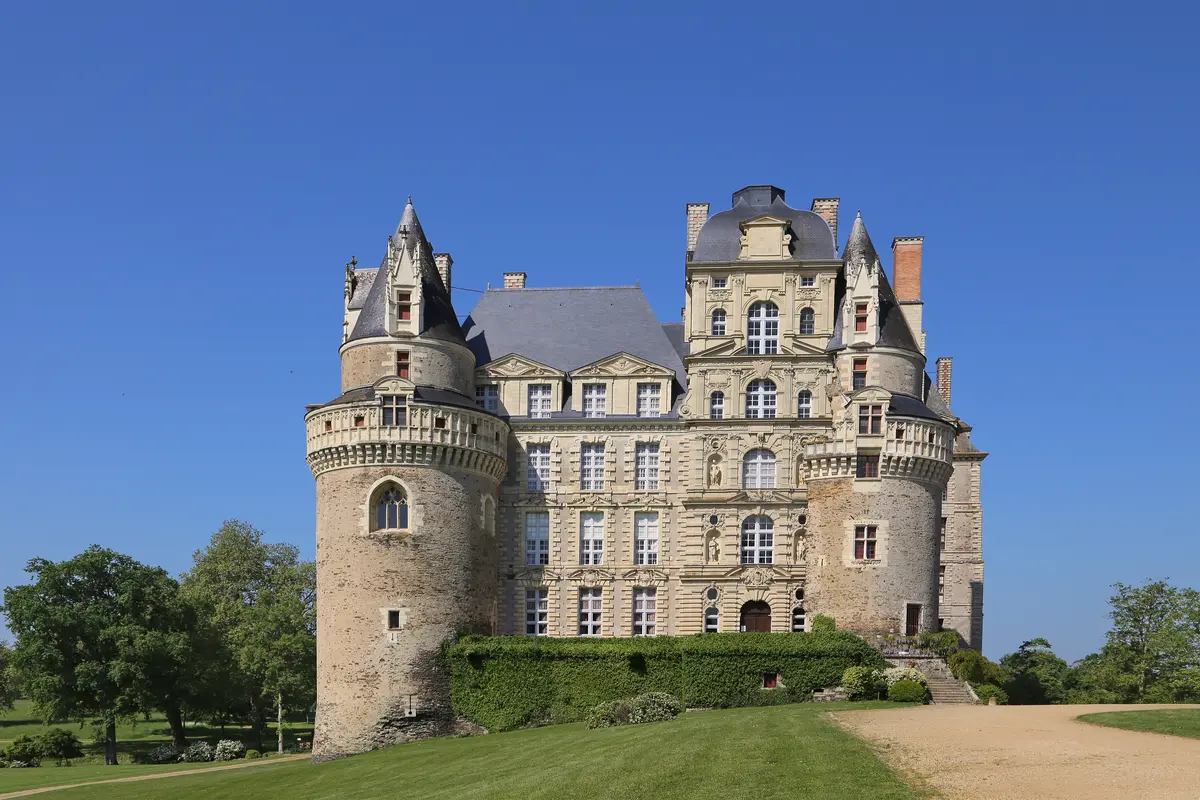
Brissac is the tallest chateau in France, seven storeys and 204 rooms, and it is tall by accident: a new house was begun inside the ruins of the old fortress in 1606 and abandoned unfinished when its builder died in 1621.
Where is Château de Brissac?
- Location
- Maine-et-Loire, France
- Type
- Castle
- Coordinates
- 47.353, -0.45
- Last updated
LOCATION
Why is Château de Brissac said to be haunted?
English-language ghost writing calls its resident spirit la Dame Verte, the Green Lady, and identifies her as Charlotte, natural daughter of Charles VII and Agnes Sorel, killed by her husband Jacques de Brezé. The murder is real and appallingly well documented. A notary of the Chatelet wrote it down at the time, the Parlement fined Brezé 100,000 ecus d'or for it, and the king seized his estates, Brissac among them. But it did not happen here: the contemporary account places it at Rouvres, a village of Brezé's own some 220 kilometres away, and has her buried in the abbey of Coulombs. The name Dame Verte appears nowhere in French before 1999, nowhere in the departmental historian who read the castle's own charters in 1874, and nowhere on the owners' website today.
What is the history of Château de Brissac?
The rock above the Aubance was fortified long before anybody thought of a ghost. Célestin Port, working from the castle's own charter room for his 1874 dictionary of Maine-et-Loire, traces a stronghold raised there by the counts of Anjou to command the crossing of the Angers-Doué road; in 1068 Geoffroy le Barbu and Foulques le Réchin fought over it, and on 11 May 1206 Philippe Auguste besieged it, stayed a day, had it razed and handed the fief to his seneschal Guillaume des Roches.
In 1434 Jean de la Haye-Passavant ceded Brissac to Pierre de Brézé, seigneur de Maulévrier — the date given both by Port and by the family's own published history. Brézé was one of the hard men of the century: minister to Charles VII and later to Louis XI, he sailed from Honfleur in 1457 with four thousand men, landed at Sandwich and brought three shiploads of plunder home, and he was killed at Montlhéry in 1465 covering the king. He rebuilt Brissac, and the two mismatched round towers that still frame the east front are what survives of his castle.
His son Jacques, comte de Maulévrier and grand sénéchal of Normandy, married Charlotte, the natural daughter of Charles VII and Agnès Sorel, born in September 1446. The genealogical literature dates the wedding to 1462; I have not been able to confirm that in an archival document.
What happened between them is not folklore. Jean de Roye, a notary at the Châtelet writing within living memory of it, set the scene down in the journal known as the Chronique scandaleuse. The seneschal had been hunting near "ung village nommé Rouvres, à lui appartenant"; the party came back for supper and to bed. He took one room; his wife took another and, his own maître d'hôtel Pierre l'Apothicaire told him, took with her Pierre de la Vergne, a gentleman of Poitou who was huntsman to the seneschal's own hunt. Brézé fetched his sword, had the door broken in, struck La Vergne through the head and body and then, "depuis qu'il le eut veu mort", gave him a hundred blows more. He found Charlotte in the next room, hidden under the mattress of a bed where his children had been sleeping. He pulled her to the floor by the arm, ran the sword between her shoulders and, as she knelt, twice through the chest. She died at once. He sent her to be buried at the abbey of Coulombs and had La Vergne buried in a garden beside the house.
None of that happened at Brissac. Rouvres is in the Eure-et-Loir, four kilometres from Anet; Coulombs, where she was buried, is a little over twenty kilometres away and about the same distance from Brissac as Rouvres: some 210 to 220 kilometres. Even the date is contested. The manuscript says Saturday 13 June 1476; its editor Bernard de Mandrot argued for 8 June, because in 1476 the Saturday before Trinity fell then; the archivist Douët d'Arcq, whose edition of the criminal file Mandrot cites, preferred 31 May 1477 on the strength of the letters of remission of August 1486 and the defence plea of 3 May 1484. French usage today gives the night of 31 May to 1 June 1477.
What is certain is that the crime was not concealed. Brézé was summoned before the Parlement, held first in the Conciergerie and then in the château de Vernon; Louis XI allowed the case to be tried as a civil matter, and a judgment of 22 September 1481 fined him 100,000 écus d'or. He could not pay, and the king took his lands. This is the only point at which Brissac genuinely touches the murder, and it is a legal one: Port, reading the Brissac charters, records that Louis XI confiscated everything Jacques de Brézé owned and restored it in 1481 to his son Louis on his marriage to Yolande de la Haie-Passavant, and that Louis rendered aveu in 1490 for his "chastel, baronnie et chastellennie de Brochessac". Charles VIII granted the father letters of remission in August 1486. Brissac is not the scene of the crime; it is part of the estate seized because of it.
On 26 May 1502 Louis de Brézé sold the seigneurie to René de Cossé, who took its name. The same family has held it ever since — the present duke is the fourteenth. The land was raised to a county in 1560 and to a duché-pairie in 1611, and in between the Wars of Religion wrecked the fortress: taken and retaken, battered by cannon, held against the royal troops from 12 to 30 August 1590 and again in January 1591.
That ruin is why Brissac looks the way it does. Charles II de Cossé began clearing and building in 1606 with the architects Jacques Dangluze and Corbineau, meaning to raise a tall, richly carved house across the medieval front. He died in 1621 with the work half done and his son Louis stopped it on the spot. The family's own account of the building is the best description of it: "un château neuf à demi construit dans un château vieux à demi détruit" — a new castle half built inside an old one half destroyed. The height record everyone quotes is a by-product of that failure. The central pavilion, the so-called Donjon, stands forty-eight metres, its five storeys carrying the five classical orders in turn, and it wore a five-metre campanile and a four-metre bronze Mercury until 1793; the rectangular pavilion on the north side raises seven storeys above the Aubance. Only one of the two flanking wings was ever built, so the great pavilion sits off-centre and half-hidden behind the cut wall of the north tower.
The rest is peaceful. Marie de Médicis stayed here in the autumn of 1619, and in August 1620 mother and son were reconciled at Brissac after the skirmish at the Ponts-de-Cé. The chapel that the ghost story uses as its stage is real: it opens inside the south-east tower and, according to Port, was decorated by the sculptor David d'Angers in the nineteenth century. The 200-seat Belle Époque opera theatre was the project of Jeanne Say, marquise de Brissac, at the end of that same century.
Timeline: the documented record of Château de Brissac
- 11 May 1206 Philippe Auguste besieges Brissac, spends a day there and has the castle razed, transferring the fief to his seneschal Guillaume des Roches. Célestin Port cites the contemporary formula recorded by the family: venit rex Francorum apud Brachessac in die Ascensionis.
- 1434 Jean de la Haye-Passavant, sieur de Chemillé, exchanges Brissac with Pierre de Brézé, seigneur de Maulévrier, who already held the pond and mills. Port and the owners' own published history give the same year.
- Saturday night, June 1476 or 31 May 1477 Jacques de Brézé kills his wife Charlotte and the huntsman Pierre de la Vergne at Rouvres, a village of his own some 220 km from Brissac. Jean de Roye, a notary at the Châtelet, writes it down almost at once; the manuscript dates it 13 June 1476, its editor Mandrot 8 June, and the criminal file used by Douët d'Arcq points to 31 May 1477.
- 22 September 1481 The Parlement fines Brézé 100,000 écus d'or for the murder. He cannot pay and Louis XI takes his lands; Port records from the Brissac charters that the king restored them the same year to his son Louis de Brézé on his marriage to Yolande de la Haie-Passavant.
- 26 May 1502 Louis de Brézé sells the seigneurie of Brissac to René de Cossé, who takes its name. The same family still lives there; the present duke is the fourteenth.
- 12-30 August 1590 During the Wars of Religion the castle, held for the League by Charles II de Cossé, is battered by cannon and held against the royal troops; it is besieged again in January 1591 and left half ruined.
- 1606 Charles II de Cossé begins building a new house inside the ruin, with the architect Jacques Dangluze and, from 1614, Corbineau, Hutin and Malherbe among the master masons.
- 1621 Charles II dies with the work unfinished and his son Louis stops it on the spot. The east front has stood ever since as the workmen left it, with only one of the two flanking wings built.
- 1874 Célestin Port publishes his article on Brissac, written from the castle's own charters. In about 4,145 words describing the vaults and the feudal oubliettes there is no fantôme, no revenant, no spectre and no Dame Verte, while the same volume uses légende 74 times elsewhere.
- 1999 Guy Tarade prints one sentence on the Dame Verte of Brissac and credits it to the journalist Guillaume Hanoteau, who died in 1985. It is the oldest datable appearance of the name in French that this research could fix.
- 4 October 2013 Wesley McDermott's list on hauntedrooms.co.uk is captured by the Internet Archive with the English formula already fixed: the green dress, the tower room of the chapel, the ruined face and the moans at dawn. Everything written in English about Brissac since then repeats it.
- 2 April 2014 An editor files the English Wikipedia article under Category:Reportedly haunted locations in France with the edit summary “/* External links */” and no source. On 8 September 2020 another editor removes it with the summary “Not in article”. In 178 revisions the article itself never says ghost, green lady or Charlotte.
Is there a rational explanation for Château de Brissac?
The crime is documented to the day, the courtroom and the fine. The haunting is documented nowhere, and the two are more than two hundred kilometres apart.
Start with the man best placed to have heard the story. Célestin Port had the Brissac charters in front of him; his 1874 article on the town and the castle runs to about 4,145 words, describes the vaulted cellars and the feudal oubliettes, and contains the words fantôme, revenant, spectre, apparition and "dame verte" exactly zero times. The control matters: in the same article château appears 13 times, Cossé 11, Brézé 4 and tour 7, and the vocabulary is alive elsewhere in the same volume — légende 74 times, hant- 40, revenant 10. He was not squeamish about ghosts; there was simply no ghost at Brissac to write down.
The name is younger than it looks, and it is not French. In 260 revisions of the French Wikipedia article, from 2004 to 2026, the phrase "dame verte" appears not once. The ghost enters that article on 11 August 2011, in a single unsourced sentence added by an anonymous IP address, and what it describes is a dame blanche — a white lady, seen on stormy nights — with the murder placed at the castle and dated 1 March 1462, which is not the murder date at all but the traditional wedding date. Another editor corrected the date to 1477 ten years later, citing a different Wikipedia article.
The English article never carried the story either. Across all 178 revisions from 2002 to 2026 the words ghost, green lady and Charlotte give zero. The only paranormal trace is administrative: on 2 April 2014 an editor filed the article under "Category:Reportedly haunted locations in France" with the edit summary "/* External links */" and no source, and on 8 September 2020 another editor removed it with the summary "Not in article". A one-line claim in 2012 — "People say that it's haunted!" — was reverted within twenty-four hours.
The oldest printed appearance in French I have been able to date is a single sentence in Guy Tarade's Les nouveaux dossiers de l'étrange (Ramuel, 1999, p. 72), and Tarade does not claim to have found it in an archive: he credits it to the journalist Guillaume Hanoteau, who died in 1985. So what can be dated is not a document but a conversation about one. Tarade also has Charlotte "égorgée", her throat cut, which is not what the fifteenth-century chronicle describes.
The fixed English wording, the one that ends up everywhere, can be dated more precisely. Wesley McDermott's list "21 Most Haunted Places in the World" on hauntedrooms.co.uk has been in the Internet Archive since 4 October 2013, and it already contains the whole package: the tallest castle in France, a double murder "within the walls of the castle", "la Dame Verte, or 'Green Lady'", the Duke's family grown used to her, the sighting "in the tower room of the chapel, wearing her green dress", a face with gaping holes where the eyes and nose should be, and moans heard in the early hours. The same paragraph is reprinted, credited to McDermott, on great-castles.com. Two of its factual claims are simply wrong — the murder was not committed at Brissac, and the castle was not rebuilt in 1502 by Charles II, who was born about half a century later.
The walled-up skeleton with the crushed skull that circulates in Spanish and English has no source at all. It is absent from Jean de Roye, from Port, from the owners' own history and from Tarade, where a search for emmur- returns zero against two hits for squelette elsewhere in the same book. It appears only on ghost blogs, and in mutually incompatible versions — one of them dresses the skeleton in white and dates the discovery to the 1930s.
The owners are the interesting witness, because they neither deny it nor sell it. Their history page does mention the ghost, and hedges it twice in one sentence: Charlotte's memory "and perhaps the ghost" of her, who "perhaps" returns to wander on feverish nights. They never call her the Green Lady, they call her blonde, and they put no colour on her at all. Nor is there a ghost tour at Brissac. What the castle actually sells after dark is a costumed family evening: in October 2007 a candlelit night visit at 7.50 euros for adults and 2 for children, and in October 2026 the second edition of "Feu d'artifice et chandelles", with fireworks, a candlelit musical tour, Cinderella waltzing with her prince and sweets thrown by Belle, at 18.50 euros. The green dress is not on the programme.
One negative result should be declared rather than used: Google Books returned HTTP 429, daily quota exhausted, for the search term and for the control alike throughout this research, so nothing follows from its silence.
Can you visit Château de Brissac?
Brissac is a lived-in house that opens to visitors, not a museum and not a ruin. The address is 1, rue Jeanne Say, 49320 Brissac Loire Aubance, about twenty kilometres south of Angers; the nearest TGV station is Angers Saint-Laud, and bus line 405 from Angers stops at Brissac Quincé, rue de l'Aubance. Car and camper parking is 150 metres from the ticket office.
The 2026 season runs in four blocks. From 7 February to 20 March and again from 9 November to 3 January, afternoons only, 14:00 to 17:30, closed Mondays and Tuesdays, with the last ticket and the last entry at 16:30. From 21 March to the end of June and from 1 September to 8 November, every day except Tuesday, 10:00 to 13:00 and 14:00 to 18:00, last entry at 12:00 and 17:00 respectively. In July and August it opens every day, 10:00 to 18:00, last entry 17:00. It is closed on 25 December and 1 January. The same hours are read out on the answering machine at +33 2 41 91 22 21.
Tickets are sold on site only and there is no booking; the château states plainly that reserving is not necessary. Full adult admission is 13.50 euros, reduced 11.50 (students, disabled visitors, jobseekers, CEZAM and Pass Loisirs holders), children from 7 to 16 inclusive 5 euros, under 7 free, and the landscape park on its own 6 euros. Admission covers the house, the park walks and a presentation and tasting of the estate wines in the stone-vaulted cellar. The visit is self-guided but documented, with regular talks on the façades, the ground-floor rooms and the family history; allow about an hour and a quarter. Cash, cheques, Visa, Mastercard, Amex, Chèques Vacances, Pass Patrimoine Pays de la Loire and Chèques Culture are accepted.
Accessibility is honest on the castle's own page and worth reading before you go. There are eight metres of unavoidable cobbles to reach the ticket office and twenty-three steps with a handrail up to the entrance perron; the interior lift is small, 80 by 100 centimetres. The main way into the park is a slope of about ten per cent and a paved gutter, after which the circuit, the stables and the packed-earth avenues along the Aubance are accessible, and the tea room at the park entrance is fully accessible with adapted toilets. Dogs are allowed in the park on a lead at all times; only small dogs carried in arms or in a bag may go inside. Photography is allowed indoors without flash.
There is no ghost tour and no night investigation on sale. The events that do run are a hot-air balloon meeting in the park in August, the Journées du Patrimoine in September — when the ducal mausoleum on the hill and the roof timbers open, at a single reduced rate of 11.50 euros, free under 18 — a spring flower show, and in late October the candlelit fireworks evening described above, 19:00 to 22:30, 18.50 euros for adults and 13.50 for ages 5 to 16, booking required. The Christmas market, long the oldest in western France, is cancelled for 2026.
Guest rooms are available in the castle itself from 15 April to 15 October, from 590 euros for one or two people including breakfast and the visit; booking is by email only, arrival between 15:00 and 19:00, departure before 11:00. Anyone hoping for the tower room and a green dress should know what they are paying for: an eighteenth-century bedroom with seventeenth-century tapestries, in a family house, with no ghost programme attached.
Sources consulted
- Jean de Roye; éd. Bernard de Mandrot, «Journal de Jean de Roye, connu sous le nom de Chronique scandaleuse, 1460-1483, tome second (pp. 46-47 et note de l'éditeur)» — Société de l'Histoire de France, Librairie Renouard, Paris, 1896 book
- Célestin Port, «Dictionnaire historique, géographique et biographique de Maine-et-Loire, art. « Brissac », t. I, pp. 540-543» — P. Lachèse, Belleuvre et Dolbeau, Angers, 1874 book
- Château de Brissac, «Histoire du château de Brissac (récit publié par la famille de Cossé-Brissac)» — brissac.net, 2026 report
- Château de Brissac, «Horaires et tarifs 2026, plan et accès, chambres d'hôtes et événements» — brissac.net, 2026 report
- Guy Tarade, «Les nouveaux dossiers de l'étrange : enquêtes au-delà du réel, p. 72» — Ramuel, Villeselve, 1999 book
- Wesley McDermott, «21 Most Haunted Places in the World (capture du 4 octobre 2013)» — HauntedRooms.co.uk / Internet Archive, 2013 web
- Wikipedia contributors, «Château de Brissac: revision history, 178 revisions, 2002-2026 (category added 2 April 2014, removed 8 September 2020)» — English Wikipedia, 2026 archive
- Contributeurs de Wikipédia, «Château de Brissac : historique des versions, 260 révisions, 2004-2026 (fantôme ajouté le 11 août 2011, révision 68332819)» — Wikipédia en français, 2026 archive
Reviewed by V. Serrano on 2026-08-21 · How we verify our content
💬 Field testimonies (0)
No testimonies yet. Add the first.
Add your testimony
🔒 Log in to add a testimony