👻 HAUNTED PLACE · EXP. Nº9474
ACTIVE
Château de Trécesson
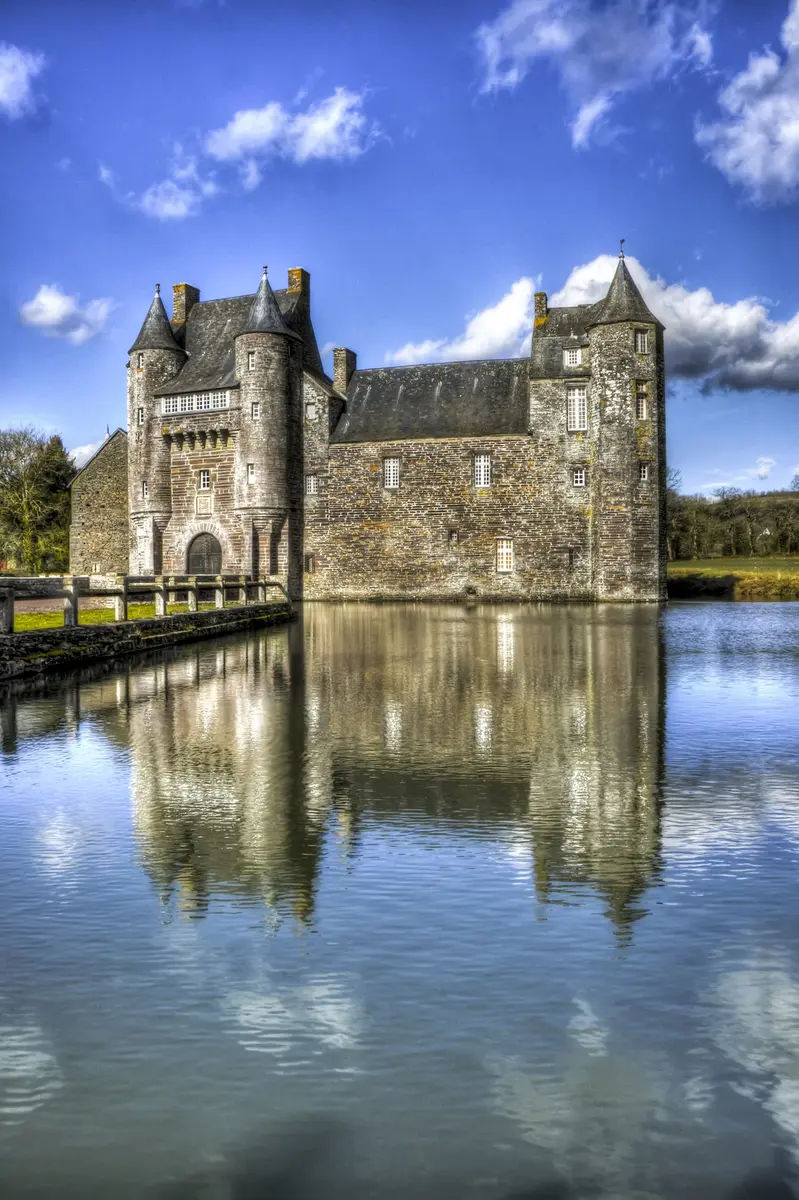
The Château de Trécesson sits in its own pond at Campénéac, on the edge of the Paimpont forest that Brittany calls Brocéliande, and its schist walls have stood there since the fifteenth century.
Where is Château de Trécesson?
- Location
- Brittany, France
- Type
- Castle
- Coordinates
- 47.976, -2.274
- Last updated
LOCATION
Why is Château de Trécesson said to be haunted?
The story attached to it is the Bride of Trécesson: a young woman in a white silk gown, buried alive at night in the park by two men she addressed as her brothers, dug out again after a poacher raised the alarm, and dead the moment she saw daylight. It was printed for the first time in 1824, in the Nantes review Le Lycée armoricain, by an anonymous writer who said he had it from the castle's old gatekeeper — and it was never a nameless folk memory, because that same text admits nobody ever learned who she was. The wedding gown, bouquet and crown displayed on the chapel altar until the Revolution were long treated as proof; in 1894 a canon of Vannes proposed instead that they were an ex-voto and that the tale had been built to explain them. The White Lady seen on the moat is a later arrival still: traceable in print only from 1932.
What is the history of Château de Trécesson?
The castle is a great deal older than its ghost, and its documented history is stranger than the one this entry used to tell.
The Trécesson family is on record in the parish from the thirteenth century, and the heritage inventory notes that a Jean de Trécesson was constable of Brittany between 1370 and 1380. The regional heritage inventory dates the southern front and the gatehouse to the end of the fourteenth century and attributes them, on stylistic grounds, to a Jean de Trécesson who served as chamberlain to Duke John IV of Brittany; most of what stands today is fifteenth century, with the wings recast in the sixteenth and altered again in the seventeenth. The Mérimée notice describes the fabric in one flat sentence worth quoting, because almost everything written about Trécesson says the opposite: "La construction est entièrement en schiste, sans aucune décoration." Inside there is a vaulted room whose walls, the same notice says, are reported to carry painted decoration, plus Louis XIII and Louis XIV panelling.
Around 1440 the last heiress of the name, Jeanne de Trécesson, married Éon de Carné; he and his son François took up the name and the arms of Trécesson and rebuilt the house. The fief was raised to a county in 1681. In 1773 the last woman to carry the name, Agathe de Trécesson, married René-Joseph Le Prestre, count of Châteaugiron, and in 1793 Le Prestre sold the place to Nicolas Bourelle de Sivry, paymaster general of the armies.
It is at exactly that moment that Trécesson acquires the one fugitive it can actually document. In June 1793 the Girondin deputy Jacques Defermon (1752-1831), proscribed after signing a protest against the exclusion of his group from the Convention, went to ground here and stayed hidden for more than a year. Between 1814 and 1830 the estate served as the agricultural school of the département. It then passed by inheritance to the Perrien de Crenan, the Montesquieu and finally the Prunelé, who held it into the twenty-first century.
In April 2022 the Prunelé sold. The buyers, Rommé and Stéphanie de Saint Léon, live in the house; on their fundraising page they say they are each descended from a different branch of first cousins of the builder Jean de Trécesson, and that the sale came about because "une gestion en indivision devenait trop problématique". They opened the grounds to paying visitors that same July, at five euros a head. The outbuildings opened that first summer were the ones the 2012 and 2014 decrees list: the entrance and honour courts, the dovecote, the bread oven, the washhouse, the kitchen garden and the chapel.
The protection is later, and far more partial, than the round "listed since 2012" that circulates in English. The Mérimée notice reproduces the terms of the decrees and is legally binding, and it records two separate acts. An inscription of 11 September 2012 covers the domain outside the water: the outbuildings of the entrance court, the barn and sheepfold, the bread oven and a schedule of land parcels. A classement of 28 May 2014 — the higher of the two French grades — covers the garden pavilion, the dovecote, the moats themselves, and every building and piece of ground within the moat, hall and chapel included. The silhouette everybody photographs was raised to the higher grade in 2014, not in 2012. The owners' own appeal page states that the whole site inside the moat has been classified since 1922; the Mérimée notice, last revised on 4 March 2026, carries no such date, and I have not been able to reconcile the two.
Timeline: the documented record of Château de Trécesson
- 1370-1380 A Jean de Trécesson is constable of Brittany, according to the regional heritage inventory, which also credits a chamberlain of the same name to Duke John IV with the oldest surviving parts of the castle.
- Late 14th century The regional heritage inventory dates the southern front and the gatehouse to this period and attributes them, on stylistic grounds, to a Jean de Trécesson, chamberlain to Duke John IV of Brittany.
- c. 1440 Jeanne de Trécesson, last heiress of the name, marries Éon de Carné; he and his son François take up the name and arms of Trécesson and rebuild the castle.
- 1773 Agathe de Trécesson marries René-Joseph Le Prestre, count of Châteaugiron, and the estate passes out of the family.
- June 1793 Le Prestre sells to Nicolas Bourelle de Sivry, paymaster general of the armies. In the same year the proscribed Girondin deputy Jacques Defermon takes refuge in the castle and stays hidden for more than a year.
- 1814-1830 Under the Restoration the estate serves as the agricultural school of the Morbihan département.
- 1824 The story is printed for the first time: an anonymous author signing "A." publishes "Le château de Trécesson" in Le Lycée armoricain, saying he had it from the castle's old gatekeeper. The text ends by admitting that the young woman's name was never learned.
- 1843 The Ogée dictionary, in the edition revised by Marteville and Varin, records at the Campénéac entry that a wedding gown, a bouquet and a bridal crown were displayed on the chapel altar before 1789 — the first time the tale appears in a work of reference rather than a literary review.
- 1847 François-Marie Cayot-Delandre reprints a version close to the 1824 text in his survey of the Morbihan, but claims to have heard it himself in the country around Campénéac.
- 1885 Gustave de Closmadeuc, in his eulogy of Armand du Châtellier, records the old man telling the story at 88 with a different culprit: a husband who buried his young wife alive in a fit of jealousy.
- 1894 Canon Joseph-Marie Le Mené becomes the first author to doubt the story in print: the objects in the chapel were "une offrande, un souvenir, ou un ex voto de quelqu'une des châtelaines", and the burial tale was built by people who like the marvellous and the tragic.
- 1897 Paul Sébillot prints the legend in the Revue des traditions populaires under "Les petites légendes locales" — reproducing the 1843 dictionary entry rather than a field collection.
- 15 March 1914 Clément Rochel publishes "La Dame de Trécesson" in L'Ouest-Éclair's weekly short-story slot, moving the disappearance to the thirteenth century with a lord named Artus and a bride named Jeanne-la-Crollée. The piece is still quoted as the legend's historical basis.
- 1932 Charles Le Goffic, in Brocéliande, gives what appears to be the earliest datable printed mention of a White Lady around the moat, and the first record of young women touching the gown to find a husband within the year — 108 years after the tale first reached print.
- 1961 Jean Markale retells the story as a local folk tale under the title that has stuck ever since, "La dame blanche de Trécesson". In 1977 he adds that no trace of the events survives in period documents.
- 11 September 2012 The domain outside the moat — outbuildings, barn and sheepfold, bread oven and a schedule of parcels — is inscribed as a monument historique by decree.
- 28 May 2014 A second decree classes at the higher grade the garden pavilion, the dovecote, the moats and everything within them, hall and chapel included. This, not 2012, is when the castle itself gained the top level of French protection.
- April 2022 The Prunelé family sells. Rommé and Stéphanie de Saint Léon move in and open the grounds to the public that July at 5 €, cash only.
- 18 March 2024 The owners sign a patronage agreement with La Demeure Historique to restore a stained-glass window in the chapel: 9,362.69 € including tax, funded half by donors and half by the regional cultural affairs directorate, with the work carried out in the second half of 2024.
Is there a rational explanation for Château de Trécesson?
Begin with the question the old version of this entry never asked: who was she? The answer is that nobody ever knew, and the oldest text says so outright.
The first printed version appeared in 1824 in Le Lycée armoricain, a Nantes literary review. Its author signed only "A." and stated where he got it: "Le voici tel qu'un vieux concierge me l'a raconté" — this is how an old gatekeeper told it to me. In that text a poacher up a tree watches a carriage drawn by two black horses; servants dig a pit; two gentlemen drag out a young woman in a white silk gown, crowned with flowers and holding a bouquet, who begs them as her brothers and is answered that she has ceased to belong to a family she dishonours. She is thrown in and covered over. The poacher does not intervene; it is his wife who calls him a coward and makes him go to the castle. M. de Trécesson has her dug out, and she sighs once and dies. And then, at the end, the sentence that settles the matter: "on ne put savoir ni le nom de cette jeune dame qui avait disparu d'une manière si étrange, ni la cause du sort cruel qu'on lui avait fait subir". There is no name to look for in a parish register, because the story was published without one, and the culprits are not stable either — in 1885 Gustave de Closmadeuc recorded the aged Armand du Châtellier telling it with a jealous husband instead of the brothers.
The chronology does not hold up either. Later tellers place the events between roughly 1740 and 1760; the first printing is 1824, sixty to eighty years afterwards. Jean Markale, who retold the tale twice and believed it rested on a real incident, conceded in 1977 that "on n'en trouve aucune trace dans les documents d'époque".
What did exist, and can be dated, are the objects. A wedding gown, a bouquet and a bridal crown were shown on the altar of the castle chapel until the Revolution; the Ogée dictionary, in the 1843 edition revised by Marteville and Varin, records them at the Campénéac entry as the material proof of the tale. The first writer to reverse the reasoning was Joseph-Marie Le Mené, canon of Vannes cathedral, in the second volume of his parish history of the diocese (1894). He described the same three objects and wrote: "C'était une offrande, un souvenir, ou un ex voto de quelqu'une des châtelaines. Mais le peuple, qui aime le merveilleux et le tragique, prétend que c'était la dépouille d'une jeune femme, enterrée vivante." On that reading the legend was built to explain the relics; the relics never proved the legend.
The ghost is later still, and dating it is the correction this entry most needed. Nothing in the 1824 article, in Ogée, in Aurélien de Courson's 1865 summary or in Le Mené says that anyone had seen anything at Trécesson. The earliest printed mention of a White Lady around the moat that I have been able to date is Charles Le Goffic's Brocéliande, written in 1932, the year of his death: a hundred and eight years after the tale first reached print, and more than a century after the relics had gone. Le Goffic himself writes it at second hand — "les gens du pays racontent que certaines nuits la silhouette fantomatique d'une dame blanche flotte autour des douves" — and it is he who first records young women touching the dress to find a husband within the year. Jean Markale gave the story its now standard title, "La dame blanche de Trécesson", in 1961. (These passages are transcribed, with page references, in the dossier the Encyclopédie de Brocéliande devotes to the legend, which is the fullest published account of its transmission.)
The "historical basis" sometimes bolted onto it is weaker than the legend. It comes from Clément Rochel, who in 1914 published a version that moved the disappearance back to the thirteenth century, with a lord called Artus and a bride called Jeanne-la-Crollée — in L'Ouest-Éclair, in the weekly slot headed "Un conte par semaine", the paper's short-story column. A text written for a fiction page now circulates as archive.
Nor is the transmission as folkloric as it looks. Paul Sébillot, the most cited authority on the popular traditions of Brittany, printed the legend in 1897 in the Revue des traditions populaires under "Les petites légendes locales" — but what he printed was the 1843 dictionary entry, near enough word for word. The great collector did not collect this one.
Finally, the incentive, stated fairly in both directions. Trécesson is a private house that has charged admission since 2022 — fourteen euros guided, nine unguided in 2026 — and it does trade on the story: there is a "Légendes" page on the website, a Contes et légendes oubliés volume in the shop, a murder party, a storytelling evening, and the owners' own appeal on the Demeure Historique site opens on "Sa dame blanche, qui vient danser par soir de pleine lune". But they do not overclaim, and that is worth saying because our own text did. Their wording is hedged throughout — "Certains disent qu'une silhouette vêtue de blanc erre dans la nuit", "auraient", "on murmure" — where this entry had asserted flatly that generations of residents had reported seeing her. And the holographic figure included in the ticket is not the White Lady at all: it is a refugee of the Revolution telling his own story, which is to say Defermon, the only ghost at Trécesson with an archive behind him.
Can you visit Château de Trécesson?
Trécesson is a private, inhabited house, and that is the first thing to know: there is no year-round access and no right to wander in.
The address is simply Trécesson, 56800 Campénéac, in the Morbihan, about three kilometres from the village and on the edge of the Coëtquidan military training area; the D312 runs past. The 2026 season announced by the Brocéliande tourist office runs from 1 July to 31 August, Monday to Saturday 11:00-17:30 and Sunday 15:00-17:00, with occasional openings at other times.
Two formulas are sold. The guided tour costs 14 € for adults and 9 € at the reduced rate, with departures every hour and groups capped at eighteen people; booking ahead is strongly advised and is done online through the castle's ticketing. The self-guided visit costs 9 € and 6 €, and gives access to six rooms plus the holographic sequence. Under-sixes go free in both. The reduced rate applies to children from 6 to 12, large families, disabled visitors, students and the unemployed. Group-only "VIP" visits, led by one of the owners, are offered in September and from April to June.
Two practical warnings that catch people out. The on-site ticket desk does not take cards — bring cash. And there is no step-free provision: the owners state plainly that "nous ne disposons pas d'accès PMR, les circuits de visite ne sont pas adaptés aux personnes à mobilité réduite", which for a fifteenth-century building with spiral stairs and cobbled courts is not a surprise but does need planning for. There is a car park facing the castle. Dogs are allowed on a lead in the forecourt only, not on the visit routes.
Around the ticketed tour the owners run a programme: falconry displays, a murder party, a "Fête médiévale légendaire", temporary exhibitions, and a heritage riddle trail across five local sites for which the booklet costs one euro. Outside the season the building can still be seen and photographed from the public dike beside the pond, which is where most of the well-known views are taken from — the moated silhouette is the point, and it is free.
If you want to see the room the legend actually concerns, ask about the chapel. Its stained glass was restored in the second half of 2024 under a patronage agreement signed in Paris on 18 March 2024 between the owners and La Demeure Historique: 9,362.69 € including tax, half from donors and half from the regional cultural affairs directorate, executed by a glass restorer at Durtal and a joiner at Augan. It is the same chapel on whose altar the bride's gown, bouquet and crown were said to have stood until the Revolution.
Sources consulted
- Anonyme (signé « A. »), «Le château de Trécesson» — Le Lycée armoricain, vol. 4, p. 5-9, 1824 book
- Encyclopédie de Brocéliande, «La Mariée de Trécesson» — Encyclopédie de Brocéliande (association, Paimpont) — dossier et transcriptions, 2026 academic
- Joseph-Marie Le Mené, «Histoire archéologique, féodale et religieuse des paroisses du diocèse de Vannes, vol. 2» — Vannes, Imprimerie Galles, 1894 book
- Jean-Baptiste Ogée, rév. A. Marteville et P. Varin, «Dictionnaire historique et géographique de la province de Bretagne, vol. 1 (article Campénéac), p. 136» — Rennes, Molliex, 1843 book
- Paul Sébillot, «Les petites légendes locales» — Revue des traditions populaires, vol. 12, p. 140, 1897 academic
- Charles Le Goffic, «Brocéliande» — 1932 ; rééd. Terre de Brume, coll. Bibliothèque celte, 1995, 1932 book
- Clément Rochel, «La Dame de Trécesson» — L'Ouest-Éclair, 15 mars 1914, p. 11, rubrique « Un conte par semaine », 1914 newspaper archive
- Gustave Thomas de Closmadeuc, «Éloge de M. du Châtellier» — Bulletin de la Société polymathique du Morbihan, p. 71-92, 1885 academic
- François-Marie Cayot-Delandre, «Le Morbihan, son histoire et ses monuments, p. 310-314» — Vannes, A. Caudéran, 1847 book
- Jean Markale, «Contes populaires de toutes les Bretagne, p. 127-133» — Rennes, Ouest-France, 1977 book
- Ministère de la Culture, «Domaine du Château de Trécesson — notice PA00091072» — Base Mérimée / Plateforme ouverte du patrimoine (notice révisée le 4 mars 2026), 2026 archive
- Inventaire général du patrimoine culturel de Bretagne, «Château de Trécesson (Campénéac) — dossier IA00010308» — Région Bretagne, patrimoine.bzh, 2026 archive
- La Demeure Historique ; Rommé et Stéphanie de Saint Léon, «Convention de mécénat n° 2024-683 R passée pour le château de Trécesson» — Convention signée à Paris le 18 mars 2024 (7 p., annexes de travaux et de financement), 2024 report
- Rommé et Stéphanie de Saint Léon, «Site officiel du château de Trécesson (pages Visite, Légendes, Activités et FAQ)» — chateaudetrecesson.com, 2026 web
- Les Infos du Pays Gallo, «Campénéac. Le château de Trécesson se visite cet été» — Les Infos du Pays Gallo, 10 juillet 2022, 2022 newspaper archive
- Destination Brocéliande, «Château de Trécesson (Campénéac) — fiche de l'office de tourisme» — Office de tourisme de Brocéliande (saison 2026 : 1er juillet - 31 août), 2026 web
- La Demeure Historique, «Château de Trécesson — collecte pour la restauration du vitrail de la chapelle» — demeure-historique.org, collecte terminée, 2024 web
- Guide de Brocéliande, «Le château de Trécesson» — broceliande.guide — histoire, propriétaires successifs et informations de visite, 2026 web
Reviewed by V. Serrano on 2026-08-17 · How we verify our content
💬 Field testimonies (0)
No testimonies yet. Add the first.
Add your testimony
🔒 Log in to add a testimony