👻 HAUNTED PLACE · EXP. Nº8141
ACTIVE
Château de Montségur
Montségur was the last stronghold of the Cathar church, and the ruin that crowns its Pyrenean peak is not it.
Where is Château de Montségur?
- Location
- Ariège, France
- Type
- Castle
- Coordinates
- 42.876, 1.832
- Last updated
LOCATION
Why is Château de Montségur said to be haunted?
After a ten-month siege led by the king's seneschal at Carcassonne and the archbishop of Narbonne, the garrison capitulated at the beginning of March 1244; on 16 March the fortress was handed over and those who would not abjure — about two hundred perfecti and perfectae, 225 according to the chronicle of the abbey of Berdouès — were burned in the field at the foot of the mountain, the Prat dels Cremats. The victors then built a new royal fortress on top of the ruined Cathar village of houses and terraces, and those are the walls visitors climb to today: in July 2026 UNESCO listed them as thirteenth-century royal military architecture. On the night before the pyre four perfecti were lowered down the cliff on a single rope to save the church's money, which two others had already smuggled out at Christmas. That is not legend but sworn testimony taken by the inquisition, and it is the seed of a Grail industry running from Napoléon Peyrat in 1870 through Joséphin Péladan in 1906 to Otto Rahn in 1933. Montségur has no ghost. It has an archive.
What is the history of Château de Montségur?
Montségur is not one castle but three, and only the third is standing.
The first fortification, of unknown origin, was already a ruin around 1200. Questioned by the inquisitor Ferrier on 30 April 1244, the lord of the place, Raymond de Péreille, said that he had rebuilt the castrum "forty years and more" earlier — so about 1204 — and that he had done it at the pressing request of the Cathar perfectus Raymond Blasco and of the Cathar deacon of Mirepoix. That second Montségur was a walled village, not a keep. The inquisition registers describe a score of houses named after the perfectus or perfecta who ran each one, workshops, passages narrow enough that the scribes still called them carrieras, a seigneurial lodging with its own tower, a barbican and an outwork on the Roc de la Tour at the eastern end of the ridge.
In 1232 the Cathar bishop Guilhabert de Castres asked Raymond de Péreille to make the place the domicilium et caput — the seat and head — of a church that was by then illegal. For twelve years it was exactly that. Working from the registers, Michel Roquebert counts more than a thousand people who passed through Montségur in its forty years, and puts the besieged population of 1243-1244 at a minimum of 361: 150 lay people including the garrison, and 211 perfecti and perfectae. Nobles there worked with their hands, because the Cathar rule required it. There was a miller who was a perfectus and a baker who was a perfecta, sewing workshops run by women, carpenters, a barber, and an engineer for the catapults.
In May 1243 Hugues des Arcis, the king's seneschal at Carcassonne, and Pierre Amiel, archbishop of Narbonne, laid siege. It lasted ten months. Shortly before Christmas 1243 a party of Gascons climbed the eastern cliff by night and took the Roc de la Tour; from there the attackers still needed some seven weeks to fight their way along eight hundred metres of ridge, and the iron bolt-heads and stone catapult balls scattered over that crest are still the physical record of it. Around the same Christmas the perfectus Matheus and the deacon Pierre Bonnet slipped out with "gold, silver and an infinite quantity of coin" and hid it in a fortified cave of the Sabarthès. The sergeant Imbert de Salas told the inquisitors so, and named the sentries from Camon — local men serving in the besieging army — who showed them the way through.
Pierre-Roger de Mirepoix, who commanded the garrison, negotiated the surrender at the beginning of March 1244: life for the soldiers and lay people, pardon for any perfectus who abjured, and a truce of fifteen days for those who would not. On the night of 15 to 16 March four perfecti — Amiel Aicart, Hugo, Poitevin, and a fourth whose name the depositions never give — were lowered down the precipice on a single rope. Arnaud-Roger de Mirepoix told the inquisitors what for: so that the church of the heretics should not lose the treasure that was hidden in the woods. On 16 March the fortress was handed over, and those who refused to abjure were burned at the foot of the mountain.
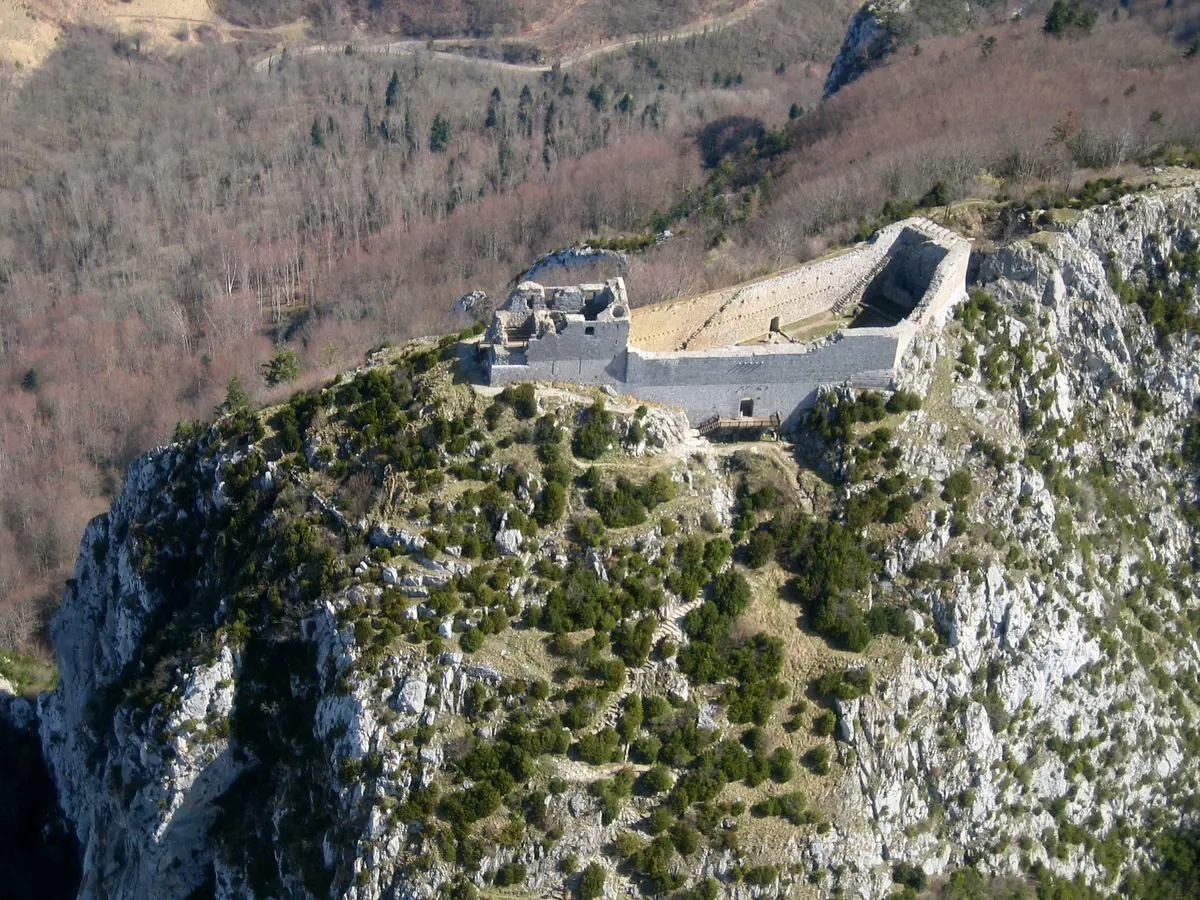
The king granted the site to Guy II de Lévis, lord of Mirepoix. He did not repair the castrum: he threw a new fortress on top of it, a rectangular keep of twenty metres by nine inside an irregular polygonal enclosure of roughly eighty by twenty-five, pierced with seven archères. That is what visitors climb to today. A royal garrison held it until the seventeenth century, and the village below was built in part out of its stones.
Timeline: the documented record of Château de Montségur
- c. 1204 Raymond de Péreille rebuilds a ruined castrum at the top of the pog. He dates it himself under interrogation on 30 April 1244 — 'forty years and more' — and says he did it at the request of the perfectus Raymond Blasco and the Cathar deacon of Mirepoix.
- 1232 The Cathar bishop Guilhabert de Castres asks that Montségur be made the domicilium et caput of his church. From then until 1244 more than two hundred perfecti and perfectae live on the mountain.
- May 1243 Hugues des Arcis, seneschal of Carcassonne, and Pierre Amiel, archbishop of Narbonne, lay siege. Roquebert puts the besieged at a minimum of 361 people: 150 lay, including some ninety-five fighting men, and 211 religious.
- Before Christmas 1243 A party of Gascons climbs the eastern cliff at night and takes the Roc de la Tour, the outwork that held the ridge. Around the same days the perfectus Matheus and the deacon Pierre Bonnet carry 'gold, silver and an infinite quantity of coin' out of the castrum and hide it in a fortified cave of the Sabarthès — told by the sergeant Imbert de Salas to the inquisitors.
- Early March 1244 Pierre-Roger de Mirepoix negotiates the capitulation: life for soldiers and lay people, pardon for any perfectus who abjures, and a truce of fifteen days. During that truce the perfecti hand over more than a thousand sous to the garrison and its commander.
- Night of 15-16 March 1244 Four perfecti — Amiel Aicart, Hugo, Poitevin and one unnamed — are lowered down the precipice on a single rope. Arnaud-Roger de Mirepoix tells the inquisition why: so that the church of the heretics should not lose the treasure hidden in the woods.
- 16 March 1244 The fortress is handed over and those who refuse to abjure are burned at the foot of the mountain. The chronicle of the abbey of Berdouès gives 225; Guillaume de Puylaurens about 200; Guillaume Pelhisson 210. No source counts them.
- 1245 The king grants the site to Guy II de Lévis, lord of Mirepoix. Instead of repairing the castrum he builds a new fortress on top of it — the walls that stand today — as part of the royal frontier system facing Aragon.
- 1862 The ruin is listed as a monument historique. A second listing follows in 1989, and the surroundings are protected as a classified natural site in 2001.
- 1870-1872 Napoléon Peyrat publishes Histoire des Albigeois. Working from the same inquisition copies, he invents the underground network, relocates the treasure cave to Ornolac and then Lombrives, and places Esclarmonde de Foix — dead around 1215 — at Montségur. Michel Roquebert calls the treasure the hinge on which Peyrat swings from documented history to pure invention.
- 1906 Joséphin Péladan asks in Le Secret des troubadours whether 'Monsalvat has not a real name, Monségur' — the earliest printed statement of the Grail claim I have been able to fix to a page. He credits it to the poet P.-B. Gheusi, whose drama Monsalvat is set at Montségur.
- 1933 Otto Rahn, who had been living at Ornolac-Ussat-les-Bains since 1931, publishes Kreuzzug gegen den Gral; the French translation by Robert Pitrou follows in 1934. He joins the SS afterwards, not before.
- 1967 Sylvain Stym-Popper, architect of the 1948-1952 restoration, tells Archeologia that the soundings prove there is beneath Montségur 'not the least tunnel, not the least cave, not the least possibility of a tunnel or a cave'.
- 1998 An archaeological sounding at the south doorway shows that the medieval threshold stood 3.85 metres above the ground level of its time, removing the basis of Fernand Niel's solar temple.
- 26 July 2026 The World Heritage Committee, meeting in Busan, inscribes the royal fortresses of Languedoc — Montségur among the eight — on the UNESCO World Heritage List, for thirteenth-century royal military architecture. Seven weeks earlier, on 8 June, a multi-year consolidation of the castle had begun.
Is there a rational explanation for Château de Montségur?
Start with what the photograph shows, because that is the whole problem. The walls on the crest are not the Cathar fortress. They are what the archaeologists call Montségur III, raised in the second half of the thirteenth century by the winners as one link in the royal frontier system facing Aragon. The French heritage register dates the keep to that period; the final report of the G.R.A.M.E., which dug the site from 1964, states that nothing survives inside the present ruin either of Montségur I or of the castrum that Raymond de Péreille rebuilt at the start of the thirteenth century. Reviewing that report in 1982, Charles Higounet wrote that its purpose was to clear away "the myth of the prestigious Cathar fortress" that a century of unbridled literature had pushed to the point of absurdity. On 26 July 2026 UNESCO inscribed Montségur on the World Heritage List — as one of the eight royal fortresses of Languedoc, that is, precisely for the building that is not the Cathar one. The tourist board of the Pyrénées Cathares says it plainly on its own page of legends: the fortress that crowns the pog did not exist at the time of the crusade.
The esoteric Montségur, unlike the ghost, can be dated almost year by year, and the dating is the argument. It begins with the Protestant pastor Napoléon Peyrat, whose Histoire des Albigeois (1870-1872) invented the network of tunnels, identified the unnamed cave of the depositions first with Ornolac and then with Lombrives, promoted an obscure perfectus into treasurer of the Cathar church and gave him a wife who was not his, and moved Esclarmonde de Foix — who had died around 1215, some thirty years before the siege — to Montségur. In 1906 Joséphin Péladan put the Grail claim into a single printed sentence: "does not the order of the Temple realise the order of the Grail, and has not Monsalvat a real name, Monségur?" He credited the idea to the poet P.-B. Gheusi, whose drama Monsalvat, catalogued by the Bibliothèque nationale, is set at Montségur. Otto Rahn, living at Ornolac-Ussat-les-Bains, turned that question into a book in 1933; the French translation appeared in 1934. The SS came afterwards, not before. The inventory of archaeological work at the site published by Laure Barthet and Michel Sabatier begins in the late 1960s and records no German excavation at all.
The tunnels can be answered flatly. Sylvain Stym-Popper, the architect in charge of the 1948-1952 restoration, told the review Archeologia in 1967 that the soundings had established that beneath the castle of Montségur there is "not the least tunnel, not the least cave, not the least possibility of a tunnel or a cave". Fernand Niel's solar temple rests on the low position of the south doorway; the archaeological sounding of 1998 showed that the medieval threshold originally stood 3.85 metres above the ground level of its own day. The solstice light through the archères is real — the commune cleared the terraces in June 2026 so that visitors could watch the sunrise — but it is a property of a fortress built after the Cathars were dead.
Two things this file itself used to get wrong, and they are worth naming. It gave 16 March 1244 as the date of the surrender: the capitulation was agreed at the start of March, and 16 March is the pyre. And it called the escape of the four perfecti an Occitan legend, when it is the best-attested episode of the entire siege, sworn to by four witnesses before the inquisition — while presenting as fact a heaviness in the air and a cold wind on the anniversary, for which there is no source whatever. There is no ghost of Montségur in the record. Across all 315 revisions of the English Wikipedia article between August 2004 and July 2026, the words ghost, haunt, apparition, spectre and paranormal occur thirty times, and every single one of them is the same bibliographic title — a guide to Gothic writers, cited for a novel by Eugène Sue, added by an anonymous editor on 24 March 2020. The control term Cathar appears in 315 revisions out of 315. The commune's own website, 4,852 words over six pages, gives zero for fantôme, esprit, spectre, dame blanche, Graal and trésor, against 95 for château and 12 for cathare. The only named apparition anywhere is on the tourist board's page of myths, which offers a White Lady, Esclarmonde, walking the ramparts on stormy nights — and introduces her with the words "every castle has its white lady".
Even the pyre is less fixed than it looks. Yves Dossat opened his 1971 study with the section heading "Montségur or Bram?" and observed that the placing of the fire at the foot of the slope goes back not to any thirteenth-century source but to Dom Vaissète in the eighteenth. The field has never been excavated. And nobody counted the dead: about two hundred according to Guillaume de Puylaurens, two hundred and ten according to Guillaume Pelhisson, two hundred and twenty-five in the chronicle of the abbey of Berdouès — the figure carved on the stele — and "more than 230" on the commune's own history page today.
Can you visit Château de Montségur?
Montségur is run directly by the commune, a village of 116 inhabitants, and the entrance fee goes into the site: upkeep, restoration, the museum collections and local jobs. The ticket office is in the reception building at the foot of the pog, beside the col de Montségur car park, which is free, unlimited and unsupervised; cash, cheque and card are accepted, chèques-vacances are not. From there it is a climb of about thirty-five minutes on a steep mountain path. Good walking shoes, a hat and water are strongly advised, because there is no water and no toilet at the top; both are in the reception building and in the village. Fires, camping and digging are forbidden inside the castle and around it. Dogs are allowed on a lead. Drones are banned across the whole commune by municipal order 31-17 of 7 February 2018, and a pair of rare raptors nests in the cliff below the walls.
For the 2026 season a single "duo" ticket covers the castle and the archaeological museum. In high season, June to September, it is 7.50 € for adults, 4.00 € for children aged 6 to 15, 5.50 € reduced, free under 6, with a family rate of 19.00 € for two adults and two children. In low season — May, October, November and December — the same tickets cost 6.00 €, 3.00 €, 4.50 € and 15.00 €. A museum-only ticket is 3.50 € or 2.00 €. The scheduled guided tours held in the castle courtyard from May to October carry no supplement; the commune has its own guides and outside guides are not permitted without a municipal authorisation. Opening hours run from February, 11:00 to 16:00, through the summer, 9:00 to 19:30 in July and August, to December, with closures in very bad weather. The museum sits in the town hall building in the village, about 1.5 km from the castle car park, and opens from 5 April to 31 October 2026.
Since 8 June 2026 the castle has been a building site. A multi-year consolidation programme run with the State, the DRAC, the department and the region is clearing the castrum terraces of vegetation and scaffolding the keep; a barbican and a staircase buried under box scrub have already reappeared. The site stays open, but expect works. Roughly 60,000 people come each year. The castle has been a listed monument historique since 1862, with a further listing in 1989, and since 26 July 2026 it has been part of the UNESCO World Heritage site of the royal fortresses of Languedoc.
Sources consulted
- Michel Roquebert, «Montségur : le castrum de 1204-1244. L'apport des sources écrites» — Historiens et archéologues, 3e session d'histoire médiévale de Carcassonne / Heresis 1990 n° 2, Centre d'Études Cathares - René Nelli, Peter Lang, Berne, 1992 academic
- Michel Roquebert, «Napoléon Peyrat, le trésor et le « nouveau Montségur »» — Communication à la 7e session d'histoire médiévale du Centre National d'Études Cathares, septembre 1994; Collection Hérésis n° 7, Centre d'Études Cathares - René Nelli, 1994 academic
- Laure Barthet et Michel Sabatier, «Montségur : le mythe à l'épreuve de l'archéologie» — Patrimoines du Sud, n° 10, 2019 academic
- Yves Dossat, «Le « bûcher de Montségur » et les bûchers de l'inquisition» — Cahiers de Fanjeaux, 6, Le Credo, la morale et l'Inquisition en Languedoc, Privat, Toulouse, pp. 361-378, 1971 academic
- Claire Fournier, «Ensemble castral dit château de Montségur, notice Mérimée IA09002575» — Inventaire général du patrimoine culturel, Plateforme ouverte du patrimoine (POP), ministère de la Culture, 2008 report
- Joséphin Péladan, «Le Secret des troubadours. De Parsifal à Don Quichotte» — E. Sansot, Paris, 1906 book
- Napoléon Peyrat, «Histoire des Albigeois. Les Albigeois et l'Inquisition» — A. Lacroix, Verboeckhoven et Cie, Paris, 3 vol.; notice BnF ark:/12148/cb31096525j. Passages cités d'après les transcriptions en appendice de Roquebert (réf. 2), 1870 book
- Charles Higounet, «Démythifier Montségur (compte rendu de « Montségur, 13 ans de recherche archéologique », bulletin du G.R.A.M.E.)» — Annales du Midi, t. 94, n° 158, pp. 322-323, 1982 academic
- Commune de Montségur, «Château de Montségur - site cathare et forteresse royale : accès, périodes d'ouverture, tarifs et Le château en chantier (saison 2026)» — Montségur, site officiel de la mairie, 2026 web
- Office de Tourisme des Pyrénées Cathares, «Montségur, mythes et légendes» — pyreneescathares.com, 2026 web
- Bibliothèque nationale de France, «Notices du Catalogue général : P.-B. Gheusi, « Monsalvat, roman historique en 3 actes et 4 tableaux » ; Otto Rahn, « La Croisade contre le Graal », trad. Robert Pitrou, 1934» — Catalogue général de la BnF (API SRU), 2026 archive
- Centre des monuments nationaux, «Les forteresses royales de Carcassonne inscrites au patrimoine mondial de l'UNESCO» — monuments-nationaux.fr, 2026 web
- Wikimedia Commons, «Fiche du fichier « Château de Montségur - vue aérienne.jpg » (prise le 28 mars 2005 depuis un avion de tourisme, MDanis, CC BY-SA 3.0)» — Wikimedia Commons, métadonnées du fichier, 2012 archive
Reviewed by V. Serrano on 2026-08-21 · How we verify our content
💬 Field testimonies (0)
No testimonies yet. Add the first.
Add your testimony
🔒 Log in to add a testimony