👻 HAUNTED PLACE · EXP. Nº9474
ACTIVE
Château de Châteaubriant
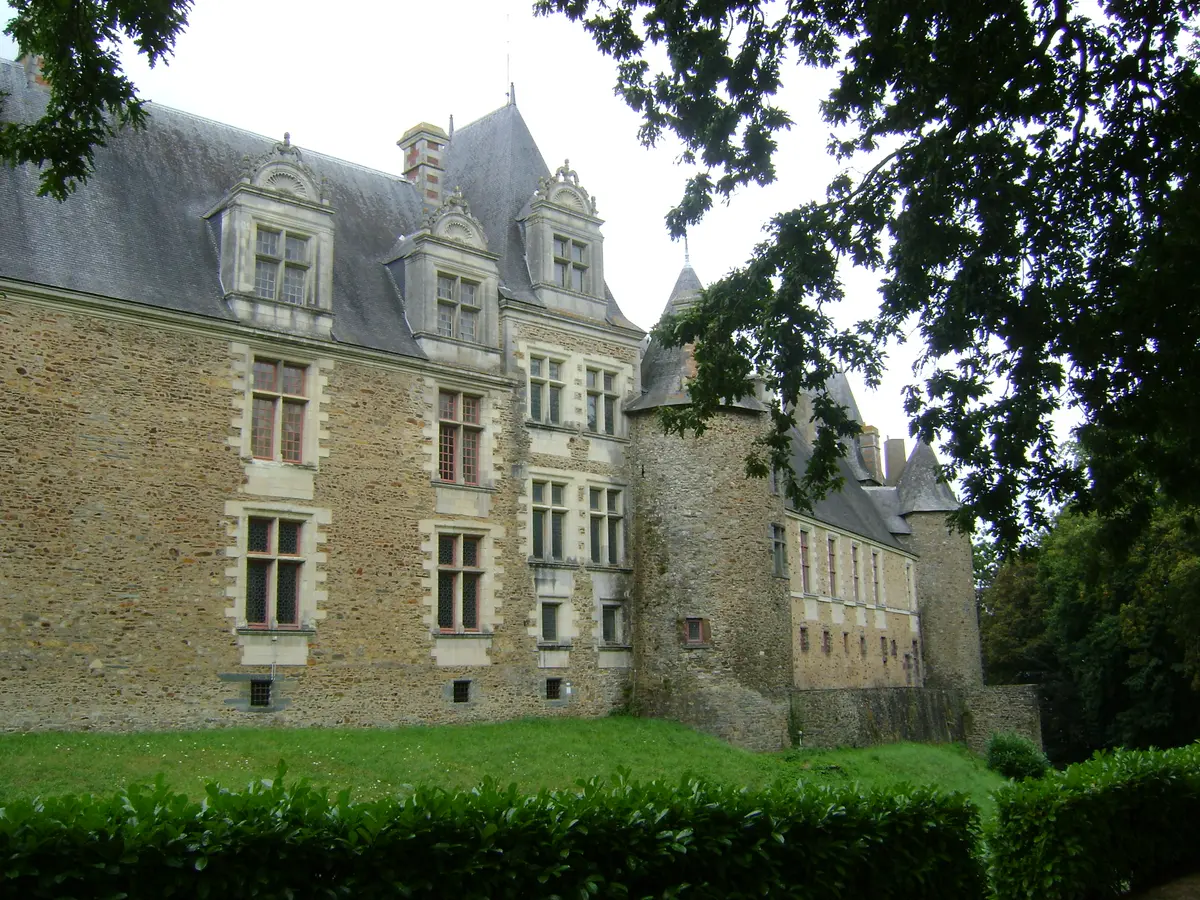
The Château de Châteaubriant, in Loire-Atlantique, was one of the border strongholds of eastern Brittany, alongside Vitré, Fougères, Ancenis and Clisson, until a French army took it in eight days in April 1488 during the Mad War and Charles VIII had it pulled down.
Where is Château de Châteaubriant?
- Location
- Loire-Atlantique, France
- Type
- Castle
- Coordinates
- 47.72, -1.373
- Last updated
LOCATION
Why is Château de Châteaubriant said to be haunted?
Jean de Laval and his wife Françoise de Foix built a Renaissance residence beside the ruin from 1524, and it is her death there, on 16 October 1537, that the castle is remembered for. Rumour said her husband had killed her out of jealousy over her years as Francis I's mistress; the scene everyone repeats — a chamber hung in black, six masked men, two surgeons — was printed in 1685 by Antoine Varillas, who dated it 1526 and was contradicted by the date on her own tombstone. The stone survives, in the castle oratory. The ghost story attached to it today, a bloodstain by the fireplace and a procession every 16 October, appears in no local history or folklore collection we could reach before the twentieth century.
What is the history of Château de Châteaubriant?
Châteaubriant was a frontier post long before it was a residence. The town takes its name from Brient, the lord who raised a fortress on the rocky spur where the Chère and the Rollard meet; the castle's own historians place that in the first half of the eleventh century, and Ogée's provincial dictionary of 1778 records that in 1056 the same Brient founded the priory of Saint-Jean-de-Béré beside it. For the next four centuries geography decided everything: Châteaubriant stood on the eastern edge of the duchy of Brittany, one of the line of border strongholds that also included Vitré, Fougères, Ancenis and Clisson, facing Anjou and the kingdom of France.
That line was broken in a single week. On 15 April 1488, during the Mad War, the duke of La Trémoille brought twelve thousand men and a siege train against a town held by twelve hundred under Odet d'Aydie. Ogée, working from the provincial records, describes a breach opened, an assault being prepared, and defenders who asked to capitulate rather than face it: the place surrendered after eight days, and the king's general "en fit démolir le château et la majeure partie des remparts" — had the castle and most of the ramparts pulled down. French accounts add that 236 houses in the town burned. Everything built here afterwards was therefore a replacement, not a modernisation, and that is why the medieval keep and the sixteenth-century lodging still stand as two separate buildings rather than one remodelled block.
The rebuilding was begun by Françoise de Dinan, lady of Châteaubriant, and finished by her grandson Jean de Laval, born in January 1487 and brought up from 1501 among the pages of Anne of Brittany. Ogée dates the new castle precisely: in 1524 Jean de Laval and his wife Françoise de Foix "firent rebâtir le château de cette ville à côté de l'ancien" — rebuilt it beside the old one, the one Charles VIII had ordered destroyed. The panelled and coffered room known as the chambre dorée went up around 1530. Charles Goudé, writing the town's history in 1870, records the local tradition that Jean de Laval fitted out his wife's apartments with particular care and gave her that room, "cette chambre dorée qui est restée si célèbre dans le pays".
In June 1531 Francis I made Jean de Laval governor of Brittany; the following year the king came to Châteaubriant in person and stayed six weeks before going on to Vannes for the provincial estates. In 1535 the castle chapel saw the marriage of Claude de Foix — Françoise's niece, orphaned in 1528 and placed under Jean de Laval's guardianship — to Guy XVII de Laval. Françoise de Foix died in the castle in October 1537, and her niece was staying there when it happened.
By an act passed in Paris on 5 January 1539 Jean de Laval gave the barony of Châteaubriant, with a long list of other lordships, to Anne de Montmorency, constable of France. He died in 1543. The castle passed from the Montmorencys to the Condés, served as a barracks from 1793, was bought by the duc d'Aumale in 1844 and sold by him in 1853 to the département of Loire-Inférieure, which owns it still. It was classified a monument historique on 11 July 1921.
Timeline: the documented record of Château de Châteaubriant
- 1056 Ogée's dictionary records that Brient, who had given the town his name, founds the priory of Saint-Jean-de-Béré beside his fortress on the eastern march of Brittany.
- 15–23 April 1488 During the Mad War the duke of La Trémoille besieges the town with twelve thousand men against twelve hundred defenders under Odet d'Aydie. It capitulates after eight days and the king's general has the castle and most of the ramparts demolished.
- 1524 Jean de Laval and Françoise de Foix begin a new castle beside the ruin of the old one, which is why the medieval keep and the Renaissance lodging still stand as separate buildings.
- 1532 Francis I, who had made Jean de Laval governor of Brittany the previous June, comes to Châteaubriant and stays six weeks before going on to Vannes for the provincial estates.
- 16 October 1537 Françoise de Foix dies in the castle. Goudé, citing the dean Blays's manuscript memoirs and the verses François Sagon wrote on her death, describes a sudden and rapid illness; her niece Claude de Foix was staying in the house. The body lies in state three days in the Trinitarians' church.
- After 1537 Jean de Laval raises a tomb for her in the choir of the Trinity church, four to five feet high with a carved figure, and a slate slab bearing the epitaph attributed to Clément Marot and the words "décédée le 16 octobre 1537".
- 5 January 1539 By an act passed in Paris, Jean de Laval gives the barony of Châteaubriant and a long list of other lordships to the constable Anne de Montmorency. Later authors read the donation as hush money; Hévin and Goudé point out that no prosecution of Jean de Laval is documented.
- 31 March 1547 Francis I dies — nine and a half years after Françoise de Foix. Any version of the legend that has her imprisoned "on the king's death" has the order of events reversed.
- 1684–1685 Antoine Varillas publishes his Histoire de François Ier, with the scene that founds the legend: a chamber hung in black, six months of confinement, six masked men and two surgeons who bleed the countess to death. He dates it 1526.
- 1686 The Breton lawyer Pierre Hévin publishes a refutation of Varillas, defending Jean de Laval's memory. Goudé still calls it, two centuries later, a learned and conscientious brief.
- 1778 Ogée prints the bleeding story, attributes it to Varillas and Brantôme, and demolishes it in one line: "Cette date seule détruit une semblable supposition, puisqu'il est prouvé qu'elle ne mourut que le 16 Octobre 1537." His entry runs to some 3,400 words and contains no ghost.
- 1870 Goudé and Guillotin de Corson publish the town's history: about 190,900 words, 45 mentions of Françoise de Foix, Varillas dismissed as "un long mensonge" — and no apparition, although the same book prints a "spectre blanc" elsewhere.
- 1882–1899 Paul Sébillot collects the legends of Haute-Bretagne. Châteaubriant is present — the bête de Béré, a skull venerated by local peasants — but "Foix" and "Laval" appear zero times, against nine white ladies and twenty-eight revenants elsewhere in the same volumes.
- 22 January 2002 Her funerary slab, of blue Nozay schist, saved when the tomb was destroyed at the Revolution and now kept in the castle's oratory, is classified as a protected object. It carries the epitaph and the death date, 16 October 1537.
Is there a rational explanation for Château de Châteaubriant?
The story this castle is famous for has a date problem, and the date is on a stone that can be inspected.
Françoise de Foix died on 16 October 1537. That is not an inference: it is engraved at the foot of her funerary slab, a blue Nozay schist plaque that survived the destruction of her tomb during the Revolution and is now kept in the castle's oratory, classified as a protected object by the French Ministry of Culture on 22 January 2002. Francis I died on 31 March 1547, nine and a half years later. Any version in which a jealous husband shuts his wife away "on the king's death" has the two events in the wrong order — this site's own earlier entry said exactly that, and it was wrong.
The murder itself has an author and a publication date. Antoine Varillas printed it in his Histoire de François Ier (The Hague 1684; definitive Paris edition, Claude Barbin, 1685): a chamber hung in black, six months of confinement, then the husband entering with six masked men and two surgeons who bled the countess at the arms and legs and left her to die. Varillas dated that scene to 1526. The Breton lawyer Pierre Hévin answered him almost at once with a printed refutation. Ogée, in 1778, disposed of it in one sentence — "Cette date seule détruit une semblable supposition, puisqu'il est prouvé qu'elle ne mourut que le 16 Octobre 1537" — and Charles Goudé, the town's own historian, called Varillas's account in 1870 "un long mensonge, rejeté maintenant de tous les gens sérieux". Véronique Garrigues traced the whole chain again in 2018 and showed how the fiction outlived every refutation, carried by novels, an opera and popular anthologies while the corrections stayed in specialist libraries.
Goudé is worth reading closely because he does not take the easy side. He notes that suspicion of violence is older than Varillas: Jean Le Laboureur had already reported a tradition that the count handed his lands to Montmorency to escape prosecution over his wife's death, and Pierre Blays, dean of Châteaubriant, wrote in his manuscript memoirs that her end had not come "sans soupçon de quelque violence". Goudé's own conclusion is that Françoise died of "une maladie subite et rapide" — a sudden, quick illness — while her niece was staying in the castle, and that the tradition "ne prouve donc pas complètement" the murder, but only the failings of a badly matched couple. He also watched the story travel: at Joué, where Jean de Laval owned Vioreau, the tale was told of an unnamed lady of the manor killed by her husband, and nobody there connected her with Françoise de Foix.
The ghost is a separate question, and the record is thinner than the story suggests. Ogée devotes roughly 3,400 words to Châteaubriant in 1778, several hundred of them to Françoise, including the epitaph and the refutation of the murder: not one apparition. Goudé and Guillotin de Corson's Histoire de Châteaubriant of 1870 runs to about 190,900 words and names Françoise de Foix 45 times; it contains no "fantôme", no bloodstain and no poisoning — and the control is inside the same book, which elsewhere prints a "spectre blanc" that terrified a revolutionary assembly and the "mystérieuses apparitions" of a local martyr, so the author plainly had no objection to printing a ghost. Paul Sébillot's Légendes locales de la Haute-Bretagne (1899), about 97,200 words gathered in exactly this region, carries nine white ladies and twenty-eight revenants, and does record Châteaubriant material — the bête de Béré appears in his Traditions et superstitions de la Haute-Bretagne of 1882 — but the words "Foix" and "Laval" appear zero times in either.
What circulates today is a specific and modern-sounding piece of staging: a stain on the floor between the monumental fireplace and the oratory door, and a procession at midnight every 16 October. The castle's own site, run by the département that owns the building, tells it as a legend and puts three phantoms in the chambre dorée; the département's tourism arm sells it harder, adding a lingering perfume in the room; and the département's institutional page on the castle does not mention it at all. A local Châteaubriant site that repeats the legend adds the detail that settles its status: the stain, it says, is touched up each year with a little paint.
Nothing here needs a supernatural explanation. A woman of thirty-odd dies suddenly in a house where the marriage was known to be bad and where the king had recently been a guest; the rumour follows within days, a historian with a taste for invention gives it a scene a century and a half later, and the room where the story is set is the most beautiful in the building and the one visitors are taken to.
Can you visit Château de Châteaubriant?
The château belongs to the département of Loire-Atlantique, which runs it through its Grand Patrimoine service. The address is Place Charles de Gaulle, 44110 Châteaubriant, and the telephone number 02 40 28 20 20. The site's hours-and-access page, read on 24 September 2026, puts the SNCF station 350 metres from the château and describes it as "À 1 heure en voiture de Nantes, d'Angers, de Laval et de Rennes", with free parking for cars and coaches nearby.
On that page the gardens are free and open Wednesday to Sunday, from 9:00 to 18:00 in February–March and October–December, and from 9:00 to 19:30 from April to September. The 3D room and the chambre dorée, the room in which the legend is set, are also free, Wednesday to Sunday from 9:00 to 17:30 between February and December. The welcome desk and shop in the maison du duc d'Aumale keeps shorter hours, 14:00 to 17:30 in the low season and 10:30 to 13:00 then 14:00 to 18:00 from April to September. The annual closures are given as "janvier, 1er et 11 novembre, 24, 25 et 31 décembre".
The prices page charges €6 for a guided tour, or €3 at the reduced rate, with free entry for under-26s. Family activities cost €8, or €4 reduced. The agenda as listed on 24 September 2026 schedules the guided tour "L'incontournable du château" on dates between 23 September and 29 November. A family engraving workshop and a family tour of the Renaissance château run from 17 October to 1 November, and no night visit is listed. The upper floors of the grand logis, restored in 2015–2016, are shown on the guided tours.
The château's own visitor plan, dated August 2026, tells the legend in full. In that telling, Jean de Laval has his wife murdered in the chambre dorée, leaving "une large mare de sang" on the floor, and on each anniversary of her death "le fantôme de Françoise de Foix réapparaît dans la chambre, suivi du roi François Ier et de son époux Jean de Laval". The same paragraph states that her epitaph is kept in that room, beside a multimedia point on the room's restoration in the 1990s. The epitaph is the document the legend has to reckon with, since it gives her death as 16 October 1537; the Ministry of Culture classified the slab that carries it as a protected object on 22 January 2002.
Sources consulted
- Jean Ogée, «Dictionnaire historique et géographique de la province de Bretagne, tome I, entrée « Chateaubriand »» — Vatar, Nantes, 1778 book
- Charles Goudé et Amédée Guillotin de Corson, «Histoire de Châteaubriant, baronnie, ville et paroisse» — Rennes, 1870 book
- Paul Sébillot, «Légendes locales de la Haute-Bretagne, et Traditions et superstitions de la Haute-Bretagne (1882)» — Paris, 1899 book
- Ministère de la Culture, «Dalle funéraire de Françoise Foix, épouse de Jean de Laval — notice PM44000865, classée au titre objet le 22 janvier 2002» — Base Palissy (Plateforme ouverte du patrimoine), 2002 report
- Véronique Garrigues, «Les clairs-obscurs de Françoise de Foix, dame de Châteaubriant (1494?-1537) : revisiter l'historiographie d'une favorite royale» — Femmes à la cour de France. Charges et fonctions (XVe-XIXe siècle), dir. C. zum Kolk et K. Wilson-Chevalier, Presses universitaires du Septentrion, p. 321-338, 2018 academic
- Ministère de la Culture, «Château à Châteaubriant — notice PA00108582, classé monument historique le 11 juillet 1921» — Base Mérimée (Plateforme ouverte du patrimoine), 1921 report
- Grand Patrimoine de Loire-Atlantique, «Histoire du château, Les grands personnages, Horaires et accès, Visitez le château» — chateau-chateaubriant.fr, 2026 web
- Loire-Atlantique Tourisme, «Légendes et lieux mystérieux en Loire-Atlantique» — tourisme-loireatlantique.com, 2026 web
- chateaubriant.org, «Du fantôme de Françoise, à la Bête de Béré» — chateaubriant.org, 2026 web
- Département de Loire-Atlantique, Grand Patrimoine de Loire-Atlantique, «Plan de visite 2026 — la chambre dorée, la légende de Françoise de Foix et son épitaphe « y est conservée »; le grand logis restauré en 2015-2016; horaires et fermetures annuelles» — chateau-chateaubriant.fr (PDF dated August 2026), 2026 web
- Grand Patrimoine de Loire-Atlantique, «Horaires et accès, Tarifs and L'agenda (guided tours €6, reduced €3, free under 26; family activities €8/€4; closures)» — chateau-chateaubriant.fr (consulted 24 September 2026), 2026 web
Reviewed by V. Serrano on 2026-08-17 · How we verify our content
💬 Field testimonies (0)
No testimonies yet. Add the first.
Add your testimony
🔒 Log in to add a testimony