📜 LEGEND · EXP. Nº0270
ACTIVE
Melusine of Lusignan
The house of Lusignan claimed descent from a water-fairy, and the story is usually told as if nobody had written it.
Where does the legend of Melusine of Lusignan come from?
- Location
- Lusignan, Poitou, France
- Kind of legend
- Folk tale
- Coordinates
- 46.437, 0.128
- Last updated
LOCATION
What is the legend of Melusine of Lusignan?
Somebody did. On 20 November 1392 a clerk named Jean d'Arras began putting it into prose for Jean de Berry, who had taken the fortress of Lusignan from the English eighteen years earlier; he finished in August 1393, and it is in that book that the fairy is first called Mélusine, that the forbidden day is Saturday, and that the duke is named her rightful heir. Before it, the pieces belong to other people: the bath, the spy-hole and the dragon to Walter Map before 1200; the nudity taboo, a husband called Raymond and the nightly return to the children to Gervase of Tilbury around 1214, in Provence; the castle of Lusignan itself only from Pierre Bersuire, who died in 1362 and left the fairy unnamed. Follow the chain and a famous folk tale turns into something better documented and far stranger: a title deed with a dragon on it.
What is the history of Melusine of Lusignan?
This story is a book, and the book has a date, an author, a patron and a purpose.
On the Wednesday before Saint Clement's day in the winter of 1392 — that is 20 November 1392, since Saint Clement fell on a Saturday that year — a clerk named Jean d'Arras began "to put this history into prose". He finished in August 1393 and presented it to the man who had ordered it: Jean de France, Duke of Berry, brother of King Charles V. D'Arras says so twice, in his prologue and in his epilogue, and he names the person for whom the commission was really meant: Berry's sister Marie, daughter of King John of France, Duchess of Bar and Marquise du Pont, who had begged her brother to get her the story. A cousin, the Margrave of Moravia, asked for a copy.
The timing is the whole point. Lusignan had been the last English stronghold in Poitou; its garrison surrendered in 1374, and Jean de Berry received Poitou in apanage. Nineteen years later he commissioned a book that made the fortress he had just conquered the foundation of a fairy, and made himself her heir. The book is a claim of title, written to order.
What was there before 1393? Walked backwards, every famous detail of the story turns out to have an owner.
The oldest layer is the peephole and the bath. In "De nugis curialium" (Distinctio IV, chapter 9), written at the court of Henry II Plantagenet in the last decades of the twelfth century, the Welsh clerk Walter Map tells of Henno cum dentibus, who finds a beautiful weeping girl at midday and marries her. She shuns holy water. It is Henno's MOTHER who makes "a small and secret hole" into the bedchamber and lies in wait — and at daybreak on a SUNDAY, with Henno gone to church, she sees the bride step into her bath "and from a most beautiful woman become a dragon". Sprinkled with holy water, she flies off with a great howl. Bath, spy-hole, transformation, flight and cry: all present, a good two centuries early, with no Lusignan and no Saturday.
The second layer is the husband's name and, most surprising of all, the ending. In the "Otia Imperialia", compiled for Emperor Otto IV around 1209-1214, Gervase of Tilbury reports that a few miles from Aix-en-Provence stands "castrum Russetum", overlooking the valley of Trets, and that its lord was "Raimundus nomine" — Raymond by name. Riding by the river, he meets a lady of unequalled beauty who greets him by his own name though he has never seen her. She marries him on one condition: that he never see her naked. Years of prosperity follow, and sons and daughters. Then one day, coming back from hunting, he pulls away the linen that covers her bath — "statimque domina in serpentem conversa", and at once the lady was turned into a serpent, put her head under the water and vanished. And then Gervase writes the sentence that d'Arras would keep two centuries later: she was never seen or heard again, "except sometimes at night, when she came to visit her little children, in the hearing of the nurses". Gervase adds that the daughter of that lady married a kinsman of his own, and that her line has come down to his day.
Only in the third layer does any of this reach Poitou. The Benedictine Pierre Bersuire, who died in 1362, wrote in his "Reductorium morale" — around 1342-1350, the first written attestation of the Lusignan version — that "in my country, Poitou, they tell that the powerful castle of Lusignan was founded by some knight and the fairy he had married", that from her descend the kings of Jerusalem and Cyprus and the counts of La Marche and Parthenay, that after her husband saw her naked she changed into a serpent, and that even now the serpent can be seen in the castle WHEN IT IS TO CHANGE MASTER. The fairy still has no name. She had to wait for Jean d'Arras to be called Mélusine.
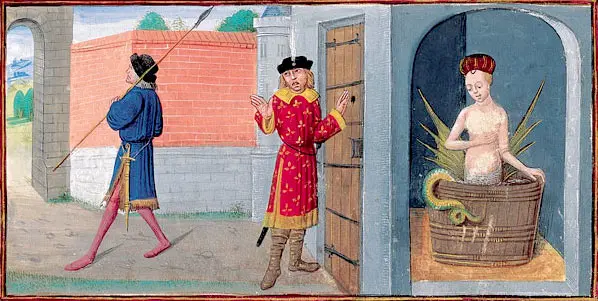
The romance itself is darker than its summaries: while hunting a boar, Raymondin has just killed his own lord and uncle, Aimery, Count of Poitiers, when his boar-spear slipped and ran the count through. He rides half-mad by moonlight, and at the Fountain of Thirst there are THREE ladies; the noblest seizes his bridle, rebukes him for riding past ladies without a greeting, and — d'Arras says it plainly — "she knew well who the young man was". The Saturday taboo is a curse laid on Mélusine by her own mother Présine, and it has two clauses: he must never see her on a Saturday, and he must never denounce her to anyone. She is a serpent "du nombril en aval", from the navel down. Raymondin bores the hole in the door with the point of his sword, sees her in a marble basin combing her hair with a tail "as thick as a herring barrel", and plugs the hole again with wax from an old letter. The man who undoes him is his brother, the Count of Forez.
And it does not end with a flight. Mélusine leaves from MERVENT when Raymondin publicly calls her "tresfaulse serpente" after their son Geoffroy the Great Tooth has burned the abbey of Maillezais with a hundred monks inside, his own brother among them. She becomes a serpent fifteen feet long, circles the fortress three times crying out in a woman's voice, and only then flies to Lusignan and falls upon the Tour Poitevine. D'Arras claims the windowsill she pushed off from still exists with her footprint in it. After that she comes back EVERY EVENING to warm her two youngest sons at the fire, and the nurses see her and dare not speak — Gervase's ending, kept. Raymondin has their monstrous son Horrible smothered with the smoke of wet hay in a cellar, as she instructed, and buried at Poitiers; he is never seen to laugh again; and he ends his life as a hermit at Montserrat in Aragon, where the King and Queen of Aragon and the counts of Empúries, Urgell, Cerdanya, Prades and Cardona attend his funeral, and where his great-nephew Bernardon stays behind to marry the heiress of Cabrera.
Around 1401 a second author, Coudrette, put the story into verse for Guillaume VII l'Archevêque, lord of Parthenay, and on his death that year continued it for his son Jean II — a rival family commissioning its own version of the same ancestress. The Limbourg brothers painted Lusignan for the Duke of Berry in the March page of the "Très Riches Heures" around 1411-1416, with a winged dragon over the Poitevine tower. And in August 1478 Adam Steinschaber printed d'Arras at Geneva: the first edition of the romance and the first illustrated book ever printed in the French language, 193 leaves and 63 full-page woodcuts. That is how a house's title deed became everybody's fairy tale.
Timeline: the documented record of Melusine of Lusignan
- c. 1181-1193 Walter Map, clerk to Henry II Plantagenet, writes the tale of Henno cum dentibus in 'De nugis curialium' (IV, 9): the mother-in-law bores 'a small and secret hole' into the bedchamber and, at daybreak on a Sunday, sees the bride enter her bath and 'from a most beautiful woman become a dragon'. Holy water drives her off, howling. The bath, the spy-hole, the transformation and the flight are already in place, two centuries before Lusignan.
- c. 1209-1214 Gervase of Tilbury, in the 'Otia Imperialia' written for Emperor Otto IV, tells of 'Raimundus nomine', lord of castrum Russetum near Aix-en-Provence, whose wife forbids him to see her naked. He tears away the linen of her bath; 'statimque domina in serpentem conversa' — at once she turned into a serpent and vanished under the water, never seen again 'except sometimes at night, when she came to visit her little children, in the hearing of the nurses'. The husband's name and the nightly return are already fixed.
- c. 1342-1350 The Benedictine Pierre Bersuire (d. 1362), a Poitevin, gives in his 'Reductorium morale' the first written attestation of the Lusignan version: 'in my country, Poitou, they tell that the powerful castle of Lusignan was founded by some knight and the fairy he had married'. From her descend the kings of Jerusalem and Cyprus and the counts of La Marche and Parthenay; after her husband saw her naked she changed into a serpent; and the serpent is still seen in the castle 'when it must change master'. The fairy has no name yet.
- 17 January 1369 Peter I of Cyprus, of the house of Lusignan, is murdered in his own bed at Nicosia by three of his knights. A generation later Jean d'Arras will report, on the sworn word of the Poitevin knight Perceval de Coulogne, that the king had seen the serpent of Lusignan days before and had said so out loud.
- 1374 Lusignan, the last English stronghold in Poitou, surrenders after a long siege. Its captain, John Cresswell, hands the fortress over, and Jean de France, Duke of Berry, receives Poitou in apanage. Every one of the eyewitness accounts that will close d'Arras's book dates from around this siege and reaches the author through the duke.
- July 1378 Owain Lawgoch — Yvain de Galles — is assassinated by the Scot John Lamb at the siege of Mortagne-sur-Gironde. He is one of the four witnesses d'Arras will name, having sworn to the Duke of Berry that he saw the serpent twice on the walls of Lusignan three days before the surrender. By the time the book appears he has been dead fifteen years.
- Wednesday 20 November 1392 Jean d'Arras dates the start of his work himself: 'le mercredi devant la Saint Cleymen en yver l'an de grace mil ccc iiii xx et xii'. Saint Clement's day, 23 November, fell on a Saturday that year, so the Wednesday before it was 20 November 1392.
- August 1393 D'Arras finishes the 'Noble Histoire de Lusignan' and presents it to Jean de Berry, who had commissioned it for his sister Marie, Duchess of Bar. It is in this book that the fairy is called Mélusine for the first time, that the Saturday taboo appears, that she is a serpent 'du nombril en aval', and that the Duke of Berry is identified as her rightful heir at Lusignan.
- c. 1401-1405 Coudrette writes a second Mélusine, in verse, for Guillaume VII l'Archevêque, lord of Parthenay, and on his patron's death in 1401 continues it for his son Jean II — a rival Poitevin house commissioning its own descent from the same ancestress. Unlike d'Arras, Coudrette claims to be translating a Latin original.
- c. 1411-1416 The Limbourg brothers paint the March page of the 'Très Riches Heures' for the Duke of Berry: the castle of Lusignan in detail, with a winged dragon above the Poitevine tower. The romance says 'serpente'; the pictures say dragon, and it is the pictures that everyone remembers.
- August 1478 Adam Steinschaber prints d'Arras at Geneva: the editio princeps of the romance and the first illustrated book ever printed in the French language, an in-folio of 193 leaves with sixty-three full-page woodcuts. Louis Stouff noted that this edition drops three long passages, among them the apparition of Mélusine on the tower of Lusignan three days before Raymondin's death.
- Winter 1574-1575 The Duke of Montpensier besieges Lusignan during the Wars of Religion and takes it. The razing of the fortress is ordered at once and carried out between February 1575 and March 1577; Louis XIII has the last remains pulled down in 1622, and by 1627 the ditch has been filled with the rubble.
- 1774 La Bourdonnaye de Blossac, intendant of Poitou, levels what remained of the castle and lays out a formal promenade of lime avenues on the spur. It is what stands on the site of Mélusine's fortress today, and it is free to walk.
Is there a rational explanation for Melusine of Lusignan?
There is no need to decide whether a fairy founded Lusignan. The interesting question is narrower and can be answered from documents: when does each piece of this story first appear in writing, and who benefited from it appearing then?
The chain above answers it. The bath, the spy-hole and the transformation belong to Walter Map, before 1200 and on the coast of Normandy, where his Henno finds his bride. The nudity taboo, the name Raymond and the nightly return to the children belong to Gervase of Tilbury, around 1209-1214 and in Provence — at Rousset near Aix, three hundred kilometres from Poitou. Nothing ties any of it to Lusignan before Pierre Bersuire, who died in 1362 and was himself a Poitevin: he is the first to write the castle's name into the story, and in his version the fairy has no name at all. Each of these layers has an author and a date; and the two names that define the legend today — Mélusine and Lusignan together — first meet in a book written for the man who had just taken the castle by force of arms.
The apparition clause is the sharpest test, because the two versions do not say the same thing. In Bersuire the serpent is seen "when the castle must change master" — and nothing else. In d'Arras the curse is enlarged: Mélusine will appear three days before the fortress changes lord AND whenever one of her heirs is about to die. Only the first half, the one about who owns the castle, is attested by the oldest source, and it is precisely the half that a book commissioned by a new owner would want to hear; the mournful half about descendants arrives with d'Arras.
Then there is the evidence: d'Arras does not leave the apparitions unsupported; he closes his book with four sworn witnesses, and every one of them reaches him through his patron. John Cresswell, the English captain who had held Lusignan, told the duke that shortly before he surrendered the fortress he was in bed there with his concubine Alixandre of Sancerre when a huge serpent appeared before him. Owain Lawgoch — Yvain de Galles — swore to the duke that he had seen her twice on the walls three days before the surrender; he was assassinated at the siege of Mortagne-sur-Gironde in July 1378, fifteen years before the book was written, so his oath reached the page only through the duke. A man called Godard, "still living in the fortress", swore on his soul that she appeared to him by the old henhouse near the well. And Perceval de Coulogne, a Poitevin knight and chamberlain of the King of Cyprus, swore that Peter I of Lusignan had seen her and told him so; Peter I was murdered in his own bed at Nicosia on 17 January 1369. Taken one by one these are ordinary depositions. Taken together they share a single funnel: the Duke of Berry heard them, and the man who wrote them down worked for him. A demand for proof produced the proof.
Two smaller cautions. The first concerns the winged dragon: d'Arras's text says "serpente" — a serpent fifteen feet long, half woman — and never a dragon. The dragon comes from the pictures: the drawing in the manuscript, and above all the Limbourg brothers' Lusignan in the March page of the "Très Riches Heures", where a winged dragon flies over the Poitevine tower, and the phrase "winged dragon" describes those pictures. The second concerns the print: Louis Stouff observed that the 1478 Geneva edition — the version that made the story a bestseller across Europe — dropped three long passages, one of them the appearance of Mélusine on the tower of Lusignan three days before Raymondin's death. The book that taught Europe the legend is the book that cut its own best-attested scene.
None of this makes the story small; it makes it datable, which is better. What can honestly be said is this: a widespread medieval tale about a supernatural wife and a broken promise was attached to one particular Poitevin fortress at some point before the middle of the fourteenth century; a duke who had just conquered that fortress had the tale written up, named and genealogised in 1392-1393; and the name Mélusine, the Saturday, the serpent's tail from the navel down and the flight over the towers are first found in that book.
Can you visit Melusine of Lusignan?
Lusignan is in the Vienne, some 25 km south-west of Poitiers. The castle where Mélusine is said to have alighted is gone. The duc de Montpensier laid siege on 27 September 1574; the garrison under the vicomte de Rohan capitulated on 5 January 1575; the Sarrieu regiment held the place for a time and then pulled it down. French Wikipedia, read on 9 September 2026, sets the end of the process as "démantelé sur ordre du roi Henri III en 1586 et seule la tour Mélusine subsistera jusqu'en 1622".
The site is now the Promenade de Blossac, a free public park on the spur above the Vonne valley. The comte de Blossac, intendant of Poitou, levelled what the stone-robbers had left and planted a formal garden in the eighteenth century: "une allée de tilleuls, entourée de jardins, conduit à une terrasse avec une très belle vue sur la vallée". Whole stretches of castle wall survive plastered against the cliffs below. The castle site has been inscribed as a monument historique since 1997, under Mérimée reference PA86000005. An equestrian statue put up in 2007 on the promenade, L'Épopée chimérique, represents Geoffroy la Grand'Dent, the son the romance gives Mélusine. The eleventh-century priory church of Notre-Dame-et-Saint-Junien is in the town and free to enter.
A tower that carries her name can be climbed at Vouvant, in the Vendée, about 60 km west. The Tour Mélusine is the only surviving piece of the Lusignan lords' castle there, which stood where the place du Bail now is; it is circular, 36 metres high measured from the ditch, and it is dated to the end of the twelfth century or the beginning of the thirteenth. The commune owns it. It has been inscribed as a monument historique since 1927, Mérimée PA00110288. The third and fourth levels each hold a dome-vaulted chamber with a fireplace and are reached by a spiral stair that is now metal, the stone one having gone; the fourth also keeps its latrines. The fifth level is the terrace, with the view over the fortified town, the river Mère and the Mervent-Vouvant forest. The key is hired from the Office de Tourisme on the place du Bail at Vouvant, from April to All Saints. Prices and dates checked on 9 September 2026: 3.00 euros from age 13, 1.50 euros for ages 7 to 12, free below 7, with the tower open from 4 April to 1 November 2026, 10.00 to 12.30 and 14.00 to 18.00.
Two of the sources are objects in their own right. The Limbourg brothers' March page, with Lusignan under snow and the winged dragon over the Poitevine tower, belongs to the Très Riches Heures du duc de Berry, held at the Musée Condé in Chantilly under shelfmark Ms. 65 and owned by the Institut de France. The duc d'Aumale bought the manuscript on 20 January 1856 for 18,000 francs, and the terms of his will, in force since his death in 1897, forbid it to leave the museum; it has always been shown to the public very rarely. The illumination reproduced on this page, Raymondin discovering Mélusine in her bath, is folio 19 of Paris, Bibliothèque nationale de France, Département des manuscrits, Français 24383, a fifteenth-century parchment copy of Coudrette's verse version, and it is in the BnF's digital collections.
Sources consulted
- Pierre Bersuire, «Reductorium morale (the Lusignan fairy passage), quoted and translated in Jean-Jacques Vincensini's critical edition of Mélusine» — quoted from the Reductorium morale in J.-J. Vincensini's critical edition of Mélusine (Le Livre de Poche, Lettres gothiques, 2003), p. 8, 1350 book
- Walter Map, ed. Thomas Wright, «De nugis curialium, Distinctio IV, cap. ix: 'Henno cum dentibus' (Latin text)» — Camden Society, London, 1850 book
- Gervase of Tilbury, ed. Felix Liebrecht, «Otia Imperialia: the tale of Raimundus, lord of castrum Russetum near Aix-en-Provence (Latin text)» — Carl Rümpler, Hannover, 1856 book
- Jean d'Arras, ed. Jean-Jacques Vincensini, «Mélusine ou La Noble Histoire de Lusignan. Nouvelle édition critique d'après le manuscrit de la bibliothèque de l'Arsenal, with translation, introduction and notes» — Le Livre de Poche, Lettres gothiques, 2003 book
- Association Les Lusignan et Mélusine, «Le château de Lusignan — historique (siege of 1374, the Duke of Berry's works, the Wars of Religion and the demolitions)» — leslusignanetmelusine.fr, 2020 web
- Owain Glyndŵr Society, «Owain Lawgoch (Yvain de Galles): Welsh captain in French service, killed at the siege of Mortagne-sur-Gironde in July 1378» — owain-glyndwr.wales, 2020 web
- Peter W. Edbury, «The murder of King Peter I of Cyprus (1359-1369)» — Journal of Medieval History, vol. 6, no. 2, pp. 219-233, 1980 academic
- Office de tourisme Grand Poitiers, «Promenade de Blossac, Lusignan — public garden laid out over the castle site, free access» — tourisme-vienne.com, 2026 web
- Limbourg brothers (described by Herodote.net), «Mars, Les Très Riches Heures du duc de Berry: the château de Lusignan with a winged dragon above the Poitevine tower» — herodote.net, 2015 web
- Office de Tourisme Pays de Fontenay-Vendée, «Tour Mélusine, Vouvant — access, opening period, rates and description of the keep» — vendee-maraispoitevin.com, 2026 web
- Bibliothèque nationale de France / Biblissima, «Paris, BnF, Département des manuscrits, Français 24383: Coudrette's verse Roman de Mélusine, 15th century, 14 miniatures (fol. 19: Raimondin discovers Mélusine's secret)» — portail.biblissima.fr, 2024 archive
Reviewed by V. Serrano on 2026-08-16 · How we verify our content
📎 Source: Enigma Atlas
💬 Field testimonies (0)
No testimonies yet. Add the first.
Add your testimony
🔒 Log in to add a testimony