👻 HAUNTED PLACE · EXP. Nº9046
ACTIVE
Catacombs of Paris
When the overflowing Cemetery of the Holy Innocents began collapsing into neighboring basements in the late 18th century, Parisian authorities began the grim task of emptying it into the abandoned limestone quarries beneath the city, starting in 1786 and continuing for decades until an estimated six million skeletons had been transferred and stacked underground.
Where is Catacombs of Paris?
- Location
- Paris, France
- Type
- Cemetery
- Coordinates
- 48.834, 2.332
- Last updated
LOCATION
Why is Catacombs of Paris said to be haunted?
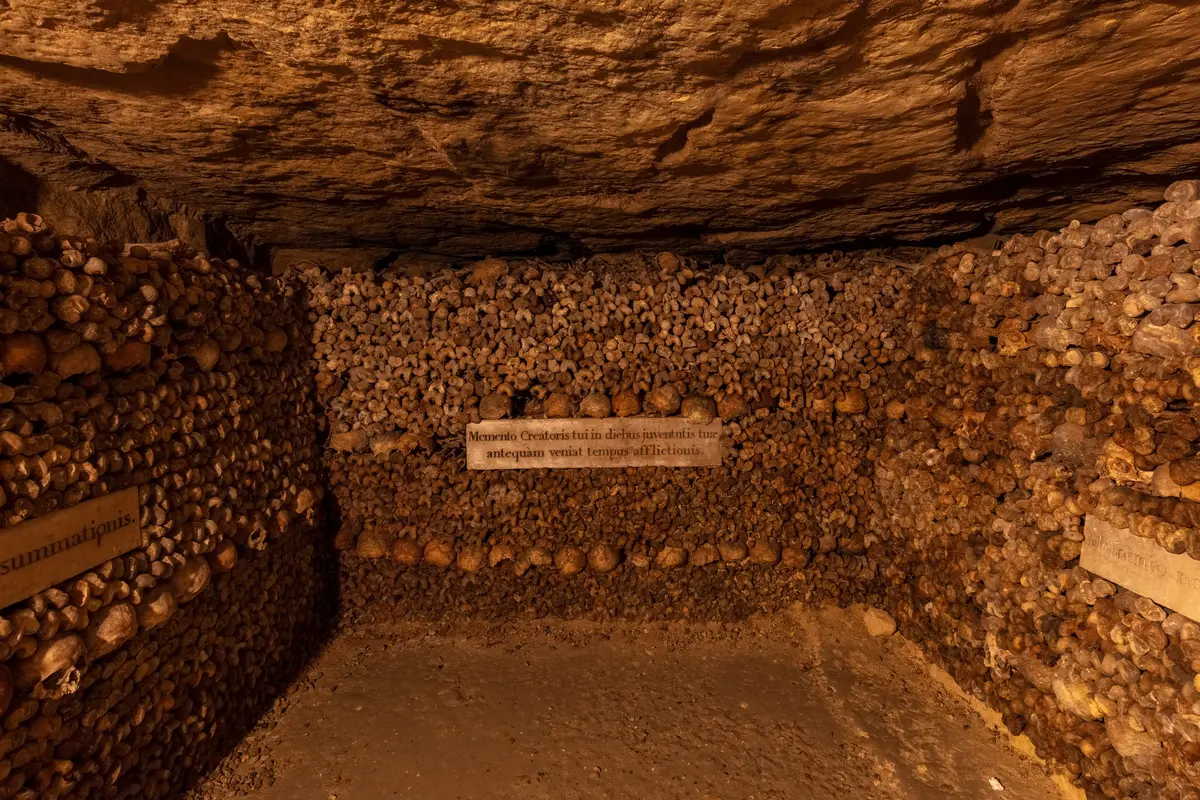
Workers arranged the bones into deliberate walls of skulls and femurs, turning a practical solution into what became known as the Ossuaire Municipal. The tunnels stretch far beyond the roughly 1.5-kilometer stretch open to visitors today, and cataphiles who explore the unauthorized passages report whispers, disembodied footsteps trailing behind them, and sudden cold spots deep in the dark. Officially opened to the public as an ossuary in 1809, the catacombs remain one of the few places where visitors walk face to face with millions of the anonymous dead.
What is the history of Catacombs of Paris?
The Paris catacombs began as a public health measure. The site's own history opens with the "major public health problems tied to the city's cemeteries" that, in the late eighteenth century, "led to a decision to transfer their contents to an underground site".
The largest of those cemeteries, Saints-Innocents, in the centre of Paris, had been in use for close to ten centuries, and an estimated two million Parisians had been buried there, according to Sortiraparis. Its end came when, under the weight of the burials, a wall gave way and remains spilled into the cellar of a restaurant owner. It was closed in 1780.
The city chose the disused Tombe-Issoire quarries under the plain of Montrouge, then outside the capital. On 7 April 1786 the site was consecrated as the Paris Municipal Ossuary, and from then on it took the name by which it is known, the Catacombs, after the Roman catacombs that had fascinated the public since their discovery.
The transfer itself is the extraordinary part. Tombs, common graves and charnel houses were emptied of their bones, and those bones were carried across Paris at night, to avoid hostile reactions from the population and from the Church. The first evacuations, from Saints-Innocents, ran from 1785 to 1787. Transfers continued after the French Revolution until 1814, as parish cemeteries in central Paris were suppressed — Saint-Eustache, Saint-Nicolas-des-Champs, the Bernardins convent — and began again in 1840 and during Haussmann's works of 1859 and 1860; the last deposits date from 1860.
The ossuary holds the remains of several million Parisians, in the site's own words. Under Inspector Héricart de Thury, whose rearrangement the site dates to 1810-1814, the loosely piled bones were built into walls: in front, rows of femurs and tibiae alternating with skulls, and behind them the rest of the bones, often only small fragments. The site was opened to the public by appointment from 1809.
Timeline: the documented record of Catacombs of Paris
- 1780 The Saints-Innocents cemetery in central Paris is closed after nearly ten centuries of continuous use. It was catastrophically overfilled with no possibility of expansion.
- 7 April 1786 The site is consecrated as the Paris Municipal Ossuary, in the disused limestone quarries beneath the city. From then on it takes the name Catacombs.
- 1785–1787 The tombs, common graves and charnel houses of Saints-Innocents are emptied. The bones are carried across Paris at night, deliberately, to avoid hostile reactions from the population and the Church.
- 1814 The transfers end, having continued through and after the Revolution with the suppression of central parish cemeteries: Saint-Eustache, Saint-Nicolas-des-Champs, the Bernardins. In all, more than six million people.
- 1955 Access to the quarry network through unofficial entry points is banned by law. Those who go anyway are known as cataphiles; one of those Dazed interviewed in 2022 had once woken up in hospital after a serious injury underground.
- Spring 2026 The Catacombs reopen after renovation and accessibility works, with €31 admission and mandatory timed booking.
Is there a rational explanation for Catacombs of Paris?
The catacombs need no ghost, and their documented history has almost none. The three history pages that the City of Paris publishes for the site, read on 6 October 2026, do not once use the words "ghost", "spirit", "haunting" or "apparition". The dangers documented down there are physical.
The site itself warns about a confusion of names. Its ossuary page says that "Paris Catacombs", the name of the part of the quarry turned into an ossuary in the eighteenth century, "is currently used by extension and erroneously to designate the quarries under Paris and even beyond the city." The ossuary open to visitors is a lit, one-way circuit of 1.5 kilometres run by Paris Musées. The quarries are a labyrinth that the same site measures at about 800 hectares, and that Dazed put at over 280 kilometres of galleries in 2022.
Entering that network through an unofficial entry point has been illegal since 1955, Dazed reported, and the people who do it are known as cataphiles. Those it interviewed described a maze without phone service, with maps that cataphiles draw and update themselves when a new passage is dug. The police seal entrances and they are opened again, and descents last up to seven hours; the fine for entering illegally was then 60 euros. One of them, Claire, had once woken up in hospital after a serious injury underground: "There are real risks, which shouldn't be minimised, because it's when you're not paying attention and you think you're safe that you end up getting hurt."
Attention from outside has its own cost underground. Claire told Dazed that cataphiles "hate articles, videos and photos posted on Instagram with hashtags", because a viral video revealing a secret entrance draws the wrong kind of visitor, and said of the bones: "You can find skulls inside, but most of them have been stolen by YouTubers or reporters looking to go viral."
The unease that visitors describe on the official route has physical conditions to draw on, and the museum lists them in its practical information: twenty metres below the street, a constant 14°C, 131 steps down and 112 back up, narrow passageways, an uneven and slippery floor and dim light. Its ossuary page adds that the bones are kept in "a very humid underground environment". Along the walls lie the remains of several million Parisians, in the site's own words; Dazed gives a figure of over six million.
The museum describes the ossuary as "one of the world's largest and one of only a handful located underground", and as a piece of eighteenth-century quarry engineering it needs no other mystery.
Can you visit Catacombs of Paris?
The Catacombs are a museum of the City of Paris run by Paris Musées. Visitors go in at 1, avenue du Colonel Henri Rol-Tanguy, on place Denfert-Rochereau in the 14th arrondissement, and come out through a different door at 21 bis, avenue René-Coty in the same arrondissement.
The site shut on 3 November 2025 and opened again five months later. Its own news page, read on 9 September 2026, records that "Les Catacombes de Paris ont rouvert leurs portes au public le 8 avril 2026 après 5 mois de travaux qui comptent parmi les plus importants dans l'histoire du site". The work renewed the technical installations of the underground route and brought in a new scenography with an immersive headset.
Hours and tariffs, from the official pages on the same date. Tuesday to Sunday, 9.45 to 20.30; last admission 19.30; closed on Mondays as well as 1 January, 1 May, 25 December. Full admission is 31 euros with the audio companion included; the reduced rate is 25 euros; ages 8 to 17 pay 15 euros. Under-8s enter free without the audio, which is then sold at the desk for 5 euros. Bookings open seven days ahead. The audio companion runs about an hour in four languages: French, English, Spanish, German, with an audio-described French version. Individual guided visits are listed as ACTUELLEMENT NON DISPONIBLE. People entitled to free entry collect their ticket on the day and have "entrée garantie sans réservation" even when the site shows as full, which is the one route in that does not depend on a timed slot.
The practical-information page states the physical conditions without softening them. No more than 200 people are inside at once. The route runs 1.5 km in one direction and takes about an hour, twenty metres below street level, at a constant 14 degrees. Access is by staircase alone: 131 steps down and 112 back up, over an uneven, slippery floor in low light. There is no cloakroom. Bags over 40 by 30 centimetres are refused, and smaller ones have to be carried in front or by hand. Children under 14 must be accompanied by an adult. The site is closed to anyone in a wheelchair or using a walking frame, and it is advised against for reduced mobility, for claustrophobia, for cardiac insufficiency, for respiratory insufficiency.
Two of the rules measure what the museum takes the ossuary to be. Blind and partially sighted visitors must be accompanied and guide dogs are admitted, while white canes are banned "en raison des mesures de conservation préventive des hagues d'ossements" — the bone walls are a conservation object that a cane would strike. And the prohibition on touching is written to admit no exception whatever: "L'interdiction de toucher aux œuvres, aux ossements et au décor s'applique à tous, y compris aux personnes en situation de handicap visuel".
Sources consulted
- Catacombes de Paris, «Site history — historia oficial del osario municipal» — Ville de Paris / Paris Musées, 2026 archive
- Paris Musées, «Reserva de entradas con franja horaria — condiciones de visita» — Billetterie oficial, 2026 archive
- Dazed, «Inside the secret world of the cataphiles» — Dazed Digital, 2022 interview
- Rizhlaine de Sortiraparis, «History of Paris: the Cemetery of the Innocents — diez siglos de uso, saturación y cierre en 1780 del cementerio que originó el traslado» — Sortiraparis, 2024 newspaper archive
Reviewed by V. Serrano on 2026-07-28 · How we verify our content
💬 Field testimonies (0)
No testimonies yet. Add the first.
Add your testimony
🔒 Log in to add a testimony