🦶 CRYPTID SIGHTING · EXP. Nº0555
ACTIVE
Yara-ma-yha-who
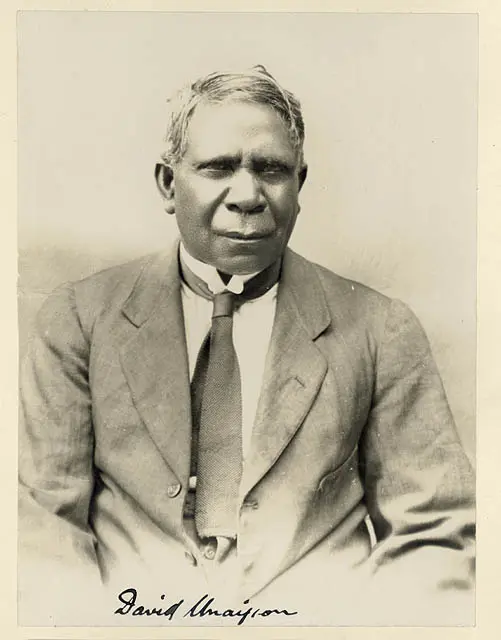
The Yara-ma-yha-who is a spirit of the wild fig tree, not an animal waiting to be found, and it reaches us through one traceable line: the Ngarrindjeri writer David Unaipon, who collected and wrote it up in 1924-25 as "Yara Ma Tha Who".
Where and when was Yara-ma-yha-who sighted?
- Location
- Raukkan (Point McLeay), Lower Murray, South Australia, Australia
- Date sighted
- Unknown
- Coordinates
- -35.506, 139.135
- Last updated
LOCATION
What is Yara-ma-yha-who?
His manuscript is still in the State Library of New South Wales. After his negotiations with Angus & Robertson collapsed in 1925, the publisher sold it on to William Ramsay Smith, who printed the tale in Myths & Legends of the Australian Aboriginals (London, 1930) under his own name alone. Set side by side, the two texts are almost identical - and what Smith removed is the author: "this little man of ours" became "this little man"; the creature's Aboriginal name, Thuyoa-niperrie, disappeared; so did the reference to Cook's landing at Kurnell and the storyteller's own "I may say that". Unaipon's name was restored to the book in 2001. The tarsier and the marsupial lion arrived much later, and from cryptozoology, not from the story.
What is the history of Yara-ma-yha-who?
The Yara-ma-yha-who does not reach us out of the bush. It reaches us through a manuscript, a broken negotiation and a name that was kept off a title page for seventy-one years.
David Unaipon (1872-1967) was born at the Point McLeay Mission on Lake Alexandrina, near the mouth of the Murray in South Australia. He was Ngarrindjeri; his parents, James Ngunaitponi and Nymbulda, were Yaraldi speakers of the lower Murray. Writing to the anthropologist Herbert Basedow from Adelaide on 21 April 1914, he introduced himself in his own words: "I am an Australian aboriginal belong[ing] to the lower Murray on Lake Alexandria know[n] as the Narrringeri tribe; Born on the Point McLeay Mission Station." He was a Christian preacher, an inventor with a patented improvement to the shearing handpiece (1909), and a professional writer. He was not an informant. He was the author.
Through 1924 and 1925 Unaipon collected and wrote up the legends. The manuscript survives: Volume 1 of Legendary Tales of Australian Aborigines, State Library of New South Wales, call number A 1929, dated 1924-1925 and digitised. He was writing it for Angus & Robertson in Sydney. According to the historian Billy Griffiths, the publisher George Robertson paid him at standard rates and referred to it as "his book", but communications broke down in August 1925 and a letter of 3 October 1925 accepting the work for publication never reached him. William Ramsay Smith (1859-1937) - a Scottish-born physician who was Adelaide's city coroner, inspector of anatomy and chairman of South Australia's Central Board of Health - then bought the complete manuscript from Angus & Robertson in order to "edit" and "prepare" it.
It came out in London in 1930, published by Harrap as Myths & Legends of the Australian Aboriginals, with W. Ramsay Smith on the title page and Unaipon nowhere on it. The tale is there, listed at page 344 in the 1932 Farrar & Rinehart printing, under a respelled heading: Unaipon had written Yara Ma Tha Who; Smith printed Yara-ma-yha-who, and that is the spelling the world uses.
How much did he change? The two texts can be laid side by side, because the searchable full text of both is on the Internet Archive. The answer is that Smith reprinted the story almost word for word and edited out its author.
Unaipon's chapter opens: "There were many strange beings who lived a long while ago, many, many years, before Captain Cook found a landing at Kurnell. Some took the form of the mythological Bunyip, the Tuckoonie, and the Thuyoa-niperrie (a queer little red man). Now, this little man of ours was an exceptionally funny fellow. He stood about four feet and he had..." Smith's opens with the identical words - "There were many strange beings who lived a long while ago, many, many..." - and continues: "...little red man. Now this little man was an exceptionally funny fellow. He stood about four feet high, and he..."
Four things disappear in that gap. The colonial time-anchor, Cook's landing at Kurnell, which is how Unaipon dated the beings. The neighbouring beings, the Tuckoonie and the Thuyoa-niperrie. That second word occurs exactly once in the Internet Archive's searchable corpus of books - in Unaipon's own volume - so the only Aboriginal-language name attached to the creature anywhere in print is the one Smith cut. And the two words "of ours", which are the entire difference between a man telling his people's story and a specimen being described.
The same operation runs through the tale. Unaipon: "I may say that he does not try to suck all the blood from the body but leaves sufficient to keep him..." Smith: "The Yara-ma-yha-who does not try to suck all the blood from the body, but leaves sufficient to keep the..." The first person goes and the respelled name is dropped in to replace it. When the creature calls after its victim, Unaipon writes "Yara ma, Yara ma, which way hast thou gone, which way hast thou gone, my victim, my victim?" - the doubling of oral telling, with the being's own name in its mouth. Smith prints "Which way hast thou gone, my victim, my victim?" And Unaipon's closing image, unmistakably a preacher's, is cut altogether: "And when he wakes he will do just what the whale did to Jonah - spew him out."
The erasure held for a long time. As late as 1988 the Australian Dictionary of Biography's entry on Ramsay Smith, by Ronald Elmslie and Susan Nance, still described the 1930 book as his own effort to preserve Aboriginal folklore, remarking only that "the accuracy of this work has been questioned"; Unaipon appears there as a cross-reference. Between 1996 and 1998 Stephen Muecke and Adam Shoemaker established the appropriation and arranged for the copyright to be transferred to Unaipon's family. In 2001 Melbourne University Press published the manuscript under his name and his own title, Legendary Tales of the Australian Aborigines, with a paperback following in 2006. The copyright holder recorded today against the State Library's manuscript is Ms Judy Kropinyieri.
Timeline: the documented record of Yara-ma-yha-who
- 28 September 1872 David Unaipon is born at the Point McLeay Mission on Lake Alexandrina, South Australia, fourth of the nine children of James Ngunaitponi and Nymbulda, both Yaraldi speakers of the lower Murray.
- 21 April 1914 Writing from Adelaide to the anthropologist Herbert Basedow, Unaipon describes himself as "an Australian aboriginal belong[ing] to the lower Murray on Lake Alexandria know[n] as the Narrringeri tribe". It is the clearest statement of his own identity in his own hand.
- 1924-1925 Unaipon collects and writes up the legends. The manuscript survives as Volume 1 of Legendary Tales of Australian Aborigines, State Library of New South Wales, call number A 1929.
- August-October 1925 Communications with the Sydney publisher Angus & Robertson break down. A letter of 3 October 1925 accepting the book for publication never reaches Unaipon. William Ramsay Smith then buys the complete manuscript from the publisher to "edit" and "prepare" it.
- 1927-1929 The Aborigines' Friends' Association publishes three booklets under Unaipon's own name: Hungarrda (1927), Kinie Ger - The Native Cat (1928) and Native Legends (1929). His authorship was never in doubt to those who dealt with him.
- 1930 Harrap publishes Myths & Legends of the Australian Aboriginals in London under the name of W. Ramsay Smith alone. The tale appears as "Yara-ma-yha-who" - Unaipon had written "Yara Ma Tha Who" - listed at page 344 in the 1932 Farrar & Rinehart printing.
- 1955 Bernard Heuvelmans publishes Sur la piste des betes ignorees (Plon, Paris), the founding book of cryptozoology.
- 1958 In the English translation, On the Track of Unknown Animals, chapter 8 identifies the yara-ma-yha-who as the spectral tarsier and asks: "Does not this description agree with the yara-ma-yha-who in everything except the demon's savagery?" This is the moment the cautionary tale becomes an animal.
- 1988 The Australian Dictionary of Biography's entry on Ramsay Smith, by Ronald Elmslie and Susan Nance, still credits the 1930 book to him, noting only that "the accuracy of this work has been questioned". Unaipon appears as a cross-reference.
- 2001 After establishing the appropriation between 1996 and 1998 and having the copyright transferred to Unaipon's family, Stephen Muecke and Adam Shoemaker publish the manuscript through Melbourne University Press under his name and his title, Legendary Tales of the Australian Aborigines.
- 9 December 2022 English Wikipedia names David Unaipon in its article for the first time, sixteen years after the article was created and ninety-two years after the book. Ramsay Smith had been named there since 10 April 2018.
- 16 June 2024, 09:31 UTC An editor using the name RootOfAllLight adds the tarsier hypothesis to English Wikipedia, citing Heuvelmans 1958. It is the moment Heuvelmans's 1950s speculation enters the reference work most readers consult.
- 9 September 2025, 17:10 UTC An anonymous editor at IP 178.223.36.97 adds Thylacoleo carnifex as a second candidate by typing it inside the existing Heuvelmans footnote, between the title of the book and its publisher. The claim is now sourced to a book that does not make it.
Is there a rational explanation for Yara-ma-yha-who?
There is nothing to disbelieve here in the usual sense, because nobody has ever reported seeing a Yara-ma-yha-who. It is a story told to children who misbehave, and both Unaipon and Ramsay Smith say so on the page: Smith's text ends by explaining that children are taught "that if they do not behave the Yara-ma-yha-who will come and take them and make them become..." What is worth examining is how a cautionary tale ended up filed as an animal awaiting discovery.
That conversion has an author, a book and a chapter. In 1955 the Belgian zoologist Bernard Heuvelmans published Sur la piste des betes ignorees (Plon, Paris), the book that founded cryptozoology; the English translation appeared in 1958 as On the Track of Unknown Animals. Its chapter 8, "The Incredible Australian Bunyips", runs through a series of Aboriginal beings asking of each which animal it "really" is: the mindi becomes a diamond python, thaballa becomes the laughing kookaburra, the gauarge becomes an ostrich-like dinosaur. Of this one Heuvelmans writes: "I am surprised that no zoologist seems to have identified this creature, for, apart from its vampire's habits and savage attacks, it should be immediately recognisable to any expert as the spectral tarsier (Tarsius spectrum) the strangest of all the primates." The pivot of the argument is a question: "Does not this description agree with the yara-ma-yha-who in everything except the demon's savagery?"
Heuvelmans knew the obvious objection and printed it himself: "The only reason why it has not been identified with the yara-ma-yha-who is that it is found only in the Malay archipelago... never in Australia." Rather than drop the identification, he turned the geography into an argument about people. Invoking a suggestion by John Mathew that men of Malay race had reached northern Australia recently - a theory he concedes "has been rejected" - he concluded that "the legend of the yara-ma-yha-who is a small scrap of evidence that the last of these waves... did not arrive long before the discovery of Australia by white men." A children's story became evidence for a migration theory its own citer called rejected. Note also that the passage quoted here is Richard Garnett's English translation; the 1955 French original could not be consulted for this file.
The relay into general reference works is datable to the minute. English Wikipedia's article was created on 29 August 2006 and named neither man. Ramsay Smith was added on 10 April 2018; Unaipon only on 9 December 2022, ninety-two years after the book and twenty-one after the restitution. The tarsier hypothesis, with the Heuvelmans citation, was added on 16 June 2024 at 09:31 UTC by an editor using the name RootOfAllLight. On 9 September 2025 at 17:10 UTC an anonymous editor at IP address 178.223.36.97 added a second candidate, Thylacoleo carnifex, by typing it into the middle of the existing Heuvelmans footnote, between the book's title and its publisher. The claim is now footnoted to a 1958 book that does not make it: Heuvelmans mentions Thylacoleo exactly once, some thirty pages later, in a chapter about a supposed marsupial tiger in Queensland.
Print does the same thing. Neil Arnold's cryptozoological encyclopedia MONSTER! The A-Z of Zooform Phenomena (CFZ Press, 2007) heads its entry "YARA-MA-YHA-WHO - (the 'little laughing boy who never dies')". That epithet is not this creature's: it belongs to thaballa, the being Heuvelmans discusses in the paragraph immediately before. Two entries were welded into one.
Measured against the printed record, the creature is barely a cryptozoological subject at all. A full-text search of the Internet Archive's book corpus returns about 106 volumes containing "Yara-ma-yha-who": vampire compendiums, children's folklore, anthologies of Aboriginal tales, general monster encyclopedias, and Ramsay Smith's own editions. Cryptozoology surfaces only when the query is narrowed with "tarsier", which returns two books - Heuvelmans and Arnold. The control run the same day on a genuine Australian cryptid, "yowie", returned about 2,079 volumes, with titles such as Unexplained Monsters and Cryptids and Tales of the Cryptids on the first page.
Is there a version older than Unaipon's? I could not find one, and I could not search where it would most likely be. About 4.5 MB of digitised pre-1930 Australian ethnography was swept: K. Langloh Parker's Australian Legendary Tales (1896), More Australian Legendary Tales (1898) and The Euahlayi Tribe (1905), A. W. Howitt's The Native Tribes of South-East Australia (1904), Fison and Howitt's Kamilaroi and Kurnai (1880), W. E. Roth's Ethnological Studies among the North-West-Central Queensland Aborigines (1897) and W. J. Thomas's Some Myths and Legends of the Australian Aborigines (1923). No instance of the name appears in any of them; the control terms in the same sweep behaved normally, with 463 hits for "kangaroo", 59 for "corroboree" and 1,292 for "Australia". That is not proof that no earlier record exists. The Australian newspaper archive Trove sat behind an anti-crawler gate throughout this work, HathiTrust returned 403 and AustLit returned 418, so neither the pre-1920 Australian press nor the national bibliographic record could be searched at all. What the accessible printed record shows is simply this: the earliest datable text is Unaipon's manuscript of 1924-25.
Finally, the reading that treats the story as a story. Emily Zarka of Arizona State University, who presents the PBS series Monstrum, told Atlas Obscura in 2024 that the Yara ma tha who is "hauntingly creepy, and yet surprisingly practical from a community organization standpoint": it carries an instruction about where it is safe to shelter, under the rock ledges of the cliffs rather than under thick-boughed trees where animals hide. That is what the tale is for, and it needs no animal behind it.
Can you visit Yara-ma-yha-who?
The Yara-ma-yha-who has no location. What this entry points at is a manuscript and the printed editions made from it.
Volume 1 of David Unaipon's "Legendary Tales of Australian Aborigines", written in 1924-1925, is held by the State Library of New South Wales under call number A 1929 and has been digitised; the Library is at 1 Shakespeare Place, Sydney NSW 2000. Its item page refers the copyright status of the images to the catalogue record, so the reuse conditions have to be read there.
The edition that carries the tale as "Yara Ma Tha Who" is the one Stephen Muecke and Adam Shoemaker edited for Melbourne University Press in 2001, ISBN 0522849059, xlviii plus 232 pages, with a paperback of 2006 under ISBN 9780522852462. William Ramsay Smith's rival version is on the Internet Archive, in printings that run from Farrar and Rinehart in 1932 to the Senate reissue of 1996 retitled "Aborigine: Myths and Legends".
The place that belongs to Unaipon is Raukkan, on the south-eastern shore of Lake Alexandrina in South Australia, 4.5 km west of Narrung and some 80 km south-east of Adelaide. It began as the Point McLeay mission in 1859 and became an Aboriginal reserve in 1916. The land was handed back to the Ngarrindjeri in 1974 and took the name Raukkan in 1982. Unaipon was born there in 1872, and the church of 1869 stands beside his portrait on the Australian fifty-dollar note; the old hall holds a community collection of photographs and objects. At the 2021 census Raukkan had 96 residents, all Aboriginal people. The Raukkan Community Council administers the community and arranges the guided visits, and the Coorong District Council names it as the point of contact for them.
Sources consulted
- David Unaipon; edited by Stephen Muecke and Adam Shoemaker, «Legendary Tales of the Australian Aborigines» — Melbourne University Press (The Miegunyah Press), Carlton, 2001 book
- David Unaipon, «Volume 1: Manuscript of 'Legendary Tales of Australian Aborigines' by David Unaipon, 1924-1925 (call no. A 1929)» — State Library of New South Wales, 1925 archive
- W. Ramsay Smith, «Myths & Legends of the Australian Aboriginals» — George G. Harrap, London (1930); Farrar & Rinehart, New York (1932); reissued as Aborigine: Myths and Legends, Senate, London (1996), 1930 book
- Bernard Heuvelmans, «On the Track of Unknown Animals, chapter 8, 'The Incredible Australian Bunyips' (translated by Richard Garnett from Sur la piste des betes ignorees, Plon, Paris, 1955)» — Rupert Hart-Davis, London, 1958 book
- Philip Jones, «Unaipon, David (1872-1967)» — Australian Dictionary of Biography, vol. 12, Melbourne University Press, 1990 academic
- Billy Griffiths, «Legendary Tales of the Australian Aborigines (Reading Australia essay)» — Reading Australia / Copyright Agency, 2016 web
- Ronald Elmslie and Susan Nance, «Smith, William Ramsay (1859-1937)» — Australian Dictionary of Biography, vol. 11, Melbourne University Press, 1988 academic
- English Wikipedia contributors, «Yara-ma-yha-who: revision history (revisions 1126438959, 1229350972 and 1310445953)» — Wikipedia, 2025 web
- State Library of New South Wales, «Significant individuals: David Unaipon - Biography planner (transcript of Unaipon's letter to Herbert Basedow, Adelaide, 21 April 1914; Basedow papers, MLMSS 161)» — State Library of New South Wales, 2026 archive
- April White, «The Child-Eating Bloodsucker of Aboriginal Australian Nightmares» — Atlas Obscura, 2024 web
- Neil Arnold, «MONSTER! The A-Z of Zooform Phenomena» — CFZ Press, Woolsery, 2007 book
- Internet Archive / Open Library, «Full-text search inside books (measurements of 13-14 August 2026: 'Yara-ma-yha-who' 106 volumes, 'niperrie' 1, 'yowie' 2,079)» — Open Library Search Inside, 2026 web
Reviewed by V. Serrano on 2026-08-14 · How we verify our content
📎 Source: Enigma Atlas
💬 Field testimonies (0)
No testimonies yet. Add the first.
Add your testimony
🔒 Log in to add a testimony