👻 HAUNTED PLACE · EXP. Nº9475
ACTIVE
Aradale Mental Hospital
Aradale opened above the town of Ararat, in western Victoria, in October 1867: one of two country asylums begun that decade alongside Beechworth, and a sister building to Kew.
Where is Aradale Mental Hospital?
- Location
- Ararat, Victoria, Australia
- Type
- Hospital / asylum
- Coordinates
- -37.278, 142.958
- Last updated
LOCATION
Why is Aradale Mental Hospital said to be haunted?
Its name changed with every change of policy, from asylum to hospital for the insane in 1905 to mental hospital in 1934, and it only became Aradale after a local naming competition in 1958 produced a title the Mental Health Authority used but never made official. The last patients were moved into community housing in 1993 and the site was decommissioned in April 1994; since 2001 its grounds have carried a vineyard and a wine-training campus. J Ward, the maximum-security ward for men judged criminally insane, is not part of this complex at all: it is the old Ararat Gaol, a separate building two kilometres away, proclaimed a ward of the asylum in December 1886 and closed in January 1991. Both are open today by guided tour only, volunteers by day and a commercial ghost tour by night, and it is the Public Record Office Victoria, not the guides, that holds what survives of the patients' records.
What is the history of Aradale Mental Hospital?
Victoria chose Ararat and Beechworth as the sites of its two country asylums in 1863. Building at Ararat started in 1864, and on 1 October 1867 the Government Gazette proclaimed the place an asylum "for the reception of lunatics" — the legal formula of the day, and it opened later that month. Heritage Victoria attributes the design to John James Clark of the Public Works Department, working under the department's inspector-general William Wardell, and the same plan produced the sister asylums at Kew and Beechworth.
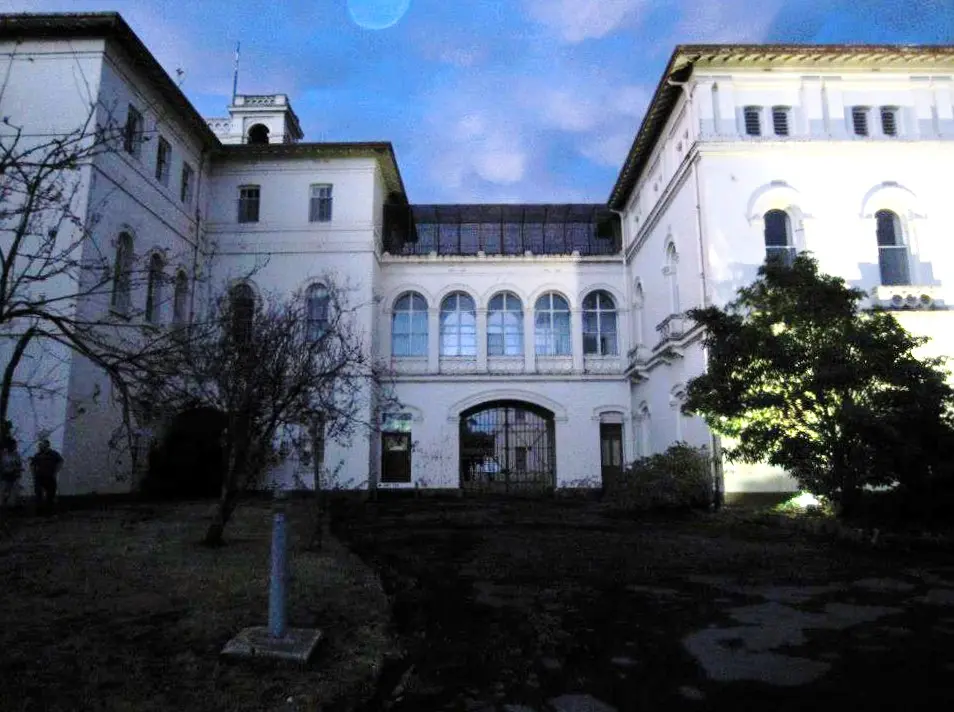
What went up on the hill was not a bluestone prison. The Victorian Heritage Register describes cement-rendered brick buildings in the Italianate manner: a vast main block with towers, a dining hall and kitchen, gate lodges, convalescent cottages, sun-shades, a fever tent, farm buildings and a morgue, twenty-three of which are individually listed in the 1996 registration notice along with five surviving trees. Around the airing courts ran a ha-ha: a trench with a vertical inner face and a sloping turfed outer face, so that a patient saw an unclimbable wall while a visitor saw a lawn. The whole institution was designed to look like anything but what it was.
Its names track a century of policy. The Lunacy Act 1903 turned every Victorian asylum into a "hospital for the insane" from March 1905; the Mental Hygiene Act 1933 turned them into "mental hospitals", and Ararat became the Ararat Mental Hospital in 1934. The name Aradale came last and came from the town: a local community competition in 1958 produced it, the Mental Health Authority adopted it, and it was never formalised in law.
J Ward was never part of this complex. It is a separate building on a separate street, about two kilometres away, built between 1859 and 1863 as the Ararat Gaol on the Pentonville model. When the goldfields emptied, the gaol was discontinued in 1886, and in December of that year it was proclaimed "J Ward" of the Ararat Asylum: a maximum-security ward for men detained in gaols, reformatories or industrial schools who had been certified insane by two medical practitioners and transferred on the Chief Secretary's warrant. It was meant to be temporary, and a purpose-built institution at Sunbury was to replace it, but when that building neared completion the government decided it would take women only, so the men stayed, and J Ward operated for over a century.
Part of Ararat became a training centre for people with intellectual disabilities in 1966, and then deinstitutionalisation closed everything. J Ward shut in January 1991 and was replaced by the twenty-bed, medium-security Ararat Forensic Psychiatry Centre. By 1993 the last patients and trainees had been moved into community housing, and in April 1994 the mental hospital and training centre were formally decommissioned. The forensic centre closed in 1997, its remaining patients transferred to Rosanna at Mont Park. Between December 2000 and August 2001 the empty forensic building briefly held fifty prisoners to relieve overcrowding elsewhere.
Then it became a vineyard: in May 2001 the state minister Lynne Kosky announced a 7.4 million dollar plan for an Australian College of Wine, run by the Northern Melbourne Institute of TAFE, later Melbourne Polytechnic; one of its two new teaching centres, with thirty hectares of vines and ten of olive trees, was to be "in Ararat on the site of the old Aradale hospital".
What survives of the patients is in the archive. The Public Record Office Victoria holds Ararat's case books, its nominal register of patients from 1867 to 1959, a seclusion register for 1869 to 1881, a register of complaints against staff running from 1871 to 1948, and a post-mortem register for 1906 to 1946.
Timeline: the documented record of Aradale Mental Hospital
- 1859-1863 The Ararat Gaol is built for the goldfields district on the Pentonville model, a high-security prison whose forbidding exterior was designed, in Heritage Victoria's words, as a physical and symbolic deterrent to crime.
- 1863 Victoria selects Ararat and Beechworth as the sites of its two country asylums, to relieve the colony's overcrowded institutions.
- 1 October 1867 The Government Gazette proclaims the Ararat Lunatic Asylum, which opens that month. Its buildings are cement-rendered brick in the Italianate style, not bluestone, and share their plan with Kew and Beechworth.
- 1870-1884 Three men are executed at the Ararat Gaol and buried inside its walls under the Criminal Law and Practice Statute 1864: Andrew Vere in 1870, Robert Francis Burns in 1883 and Henry Morgan in 1884. Their graves are the reason the site is also a listed archaeological place.
- December 1886 The disused gaol is proclaimed 'J Ward' of the Ararat Asylum, for men certified insane by two medical practitioners while held in gaols, reformatories or industrial schools. It is intended as a temporary measure and lasts more than a century.
- 1905 and 1934 The Lunacy Act 1903 renames every Victorian asylum a 'hospital for the insane' from March 1905, and the Mental Hygiene Act 1933 makes Ararat a 'mental hospital' in 1934. The labels change faster than the regime does.
- 1958 A local community competition produces the name Aradale. The Mental Health Authority adopts it, but the title is never formalised in law: the institution's legal name remains the Ararat Mental Hospital.
- 1966 Part of the hospital becomes the Ararat Training Centre. Patients identified as having an intellectual disability are reclassified as trainees and moved across.
- 20 August 1982 Aradale is entered in the Victorian Heritage Register as H1223, while the hospital is still running. The 1996 extent covers twenty-three buildings and structures, from the main block and the ha-ha wall to the morgue, plus five trees.
- January 1991 J Ward closes and is replaced by the twenty-bed Ararat Forensic Psychiatry Centre. The date is disputed between two state sources: the Public Record Office gives January 1991, while the heritage registration says the ward was decommissioned in 1989.
- 1993-1994 The last patients and trainees are relocated to community housing during 1993, and in April 1994 the mental hospital and training centre are formally decommissioned. Only the forensic centre remains, until it too closes in 1997.
- 15 May 2001 Minister Lynne Kosky announces a 7.4 million dollar plan for an Australian College of Wine, one of whose two new teaching centres, with thirty hectares of vines and ten of olive trees, is to be 'in Ararat on the site of the old Aradale hospital', run by the Northern Melbourne Institute of TAFE, later Melbourne Polytechnic.
- 2015 The volunteer body that runs the day tours states on its website: 'We do not conduct night tours of Aradale and have no connection to Aradale Ghost Tours.' The heritage tour and the ghost business have been separate operations from the start.
- August 2026 Both sites are open by guided tour only: Friends of J Ward volunteers by day at Aradale and daily at J Ward, and Eerie Tours by night at Aradale. The domain of the original ghost tour company no longer resolves.
Is there a rational explanation for Aradale Mental Hospital?
The people who show visitors around Aradale disclaim any knowledge of its patients. The Friends of J Ward, the volunteers who run the day tours at both sites, state on their own booking page, read on 4 October 2026, that "the guides do not have access to records or have knowledge of former patients or medical procedures". What survives of those records is held by the Public Record Office Victoria: the case books, the nominal register of patients from 1867 to 1959 and a post-mortem register for 1906 to 1946.
It also matters who is telling the story. Two organisations work at the same address with very different aims. In 2015 the Friends of J Ward stated flatly on their website: "We do not conduct night tours of Aradale and have no connection to Aradale Ghost Tours." The paranormal reputation was the night business's to sell. That company's domain, aradaleghosttours.com.au, returned no address on 4 October 2026, and its pages archived in 2020 and 2021 show it recycled into a travel-advice blog with filler articles on lunch recipes. The ghost tour at Aradale is now sold by Eerie Tours, which advertises "professional theatrical historians", night tours of two and four hours, and paranormal investigations of three and six.
Those tours run after dark through a complex of long rendered corridors, for groups who have paid to be frightened. And one figure on the operator's page reads larger than it is. When Eerie Tours says that "over almost 130 years, the lunatic asylum housed thousands of patients", that is a cumulative count of admissions between 1867 and the last transfers in 1993. The Friends' own website gave a different kind of figure in 2015, "up to 900 patients yearly", on a page that also dated the opening to 1865 and the closure to 1998, both wrong by the Public Record Office's account.
Can you visit Aradale Mental Hospital?
Aradale and J Ward are two separate sites in Ararat, both shown to the public by the volunteers of Friends of J Ward Inc., and on 23 September 2026 only one of them was open. A notice on the Friends' Aradale page, still up that day, says that as of Friday 21 August 2026, "due to safety concerns, our tours of the Aradale Asylum have been suspended by Melbourne Polytechnic (whom we lease from) until further notice". Melbourne Polytechnic in turn leases the property from the state government. The ABC reported on 25 August that its inspection had "identified a number of safety concerns requiring further investigation and assessment", and that the closure applied to the affected areas of the site. The night tours of the commercial operator Eerie Tours are marked as temporarily closed on its own page; its owner, Nathaniel Buchanan, told the ABC in mid-September that he had been told repairs would start soon and hoped to resume within six weeks. This is the second such stoppage: tours were closed in August 2019 over lead in the dust of deteriorating paint.
When the Aradale tours run, the terms published by the Friends are these. Day tours leave from the Grano Street entrance on Sundays and Wednesdays at 10:00 and last about two hours. Adults pay A$22, concessions A$18, children aged 5 to 16 A$8 and students A$15; a family ticket for two adults and two children is A$50, and groups of ten or more pay A$18 a head. The route has stairs and no wheelchair access, and under Melbourne Polytechnic's health and safety policy the tours are cancelled, with a refund, on any day of Total Fire Ban in the South West Fire District. Eerie Tours lists a two-hour ghost tour at A$50 and a four-hour version at A$100 on Fridays and Saturdays, for ages 12 and over, meeting in Heath Street, with about 300 steps and a limit of 30 people.
J Ward, the former gaol that became the asylum's ward for the criminally insane, is in Girdlestone Street, in the town, and according to the same ABC report it remains open. Tours run Monday to Friday at 10:00 and 13:00, and at 10:00, 11:00, 13:00 and 14:00 on weekends and on Victorian public and school holidays, except Christmas Day, and take between one hour and an hour and a half. Prices on the Friends' page on 23 September 2026: adults A$17, concessions A$15, ages 5 to 16 A$8, students A$15, school groups A$6 a head, under-fives free. The buildings date from 1859-1861 and have steps at the front door, with an alternative entrance arranged through the front desk on 5352 2703; the upper level of the main cell block and the underground kitchen can only be reached by stairs. There is an accessible toilet, and certified assistance dogs are admitted.
The Discovery Centre at J Ward opens on Saturdays from 11:00 to 13:00 and on Sundays from 11:00 to 14:00, costs A$5 for adults and nothing under 16, and gives access to archived records without a tour. The bulk of the institution's own records is held by the Public Record Office Victoria, as agency VA 2841.
Sources consulted
- Public Record Office Victoria, «Agency VA 2841 — Ararat (Asylum 1867-1905; Hospital for the Insane 1905-1934; Mental Hospital 1934-1993; Training Centre 1966-1993; Ararat Forensic Psychiatry Centre 1991-1997)» — PROV archival collection, 2026 archive
- Public Record Office Victoria, «Agency VA 4140 — Ararat Gaol» — PROV archival collection, 2026 archive
- Heritage Victoria, «ARADALE — Victorian Heritage Register H1223, statement of significance and extent of registration» — Victorian Heritage Database, 1996 report
- Heritage Victoria, «FORMER ARARAT GAOL — Victorian Heritage Register H1067, statement of significance» — Victorian Heritage Database, 2008 report
- Heritage Victoria, «J WARD (ARARAT ASYLUM) — Victorian Heritage Inventory H7423-0084, history and archaeological significance» — Victorian Heritage Database, 2008 report
- Lynne Kosky, Minister for Post Compulsory Education, Training and Employment, «State-of-the-Art Australian College of Wine (ministerial statement, State Budget 2001)» — Victorian Government, 2001 report
- Friends of J Ward Inc., «Book your visit — J Ward, Ararat's Old Gaol and Lunatic Asylum» — jward.org.au, 2026 web
- Friends of J Ward Inc., «Book your visit — Aradale, Lunatic Asylum» — aradale.com.au, 2026 web
- Friends of J Ward Inc., «Aradale (archived site, capture of 10 August 2015)» — Internet Archive Wayback Machine, 2015 archive
- Eerie Tours, «Aradale Ghost Tour» — eerietours.com.au, 2026 web
- Wikipedia contributors, «Aradale Mental Hospital (article giving the closure year as 1998, the origin of the error corrected here)» — Wikipedia, 2026 web
Reviewed by V. Serrano on 2026-08-11 · How we verify our content
💬 Field testimonies (0)
No testimonies yet. Add the first.
Add your testimony
🔒 Log in to add a testimony