📜 LEGEND · EXP. Nº0270
ACTIVE
The Rainbow Serpent
“Rainbow Serpent” and “Dreamtime” are both English inventions, and both can be dated.
Where does the legend of The Rainbow Serpent come from?
- Location
- Ubirr, Kakadu National Park (Northern Territory), Australia
- Kind of legend
- Myth
- Coordinates
- -12.411, 132.958
- Last updated
LOCATION
What is the legend of The Rainbow Serpent?
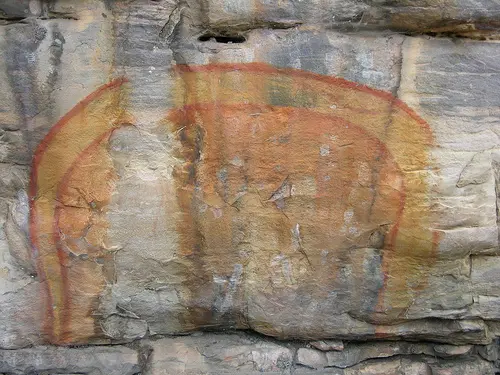
“Dream-times” first appears on page 185 of a paper by Francis James Gillen, the Alice Springs telegraph stationmaster, in the 1896 Horn Expedition report; it does not survive into Spencer and Gillen's famous 1899 book, which glosses Alcheringa as “the far past times” and uses the word “dream” five times in 240,000 words, never as a translation. “Rainbow Serpent” was fixed as a pan-Australian category by A. R. Radcliffe-Brown in 1926, and the printed index to volume I of Oceania shows the merger happening: three fieldworkers describing three different regions, filed in 1930 under one heading. The beings underneath are not one. In Bininj Kunwok, Ngalyod is female, the daughter of Yingarna the mother rainbow serpent, and the dictionary speaks of rainbow serpents in the plural, living in deep waterholes, still detectable by marrkidjbu. The oldest evidence is painted, in a rock-art style reputed to be 4,000 to 6,000 years old, and its figure is shaped, one archaeological argument holds, like a small marine pipefish.
What is the history of The Rainbow Serpent?
Two of the four words in the title of this file are English inventions with a date, an author and a page number. The beings they were placed on top of are older, more numerous, and mostly female.
Start with the second word. In September 1896 the Carlton printers Ford and Son turned out Part IV — Anthropology of the Report on the Work of the Horn Scientific Expedition to Central Australia, edited by Baldwin Spencer. Pages 161 to 196 carry a separate paper by Francis James Gillen, the post and telegraph stationmaster at Alice Springs, who was also Special Magistrate and Sub-Protector of Aborigines. On page 185, explaining how the Arrernte account for fire, Gillen writes that their ancestors lived in the distant past, ulchurringa, "which really means in the dream-times, for this is the manner in which the natives always speak of the long ago". That sentence is the earliest use on record of the English expression. The phrase is in the plural, comes as an aside between commas and sits in a paper about how fire is made.
The expression then vanishes. Spencer and Gillen's famous monograph of 1899, The Native Tribes of Central Australia, runs to roughly 240,000 words and uses "Alcheringa" 298 times; the word "dream" occurs five times in the whole book and never once as a translation of it. The footnote on page 73 says only "the name applied to the far distant past with which the earliest traditions of the tribe deal", and the glossary repeats it: "Name given to the far past times in which the mythical ancestors of the tribe are supposed to have lived". When W. E. H. Stanner opened his 1953 essay The Dreaming by crediting "Spencer and Gillen" with having "immortalised" the phrase, he was, as the linguists Cliff Goddard and Anna Wierzbicka put it in 2015, "speaking somewhat loosely": they trace it back past Spencer, past the 1899 book, to Gillen alone, in 1896, on page 185. Behind Gillen stand the Arrernte speakers who gave him the word, and they are named nowhere.
Now the label. In 1926 A. R. Radcliffe-Brown published "The Rainbow-Serpent Myth of Australia" in the Journal of the Royal Anthropological Institute (volume 56, pages 19-25), assembling accounts from peoples across the south-east — Kamilaroi, Yuwaalaraay, Wiradjuri, Wongaibon, Weilwan — under a single heading. Catherine H. Berndt, writing the Encyclopedia of Religion entry on the subject in 1987, quotes the position he reached: the being was "perhaps the most important nature-deity", the embodiment of "the creative and destructive power of nature".
The moment the category hardened can be read off a printed index. The October-December 1930 issue of Oceania, the journal's first volume, carried three papers on the same theme at once: Radcliffe-Brown on the south-east, Ursula McConnel on North Queensland, A. P. Elkin on the north-west, with Ralph Piddington on the Karadjeri water-serpent alongside. When the volume was indexed, all of them were filed under one entry — "Rainbow-Serpent— in North Queensland .. 347, 348 / in North-West Australia 349-351 / in South-East Australia 342-346" — with a cross-reference reading "Serpent myths. See Rainbow-Serpent". Three regions, three fieldworkers, three sets of beings, one heading. The pan-Australian Rainbow Serpent is visible there being made.
The beings themselves are the part the label flattens. In Bininj Kunwok, the language of western Arnhem Land and part of Kakadu, the community language centre's dictionary carries ngalyod as a headword: "Rainbow serpent, daughter of the Mother One Rainbow Yingarna. The rainbow serpent is a central figure in traditional Bininj religion. She is the creator of places and is active during the wet season and is associated with rain and bodies of water. Rainbow serpents live in deep waterholes and rivers. Marrkidjbu are able to discern their presence and control them." Four things in that entry contradict the standard English retelling. She is female — the dictionary's grammar note explains that "the feminine prefix reflects the conception of the rainbow serpent as a generative figure, 'the mother one'". She is a daughter: the entry for Yingarna gives "Mother rainbow serpent, the mother of ngalyod, really 'biggest one'", a "female creation ancestor, who emerged from the sea to the north and travelled throughout many lands", dropping off particular people and foods in particular places and telling each which language to speak. There is more than one of them: the entry says rainbow serpents, plural, live in deep waterholes. And the dictionary places them in the present, since marrkidjbu, defined as men "with special supernatural power", can still detect and control them.
The same dictionary shows how deep the being runs in the vocabulary. Delek, the white ochre used in painting, is defined as kaolin and huntite, with the note that it "is believed to be the faeces or vomitus of ngalyod", and a named djang or sacred site for it at kudjarnngal near Manmoyi. Larraddi is an intransitive verb that exists for one purpose: "there is a light given off by Ngalyod (the Rainbow Serpent), esp. in the sky in the distance". The entry for ngalmudj lists the regional forms: ngalyod in Kunwinjku and Kuninjku, ngalmudj in Kune, almudj in Kundjeyhmi, the Kakadu language, with bolung given as a synonym. Each variety of the language has its own name for the being.
The oldest evidence is on rock. In 1996 Paul Taçon, Meredith Wilson and Christopher Chippindale published "Birth of the Rainbow Serpent in Arnhem Land rock art and oral history" in Archaeology in Oceania, analysing 107 painted images and comparing the stories with "'Yam Style' Rainbow Serpents, reputed to be 4000–6000 years of age". They argued that the odd anatomy of the early figures — the snout, the projections behind the head, the trailer, the spines on the tail — matches a small marine fish better than any snake: the ribboned pipefish Haliichthys taeniophorus of the northern Australian coast, which would have arrived in country as post-glacial seas flooded the plains. At Ubirr in Kakadu, Parks Australia records that the Rainbow Serpent "painted her image on the rock as she passed through Ubirr to remind people of her presence" — the pronoun in the park's own text is her.
Timeline: the documented record of The Rainbow Serpent
- September 1896 Francis James Gillen, post and telegraph stationmaster at Alice Springs, writes on page 185 of his paper in Part IV of the Horn Expedition report that the Arrernte ancestors lived in the distant past, ulchurringa, "which really means in the dream-times, for this is the manner in which the natives always speak of the long ago". It is the earliest recorded use of the English expression, in the plural, inside a parenthesis, in a paper about how fire is made.
- 1899 Spencer and Gillen publish The Native Tribes of Central Australia without the gloss. In roughly 240,000 words the book uses "Alcheringa" 298 times and "dream" five times, none of them as a translation; the footnote and the glossary both render it as the far past. The English phrase that would conquer the world drops out of the book that made its authors famous.
- 1926 A. R. Radcliffe-Brown publishes "The Rainbow-Serpent Myth of Australia" in the Journal of the Royal Anthropological Institute, volume 56, pages 19-25, gathering accounts from south-eastern peoples under a single English heading and treating them as versions of one myth.
- October-December 1930 Volume 1, issue 3 of Oceania carries three regional papers at once — Radcliffe-Brown on the south-east (342-346), Ursula McConnel on North Queensland (347-348), A. P. Elkin on the north-west (349-351) — plus Ralph Piddington on the Karadjeri water-serpent. The printed index to the volume files all three under one heading, "Rainbow-Serpent", with the cross-reference "Serpent myths. See Rainbow-Serpent". The pan-Australian category can be watched being assembled in a table of contents.
- 1953 W. E. H. Stanner opens his essay "The Dreaming" by crediting the phrase to "Spencer and Gillen", who, he writes, "immortalised" it as "the dreamtime" or alcheringa of the Arunta. The attribution stuck for sixty years and is off by one author and three years.
- 1987 Catherine H. Berndt writes the Encyclopedia of Religion entry "Rainbow Snake". She reports Radcliffe-Brown's conclusion that the being is "perhaps the most important nature-deity", and adds the observation that undercuts the category: even among Aboriginal people the name can be applied to snakes with no obvious rainbow connection.
- 1996 Paul Taçon, Meredith Wilson and Christopher Chippindale analyse 107 painted images in Archaeology in Oceania, compare the earliest Rainbow Serpent figures with 'Yam Style' paintings reputed to be 4,000 to 6,000 years old, and argue that their anatomy matches the ribboned pipefish, Haliichthys taeniophorus, a coastal fish that would have appeared inland as post-glacial seas flooded the plains.
- 2014 Christine Nicholls publishes a four-part series arguing that "Dreamtime" and "The Dreaming" are grossly inadequate English translations and that the words to use are the ones the languages already have: Jukurrpa, Altyerr, Ungud, Ngarrankarni, Manguny, Wongar.
- 28 October 2021 The historian Shino Konishi publishes an essay describing what settler Australia did with the being as "intellectual colonisation": domesticating it into something comprehensible and palatable to Western ideas, rather than understanding it. She names Yingarna and her child Ngalyod among the Kunwinjku and the Waugal among the Noongar, and notes that before colonisation there were around 250 Aboriginal languages, each with its own Dreaming stories.
Is there a rational explanation for The Rainbow Serpent?
The claim most often attached to the Rainbow Serpent is its age: that its stories are among the oldest continuous traditions in the world. The claim can be traced to its authors: when Paul Taçon, Meredith Wilson and Christopher Chippindale published their paper in Archaeology in Oceania in October 1996, Times Higher Education reported on 1 November that Taçon called the being "a continuous religious icon and the core of a religious system that goes back 6,000 years and continues to the present day", and that Chippindale called it "the longest continuous (religious) tradition that has been traced". Shino Konishi repeated the strong form in 2021: the oldest paintings "have been dated to 6000 years, supporting the argument that Rainbow Serpent stories are among the world's oldest continuous religious traditions".
That sentence joins two kinds of evidence: one is a sequence of images on rock, which archaeologists can order and roughly date. The other is oral narrative, whose written record begins with colonial observers; the earliest that Konishi cites is Francis Armstrong, interpreter to the Swan River Colony, describing the Noongar Waugal in 1836. The 1996 paper's own abstract is more guarded than its authors were with the press. It compares the stories with "'Yam Style' Rainbow Serpents, reputed to be 4000–6000 years of age", and argues that "an archaeological context for many of the more significant aspects of Rainbow Serpent oral history can be found over several millennia". An age range attached to a painting style is a different measurement from a laboratory date on the pigment of a named painting, and a likeness between an old image and a story told today leaves the age of the story open.
The singular is the second weak point: Catherine Berndt, in 1987, wrote that "even among traditionally oriented Aborigines, the name Rainbow Snake can apply to snakes with no obvious rainbow connections", and that such beings "may have quasi-crocodile shapes". The Bininj Kunwok dictionary uses the plural, "Rainbow serpents live in deep waterholes and rivers", and distinguishes Yingarna from her daughter Ngalyod. The printed index to the first volume of Oceania shows the merger being made on paper: three fieldworkers describing three regions in 1930, filed under one heading. Konishi traces the single being to Radcliffe-Brown, who "assumed that there was just a single Rainbow Serpent, and that it was akin to a god".
The pipefish argument is a resemblance argument: Taçon and his co-authors held that the anatomy of the early painted figures is closer to the ribboned pipefish than to any snake, and in the 1996 report Chippindale credited Wilson as "the first to compare them with the pipefish". His summary of the sequence was that "the rainbow serpent starts off as closely following the form of a pipefish, then as time passes it takes a more varied form".
One caution matters more than the others: Aboriginal knowledge is not uniformly public, and Bininj Kunwok has words for the distinction: bolkdjamun is a "sacred place, restricted place", and darrinj means "in the public domain, non-secret knowledge or a place which is open to general public access". Everything in this entry is drawn from published dictionary entries, peer-reviewed archaeology and the national park's own signage and website, the darrinj side of that line. Where a fuller account exists, it belongs to the people who hold it.
Can you visit The Rainbow Serpent?
The beings gathered under this English label belong to many different countries, from the Kimberley to Cape York and the Swan River, so no single place stands for them. The pin marks Ubirr, in the East Alligator (Erre) region of Kakadu National Park, Northern Territory, where Parks Australia's own page on the site names the Rainbow Serpent "who painted her image on the rock as she passed through Ubirr". The park's map point is -12.411359, 132.957727, which the pin on this file matches to within a few metres. It lies about 32 km north-north-east of Jabiru, the park township, and about 230 km east of Darwin, both in a straight line.
Parks Australia's walk page, read on 23 September 2026, describes a 1 km loop of Grade 2 on a hardened surface, with a steep 250 m climb to a rocky lookout over the Nadab floodplain; the area around the main art site is flat and accessible to wheelchairs. The road is suitable for 2WD vehicles. The rock-art page lists X-ray paintings from the last 1,500 years of fish, waterfowl, mussels, wallabies, goanna, echidnas and yams, a thylacine, and a contact-period figure of "a white fella shown wearing a shirt, boots and with his hands in his pockets", probably an early buffalo hunter painted in the 1880s. The same pages record that alcohol is not permitted at Ubirr "for cultural reasons". Burrungkuy (Nourlangie), the other major rock-art site, opens its gates from 07:00 to 19:00 daily.
A park pass is required. The passes page, read on 23 September 2026, prices it by season: from 15 May to 31 October, $40 adult, $20 child aged 5-15, $30 concession and $100 family; from 1 November to 14 May, $25, $12.50, $19 and $65. It adds that passes bought to visit between 1 July and 31 October 2026 are charged at wet-season rates. Passes are valid for seven days, are free for Northern Territory residents, and are sold online, at the Bowali Visitor Centre and at Cooinda Lodge.
In the tropical summer Magela Creek floods and Ubirr is reached across it on the Guluyambi boat cruise. Parks Australia's Kakadu Access Report, last updated on 11 September 2026 when read, listed Ubirr and Burrungkuy as open and Cahills Crossing as "open with risks", with water over the crossing.
The park's culture page opens with "The Aboriginal Traditional Owners welcome you to Kakadu National Park" and says that its people are called Bininj in the north of the park and Mungguy in the south. It asks visitors not to enter restricted areas, which "may be sacred sites, ceremonial sites, burial grounds or even someone's home", and says that it is "good manners not to take photographs of us without permission". East of the East Alligator River, which at Cahills Crossing marks the boundary between the park and the Arnhem Land Aboriginal Land Trust, the Northern Land Council states that "entry to Aboriginal land requires a written permit"; it asks applicants to allow up to 10 days for processing and says that in most cases there is no charge.
Sources consulted
- Francis James Gillen, «Notes on some Manners and Customs of the Aborigines of the McDonnell Ranges belonging to the Arunta Tribe, in Report on the Work of the Horn Scientific Expedition to Central Australia, Part IV — Anthropology, ed. Baldwin Spencer, pp. 161-196. The "dream-times" passage is on p. 185. Read in the University of Illinois scan (80,048 words); "dream" occurs twice in the whole volume, of which this is one.» — Dulau and Co., London / Melville, Mullen and Slade, Melbourne, 1896 archive
- Baldwin Spencer and Francis James Gillen, «The Native Tribes of Central Australia. Read in the University of Toronto scan (239,931 words): "Alcheringa" 298 occurrences, "dream" 5 and none of them a gloss, "rainbow" 0. Footnote to p. 73 and the glossary entry for Alcheringa are the source of "the far distant past" and "the far past times".» — Macmillan, London, 1899 book
- Oceania (Australian National Research Council), «Index to Volume I, Oceania 1930-1931. Source of the single heading "Rainbow-Serpent — in North Queensland 347, 348; in North-West Australia 349-351; in South-East Australia 342-346" and of the cross-reference "Serpent myths. See Rainbow-Serpent".» — Oceania, volume I index, 1930 archive
- A. R. Radcliffe-Brown, «The Rainbow-Serpent Myth of Australia, Journal of the Royal Anthropological Institute of Great Britain and Ireland 56: 19-25. Cited for the existence, date and scope of the article; the full text was not read.» — Journal of the Royal Anthropological Institute, 1926 academic
- Bininj Kunwok Regional Language Centre, «Bininj Kunwok Dictionary, read in the dictionary data file (njamed.com/data/normalized-entries.json) on 1 October 2026, 2,445 headword entries. Headwords cited: ngalyod, Yingarna, ngalmudj, delek, larraddi, marrkidjbu, djang, bolkdjamun, darrinj. Twenty-eight entries carry the semantic domain "mythology".» — Bininj Kunwok Regional Language Centre, Jabiru, 2026 archive
- Paul S. C. Taçon, Meredith Wilson and Christopher Chippindale, «Birth of the Rainbow Serpent in Arnhem Land rock art and oral history, Archaeology in Oceania 31(3): 103-124. Paywalled; the abstract (read via Crossref) gives the 107 images analysed and the comparison with 'Yam Style' Rainbow Serpents "reputed to be 4000–6000 years of age"; the pipefish identification comes from published summaries and from the Times Higher Education report of 1 November 1996.» — Archaeology in Oceania, 1996 academic
- Catherine H. Berndt, «Rainbow Snake, entry in the Encyclopedia of Religion (revised bibliography). Source of the summary of Radcliffe-Brown's "perhaps the most important nature-deity" and of the note that the name is applied to snakes with no obvious rainbow connection.» — Encyclopedia of Religion, Macmillan, 1987 book
- Cliff Goddard and Anna Wierzbicka, «What does Jukurrpa ('Dreamtime', 'the Dreaming') mean? A semantic and conceptual journey of discovery, Australian Aboriginal Studies 2015/1. Note 2 traces the phrase to "Gillen 1896: 185" and calls Stanner's attribution to Spencer and Gillen "speaking somewhat loosely"; §1 quotes Stanner's 1953 opening.» — Australian Aboriginal Studies (AIATSIS), open access via the ANU Open Research Repository, 2015 academic
- Christine Judith Nicholls, «'Dreamtime' and 'The Dreaming': who dreamed up these terms?» — The Conversation, 2014 web
- Shino Konishi, «Friday essay: creation, destruction and appropriation — the powerful symbolism of the Rainbow Serpent» — The Conversation, 2021 web
- Parks Australia, «Ubirr — Kakadu National Park. Source of the park's own map point (-12.411359, 132.957727), the 2WD access, the Guluyambi crossing of Magela Creek, the X-ray and contact-period paintings, and the sentence that the Rainbow Serpent "painted her image on the rock as she passed through Ubirr".» — Kakadu National Park (kakadu.gov.au), 2026 report
- Parks Australia, «Park passes — Kakadu National Park. Prices and season dates as published in August 2026; passes valid seven days, Northern Territory residents exempt.» — Kakadu National Park (kakadu.gov.au), 2026 report
- Northern Land Council, «Permits: access to Aboriginal land in the Top End» — Northern Land Council (official), 2026 report
- Unsigned, «Serpent is core of a religion (report on the Taçon, Wilson and Chippindale study, with quotations from Taçon and Chippindale on the 6,000-year 'continuous' tradition and on Wilson's pipefish comparison)» — Times Higher Education, 1 November 1996, 1996 newspaper archive
Reviewed by V. Serrano on 2026-08-17 · How we verify our content
📎 Source: Enigma Atlas
💬 Field testimonies (0)
No testimonies yet. Add the first.
Add your testimony
🔒 Log in to add a testimony