👻 HAUNTED PLACE · EXP. Nº9475
ACTIVE
Princess Theatre (Melbourne)
Melbourne's Princess Theatre had been open barely fifteen months when, on Saturday 3 March 1888, the baritone Frederick Federici died in it.
Where is Princess Theatre (Melbourne)?
- Location
- Victoria, Australia
- Type
- Theater
- Coordinates
- -37.811, 144.972
- Last updated
LOCATION
Why is Princess Theatre (Melbourne) said to be haunted?
At the close of the first English-language performance of Gounod's Faust he was going down to hell on the Corsican trap beside C. H. Leumaine's Faust; Table Talk reported six days later that he fell onto the gasman working the stage lights just before the platform reached the cellar floor, and that his own doctor failed to revive him in the green room. The audience had already dispersed and never knew. Out of that night grew the ghost story The Argus called "Australia's greatest theatre legend" in 1946 — and that same article, the earliest printed telling that can be dated, names its witness, records that the legend then said Federici broke his neck, and explains away an early sighting as a street carbon light reflecting through a window in strong wind. The Marriner Group, which owns the Princess and named its bistro after him, says Federici "continues to reside" there. What it does not say, and what no source found here can date, is that a seat is still kept empty for him.
What is the history of Princess Theatre (Melbourne)?
The Princess Theatre is the building Frederick Federici died in, and when he died it was barely fifteen months old.
The Victorian Heritage Register records that the site was first occupied in 1854 by Astley's Amphitheatre, a corrugated-iron equestrian ring seating more than 2,000 people. It was remodelled and reopened in 1857 as the Princess's Theatre and Opera House under the Melbourne theatrical figure George Coppin. By 1886, the Register notes, it was reckoned the fourteenth theatre erected in Melbourne, of which only four were still trading.
When the first Princess came down is not agreed. The Register says 1885. But The Argus, describing the replacement on 11 December 1886, wrote that "some eight months ago the old Princess's Theatre went the way of all buildings" - which puts the demolition around April 1886 and matches the nine-month build the present owner claims. The contemporary newspaper and the modern register disagree by roughly a year, and the newspaper was there.
The new house was designed by William Pitt for the partnership of Williamson, Garner and Musgrove - the "Triumvirate" that included J. C. Williamson - and built by Cockram (The Argus names "Messrs. Cockram and Comley"; the Register says Cockram and Company). The Argus put the outlay at about 40,000 pounds; the Marriner Group, the theatre's owner today, says 50,000.
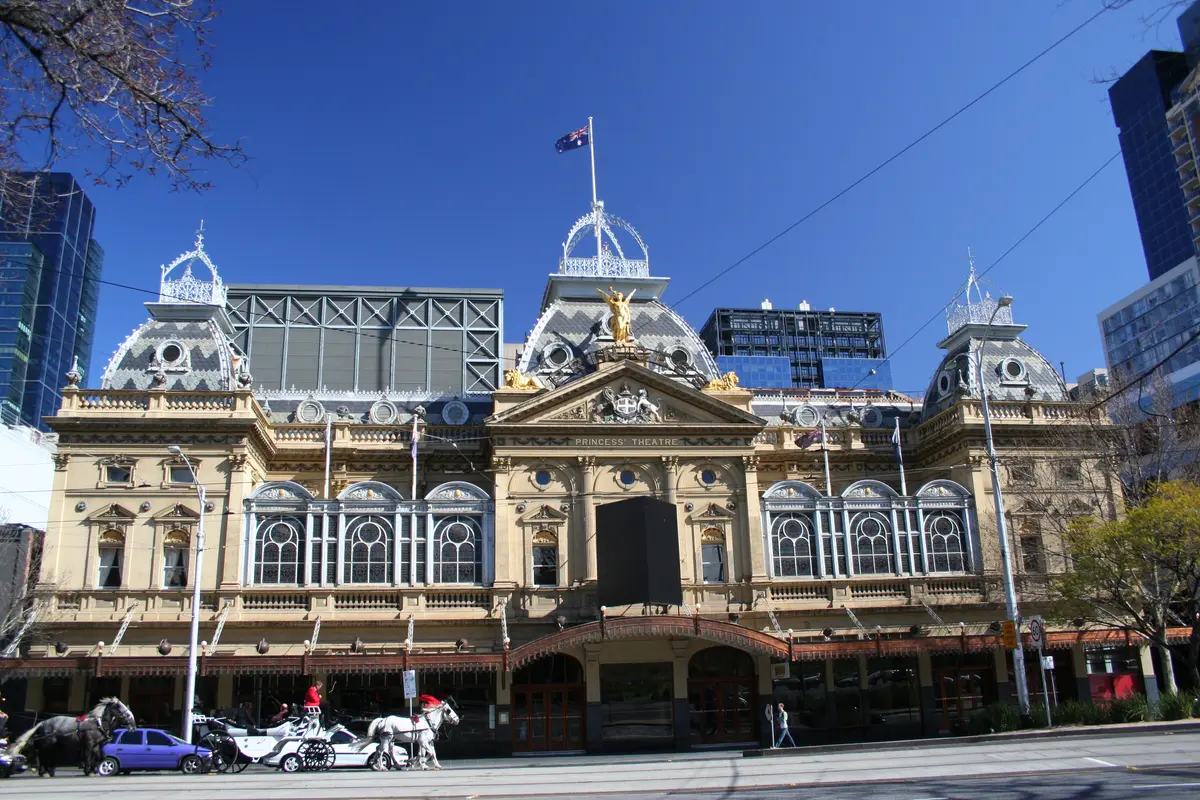
The Argus walked its readers through the finished building a week before it opened, and much of what it described is still on the facade in Spring Street: three dominant bays whose "mansard pyramidal domes" carry crests of cast-iron scrollwork, piers of Malmsbury bluestone, a frieze festooned with laurel wreaths, the British coat of arms in relief and above it "a nicely modelled figure of the goddess or herald Fame, flanked on either side by lions couchant". The interior scheme was by the scenic artist George Gordon and used almost nothing but peacock blue, warm cream and dead gold. The auditorium was lit by electricity alone.
Its famous trick was the ceiling. The Argus explained that the painted dome "is so arranged that by an easy mechanical contrivance it can be shot back, showing for a space of 24ft the sky above", calling it "a cool prospect for a crowded audience on an Australian summer's night". Cool air was also drawn in through two artificial fern grottoes with a trickling cascade, revealed between the acts. How large a claim that deserves depends on who makes it: the Marriner Group calls it "the world's first sliding or retractable roof", Wikipedia calls it Australia's first, and the Victorian Heritage Register - the statutory authority - says only that the sliding roof and ceiling, with their eight-metre circular opening, were "one of the first applications of such a feature in Victoria".
Style is contested too. The Register and the owner both call the building French Second Empire; The Argus in 1886 called it "Italian Renaissance" with "occasional suggestions of the French style". The theatre opened on Saturday 18 December 1886 with The Mikado.
Federici was born Frederick Baker in Florence on 23 April 1850, according to David Stone's roll of D'Oyly Carte performers. Table Talk, reporting his death, said he came "of a good English family" and was a cousin of the soldier Valentine Baker, later Baker Pasha; that he had been educated for the diplomatic service and spoke four or five languages; and that at twenty-three he turned to music, studying six years in Milan under Trivulzi and Lamperti and then with Sims Reeves. He sang first on the London concert platform, then in grand opera at Drury Lane under Mapleson, and had already played Mephistopheles in Faust in Paris before Gilbert and Sullivan claimed him.
Stone traces that second career in detail: Captain Corcoran in H.M.S. Pinafore from July 1879; the Pirate King in the single copyright performance of The Pirates of Penzance at Paignton on 30 December 1879; Colonel Calverley in Patience; Strephon in Iolanthe; Florian in Princess Ida; and on 27 July 1885 the title role in his company's first Mikado, which took him to New York's Fifth Avenue Theatre as Carte's first American Mikado, then to Germany and Austria, then back to New York for Ruddygore. He married a fellow D'Oyly Carte artist, Lena Monmouth, who performed as Miss Monmouth.
George Musgrove telegraphed for him in 1887 and he sailed within a week. He first appeared at the Princess's on 16 July 1887 as Florian in the first Australian Princess Ida, and in eight months played Harry Sherwood and Squire Bantam in Dorothy, the Mikado, the Pirate King, Dick Deadeye, the Marquis de Pontvert in Erminie, Colonel Calverley and Strephon.
On Saturday 3 March 1888 the company gave the first performance of Faust in English, and Table Talk's account six days later is the fullest contemporary description of what happened. Federici sang Mephistopheles; C. H. Leumaine sang Faust; and at the close of the opera the two men went down together to "the infernal regions" on the Corsican trap, so named because it was first used in The Corsican Brothers. Federici was seen to raise an arm feebly, "indicating that he was completely worn out". Just before the platform reached the cellar floor the gasman working the steam pipe that regulated the stage lighting saw him lean forward as if fainting, and the next instant Federici fell onto the man's shoulders; Leumaine, who "felt the dying man's touch", fell off the platform.
He was carried to the green room. Dr Wilmott, his own physician, was in the house and reached him quickly, applied a galvanic battery and other restoratives, and failed. Table Talk described the scene precisely: the dead man lying full length in the red costume of Mephistopheles, his crimson hood, pointed shoes and cap scattered near him, surrounded by colleagues still in costume and by his wife. The cause it gave was heart disease "from which he had for years been a sufferer", aggravated by overwork and first-night nerves.
The funeral left his lodgings in Gipps Street, East Melbourne, at two o'clock on Monday 5 March, with a plumed hearse, four mourning coaches and a long train of private carriages, and went to the Church of England portion of the Melbourne General Cemetery, to a grave near those of the actors F. M. Bates, Gerald Eyre and Phil Day. The pall bearers were J. C. Williamson, Arthur Garner, George Musgrove, Herbert Fleming, W. Forlonge, Knight Aston and Leumaine. The Rev. E. H. Goodwin, visibly shaken from the start, collapsed in a fainting fit as the coffin was lowered and could not finish the service; at the pall bearers' request the actor Charles Warner read it instead. The Princess' Theatre closed that evening as a mark of respect.
The theatre did not stay the building he died in for long. The Register records that in 1922 the theatre architect Henry E. White re-planned and reconstructed both auditorium and stage and redecorated the interior in a delicate "Adam" style; the house ran as a full-time cinema from 1942 to 1947; and a 1989 restoration by Axia, Greenhatch and Allom Lovell installed a new flytower. It was entered on the Victorian Heritage Register as H0093 by a gazettal of Wednesday 9 October 1974.
Timeline: the documented record of Princess Theatre (Melbourne)
- 1854 Astley's Amphitheatre, a corrugated-iron equestrian ring seating over 2,000, becomes the first place of entertainment on the Spring Street site, according to the Victorian Heritage Register.
- 1857 The amphitheatre is remodelled and reopens as the Princess's Theatre and Opera House under the Melbourne theatrical figure George Coppin.
- 11 December 1886 A week before the opening, The Argus describes William Pitt's new theatre in detail, including the dome that "by an easy mechanical contrivance… can be shot back, showing for a space of 24ft the sky above". It puts the cost at about 40,000 pounds and names the contractors as Cockram and Comley.
- 18 December 1886 The rebuilt Princess Theatre opens with The Mikado, according to the Marriner Group. The date falls on a Saturday.
- 16 July 1887 Federici makes his first Melbourne appearance at the Princess's as Florian in the first Australian production of Princess Ida, weeks after George Musgrove telegraphed for him in England.
- Saturday 3 March 1888 At the close of the first English-language performance of Gounod's Faust, Federici and C. H. Leumaine descend together on the Corsican trap. Federici falls onto the gasman working the steam pipe just before the platform reaches the cellar floor; Dr Wilmott fails to revive him in the green room. Table Talk attributes the death to heart disease he had suffered for years.
- Monday 5 March 1888 The funeral leaves his lodgings in Gipps Street, East Melbourne, at two o'clock for the Church of England portion of the Melbourne General Cemetery. The Rev. E. H. Goodwin faints as the coffin is lowered and the actor Charles Warner reads the rest of the service. The theatre closes that evening.
- Friday 9 March 1888 Table Talk publishes the fullest contemporary account of the death, the funeral and Federici's career, naming his wife's stage name, Miss Monmouth. There is no ghost in it.
- 8-10 March 1919 The Rigo Grand Opera Company brings Faust back to the Princess. Reviewing the Saturday performance, The Argus writes that "the omission of Faust's descent into the nether regions was appreciated", on the grounds that a realistic damnation is dramatically unnecessary and rarely effective. Federici is not mentioned.
- 1922 The theatre architect Henry E. White re-plans and reconstructs both auditorium and stage and redecorates the interior in a delicate "Adam" style, altering the building in which the death occurred.
- 1923 Nellie Stewart, who according to The Argus sang Marguerite that night, publishes My Life's Story (J. Sands, 1923). The Argus later quotes it: "We were stunned. To us of the company the effect was terrifying. The audience left the theatre ignorant of the ghastly tragedy." The memoir itself could not be consulted here; the wording is as The Argus printed it in 1946.
- Saturday 1 June 1946 The Argus publishes the earliest printed telling of the ghost story this entry has been able to date, signed L.K.K. It quotes Bill Smith of the Princess by name, reports that the legend said Federici broke his neck, calls it "Australia's greatest theatre legend", and debunks an early sighting: the firemen's "sinister shadow" was a street carbon light reflecting through a window in strong wind.
- 9 October 1974 The Princess Theatre is entered on the Victorian Heritage Register as H0093 by a gazettal of Wednesday 9 October 1974. The Marriner Group separately dates a National Trust classification to 1973; the two are different things.
- 1989 Axia, Greenhatch and Allom Lovell restore the theatre and install a new flytower.
- August 2026 The theatre is trading normally at 163 Spring Street, with a capacity of up to 1,500 and the musical A Beautiful Noise billed from 5 August. Neither of the Marriner Group's two history pages mentions a seat kept empty for Federici, though both tell the ghost story.
Is there a rational explanation for Princess Theatre (Melbourne)?
Every element of the ghost story can be dated, and dating them is what takes it apart.
Start with the claim that the company played on in ignorance. The earliest source, Table Talk on 9 March 1888, says something narrower: "The melancholy incident was quite unknown to the audience, which had by this time dispersed, and it was some time even before all the members of the company became aware of it." The audience never knew; some of the cast took a while to hear. Nellie Stewart, who sang Marguerite, is quoted in The Argus in 1946 from her memoir My Life's Story (J. Sands, 1923; the book itself could not be consulted for this entry, only the passage The Argus reproduced): "We were stunned. To us of the company the effect was terrifying. The audience left the theatre ignorant of the ghastly tragedy." Neither version has the cast unaware. The Marriner Group's own history page now says the cast "were in disbelief as they had all just seen him on stage for the curtain call" - and that cannot be right, because Federici collapsed on the trap at the close of the opera and never came back up. The tidiest version of the anecdote is the one no source supports.
The cause of death drifted too. Table Talk in 1888 attributed it to long-standing heart disease; David Stone writes "heart failure". By 1946 The Argus reported that "the legend states emphatically that Federici broke his neck, although a later generation of theatre folk has soberly suggested that it may have been heart attack" - the legend had walked away from the documented cause and then walked back. His age has slipped as well: Table Talk said 38, but Stone's birth date of 23 April 1850 makes him 37 years and ten months.
One embellishment can be caught in the act. Stone notes that "others have said that the clergyman officiating at Federici's funeral collapsed, couldn't finish the service, and died himself the next day". The collapse is real and documented on 9 March 1888: the Rev. E. H. Goodwin fainted as the coffin was lowered and Charles Warner finished the service. The death the next day is not in the contemporary report. That is legend growth with the primary source still on the table.
The 1946 article also carries its own debunking, which is the best sceptical material available. Shortly after the death, it says, firemen saw "a sinister shadow flash backwards and forwards across the stage"; box-office sales fell, so the manager sat in the gallery all night, and the shadow "proved to be a street carbon light reflecting through a window when the wind blew strongly". The same piece names its witness - Bill Smith of the Princess, who said "that's where I saw him, tall and thin he was, walking leisurely right across the gallery" - and reports that Federici's visits had lately become "more and more infrequent", because "the war seemed to affect the ghost".
The famous stagecraft detail also has a mundane paper trail. In 1946 The Argus wrote that "never since that fatal performance has an actor dared to tempt fate by descending to Gounod's hell by trapdoor". But when the Rigo Grand Opera Company brought Faust back to the Princess on Saturday 8 March 1919, The Argus reviewer welcomed the change on purely dramatic grounds: "the omission of Faust's descent into the nether regions was appreciated", because a realistic damnation is dramatically unnecessary and rarely effective. Mephistopheles dragged Faust off at stage level instead. Federici is not mentioned once.
The empty seat is the weakest link. The 1946 account does not describe a seat kept for him; it says he "is supposed to have sat at the back of the dress circle", moving about to watch the critics' faces - which is nearly the opposite of a reserved vacancy. Wikipedia puts the custom firmly in the past ("for many years, a third-row seat in the dress circle was kept vacant in his honour"), and the Marriner Group, which owns the theatre and does tell the ghost story on two of its own pages, does not mention the seat at all. A business is a good source for what it claims; the Princess claims the ghost and stays silent on the seat.
Finally, the physical setting. The stage and auditorium Federici is said to walk were re-planned and reconstructed in 1922 and given a new flytower in 1989, and the theatre spent five of the intervening years as a cinema. Meanwhile the theatre profits mildly from him: Federici Bistro at the Princess is named after him. None of that makes the accounts dishonest, and this entry does not treat them as reports of events - only as reports of what people said they saw.
Can you visit Princess Theatre (Melbourne)?
The Princess Theatre is at 163 Spring Street, Melbourne VIC 3000, facing Parliament Gardens. The Victorian Heritage Register carries it as H0093 under the address 163-181 Spring Street. Marriner Group, which operates it, says the theatre “holds up to 1500 patrons over its three levels”. There are no public heritage tours; the way in is a ticket to whatever is playing. On 10 September 2026 the operator listed A Beautiful Noise from 5 August to 7 November 2026, with Mrs Doubtfire booked from 25 November.
Parliament station is about 150 m away. The nearest tram stop is Nicholson Street (stop 10) on routes 86 and 96, described by the operator as a level access stop. The taxi rank at the Windsor Hotel is a five-minute walk along Spring Street, and drop-off works from Spring Street directly outside. Marriner gives Princess patrons 20% off at First Parking in 59 Lonsdale Street and 34-60 Little Collins Street. The theatre asks for arrival at least 30 minutes before the performance and cloaks bags larger than A4. Its accessibility sheet, a separate document current at 10 November 2025, covers wheelchair access, hearing support and assistance animals. Federici Bistro, inside the theatre, opens 90 minutes before each scheduled performance and takes no bookings.
The facade is free to read from the far side of Spring Street: three mansard-domed bays under a balustrade of urns, with the gilded figure of Fame over the coat of arms. The open balconies that flanked the central bay in 1886 were infilled with stained glass around 1901, and the verandah dates from the early 1890s. The Corsican trap belongs to a stage that Henry Eli White reconstructed in 1922, and the understage cellars described in 1946 are closed to the public. Federici's grave is in the Church of England section of the Melbourne General Cemetery in Carlton North, about 2 km north of the theatre, and that cemetery is public ground.
Sources consulted
- Unsigned, «Tragic Death of Mr. Federici» — Table Talk (Melbourne), 9 March 1888, p. 16, 1888 newspaper archive
- Unsigned, «New Princess's Theatre» — The Argus (Melbourne), 11 December 1886, p. 6, 1886 newspaper archive
- L.K.K., «Australiana: Ghost Haunts the “Princess” — Mephistopheles Returns to Act as Critic» — The Argus (Melbourne), 1 June 1946, p. 17, 1946 newspaper archive
- Unsigned, «Princess Theatre — “Faust”» — The Argus (Melbourne), 10 March 1919, p. 8, 1919 newspaper archive
- Heritage Council of Victoria, «Princess Theatre, 163-181 Spring Street, Melbourne — Victorian Heritage Register H0093» — Victorian Heritage Database (statement of significance, Online Data Upgrade Project 2008), 2008 report
- David Stone, «Frederick Federici (1879-87)» — Who Was Who in the D'Oyly Carte Opera Company, Gilbert and Sullivan Archive (page modified 16 May 2018), 2018 web
- Marriner Group, «History of the Princess Theatre Melbourne» — marrinergroup.com.au (owner's own account of the theatre and the ghost), 2026 web
- Marriner Group, «Princess Theatre — venue, tickets and At the Theatre visitor information» — marrinergroup.com.au, 2026 web
- Federici Bistro, «Federici at the Princess Theatre» — federici.com.au, 2026 web
- Wikipedia contributors, «Princess Theatre (Melbourne)» — Wikipedia (consulted 13 August 2026; cited only as the source of the wording this entry corrects), 2026 web
Reviewed by V. Serrano on 2026-08-13 · How we verify our content
💬 Field testimonies (0)
No testimonies yet. Add the first.
Add your testimony
🔒 Log in to add a testimony