🦶 CRYPTID SIGHTING · EXP. Nº9045
ACTIVE
Yowie
The Yowie is the hairy man-beast of eastern Australia's forests and ranges, routinely described as taller and heavier than a person, foul-smelling and given to a piercing howl.
Where and when was Yowie sighted?
- Location
- Kilcoy, Queensland, Australia
- Date sighted
- 1970-01-01
- Coordinates
- -26.944, 152.56
- Last updated
LOCATION
What is Yowie?
Its paper trail, however, is stranger and better documented than the creature. One of the earliest sustained printed accounts, an unsigned article of February 1842, calls it a Yahoo — a name Jonathan Swift had invented for Gulliver's Travels in 1726 — and describes not an ape but a slender figure with long white hair over its face, great talons and feet turned backwards. The oldest printed appearance of the word yowie itself is in the Reverend William Ridley's 1875 language survey, where it belongs to the Wailwun of the Barwon and Narran and means a spirit that roams the earth at night, with no mention of hair, height or an ape. The ape-man now called the Yowie is a creature of the mid-1970s, popularised by Rex Gilroy and made a household word by a Cadbury chocolate. Aboriginal traditions of hairy bush beings are old and well recorded under their own names and in their own languages, such as the dulagal of the Yuin on the New South Wales south coast.
What is the history of Yowie?
Australia's hairy man of the bush has been in print for as long as the colony has had magazines. What has changed, repeatedly, is his name — and the names did not come from where the popular accounts say they did.
1842: the Yahoo, and what it actually looked like. One of the earliest sustained printed accounts is an article headed "Superstitions of the Australian Aborigines: The Yahoo", published in the Australian and New Zealand Monthly Magazine (vol. 1, no. 2, February 1842, p. 92) and quoted here from the transcription published by the Australian Yowie Research archive. The catalogue of Australian cases in Tony Healy and Paul Cropper's The Yowie (2006) starts earlier, with a report of 1789 that, as Joe Nickell summarises it, is acknowledged as "obviously a hoax". The being described in 1842 stands nearly a man's height but is "more slender, with long white straight hair hanging down from the head over the features, so as almost entirely to conceal them; the arms as extraordinarily long, furnished at the extremities with great talons, and the feet turned backwards". White hair, talons and reversed feet are the marks of a kind of spirit that recurs in folklore worldwide, and nothing in the description is ape-like.
The name was already literature. "Yahoo" came from England. Jonathan Swift invented it for the degraded human brutes of Gulliver's Travels in 1726, and the Oxford English Dictionary credits the coinage to him, as Nickell notes. So at the very start of the chain, the word settlers reached for to file the thing they could not name was a piece of English satire a century old. Graham Joyner, in a study for the Canberra Historical Journal that Nickell cites, found that Aboriginal people "probably adopted the term Yahoo from settlers, rather than the other way around". Anyone tracing the Australian hairy man back through the colonial press is tracing a literary label as much as an animal.
1875: the first "yowie" in print, and what it meant. The earliest published record of anything resembling the modern word is in the Reverend William Ridley's Kámilarói, and other Australian languages (Sydney: Thomas Richards, Government Printer, 1875). On page 138, in a chapter on traditions, Ridley writes: "Among the Wailwun tribes 'Kinirkinir' are the spirits of the departed, wandering over the face of the earth. 'Yō-wī' is a spirit that roams over the earth at night." The people are the Wailwun (Wayilwan), of the Barwon and Narran country in northern inland New South Wales, 500 to 600 km north-west of Sydney in a straight line. The gloss is "a spirit that roams over the earth at night". The company it keeps is telling: Ridley lists it beside Wawi, "a snake or a monster, as large as a gum-tree (30 to 40 feet high)", and Murriula, "a dog-like monster". The entry says nothing about hair, height or shape. The Wailwun traditions that open on the previous page are given "according to Mr. Thomas Honery, of the Upper Hunter, who was brought up on the Barwan, and was familiarly acquainted with the tribe".
1889: the colonial press already found it funny. A double-page tourism feature in the Illustrated Sydney News of 3 October 1889 devoted a section to "The Legend of Lindon", in which the wife of the caretaker of Sir Henry Parkes's Falconbridge property met "a Thing about seven feet high" with hair trailing to the ground and yellow-rimmed eyeballs. The paper played it for laughs, and recorded that a Mr Cummins of the Royal Hotel at Springwood was offering fifty pounds for the creature, to exhibit it or sell it to a hair-restorative company. Mystery tourism in the Blue Mountains is older than the word yowie.
1970s: the yowie arrives. The Canberra historian Graham Joyner spent the decade gathering the nineteenth-century documents and published them himself as The Hairy Man of South Eastern Australia in 1977 (ISBN 0-908127-00-6). His later book, Monster, Myth or Lost Marsupial? (2009), argues, as the English Wikipedia summarises it, that the modern yowie may have come from a conflation with the earlier yahoo reports and was relatively unknown before the mid-1970s. The catalyst he points to is the publicity around John Napier's Bigfoot: The Yeti and Sasquatch in Myth and Reality (1972), after which the self-described cryptozoologist Rex Gilroy began promoting an Australian equivalent, presented to the public from about 1975.
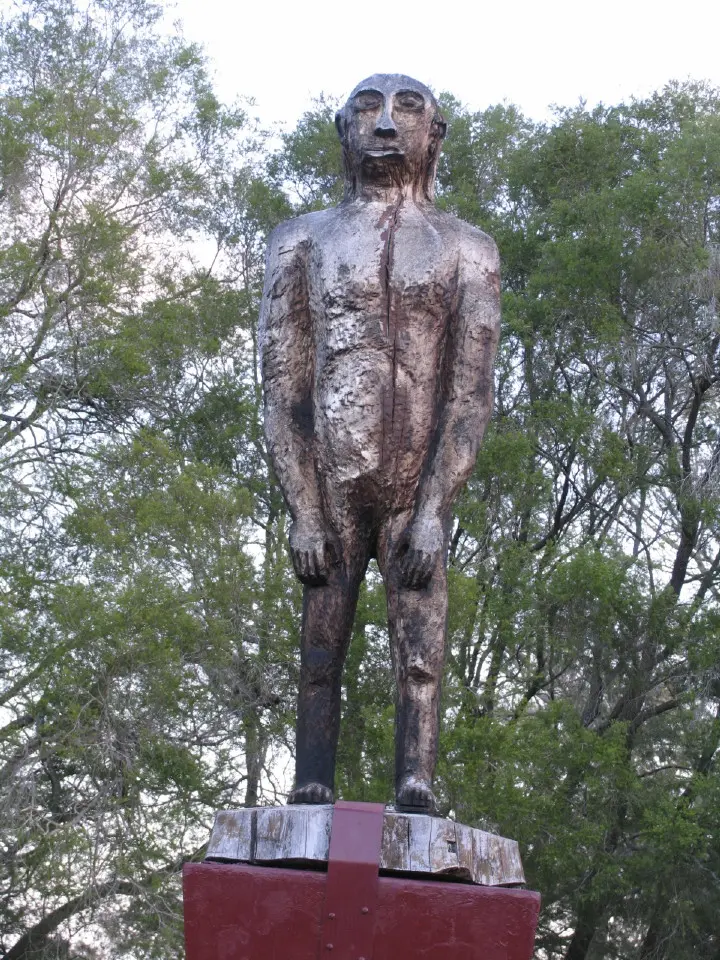
Then the commerce. In December 1979, according to ABC News, two Brisbane students camping in bushland near Kilcoy, Queensland, said they had been confronted by a "two to three-metre brown-haired creature"; the town put up a statue in 1980 in what became Yowie Park, and its rugby team plays as the Yowies. In 1994 the novelist Bryce Courtenay and Geoff Pike pitched a set of characters called Yowies to Cadbury; the chocolate that followed sold, at its peak, more than a million units a week, and in its first year the equivalent of 2.5 Yowies for every man, woman and child in Australia. Production stopped in 2005 after a dispute between Cadbury and the creators.
Timeline: the documented record of Yowie
- 1726 Jonathan Swift invents the word "Yahoo" for the degraded human brutes of Gulliver's Travels. It is the name Australian settlers will later reach for when writing about a hairy man in the bush — a point Joe Nickell makes flatly in Skeptical Inquirer.
- February 1842 An unsigned article, "Superstitions of the Australian Aborigines: The Yahoo", appears in the Australian and New Zealand Monthly Magazine (vol. 1, no. 2, p. 92). It describes not an ape but a slender figure with long white hair over its face, great talons and feet turned backwards.
- 1875 The Reverend William Ridley publishes Kámilarói, and other Australian languages. On page 138 he records, among the Wailwun of the Barwon and Narran, that "Yo-wi is a spirit that roams over the earth at night" — the oldest printed appearance of the word, with no mention of hair, height or an ape.
- 3 October 1889 The Illustrated Sydney News runs "The Legend of Lindon" inside a holiday feature on the Blue Mountains, reporting a seven-foot hairy figure at Sir Henry Parkes's Falconbridge property — and a fifty-pound reward offered by a Springwood hotelier who wanted to exhibit it. The press treats the whole thing as a joke and as an attraction.
- 1972 John Napier publishes Bigfoot: The Yeti and Sasquatch in Myth and Reality. Graham Joyner identifies the Australian publicity around this book as the trigger for the modern yowie, promoted from about 1975 by the self-described cryptozoologist Rex Gilroy.
- 1977 Graham Joyner self-publishes The Hairy Man of South Eastern Australia, in which, according to the English Wikipedia, he compiled the nineteenth-century reports of the "yahoo" or hairy man. In Monster, Myth or Lost Marsupial? (2009) he argues that the yowie was relatively unknown before the mid-1970s and may have come from a conflation with those earlier yahoo reports.
- December 1979 Two Brisbane students camping in bushland near Kilcoy, Queensland, report being confronted by a "two to three-metre brown-haired creature". The town bolts a yowie statue into place in 1980 and takes the creature as its emblem.
- 1994 The Yuin woman Eileen Morgan publishes The Calling of the Spirits, setting down the south-coast tradition of the dulagal or doolagarl. She connects it with the yowie but records that yowie was not a term the Yuin used — the clearest statement anywhere that the tradition is one thing and the modern name another.
- 1994 Geoff Pike and the novelist Bryce Courtenay pitch the Yowie characters to Cadbury. The confectionery that follows peaks at over a million units a week and sells, in its first year, the equivalent of 2.5 Yowies for every person in Australia. Production ends in 2005 after a dispute between Cadbury and the creators.
- 2014 Bryan Sykes and colleagues publish in Proceedings of the Royal Society B the first systematic genetic survey of hair attributed to anomalous primates: 57 samples received after a worldwide appeal issued on 14 May 2012, 30 sequenced. The origins are India, Bhutan, Nepal, Russia, Sumatra and the United States. None is Australian.
- January–April 2018 The worn wooden statue is taken away from Yowie Park in January, to a public outcry, and used to make the cast for a more durable fibreglass version by NatureWorks of Brisbane. The new statue is installed in April 2018.
Is there a rational explanation for Yowie?
Not a word of the Sydney language. Jakelin Troy's The Sydney Language (Canberra, 1993) is the fullest published wordlist of the Dharug or Sydney language, assembled from Dawes, Collins, the anonymous vocabularies and the rest of the early record. Its lists contain no yowie, yowi or yahoo. The words it gives for a ghost or the spirit of the dead are mani and man, and the y- words it does record include yanada (moon), yura (people), yuruga (sun) and yuwin (yes).
What did happen is a swap of language and a swap of meaning. Wiktionary derives the word from Gamilaraay yuwi, "dream spirit". Everything runs back to Ridley 1875, whose entry names the Wailwun and glosses the word as "a spirit that roams over the earth at night"; Gamilaraay and "dream spirit" appear nowhere in it. His book is titled Kámilarói, and other Australian languages, and it is the "and other" that got lost. Somewhere between page 138 and us, a Wailwun night-spirit became a Gamilaraay dream-spirit.
On physical evidence. The only systematic genetic survey of hair attributed to anomalous primates had an open call behind it: "Hair samples submissions were solicited from museum and individual collections in a joint press release issued on 14 May 2012 by the Museum of Zoology, Lausanne and the University of Oxford." Fifty-seven samples arrived. Screening removed one of plant material and one of glass fibre, 37 were chosen for analysis "based on their provenance or historic interest", and 30 yielded DNA, published by Bryan Sykes and colleagues in Proceedings of the Royal Society B in 2014. Those 30 came from India, Bhutan, Nepal, Russia, Sumatra and the United States; none is Australian, and the paper does not list where the samples it set aside came from. A search of Europe PMC, the life-sciences literature index, for "yowie" on 10 October 2026 returned seven records, none of them an analysis of hair, bone or tissue; the same index, searched for "yeti AND hair", returns the Sykes paper and the published comments on it.
The sceptics, by name. Joe Nickell, of the Committee for Skeptical Inquiry, wrote in 2016 that "Yahoo" must at once be recognised as a word "used—indeed invented—by English satirist Jonathan Swift", and that "the Yowie/Yahoo is similarly derivative" of the European wild man, as Bigfoot was. The palaeontologist Darren Naish, reviewing Neil Frost's 714-page Fatfoot: Encounters With A Dooligahl (2023) on his blog Tetrapod Zoology in February 2025, wrote that the data compiled by Frost "is anecdotal and suggestive, but never convincing". Graham Joyner, from the archive side, has argued that the modern creature may come from a conflation with the nineteenth-century yahoo reports.
And the mundane candidate. Nickell names it: "The kangaroo and its cousins the wallaby and the wallaroo are also good suspects." When three Queensland youths reported a six-foot hairy creature with a long tail and an "apron" draped from its waist in 1954, he writes, that last detail was "an obvious clue pointing to a marsupial pouch", and someone at the time suggested they had been scared by "a cranky old wallaroo". The Australian Museum gives the male red kangaroo a body length of up to 1.4 m, a tail of up to 1 m and a weight of up to 92 kg. The most recent yowie hypothesis runs the same way: in the book Naish reviewed, Frost proposes that yowies are giant macropods that stride and run on two legs.
None of this touches the Aboriginal traditions. Hairy beings of the bush are documented across many Aboriginal nations under their own names — dulagal or doolagarl among the Yuin of the New South Wales south coast, described by the Yuin elder Guboo Ted Thomas as red-eyed, neckless and long-browed, able to imitate birds and to put people to sleep. The Yuin woman Eileen Morgan set that down in The Calling of the Spirits (Aboriginal Studies Press, 1994, pp. 111–113), connecting dulagal with the yowie and recording that the word yowie was not one the Yuin used. Nickell quotes the elder Percy Mumbulla on the Dulagarl: "He only appears to Aboriginal people." The tradition is old and attributable; the label stuck on it is late and borrowed.
Can you visit Yowie?
Yowie Park is in Kilcoy, Queensland 4515, about 74 km north-west of central Brisbane in a straight line. It fronts Hope Street, which is the stretch of the D'Aguilar Highway that runs through the town. Somerset Regional Council runs it as a free public park with a playground and barbecues; there is no fence and no gate. The statue stands beside the highway, and the Kilcoy and District Historical Society keeps its Hall of History in the same park. Queensland's own tourism listing for Yowie Park points to the statue as the thing to photograph.
A statue was first bolted into place in 1980, after two Brisbane students reported a creature near the town in December 1979; ABC News described the figure unveiled in 2018 as the third version of that original. The Canberra Times reported that the worn wooden statue was taken away in January 2018, to a public outcry, and that the Brisbane firm NatureWorks used it to make the cast for a more durable fibreglass version, installed in April 2018. Mayor Graeme Lehmann told the press at the time that "people come from far and wide to find out about the yowie".
Sources consulted
- William Ridley, «Kámilarói, and other Australian languages» — Thomas Richards, Government Printer, Sydney, 1875 book
- Unsigned, «Superstitions of the Australian Aborigines: The Yahoo» — Australian and New Zealand Monthly Magazine, vol. 1, no. 2, p. 92 (read in the transcription published by Australian Yowie Research), 1842 newspaper archive
- Jakelin Troy, «The Sydney Language» — Canberra (PDF hosted by The Notebooks of William Dawes project), 1993 book
- Bryan C. Sykes, Rhettman A. Mullis, Christophe Hänni and Terry Melton, «Genetic analysis of hair samples attributed to yeti, bigfoot and other anomalous primates» — Proceedings of the Royal Society B, 281(1789): 20140161, 2014 academic
- Graham Charles Joyner, «The Hairy Man of South Eastern Australia» — Self-published, Canberra (ISBN 0-908127-00-6), 1977 book
- Joe Nickell, «Searching for the Yowie, the Down Under Bigfoot» — Skeptical Inquirer, 2016 web
- Wikipedia contributors, «Yowie (chocolate)» — Wikipedia, 2026 web
- Eileen Morgan, «The Calling of the Spirits» — Aboriginal Studies Press, Canberra (ISBN 0-85575-255-6); passage on dulagal (pp. 111–113) read in secondary citation, in the English Wikipedia article «Yuin», 1994 book
- Toby Crockford, «Giant yowie returns to Queensland after three-month disappearance» — The Canberra Times, 2018 newspaper archive
- Darren Naish, «Yowies and the Marsupial Hominoid Hypothesis: Neil Frost's Fatfoot» — Tetrapod Zoology, 2025 web
- Unsigned, «Our Holiday Resorts: An Artist's Wanderings in the Blue Mountains — The Legend of Lindon» — Illustrated Sydney News, 3 October 1889, pp. 16-17 (read in the transcription published by the Yowieocalypse archive project), 1889 newspaper archive
- Nathan Morris, «Yowie country: Queensland town revamps tourism brand as a prime spot for mythological creature» — ABC News (ABC Southern Queensland), 2018 newspaper archive
- Australian Museum, «Red Kangaroo — body length, tail and weight of males and females» — australian.museum, 2026 web
- Wiktionary contributors, «yowie — etymology: borrowed from Gamilaraay yuwi, «dream spirit»» — Wiktionary, 2026 web
- Europe PMC, «Search for «yowie» in the Europe PMC literature index (7 records, none an analysis of a sample; consulted 10 October 2026)» — EMBL-EBI, 2026 web
- Wikipedia contributors, «Yowie — section «Graham Joyner's perspective», citing Joyner, Monster, Myth or Lost Marsupial? (Canberra: Hayes UK & Thomas, 2009)» — Wikipedia, 2026 web
Reviewed by V. Serrano on 2026-08-14 · How we verify our content
📎 Source: Enigma Atlas
💬 Field testimonies (0)
No testimonies yet. Add the first.
Add your testimony
🔒 Log in to add a testimony