👻 HAUNTED PLACE · EXP. Nº9475
ACTIVE
Beechworth Asylum
The asylum on the hill above Beechworth opened on 24 October 1867 and closed in 1995: 128 years under five successive official names.
Where is Beechworth Asylum?
- Location
- Beechworth, Victoria, Australia
- Type
- Hospital / asylum
- Coordinates
- -36.369, 146.696
- Last updated
LOCATION
Why is Beechworth Asylum said to be haunted?
It was not called Mayday Hills for most of them. Public Record Office Victoria lists it as Beechworth Asylum from 1867, Hospital for the Insane from 1905, Mental Hospital from 1934, and only Mayday Hills from 1967 onward. The ghost-tour version has grown over that archive rather than out of it. The most repeated claim, that more than 9,000 people died here and lie in unmarked graves on the asylum grounds, has no documented source, and the picture of numbered iron pegs standing in for names belongs to a different hospital on a different continent: Cedar Lane, at Central State Hospital in Milledgeville, Georgia. Patients who died at Beechworth were buried in the town's ordinary public cemetery, in denominational sections, and for most of the institution's life under no stone at all. Since 2019 five of them have their names in granite: the Beechworth Public Cemetery Trust and the Mayday Hills Research Group traced five First World War veterans who died as patients, and the Department of Veterans' Affairs put a headstone on each grave.
What is the history of Beechworth Asylum?
Three sites, one decision. In 1863 the Victorian government chose three locations for new lunatic asylums to relieve the overcrowded Yarra Bend, outside Melbourne: Kew, Ararat and Beechworth. Beechworth was a gold town — some 8,000 diggers had poured into the ranges within eleven months of the 1852 strike at the Ovens — and the two-hundred-acre hilltop south of the settlement, across Spring Creek, was chosen for its air and its panoramic views, which the medicine of the day held to be therapeutic in themselves.
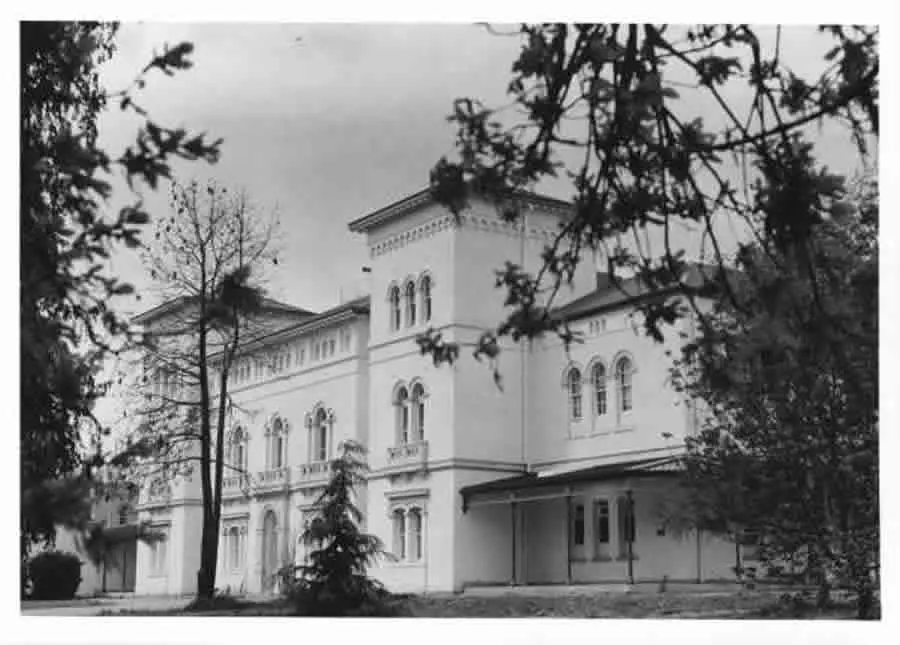
The complex was built between 1864 and 1867 to a Public Works Department design under John James Clark, and the Victorian Heritage Register calls the result "a particularly fine example of an extensive complex of Italianate asylum" buildings: an E-shaped main block holding accommodation, administration, laundry, kitchens, stores and a recreation hall. It opened on 24 October 1867 under its first superintendent, Thomas Dick, and the first patients arrived by transfer from Yarra Bend. A separate morgue went up to the west in 1868.
The most eloquent thing on the site is a piece of landscaping. The compound was ringed by a wall and a ha-ha — a sunken barrier that reads as a low step from outside and a high wall from within. It kept people in without ever letting them see that they were being kept in. Parts of the wall, the ha-ha and one of the two entrance lodges are still there.
Work was the treatment, so the estate had to produce. By 1878 there were roughly 31 acres of ornamental ground, 16 of farm and 12 of kitchen garden, worked by patients; many of the buildings were raised with asylum labour and local stone. The ornamental grounds were laid out by Robert Coates, a landscape designer and gardener who was himself a patient there, and who sourced Bunya pines, Douglas firs, cedars and redwoods from the Royal Botanic Gardens in Melbourne. In 1912 Hugh Linaker, landscape adviser to the Lunacy Department, planted the oak and plane avenues that still frame the main approach.
The name on the gate changed every time the law changed, and Public Record Office Victoria keeps the sequence: Beechworth Asylum from 1867; Hospital for the Insane from 1905, after the Lunacy Act 1903 redesignated every asylum in the colony; Mental Hospital from 1934, under the Mental Hygiene Act 1933; Mayday Hills Mental Hospital from 1967; and Mayday Hills Psychiatric Hospital until closure in 1995. "Mayday Hills" — the older name for the district itself — therefore covers barely the last quarter of the institution's life.
At its peak the place held around 1,200 patients and employed more than 600 staff across some 67 buildings, and it was porous in ways the horror version never mentions. Weekly dances were held in the recreation hall — the Bijou Theatre — from the 1880s, and townspeople came to them. Patients and staff jointly produced a magazine, The Open Door, later The New Open Door: 160 copies a month by 1953, carrying dance and concert notices, cricket results, swimming at Lake Sambell, the annual patients' picnic and crosswords. A birthday issue was sent to Queen Elizabeth II in 1952. The Mental Health Authority created that same year brought an "open door" policy in fact as well as in title, and the perimeter wall came down in 1955. From 1964 a separate Beechworth Training Centre served more than two hundred people with intellectual disability until 1990.
The individuals are recoverable, which is the point. Edith Agnes Harrington (1899–1980), admitted around the middle of the century, embroidered garments until the cloth underneath had all but vanished, called herself "Doctor" Harrington and talked about a son she could not trace; her work is now in the Cunningham Dax Collection at the University of Melbourne. The woman admitted in 1907 as "Marie Stella Hewitt, born 1868" was, on the genealogist Eileen Clark's reconstruction, Maria Anne Hewitt, born 1849 — a woman who arrived with a fabricated identity and a claim to have been a witness in the Deeming murder case that the trial transcripts do not support. John Flower, an English immigrant off the Indigo goldfields, was transferred from Yarra Bend in 1869 and died at Beechworth in 1877, aged 41; in 2024 his descendant, the actor Stephen Curry, was shown the record on SBS.
Deinstitutionalisation closed it. Patient numbers fell, community residential options replaced the wards, and the hospital shut in 1995, with psychiatric services moving to Beechworth Hospital around 1996. La Trobe University bought the estate in 1996 and ran it as its Beechworth campus until 2011; in 2013 it was sold for about $1.5 million to two local businessmen, George Fendyk and Geoff Lucas, and the precinct has been subdivided, leased and sold on to tourism, hospitality and arts businesses since.
Timeline: the documented record of Beechworth Asylum
- 1863 The Victorian government selects three sites for new lunatic asylums to relieve the overcrowded Yarra Bend: Kew, Ararat and Beechworth. The Beechworth site is a two-hundred-acre hilltop chosen for its air and its views.
- 24 October 1867 The asylum opens under its first superintendent, Thomas Dick, after three years of construction to a Public Works Department design by John James Clark. The first patients arrive by transfer from Yarra Bend.
- 1869 John Flower, an English immigrant who had worked the Indigo goldfields and been committed to Yarra Bend in 1864, is transferred to Beechworth. He dies there in 1877 aged 41; in 2024 his descendant, the actor Stephen Curry, is shown the record on SBS.
- 1878 The estate is recorded as roughly 31 acres of ornamental ground, 16 of farm and 12 of kitchen garden, worked by patients. The ornamental layout is the work of Robert Coates, a landscape gardener who was himself a patient.
- 1880s Weekly dances begin in the recreation hall, later the Bijou Theatre, and are open to Beechworth residents as well as patients and staff. The same room is on the route of today's commercial ghost tours.
- 1905 Following the Lunacy Act 1903, every asylum in Victoria is redesignated a "hospital for the insane". Beechworth Asylum becomes Beechworth Hospital for the Insane, the first of four changes of name.
- 1907 A woman is admitted as "Marie Stella Hewitt, born 1868", her illness attributed to the Deeming murder case. Genealogist Eileen Clark later identifies her as Maria Anne Hewitt, born 1849, who does not appear in the trial transcripts and had arrived with a fabricated identity.
- 1912 Hugh Linaker, landscape adviser to the Lunacy Department, redevelops the grounds and plants the avenues of oaks and plane trees that still frame the main approach.
- 1955 The perimeter wall is taken down, three years after the new Mental Health Authority adopts an "open door" policy. The patient and staff magazine already carries the same name, The Open Door.
- 1964 A separate Beechworth Training Centre opens on the site and serves more than two hundred people with intellectual disability until 1990.
- 1967 The institution becomes Mayday Hills Mental Hospital — the first time the name by which it is now universally known is applied to it, a century after it opened.
- 1995 Mayday Hills Psychiatric Hospital closes after 128 years, with psychiatric services transferring to Beechworth Hospital around 1996. At its peak it had held some 1,200 patients and more than 600 staff.
- 1996 La Trobe University buys the estate and runs it as its Beechworth campus until 2011. In 2013 it is sold to two local businessmen, George Fendyk and Geoff Lucas, for about $1.5 million.
- 2019 After lobbying by the Beechworth Public Cemetery Trust and the Mayday Hills Research Group, the Department of Veterans' Affairs erects a headstone on the previously unmarked grave of each of five First World War veterans who died as patients: Dudley George Tong, Thomas Charles O'Hara, Victor Wesley Sedgman, Claude Frederick Reid and Edward Albert Gibbs.
- 2023 Eileen Clark completes a doctoral thesis at Charles Sturt University on the hospital between 1900 and 1995, combining oral history with genealogical record linkage — the first sustained academic study of the place.
- 14 May 2025 Mayday Hills Beechworth Pty Ltd is fined A$35,000 plus A$15,365 in council legal costs at Wodonga Magistrates' Court over illegal building works at the site, including the creation of residences unfit for people to live in.
Is there a rational explanation for Beechworth Asylum?
The archive here is enormous and almost nobody reads it. Public Record Office Victoria holds admission and discharge registers running 1867–1991, a register of patients 1867–1929, admission index cards for male and female patients 1867–1975, a register of absconders 1901–1984 and a patient discharge comments book 1896–1921, among some thirty series. The ghost story fills the space left by not opening any of them.
Start with the number. "Over 9,000 souls met their untimely demise, laid to rest in unmarked graves on the asylum grounds" is the sentence that circulates, published in that form by the paranormal travel site Amy's Crypt in November 2024 with no source attached; the same page dates the closure to 1998, which the archive contradicts. The figure is a death toll in its original form, and versions of this entry — including our own earlier one — have quietly converted it into a total of patients treated. Neither version has a source. With PROV's registers, someone could actually count. Nobody has published the count, and we are not going to invent one.
The numbered iron pegs belong to a different hospital on a different continent. Cedar Lane, the burial ground of Central State Hospital in Milledgeville, Georgia, is the site where some 2,000 cast-iron markers bearing numbers instead of names stand for an estimated 25,000 patients buried on the grounds; a restoration begun there in 1997 started a national movement to memorialise asylum burials. That image has drifted onto Beechworth. The Beechworth patients who died in care were buried in the town's public cemetery — a separate, ordinary municipal cemetery opened in 1856 — in denominational sections and, for most of the institution's life, in graves that carried no stone at all. That part is true, and it is documented plot by plot.
"Tommy Kennedy" does not survive a control test. Searching the Internet Archive's full-text book corpus for "Tommy Kennedy" together with "Beechworth" returns nothing; the search was repeated with the same result. Controls run in the same corpus and on the same day: "Mayday Hills" with "Beechworth" returns about 22 books, and "Beechworth" with "Yarra Bend" about 189. On the Charles Sturt University research site devoted to the hospital, a search for "Kennedy" returns a single hit, and it is about a television programme; a search for "Harrington" — a patient who is genuinely documented — returns three. What does exist is a tour-lore character: the versions in circulation describe a well-liked patient given a job as a kitchen hand who died in the kitchen that is now part of the Bijou Theatre. None of those versions says he had dwarfism. That detail was added downstream, and it is the reason this needs saying plainly: if a Thomas Kennedy is one day found in the registers, a real disabled man is not an attraction who "darts between the buildings", and turning him into one is not folklore.
"Ward 2" as a locked ward for the most disturbed patients, with temperature drops and dragging footsteps, has no source we can find — not in the archive and not even in the ghost-tour material. The only Beechworth Ward 2 that is documented is Female Ward 2, recorded as the provenance of a straitjacket now in the Museums Victoria collection: heavy cream canvas, around 1900. Its interest is the opposite of frightening.
Finally, the incentive. The interiors are not a museum and nobody is showing them for free: Asylum Ghost Tours runs 90-minute guided tours on the site from A$49, and one of the rooms on the route is the Bijou Theatre — the very room the Tommy Kennedy story needs. A business is a reliable source for what it claims and no evidence at all that the claim is true.
Can you visit Beechworth Asylum?
The site occupies the top of Albert Road, Beechworth, Victoria 3747, about 1.3 km from the visitor information centre at 103 Ford Street. The Victorian Heritage Register carries it as Mayday Hills Hospital, number H1189. It is private property under commercial redevelopment, and the Indigo Shire's own visitor listing gives its hours as "Always Open": some eleven hectares of nineteenth-century pleasure grounds can be walked free of charge. Three self-guided routes through the trees and gardens are described in a Beechworth Treescape Group brochure that the Ford Street centre hands out on 1300 366 321.
Interiors are reached only on a commercial tour. Asylum Ghost Tours works from 22 Kurrajong Way inside the precinct and priced its 90-minute guided walk on 10 September 2026 at A$49 for adults and A$42 concession. The operator's page that day put the tour on four nights a week and seven "during holiday periods". Children under 13 are not admitted to it; a separate twilight tour takes them from five.
In May 2025 the owning company, Mayday Hills Beechworth Pty Ltd, was fined A$35,000 plus A$15,365 in council costs at Wodonga Magistrates' Court over eight counts of unpermitted building work, among them dwellings created without approval. The Border Mail reported that the company had acquired the property in 2012 and quoted Magistrate Watkins: "They're serious matters and they involve breaches of the relevant regulation over a significant period of time." Large parts of the complex are unrestored or closed off.
The patients who died here are buried at the Beechworth Public Cemetery on Balaclava Road, an 8.5-hectare municipal ground run by a trust of eight local members, where the Chronicle online map indexes 16,442 burials by name.
Sources consulted
- Public Record Office Victoria, «VA 2842 Beechworth (Asylum 1867-1905; Hospital for the Insane 1905-1934; Mental Hospital 1934-1967; Mayday Hills Mental Hospital 1967-1991; Mayday Hills Psychiatric Hospital 1978-1995)» — PROV agency record and record series, 2026 archive
- Heritage Council Victoria, «Mayday Hills Hospital, Albert Road Beechworth (VHR H1189)» — Victorian Heritage Database, 2016 report
- Eileen Clark, «Snapshots from Mayday Hills: A multidisciplinary study of Beechworth's psychiatric hospital, 1900-1995» — Doctoral thesis, Charles Sturt University, 2023 academic
- Eileen Clark, «Five Diggers from Mayday Hills» — The Mayday Hills Project, Charles Sturt University, 2022 web
- Beechworth Public Cemetery Trust, «Beechworth Public Cemetery WW1 Veterans' Virtual Reality Walk» — Project document, 2021 report
- Eileen Clark, «The gardens at Mayday Hills» — The Mayday Hills Project, Charles Sturt University, 2022 web
- Eileen Clark, «Bijou Theatre» — The Mayday Hills Project, Charles Sturt University, 2022 web
- Alison Watts, «The Open Door patient magazine» — The Mayday Hills Project, Charles Sturt University, 2022 web
- Alison Watts, «Physical restraints» — The Mayday Hills Project, Charles Sturt University, 2022 web
- Eileen Clark, «Patient story: Edith Harrington» — The Mayday Hills Project, Charles Sturt University, 2022 web
- Eileen Clark, «Who was Marie Stella Hewitt?» — The Mayday Hills Project, Charles Sturt University, 2022 web
- Eileen Clark, «Who Do You Think You Are: John Flower and Stephen Curry» — The Mayday Hills Project, Charles Sturt University, 2024 web
- Ashlee Aldridge, «Albury LibraryMuseum exhibition puts a human face on Mayday Hills asylum» — ABC News (Australia), 2020 newspaper archive
- Court reporter, «George Fendyk's Mayday Hills company fined for building breaches» — The Border Mail (Albury-Wodonga), 2025 newspaper archive
- Asylum Ghost Tours, «Beechworth Asylum ghost tours: tour details and prices» — Operator website, 2026 web
- Amy's Crypt, «Beechworth Asylum - Mayday Hills Psychiatric Hospital» — Paranormal travel site, 2024 web
- Visit Milledgeville, «Cedar Lane Cemetery at Central State Hospital, Milledgeville, Georgia» — Baldwin County tourism authority, 2024 web
- Eileen Clark, «Lessons from the past: family involvement in patient admission and discharge, Beechworth Lunatic Asylum 1900-1912» — Summary of International Journal of Mental Health Nursing 27, 320-328, 2018 web
- Victorian Places (Monash University and University of Queensland), «Beechworth» — Victorian Places, 2015 web
- Explore Beechworth (Indigo Shire), «Mayday Hills» — Official visitor information, 2026 web
Reviewed by V. Serrano on 2026-08-11 · How we verify our content
💬 Field testimonies (0)
No testimonies yet. Add the first.
Add your testimony
🔒 Log in to add a testimony