👻 HAUNTED PLACE · EXP. Nº1189
ACTIVE
Kenmore Asylum
Kenmore Asylum is a location reputed to be haunted in Goulburn, AU. Its reputation comes from reported apparitions, unexplained phenomena and eyewitness accounts gathered over time.
Where is Kenmore Asylum?
- Location
- Goulburn, AU
- Type
- Hospital / asylum
- Coordinates
- -34.719, 149.755
- Testimonies
- 0
- Last updated
LOCATION
Why is Kenmore Asylum said to be haunted?
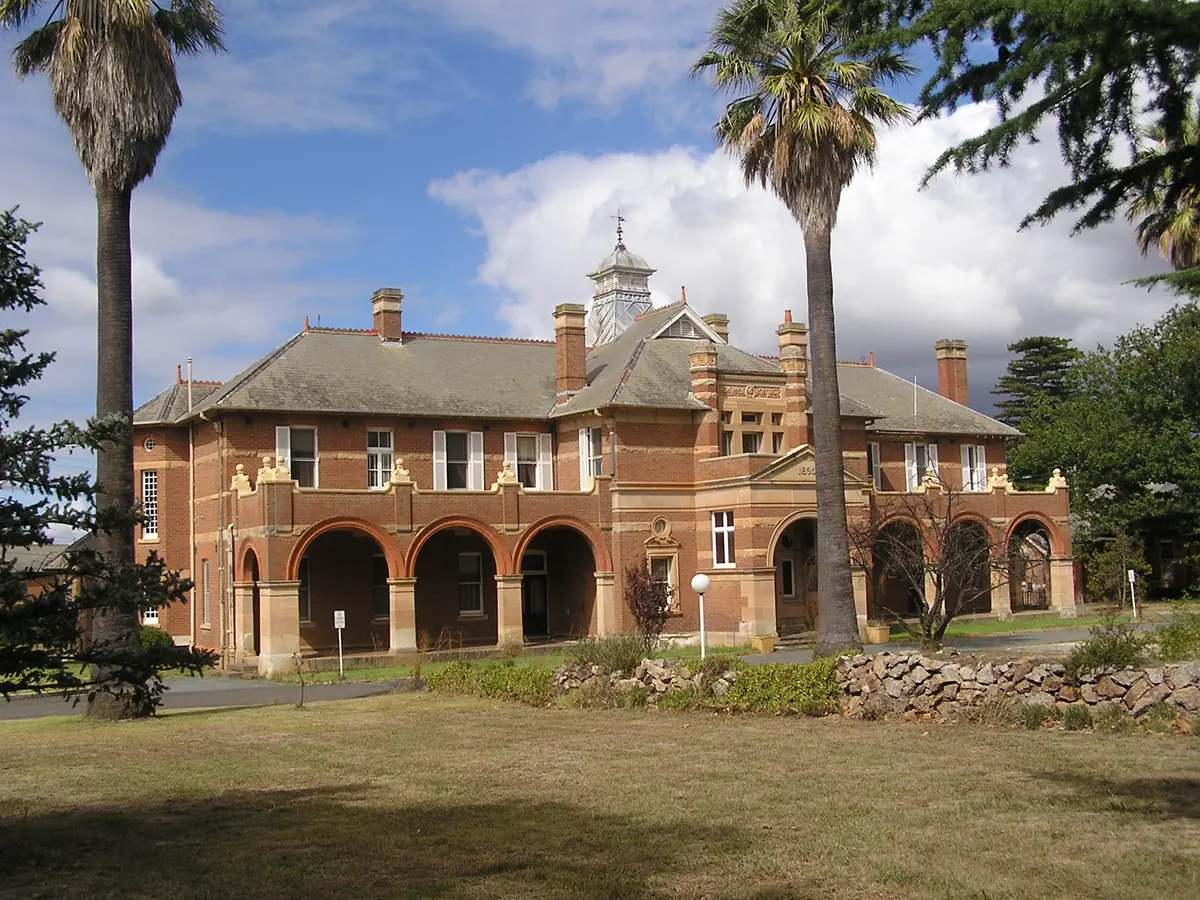
Kenmore Asylum is the local name for the Kenmore Hospital Precinct outside Goulburn, in the Southern Tablelands of New South Wales: nineteen ward buildings, an administration block, a farm, sports fields and a pauper cemetery, designed by the colony's first Government Architect, Walter Liberty Vernon, and opened to its first patients in January 1895. The State Heritage Register, which listed it on 1 April 2005, calls the early buildings perhaps the finest corporate architectural expression of the Edwardian Free style in Australia. Its violent history is documented rather than rumoured: a suicide reported by the Sydney Morning Herald in January 1902, a patient killed by another in 1908, twenty-one deaths in the influenza epidemic of 1919, and the shooting of charge nurse Elizabeth Eva Naughton on 16 December 1922, whose memorial font carries her name and the date. Psychiatric care still runs on part of the grounds. The Vernon buildings do not: sold out of government hands in 2003, they stand fenced, vandalised and fire-damaged in private ownership, and that emptiness is what made the place famous.
What is the history of Kenmore Asylum?
The government bought the ground twice. At an auction on 29 October 1879 the District Surveyor Edward Twynam, who lived at nearby Riversdale, bought lots 32 and 33 of the subdivided Kenmore Estate on behalf of the government for use as a lunatic asylum; the purchase was the first major act of Frederick Norton Manning, newly appointed as the colony's Inspector-General of the Insane. Eleven years later the same government bought a second property for the same purpose. The State Heritage Register entry records the episode in the flat voice of an administrative file: "A curious piece of departmental bunglings is revealed by transactions in connection with Kenmore and Rossiville estates. Rossiville was purchased by the Government in 1890 (for 15,158 pounds) for the building of a lunatic asylum, it having forgotten that it owned Kenmore since 1879." The Public Works Committee had spent 1890 weighing the two sites; on 5 June that year the Goulburn Evening Penny Post reported that "THE Public Works Committee on Tuesday further considered the proposal to erect a hospital for the insane on the Kenmore Estate, near Goulburn." Goulburn City Council was still pressing for Kenmore in 1892, and in 1895 Parliament asked why two lots of land had been bought for one asylum. A design competition for the abandoned Rossiville scheme was won by the architect John Sulman; the commission went to the second prize winner, Walter Liberty Vernon, the colony's first Government Architect.
Building at Kenmore began in 1894 under two contracts: 12,760 pounds 6s 5d to the Sydney builder John Baldwin, and 923 pounds 9s to the Goulburn builder J. C. O'Brien. O'Brien's included a small brick "special ward" costing 423 pounds 9s, and the heritage file explains why an institution stocked with calm cases needed one: "Although the first patients would be chosen for their quiet and industrious natures, it was necessary to provide separate accommodation for any patients who became violent or uncontrollable." The Penny Post went out to look in October 1896 and opened its report: "A VERY important Government institution is being steadily established at Kenmore, situated some three miles to the north-east of Goulburn." The first patients arrived in January 1895 — the Goulburn historian Leone Morgan puts it as "It was not until January, 1895 that the first patients started to trickle in" — and by 30 May 1901 the same paper could write that "The above institution is now complete as far as the contract work is concerned." Nineteen ward buildings, an administration block, staff cottages, a farm, sports fields and a pauper cemetery stood on the site, in orange-red brick fired on the ground with sandstone dressings and Welsh slate roofs. "It wasn't just a hospital, it was a village and for quite a time, self-supporting," Morgan said.
What happened inside survives in fragments of public record. On 17 January 1902 the Sydney Morning Herald reported from Goulburn that "This morning Henry George Bailey, aged 41 years a patient in the Kenmore Hospital for the Insane, committed suicide by hanging himself from a window shutter by tearing a piece off a thick canvas". Thirteen months later the same paper carried a second inquest: "An inmate of Kenmore Hospital for the Iasane was found dead in his room on Saturday. He was lying face downwards with his face in an indiarubber vessel." In August 1908 the Penny Post covered the death of John Cubitt, struck by another patient — "On Friday morning John Cubitt, a patient in Kenmore Hospital, died, and a coronial. inquiry was held in the afternoon into the cause of the death." A fire broke out "at 2 o'clock on Friday morning in the drying room" in July 1912; and a patient recorded as James John Charies Claxton was "found hanged to a tree" in July 1917. For the pneumonic influenza epidemic of August 1919 the figure in circulation, given by the Nine Network's 2014 account of the hospital, is twenty-one patients dead, nineteen men and two women.
The worst day was Saturday 16 December 1922. Richard Galbraith Sindell, 24, a returned soldier shot through the jaw in the First World War and committed after it, came back to Kenmore on leave from another hospital with a revolver he had bought, looking for the medical superintendent, Dr Charles Moffitt. He fired at Moffitt on a verandah and chased him through the grounds, ran into a group of nurses, and shot charge nurse Elizabeth Eva Naughton twice in the chest; the hospital manager took the hospital revolver from the office safe and brought Sindell down with a shot through the hand. A wing of the hospital was named after Naughton, and a marble holy water font was placed in the chapel of a Goulburn orphanage — St Joseph's in Christopher Knaus's report, St John's in the Nine feature — inscribed "Pray for the soul of Elizabeth Eva Naughton, charge nurse who was killed at Kenmore Hospital, 16th December 1922. RIP." The font was found behind bushes in a Canberra alleyway in May 2012, after an anonymous call to police; it weighed 160 kilograms and took three officers to lift into a van. Fifteen months after the shooting, on 23 March 1924, a war memorial listing sixty-eight members of staff who served in the two world wars was dedicated at Kenmore by General McNicholl, so spelled in the Goulburn Post caption; it was moved to its present position opposite the administration building in 1980.
In March 1941 the New South Wales government offered the hospital to the army, "an offer the army promptly accepted"; Kenmore became the 114th Australian General Hospital, treating service personnel and prisoners of war, and its own patients went to institutions in Sydney. Morgan calls the transfer "the largest evacuation of people until the aftermath of Cyclone Tracey (Darwin 1974)". The army left at the end of January 1946 and the Department of Health resumed control a week later; by 1949 the wards were overcrowded again, and at the peak in the 1960s more than 1,400 patients lived on the site. David Graham, who started at Kenmore at seventeen in 1964, worked in ward one among ninety-three men, several of them displaced by the Second World War. One of them, he told the reporter John Thistleton in 2025, could name every surgical instrument on the tray because as a boy his job had been to clean up "after the Nazis' experimental techniques to sterilise females in the concentration camps". Welfare payments from the early 1970s, and the deinstitutionalisation policy that followed, emptied the wards.
The hospital museum closed to the public in March 2011 and its contents were dispersed; the National Museum of Australia, the Powerhouse Museum and the National Film and Sound Archive took the pick of the collection, and the last exhibit, a timeline of the hospital, was handed to Goulburn Mulwaree Council in February 2013. "It took two years to dismantle the contents of the Kenmore Museum," Morgan said. The precinct itself was sold in 2003 and resold in 2010, was entered on the State Heritage Register on 1 April 2005 as item 01728, and passed in 2015 to the investment company Australia China International, which renamed it Kenmore Gardens the following year.
Timeline: the documented record of Kenmore Asylum
- 29 October 1879 At auction, District Surveyor Edward Twynam buys lots 32 and 33 of the subdivided Kenmore Estate for the government, as a site for a lunatic asylum. The purchase is the first major act of Frederick Norton Manning as Inspector-General of the Insane.
- 5 June 1890 The Goulburn Evening Penny Post reports that the Public Works Committee "on Tuesday further considered the proposal to erect a hospital for the insane on the Kenmore Estate, near Goulburn". The government had by then bought a second site, Rossiville, having forgotten it already owned Kenmore.
- 1894 The first building contracts are let: 12,760 pounds 6s 5d to the Sydney builder John Baldwin and 923 pounds 9s to the Goulburn builder J. C. O'Brien, whose work includes a brick "special ward" for patients who became violent.
- January 1895 The first patients arrive. The Goulburn historian Leone Morgan: "It was not until January, 1895 that the first patients started to trickle in."
- 30 May 1901 The Goulburn Evening Penny Post reports that "The above institution is now complete as far as the contract work is concerned."
- 17 January 1902 The Sydney Morning Herald reports the suicide of Henry George Bailey, 41, "by hanging himself from a window shutter by tearing a piece off a thick canvas".
- 15 August 1908 The Goulburn Evening Penny Post covers the inquest on John Cubitt, a patient killed by another inmate while the two were scrubbing floors.
- 31 July 1912 Fire in the drying room: "A fire occurred at 2 o'clock on Friday morning in the drying room of Kenmore Hospital for Insane, Goulbourn. The alarm whistle was blown".
- 10 July 1917 The Young Witness reports that "A man named James John Charies Claxton an inmate of the Kenmore Hospital for the Insane, was on Sunday morning found hanged to a tree."
- 16 December 1922 Richard Galbraith Sindell shoots at the medical superintendent Charles Moffitt and kills charge nurse Elizabeth Eva Naughton. Her memorial font reads "Pray for the soul of Elizabeth Eva Naughton, charge nurse who was killed at Kenmore Hospital, 16th December 1922. RIP."
- 23 March 1924 The Kenmore war memorial, listing sixty-eight members of staff who served in the two world wars, is dedicated by General McNicholl. It was moved to its present position opposite the administration building in 1980.
- March 1941 The NSW government offers the hospital to the army as a military hospital, "an offer the army promptly accepted". Kenmore becomes the 114th Australian General Hospital and its patients are moved to institutions in Sydney.
- End of January 1946 The army moves out and the Department of Health resumes control a week later. By 1949 the hospital is overcrowded again.
- 1964 David Graham joins the staff at seventeen and is posted to ward one, where ninety-three men live, several of them displaced by the Second World War.
- 2003 The 75-hectare site is sold out of government hands; it is resold in 2010. Psychiatric services continue on part of the grounds, outside the original wards.
- 1 April 2005 Kenmore Hospital Precinct is entered on the New South Wales State Heritage Register as item 01728, gazetted in Gazette 38 at page 1013.
- March 2011 The Kenmore Hospital Museum opens to the public for the last time. Its collection goes to the National Museum of Australia, the Powerhouse Museum and the National Film and Sound Archive.
- 2 December 2014 The Nine Network publishes "Abandoned Kenmore insane asylum 'undoubtedly haunted'", quoting the Sydney accountant Anthony Lakoff. It is the earliest source located here for the site's paranormal reputation.
- 24 January 2017 The English Wikipedia article is created. Its first revision already says the place "is described as one of Australia's 'most haunted locations'", citing three sources, two of which never use the word.
- 16 October 2021 Ward 15, the former female section, is destroyed by fire; damage is put at more than 500,000 dollars. In December two teenagers are dealt with under the Young Offenders Act and Heritage NSW takes over the emergency work.
- 16 July 2025 A twenty-one lot subdivision of the precinct, DA/0005/2526, goes on public exhibition. It is withdrawn that September after the Heritage Council of NSW declines to issue its general terms of approval.
Is there a rational explanation for Kenmore Asylum?
The haunting has a first date and one source, and both can be checked. On 2 December 2014 the Nine Network's website published a feature headed "Abandoned Kenmore insane asylum 'undoubtedly haunted'", built around a Sydney accountant, Anthony Lakoff, whose grandmother had nursed at Kenmore and who had been there more than a dozen times on ghost tours and on a private tour with a former orderly. "Oh, it's haunted," Lakoff told the site. "It's kind of like Australia's Bermuda Triangle of haunted places."
On 24 January 2017 an editor created the English Wikipedia article, and its first revision already stated that the place "is described as one of Australia's 'most haunted locations'", hanging that sentence on three citations. Two of the three contain no such thing. The archived page of the 2013 Goulburn Post report on the closing of the hospital museum runs 933 words, mentions Kenmore seventeen times and the hospital thirteen, and contains zero occurrences of ghost, haunt or spirit; the archived page of the heritage inventory entry cited beside it runs 3,017 words, mentions Kenmore thirty-seven times, and contains one occurrence of spirit, inside the phrase "social, cultural, religious, spiritual, aesthetic or educational association". The same count run on the State Heritage Register listing, on the 2019 Goulburn Post article about the war memorial, on the 2020 report of the Heritage NSW compliance investigation and on the ABC's two reports of the 2021 fire returns zero every time, with the same controls. The reputation entered the encyclopaedia from a single television-network web feature and travelled outward from there.
That feature also carries claims absent from every document consulted here: shock therapy used to treat homosexuality and masturbation, eight cells nicknamed "the wet rooms" because their occupants were hosed down daily, fingernail scratches on the backs of their doors. Its dated deaths, by contrast, line up with the contemporary newspapers wherever those can be checked, which is why the whole reads as solid.
No one sells a ticket to the ghost at Kenmore. The precinct is fenced private property with no operator, no visitor centre and no night tour, and the two teenagers held responsible for the 2021 fire were dealt with for "destroying property while in company by using fire, and entering enclosed lands". David Graham, who spent his shifts in ward one from 1964, told About Regional in 2025 that almost everything written about Kenmore now centres on the buildings, while the lives of the people who worked and lived there are likely to be forgotten in the mist of time. The names on the file — Bailey, Cubitt, Claxton, the twenty-one dead of 1919, Elizabeth Eva Naughton — are the part of Kenmore that can be looked up.
Can you visit Kenmore Asylum?
Two places in Goulburn answer to the name Kenmore, and only one of them is open. Kenmore Hospital Campus, at 209 Taralga Road, is a working service of the Southern NSW Local Health District: three specialised mental health units which the NSW Government service directory describes as offering "mental health rehabilitation, older persons' mental health and dementia support". The same page gives the opening hours as "Open 24 hours - No accident or emergency services are available at Kenmore", marks the service "Referral required", and lists the telephone as (02) 4827 3464. It is a hospital for its patients, and it has nothing to do with the ruins.
The heritage precinct is the other place. It stands at 191 Taralga Road, on Lot 5 of DP 1078852, and it is private land held by Kenmore Property Development Pty Ltd, formerly Australia China International, which renamed the site Kenmore Gardens in November 2016. Ward 15, the former female section, burned on the afternoon of 16 October 2021: a two-storey building about thirty metres by fifty, alight when the crews arrived, with damage put at more than 500,000 dollars. Fire and Rescue NSW Superintendent Scott Dodson said afterwards that "The building is severely damaged, probably to the point where it will have to be demolished". Inspections by Heritage NSW found "significant damage" and a "deplorable lack of care" across many of the buildings, and the department ordered the owner to take "immediate and active measures to redress disrepair or risk to a listed place". Entering the grounds is an offence in itself: one of the charges laid over the fire was "entering enclosed lands".
The lawful way in is a guided tour arranged with the owner. The Goulburn District Historical and Genealogical Society, trading as History Goulburn, has run them, most recently on record with a talk by Leone Morgan on 11 November 2019 and a tour of the grounds on Saturday 16 November 2019, bookings essential, [email protected] or 0459 528 914. No tour was advertised for 2026 when this file was compiled on 7 September 2026. The paper trail is open to anybody: the State Heritage Register entry, item 01728, gazetted on 1 April 2005 in Gazette 38 at page 1013, is free to read online; Kenmore patient records are held by State Records NSW; and the subdivision application over the precinct, DA/0005/2526, sits on the NSW Planning Portal with its fifteen supporting documents, exhibited from 16 July to 13 August 2025 and withdrawn that September after the Heritage Council of NSW declined to issue its general terms of approval.
Sources consulted
- Heritage Division, NSW Office of Environment and Heritage, «Kenmore Hospital Precinct, State Heritage Register item 01728 (database number 5053600)» — New South Wales State Heritage Inventory, 2005 report
- NSW Department of Health, «Kenmore Hospital Complex, Department of Health s.170 register (database number 3540469)» — New South Wales State Heritage Inventory, 1993 report
- Goulburn Evening Penny Post, «THE PROPOSED LUNATIC ASYLUM AT ROSSIVILLE.» — Goulburn Evening Penny Post, 5 June 1890, p. 2, 1890 newspaper archive
- Goulburn Evening Penny Post, «THE KENMORE HOSPITAL FOR THE INSANE. PROGRESS OF THE WORK.» — Goulburn Evening Penny Post, 24 October 1896, p. 5, 1896 newspaper archive
- Goulburn Evening Penny Post, «Kenmore Hospital for the Insane.» — Goulburn Evening Penny Post, 30 May 1901, p. 2, 1901 newspaper archive
- The Sydney Morning Herald, «SUICIDE IN KENMORE ASYLUM. GOULBURN, Thursday.» — The Sydney Morning Herald, 17 January 1902, p. 5, 1902 newspaper archive
- The Sydney Morning Herald, «DEATH AT KENMORE ASYLUM. GOULBURN, Monday.» — The Sydney Morning Herald, 17 February 1903, p. 6, 1903 newspaper archive
- Goulburn Evening Penny Post, «DEATH OF A KENMORE PATIENT. ATTACKED BY ANOTHER INMATE.» — Goulburn Evening Penny Post, 15 August 1908, p. 2, 1908 newspaper archive
- Leader (Orange, NSW), «FIRE AT KENMORE.» — Leader, Orange, 31 July 1912, p. 2, 1912 newspaper archive
- Young Witness, «TRAGEDY AT KENMORE. PATIENT HANGS HIMSELF.» — Young Witness, 10 July 1917, p. 1, 1917 newspaper archive
- Christopher Knaus, «Nurse Naughton's font found in Canberra alley» — Goulburn Post, 31 May 2012, 2012 newspaper archive
- Gerard Walsh, «Last Kenmore artefact in time for 150th b'day» — Goulburn Post, 18 February 2013, 2013 newspaper archive
- Nine News, «Abandoned Kenmore insane asylum 'undoubtedly haunted'» — 9news.com.au, 2 December 2014, 2014 web
- Wikipedia contributor Burklemore1, «Kenmore Asylum, first revision of the English Wikipedia article (oldid 761692421)» — English Wikipedia, 24 January 2017, 2017 web
- David Cole, «Kenmore Hospital's role in war» — Goulburn Post, 22 April 2019, 2019 newspaper archive
- David Cole, «Kenmore Hospital's colourful history explained in a talk and tour» — Goulburn Post, 6 November 2019, 2019 newspaper archive
- Goulburn Post, «Heritage NSW undertaking compliance investigation of Kenmore Hospital» — Goulburn Post, 6 November 2020, 2020 newspaper archive
- James Coleman, «Heritage-listed Kenmore Hospital in Goulburn goes up in flames» — Region Canberra, 18 October 2021, 2021 newspaper archive
- Lauren Bohane, «Police seek help after fire rips through abandoned psychiatric hospital» — ABC News, 18 October 2021, 2021 newspaper archive
- Mollie Gorman, «NSW government to protect historic Goulburn hospital and send the bill for repairs to Chinese owner» — ABC News, 14 December 2021, 2021 newspaper archive
- John Thistleton, «Making friends with the amazing men in ward one, Kenmore Psychiatric Hospital» — About Regional, 21 June 2025, 2025 newspaper archive
- John Thistleton, «Fresh development application raises hopes for Kenmore Gardens» — Region Canberra, 17 July 2025, 2025 newspaper archive
- Goulburn Mulwaree Council, «191 Taralga Road. Twenty-One (21) Lot Torrens Title Subdivision (DA/0005/2526, PAN-549523)» — NSW Planning Portal, exhibited 16 July to 13 August 2025, 2025 report
- Southern NSW Local Health District, «Kenmore Hospital Campus, service directory entry» — nsw.gov.au, consulted 7 September 2026, 2026 web
Reviewed by V. Serrano on 2026-09-07 · How we verify our content
💬 Field testimonies (0)
No testimonies yet. Add the first.
Add your testimony
🔒 Log in to add a testimony