🦶 CRYPTID SIGHTING · EXP. Nº0555
ACTIVE
Bakunawa
Bakunawa is usually introduced as the Philippine moon-eating dragon. In the oldest books that contain the word it is not a dragon, and it is barely a creature: it is the eclipse.
Where and when was Bakunawa sighted?
- Location
- Panay, Western Visayas, Philippines
- Date sighted
- Unknown
- Coordinates
- 10.72, 122.562
- Last updated
LOCATION
What is Bakunawa?
Alonso de Méntrida's Panay vocabulary, dated 1637, records bacunaua as a serpent people understood to be swallowing the moon and, in the same entry, gives the cause: the shadow of the earth. The Jesuit Mateo Sánchez, working in Samar and Leyte around 1617, defines it flatly as "Eclipse de la Luna, o del Sol" and adds four words about the belief: "este es engaño dellos", this is a delusion of theirs. By Juan Félix de la Encarnación's Cebuano dictionary of 1885 the serpent has left the entry altogether and only the eclipse remains. The tale of the seven moons that everyone now repeats is real but late: it was printed by the Cebuano priest Fernando Buyser in 1913. No naturalist has ever proposed the bakunawa as an undiscovered species, and the only new animal attached to it is a wrasse named after the myth in 2023. What did survive was the ritual and the fear: ethnographers in Negros Oriental were still recording both in the 1960s.
What is the history of Bakunawa?
Bakunawa is a word before it is a creature, and the oldest books that contain it define it as something that happens in the sky, not as an animal that lives in the sea.
Three Spanish missionary dictionaries of the Visayan languages are the earliest datable witnesses, and all three can still be read page by page. Alonso de Méntrida, an Augustinian working on Panay, compiled the Hiligaynon vocabulary that Scott cites throughout Barangay as "Mentrida 1637a"; the copy available today is the Manila reprint of 1841. Between the entries Bacuit and Badiao it reads: "Bacunaua. p. p. Entendieron que era sierpe que se iba tragando la luna: la sombra de la tierra que la cubre en los Eclipses: y asi sinudar ang bulan sang bacunaua l. binacunauahan ang bulan, es eclipsarse." They understood it to be a serpent that was swallowing the moon; the shadow of the earth that covers it during eclipses; and so the verb means to be eclipsed. The friar reports the belief and states the astronomical cause in the same sentence, in the 1630s.
The Jesuit Mateo Sánchez compiled the Samar and Leyte vocabulary that William Henry Scott dates to 1617 and that was printed in Manila in 1711. His entry is shorter and blunter: "Bacunava ... Eclipse de la Luna, o del Sol", with conjugated forms for both bodies — nabacunava an adlao, cun an bulan, the sun or the moon is being bakunawa'd — and a four-word verdict on the belief itself: "este es engaño dellos", this is a delusion of theirs.
By the third dictionary the serpent has left the entry altogether. In Juan Félix de la Encarnación's Cebuano-Spanish dictionary (third edition, Manila, 1885) the lemma reads simply "Eclipse de sol y luna", with the example sentence "Cárong adláoa mabacunáoa ang ádlao" — there will be an eclipse of the sun today. Two and a half centuries of lexicography, and the word never stops meaning the eclipse.
The same books license the usual etymology from the inside: both Méntrida and Sánchez record saua as "culebra" and "culebra grande", the python, and bakunawa is normally read as that word compounded with a root meaning bent or curved.
What Visayans did during an eclipse is set out in Scott's 1994 synthesis of the early sources: "Nobody doubted that an eclipse (bakunawa) was caused by a huge sawa, python, trying to swallow the moon, and that it had to be frightened away by noisy pounding on mortars and house floors, followed by another holiday. They treated the sun in the same manner during a solar eclipse." Mortars and house floors — not gongs, and not the pots and pans of the online retellings.
The famous story of the seven moons is real, but it is late and it has an author. It was printed by Fernando Buyser, a Leyte-born Cebuano poet and priest, in Mga Sugilanong Karaan (1913), and again in Mga Sugilanong Pilinhon (1926), where he added his own encounters with the belief. Buyser's text is framed in Christian terms. The folklorist Damiana Eugenio, of the University of the Philippines, reprinted it in Philippine Folk Literature: The Myths (University of the Philippines Press), and it is her version, stripped of the catechism, that everything since has copied.
Timeline: the documented record of Bakunawa
- 1617 The Jesuit Mateo Sánchez compiles his Samar and Leyte vocabulary, the earliest datable record of the word. His entry defines bacunava as "Eclipse de la Luna, o del Sol" and dismisses the belief with four words: "este es engaño dellos". It is printed in Manila in 1711.
- 1637 Alonso de Méntrida's Hiligaynon vocabulary of Panay records bacunaua as a serpent people understood to be swallowing the moon, and in the same entry gives the cause: "la sombra de la tierra que la cubre en los Eclipses".
- c. 1731 Fray Tomás Ortiz, in his Práctica del ministerio, describes Filipinos going out with bells and pans to protect the moon from "the dragon, tiger, or crocodile", records the Tagalog phrase for it, and concludes that the practice was learned from the Chinese — the sentence most often dropped when the passage is quoted.
- 1841 Méntrida's dictionary is reprinted in Manila. The editor's own preface admits he worked from a manuscript copy "que no carece de mentiras" because the printed original had vanished from the convent library after 1838 — a warning attached by the source to the very edition everyone now quotes.
- 1885 The third edition of Juan Félix de la Encarnación's Cebuano-Spanish dictionary defines the word purely as "Eclipse de sol y luna". The serpent has left the entry; the OCR of the digitised copy prints the lemma as "BACON ADA", so it can only be found by reading the B section in order.
- 1913 Fernando Buyser, a Cebuano poet and priest from Leyte, prints the story of the seven moons in Mga Sugilanong Karaan. It is the earliest publication of the tale that has been identified, and Buyser's version is framed in explicitly Christian terms.
- 1913 Laura Watson Benedict publishes Bagobo Myths, in which the eclipse is caused not by a serpent but by the minokawa, a steel-beaked bird, and it is the Bagobo of Mindanao who beat gongs. The two traditions have been conflated ever since.
- 1926 Buyser reprints the story in Mga Sugilanong Pilinhon, adding his own encounters with the belief. This is the version that reaches later compilers.
- 1965 Donn V. Hart's Southeast Asian Birth Customs reports fieldwork in Caticugan, Siaton, Negros Oriental, where pregnant women were still kept indoors during an eclipse for fear of the bakunawa. The belief outlived the friars by three centuries.
- 1971 Maximo D. Ramos publishes Creatures of Philippine Lower Mythology (University of the Philippines Press), a revision of his 1965 doctoral thesis. It is the work that organises Philippine folk beings into classes for an English-reading audience — a folklorist's taxonomy, not a zoologist's.
- 1994 William Henry Scott, synthesising the sixteenth- and seventeenth-century sources in Barangay, states that an eclipse had to be frightened away "by noisy pounding on mortars and house floors", and that the sun was treated the same way. The gongs and pots of later retellings are not in his sources.
- 30 November 2006 The English Wikipedia article is created by a user calling himself IBakunawai. Across 418 revisions it has never carried a cryptozoology category and contains no occurrence of the word cryptid.
- August 2023 An anonymous editor removes the claim that Haliya was a moon goddess and the bakunawa's rival, with the note: "fake lore. There are no historical sources for it." The invention is visible, dated and reversible in the page history.
- September 2023 Kent Elson Sorgon, Yi-Kai Tea, Jasmin Meren and Cleto Nañola Jr. describe Iniistius bakunawa, a razor wrasse from Philippine fish markets, in the Raffles Bulletin of Zoology. The only new species connected to the bakunawa was named after the myth, not deduced from it.
- 28 July 2026 Six Flags Great Adventure, in New Jersey, unveils Bakunawa, a 382-foot launched coaster themed on the Visayan serpent and due to open in 2027. The park claims six world records for it. A word for an eclipse has become a ride name on the other side of the planet.
Is there a rational explanation for Bakunawa?
There is nothing here to debunk, because the debunking is older than the archive that preserves it. The men who first wrote the word down also wrote down what causes an eclipse. Méntrida gives "la sombra de la tierra", the shadow of the earth, in the entry itself; Sánchez closes his with "este es engaño dellos". No modern sceptic is required, and no anonymous collective of "scholars" needs to be invoked.
The mechanism is worth stating plainly. A lunar eclipse happens when the Moon passes into the Earth's shadow; the Moon does not go dark but turns coppery, because the only sunlight reaching it has been filtered through the whole ring of Earth's atmosphere. It is visible to the naked eye, it takes hours, and — unlike a solar eclipse — it can be watched from an entire night-side hemisphere at once. A phenomenon that lasts hours, that everybody in a village sees together, and that reverses itself without anyone doing anything is precisely the kind of event that generates a ritual with a guaranteed success rate: you make noise, and the moon always comes back.
The noise ritual was already being explained in 1731. Fray Tomás Ortiz, listing Filipino superstitions in his Práctica del ministerio, describes people going out into the street with bells and pans to protect the moon "which they say is being eaten or swallowed by the dragon, tiger, or crocodile", and notes that the very expression for an eclipse in the islands was "the dragon, tiger, or crocodile is swallowing the moon". Ortiz then adds a sentence that is regularly dropped when the passage is quoted online, including on the English Wikipedia article that made it famous: "It appears that the Indians learned all this from the Sangleys of China, where all the abovesaid is performed and executed to the letter." Whether or not he was right, the omission changes what the source is saying.
Two identifications should also be undone. Ortiz is describing Tagalogs and gives their word, laho, not bakunawa. And the moon-eater with the gongs, so often folded into this entry, belongs to another people entirely: in Laura Watson Benedict's Bagobo Myths (1913) the eclipse is caused by the minokawa, a bird as large as Negros with a steel beak and mirrors for eyes, and it is the Bagobo of Mindanao who "beat agongs" — instruments that Benedict's own footnote describes as Chinese-made and imported through Singapore.
Finally, the question this catalogue exists to ask: has anyone ever proposed that the bakunawa is an undiscovered animal? As far as I can establish, no. A full-text search of the archive.org book corpus on 15 August 2026 returned about 43 results for "bakunawa" — dragon anthologies, Philippine folklore, a study of birth customs, a history of architecture, novels — and not one work of cryptozoology; the same search for a genuine cryptid, "mokele-mbembe", returned about 671 on the same day. The English Wikipedia article has been edited 418 times since it was created on 30 November 2006; I retrieved the full text of 409 of those revisions and searched every one of them for any word beginning "crypt": zero hits, against 408 revisions containing the word "moon", and not a single cryptozoology category in twenty years. The single zoological proposal I could find is a concept-art entry submitted to the Komikon comics convention in 2009, which invents a genus, the "Ekleipsiosaur", and fossils to go with it. Filing the bakunawa as a cryptid is not something a naturalist did; it is something a cataloguer did, and in this case the cataloguer was us.
Can you visit Bakunawa?
There is no site to visit. This is not a lake with a shoreline or a house with a door: it is a word in three dictionaries and a habit of banging on the floor. Saying so is more useful than inventing a viewpoint.
What can actually be seen is the phenomenon itself. According to Fred Espenak's decade table for NASA's Goddard Space Flight Center, the next total lunar eclipse visible from Asia and therefore from the Visayas falls on 31 December 2028, greatest eclipse at 16:53 UT — the small hours of 1 January 2029 in Philippine time — with about three and a half hours of partial phase around it. Before that there is a partial eclipse on 6 July 2028, visible from Europe, Africa, Asia and Australia, and a penumbral one on 18 July 2027 that most people will not notice. No filter and no equipment are needed: unlike a solar eclipse, a lunar eclipse is safe to watch with the naked eye. In the Philippines the relevant public institution is PAGASA, the Philippine Atmospheric, Geophysical and Astronomical Services Administration, under the Department of Science and Technology, whose astronomy section publishes observing information.
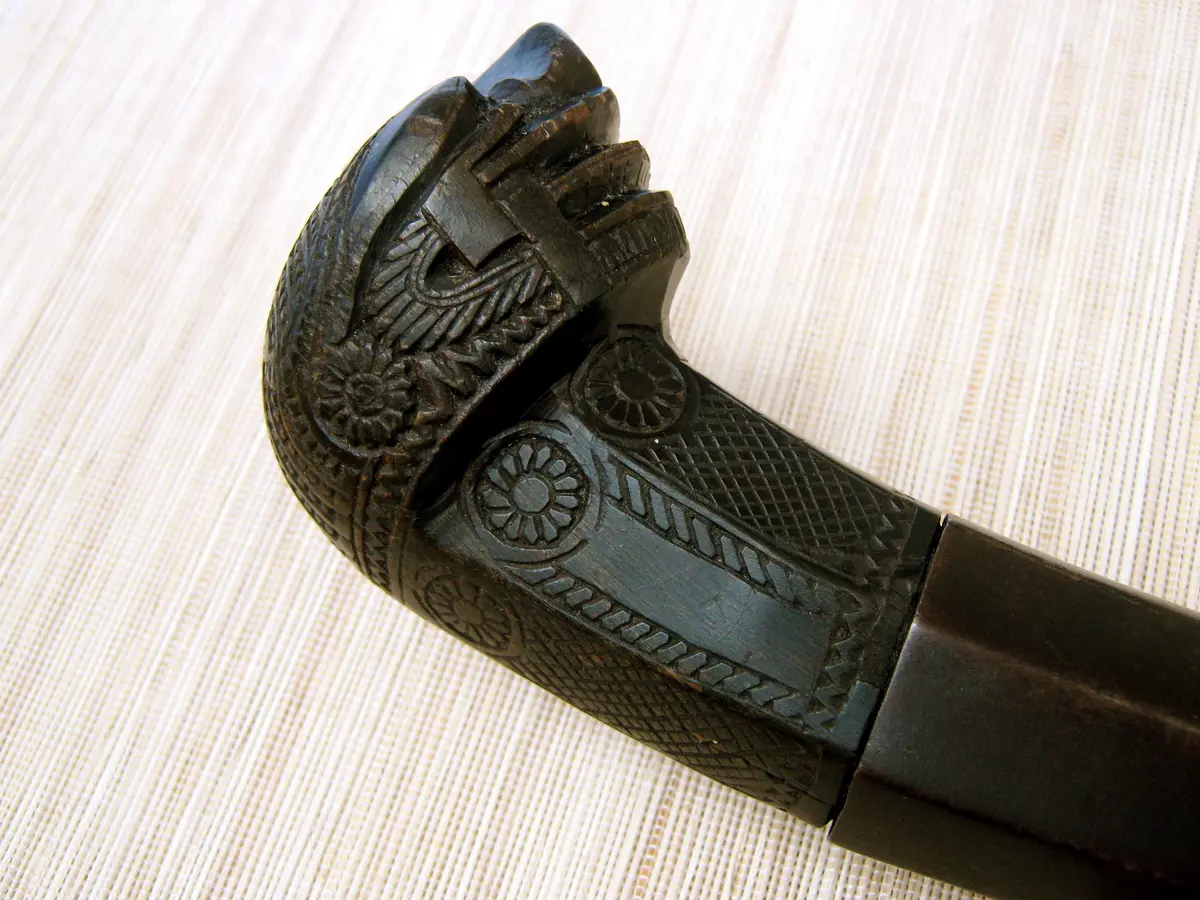
If you want an object rather than an event, there are the carved pommels of Visayan tenegre swords. The identification of those pommels as bakunawa heads is worth handling carefully: the photograph most often used to illustrate it, taken in 2009 by the Philippine historian and arms researcher Lorenz Lasco and released on Wikimedia Commons, is described by Lasco himself only as "the traditional grinning figural monster for pommel" on an antique Panay-Negros sword. The name Bakunawa was attached to it on Wikipedia in July 2018, by an editor opening a new section on sword ornament. The sword is real, the region is right and the carving is real; the label came later. Such swords are held in Philippine museum and private collections, and the National Museum of the Philippines runs regional museums for the region — National Museum Western Visayas, inaugurated in Iloilo City in 2018 in the old provincial jail, and National Museum Central Visayas in Cebu City — where the material culture of the islands is displayed.
There is also, since 2023, a fish. Iniistius bakunawa, the eclipse-spot razor wrasse, was described from seven specimens bought in public fish markets on Panay, Cebu, Bohol and Jolo — plus two trawled off Western Australia — and named for the eclipse-like ocellus on its dorsal fin. Its holotype is registered as KAUM-I. 80684.
And in Bacolod, on Negros, Bakunawa Fest — a genre and fantastic film festival that began there as Bakunawa Young Cinema — has been running for over a decade, with screenings at the Cinematheque Centre Negros in the Negros Museum. It is the closest thing to an annual bakunawa event anywhere.
Sources consulted
- Fr. Alonso de Méntrida, O.S.A., «Diccionario de la lengua bisaya, hiligueina y haraya de la isla de Panay (entrada Bacunaua; obra compuesta en el siglo XVII, reimpresa en Manila en 1841)» — Manila, Imprenta de D. Manuel y de D. Félix Dayot, 1841 book
- P. Matheo Sánchez, S.J., «Vocabulario de la lengua Bisaya (entrada Bacunava; compuesto hacia 1617)» — Manila, Colegio de la Sagrada Compañía de Jesús, 1711 book
- Fr. Juan Félix de la Encarnación, O.A.R., «Diccionario bisaya-español, 3.ª edición (lema impreso por el OCR como «BACON ADA»)» — Manila, Tip. de Amigos del País, 1885 book
- Fr. Tomás Ortiz, O.S.A., «Superstitions and beliefs of the Filipinos (Práctica del ministerio, h. 1731), n.º 42» — En E. H. Blair y J. A. Robertson (eds.), The Philippine Islands, 1493-1898, vol. 43, pp. 112-113, 1906 archive
- Laura Watson Benedict, «Bagobo Myths («Story of the Eclipse», el minokawa)» — The Journal of American Folk-Lore, vol. 26, n.º 99, pp. 19-20, 1913 academic
- William Henry Scott, «Barangay: Sixteenth-Century Philippine Culture and Society (capítulo «Natural Science»)» — Ateneo de Manila University Press, Quezon City, 1994 book
- Kent Elson S. Sorgon, Yi-Kai Tea, Jasmin C. Meren y Cleto L. Nañola Jr., «Iniistius bakunawa, a new species of razor wrasse (Teleostei: Labridae) from the Philippines and Western Australia» — Raffles Bulletin of Zoology, vol. 71, pp. 511-519, 2023 academic
- Fred Espenak, «Lunar Eclipses: 2021-2030 (tabla decenal)» — NASA Goddard Space Flight Center, Eclipse Web Site, 2014 report
- Donn V. Hart, «Southeast Asian Birth Customs: Three Studies in Human Reproduction (trabajo de campo en Caticugan, Siatón, Negros Oriental)» — HRAF Press, New Haven, 1965 book
- Jordan Clark, «Bakunawa and the Seven Moons: the original Bisaya story, with translation and annotations (sobre Buyser 1913 y 1926 y la reimpresión de Damiana Eugenio)» — The Aswang Project, 2019 web
- Wikipedia en inglés, «Bakunawa: historial completo de revisiones del artículo (418 revisiones desde el 30 de noviembre de 2006)» — Wikimedia Foundation, 2026 web
- Maximo D. Ramos (registro de la Stanford University Libraries), «Registro de catálogo: Creatures of Philippine lower mythology («A revision of the author's thesis, University of the Philippines, 1965»)» — University of the Philippines Press, Quezon City, 1971 web
- Amusement Today, «Six Flags Great Adventure unveils Bakunawa, the world's tallest and fastest spinning launch coaster» — Amusement Today, 2026 newspaper archive
- Lorenz Lasco (usuario Filhistorydotcom), «Visayan tenegre horn hilt closeup (fotografía de un sable antiguo de Panay-Negros; el autor describe el pomo como «the traditional grinning figural monster», sin nombrarlo bakunawa)» — Wikimedia Commons, subida el 4 de octubre de 2009, CC BY-SA 4.0, 2009 archive
Reviewed by V. Serrano on 2026-08-15 · How we verify our content
📎 Source: Enigma Atlas
💬 Field testimonies (0)
No testimonies yet. Add the first.
Add your testimony
🔒 Log in to add a testimony