👻 HAUNTED PLACE · EXP. Nº9475
ACTIVE
Fort Santiago
Fort Santiago guards the mouth of the Pasig River at the corner of Intramuros, the walled city the Spanish founded in 1571 — first as a palisade of palm logs and earth on the site of Rajah Matanda's fort, then, from about 1590, as a stone citadel.
Where is Fort Santiago?
- Location
- Metro Manila, Philippines
- Type
- Fort / battlefield
- Coordinates
- 14.595, 120.969
- Last updated
LOCATION
Why is Fort Santiago said to be haunted?
Jose Rizal spent his last weeks here before his execution at Bagumbayan on 30 December 1896, and brass footprints set into the pavement retrace his final walk. The dungeons hold two documented horrors. In the autumn of 1896, by the contemporary account of the merchant John Foreman, about seventy Katipunan suspects died in an overcrowded chamber after a sergeant blocked its only ventilation shaft with his rug. In February 1945, liberating troops found around 600 decomposing bodies of prisoners the Japanese had abandoned to hunger and suffocation; they lie under a white marble cross beside the dungeons. Ghost-tour guides and paranormal visitors report screams, cold spots and the lingering presence of Rizal near his cell. One thing the fort's own administrators insist on: the oft-repeated story that the dungeons were flooded by the tide to drown prisoners is, in their words, clearly a hoax.
What is the history of Fort Santiago?
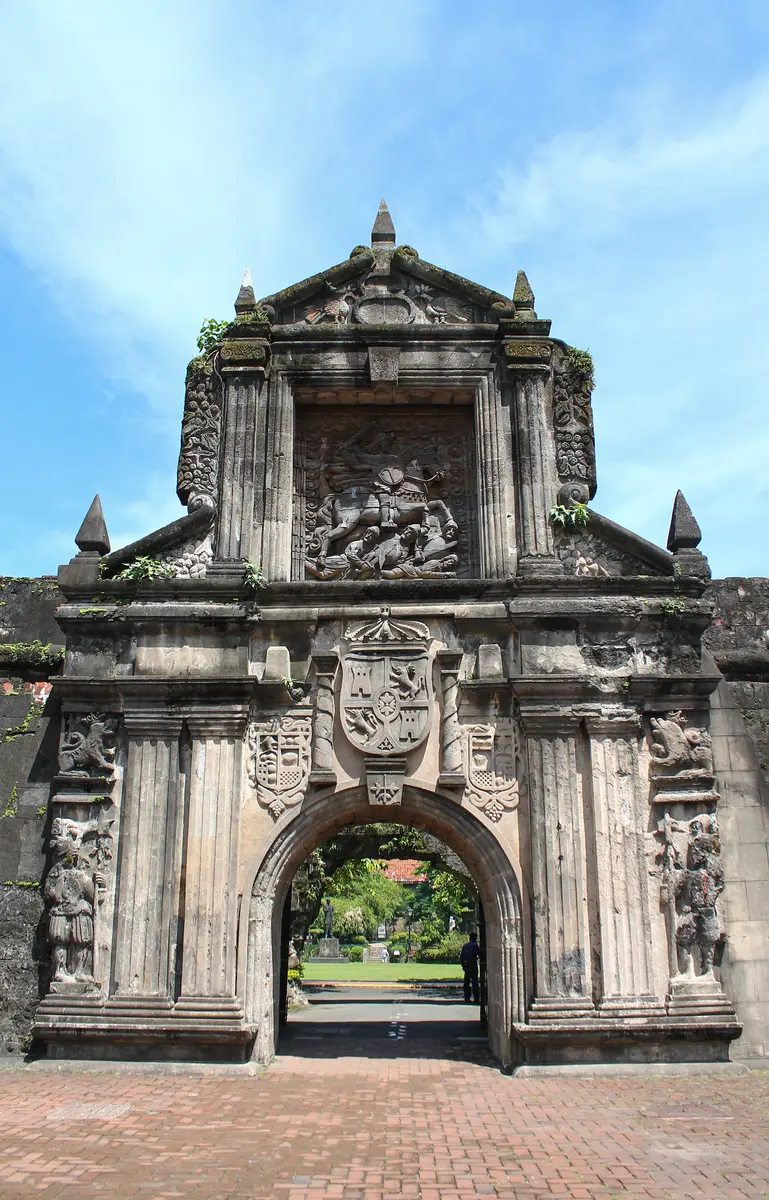
The point where the Pasig River meets Manila Bay was fortified long before any Spaniard saw it. A palisaded fort armed with bronze guns stood there under Rajah Matanda, a Muslim Tagalog ruler and vassal of the Sultan of Brunei, until the maestre de campo Martin de Goiti fought his way into the river mouth in 1570. When Miguel Lopez de Legazpi established the Spanish city of Manila on 24 June 1571, the conquerors raised their own fort of palm logs and earth on the same spot. It did not last three years: in 1574 the Chinese corsair Limahong attacked the young city, Goiti was killed, and only a desperate defence led by Juan de Salcedo drove the raiders off. The stone citadel that stands today was begun around 1590 under Governor-General Gomez Perez Dasmarinas and finished within about three years, built of volcanic tuff quarried at Guadalupe upriver, with the gun platform of Santa Barbara commanding the anchorage. The ornate main gate, crowned with a relief of Saint James the Moor-slayer — the Santiago who gives the fort its name — was added in 1714. British forces held the fort from 1762 to 1764 during their occupation of Manila, and the earthquakes of 1880 wrecked its front.
Under Spain the fort was also a prison, and its two documented tragedies frame the legend that grew here. Jose Rizal was locked up in it twice: briefly in July 1892, before his deportation to Dapitan, and from 3 November 1896, when he was returned to Manila after the Katipunan revolt had broken out. His biographer Austin Craig records that he was 'at first being held in a dungeon incomunicado and later occupying a small cell on the ground floor', furnished with a rattan table, chairs and a cot Rizal had to supply himself. Tried by court-martial, he walked out of the fort on the morning of 30 December 1896 to the esplanade of Bagumbayan, about a kilometre away, and was executed by firing squad. That same autumn the English merchant John Foreman, then living through the Manila of 1896, recorded the other tragedy: with the ordinary prisons overflowing, about 600 Katipunan suspects were crammed into the fort's dungeons at the river mouth. A Spanish sergeant threw his rug over the chamber's only light and ventilation shaft, and 'in a couple of days carts were seen by many citizens carrying away the dead, calculated to number 70'.
On 13 August 1898 an American naval lieutenant, Brumby, lowered the Spanish flag over Fort Santiago; the United States Army made the fort its headquarters, drained the moats and turned the surroundings into a golf course. The Japanese army seized it in 1942 and handed it to the Kempeitai military police, who filled the old storage cells and powder magazines with captured guerrillas and civilians. The reckoning came in February 1945. The U.S. Army's official history records that after the artillery bombardment of Intramuros, Company L of the 129th Infantry fought a 'nasty' close-quarters battle for the fort on 23 February, against defenders holed up in 'inner recesses, a few undamaged outbuildings, some subterranean dungeons'; engineers poured gasoline into holes and dungeons and ignited it, and mopping-up ended on 24 February, with some 400 Japanese dead at the fort alone. In the dungeons the liberators found around 600 decomposing bodies of the prisoners the Japanese had abandoned; by the fort administration's account they died of the combined effects of lack of food, air circulation and sanitary conditions, and none survived. They were buried in a mass grave beside the dungeons, marked today by a white marble cross.
On 6 March 1951, Republic Act No. 597 declared the ruined fort a national shrine, the 'Shrine of Freedom', 'in memory of Rizal and a Legion of National Heroes and Martyrs who had been confined and lost their lives within said premises'. The right wing of the barracks that held Rizal's cell was reconstructed in 1953 as the Rizal Shrine museum; the shattered main gate was rebuilt by the Intramuros Administration in 1982; and in February 2020 the administration opened the dungeon area by the Baluarte de Santa Barbara, with the white cross, to the visiting public.
Timeline: the documented record of Fort Santiago
- 24 June 1571 Miguel Lopez de Legazpi establishes the Spanish city of Manila; a fort of palm logs and earth rises where the palisade of Rajah Matanda, vassal of Brunei, had stood at the Pasig mouth.
- 1574 The Chinese corsair Limahong storms Manila; Martin de Goiti is killed and the Spaniards, led by Juan de Salcedo, barely hold the fort before driving the raiders north.
- c. 1590-1593 Construction of the stone citadel begins under Governor-General Gomez Perez Dasmarinas, in volcanic tuff quarried at Guadalupe; the U.S. Army's official history dates the start to 1590.
- 1714 The ornate main gate is erected, crowned by the relief of Saint James the Moor-slayer that still names the fort.
- 1762-1764 British forces under Draper and Cornish take Manila; Fort Santiago serves the Royal Navy until the occupation ends.
- Autumn 1896 With Manila's prisons overflowing after the Katipunan rising, about 600 suspects are packed into the fort's dungeons; after a sergeant covers the only ventilation shaft with his rug, carts remove some 70 dead — the eyewitness-era account of merchant John Foreman.
- 30 December 1896 Jose Rizal, held since 3 November first in a dungeon incomunicado and then in a small ground-floor cell, walks from the fort to Bagumbayan and is executed by firing squad.
- 13 August 1898 After the capitulation of Manila, Lieutenant Brumby of Dewey's squadron lowers the Spanish flag over Fort Santiago; the U.S. Army later drains the moats and lays out a golf course.
- 23-24 February 1945 Company L, 129th Infantry, storms the fort in the Battle of Manila, burning out defenders hidden in 'subterranean dungeons'; about 400 Japanese die at the fort, and around 600 decomposing bodies of abandoned prisoners are found in the cells.
- 6 March 1951 Republic Act No. 597 declares Fort Santiago a national shrine, the 'Shrine of Freedom', in memory of Rizal and the 'Legion of National Heroes and Martyrs' who died within its walls.
- 1953 The right wing of the barracks containing Rizal's cell is reconstructed as the Rizal Shrine museum; the war-shattered main gate follows in 1982, rebuilt by the Intramuros Administration.
- February 2020 The Intramuros Administration opens the dungeon area and the white-cross mass grave site to the visiting public.
Is there a rational explanation for Fort Santiago?
The story that gave this file its old centrepiece — prisoners locked in a low chamber and drowned as the tide rose — is the one claim the fort's own custodians flatly reject. The Intramuros Administration's official page on the dungeons states that the chambers 'were originally the fort's powder magazine', and that precisely because of that original purpose 'the regular flooding of the dungeons to drown its prisoners is clearly a hoax': no army stores gunpowder in a room the river visits twice a day. The deaths that actually happened there needed no tide. In 1945 the cause was hunger, want of air and disease among abandoned prisoners; in 1896 it was a blocked ventilation shaft.
The drowning motif does have a birth certificate of sorts, and it is older than the Japanese occupation our previous text attached it to. In the 1899 edition of his history, John Foreman wrote of the 1896 tragedy that 'the dungeons are below water-mark at high tide', so that 'twice a day these unfortunates were up to their waists or necks in water'. Even in that telling nobody drowns — the seventy died of suffocation. And when Foreman revised the book in 1906, he deleted the tidal flooding himself, leaving only river water filtering 'through the crevices in the ancient masonry'. A vivid image, walked back by its own author within seven years, then reattached decades later to a different occupier: that is the anatomy of a travelling dungeon legend. I found no primary 1945 source for death by tide, and the checked official histories give suffocation and starvation.
As for the ghosts, the institutional record is silent: neither the Intramuros Administration's pages nor Republic Act 597 mention any haunting. The reports come from the paranormal circuit and the night-tour trade, and should be read with their authors attached: the Australian paranormal blogger Amy, who visited in 2019, relays claims of Rizal's spirit lingering 'mostly around the area that he was held', of sudden temperature drops, disembodied voices and screams; the Filipino horror writer Yvette Tan toured the fort in 2020 with a psychic friend who sensed presences at a tunnel and by the Puerta de la Soledad; and by 2025 GMA News was covering commercial evening ghost walks through Intramuros. Two things are worth weighing against all of this. The fort is not a lonely ruin at night but a public park open until 10 p.m., its grounds busy with visitors, events and river noise. And no embellishment is needed here: roughly six hundred people genuinely died in one chamber within living memory, which is exactly the kind of documented horror onto which ghost stories are routinely grafted.
Can you visit Fort Santiago?
Fort Santiago sits at the northwestern corner of Intramuros, Manila, at the end of General Luna and Santa Clara streets, beside Manila Cathedral and the Pasig riverfront. The Intramuros Administration lists it open Monday to Friday from 8 a.m. to 10 p.m. (last entry 8 p.m.) and weekends from 6 a.m. to 10 p.m. (last entry 8:30 p.m.); admission is 75 pesos, or 50 pesos for students, senior citizens and PWDs. The dungeon area by the Baluarte de Santa Barbara, open to the public since February 2020, keeps its own schedule — the official visitor site lists 10 a.m. to 10 p.m., though announced hours have varied, so check before a special trip.
Inside, the Museo ni Rizal occupies the reconstructed barracks wing that held Rizal's cell, with memorabilia of the hero; brass footprints set into the pavement lead from the shrine towards the gate, the start of a marked trail of his final walk that originally continued beyond the walls to today's Rizal Park — press coverage of the annual 30 December reenactment noted as early as 2011 that some plates outside the fort had gone missing. The white marble cross near the dungeons marks the 1945 mass grave, and the Wall of Martyrs carries the roll of those imprisoned here during the war. Plaza Moriones and the riverside promenade are an easy stroll. The nearest rail stop is LRT-1 Central Terminal, about fifteen minutes away on foot; paths are mostly paved and level. Every 30 December, Rizal Day, marchers in period dress retrace the kilometre from the fort to his execution site.
Sources consulted
- John Foreman, «The Philippine Islands (2nd edition) — chapter on the rebellion of 1896, pp. 521-523» — Sampson Low, Marston & Co., London, 1899 book
- John Foreman, «The Philippine Islands (3rd edition) — 'Tragedy at Fort Santiago; cartloads of corpses', p. 375» — Charles Scribner's Sons, New York, 1906 book
- Austin Craig, «Lineage, Life and Labors of Jose Rizal, Philippine Patriot» — Philippine Education Company, Manila, 1913 book
- Robert Ross Smith, «Triumph in the Philippines (United States Army in World War II), pp. 238-239, 297-300» — U.S. Army Center of Military History, Washington, 1963 report
- Congress of the Philippines, «Republic Act No. 597: An Act to Declare Fort Santiago a National Shrine» — Official Gazette, vol. 47, no. 3, 1951 report
- Intramuros Administration, «Fort Santiago Dungeons» — intramuros.gov.ph, 2022 web
- Philippine Primer, «Intramuros: Fort Santiago Dungeons Now Accessible to the Public» — primer.com.ph, 2020 web
- Intramuros Administration, «Welcome to Fort Santiago! (official site page, with Museo ni Rizal and White Cross Memorial)» — intramuros.gov.ph, 2025 web
- Wikipedia contributors, «Fort Santiago» — Wikipedia (English), 2026 web
- Jeannette I. Andrade, «Rizalistas reenact hero's last steps from Fort Santiago to Bagumbayan» — Philippine Daily Inquirer, 2011 newspaper archive
- Amy (Amy's Crypt), «Haunted Fort Santiago: Manila, Philippines» — amyscrypt.com, 2019 web
- Yvette Tan, «The ghosts of Fort Santiago (at least some of them, anyway)» — yvettetan.com, 2020 web
- Carby Rose Basina, «The Ghosts of Intramuros» — GMA News Online, 2025 newspaper archive
Reviewed by V. Serrano on 2026-08-17 · How we verify our content
💬 Field testimonies (0)
No testimonies yet. Add the first.
Add your testimony
🔒 Log in to add a testimony