👻 HAUNTED PLACE · EXP. Nº9475
ACTIVE
Manila City Hall
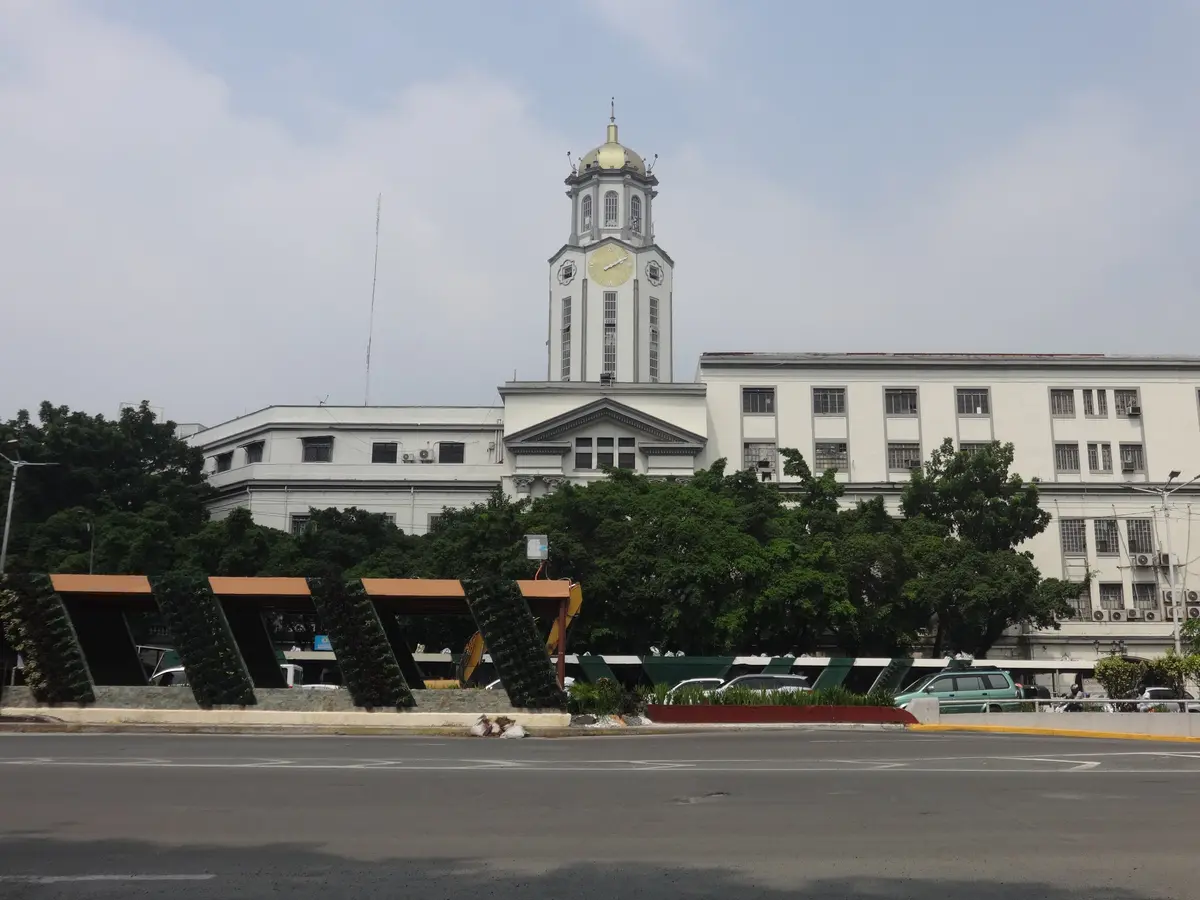
Manila City Hall is neither a ruin nor an attraction: it is the working seat of the city government of Manila, where the mayor and the city council sit and where thousands of people file papers and go to work every weekday.
Where is Manila City Hall?
- Location
- Metro Manila, Philippines
- Type
- Public building
- Coordinates
- 14.59, 120.982
- Last updated
LOCATION
Why is Manila City Hall said to be haunted?
Its ghost stories are real in the sense that they are documented, and they can be dated. The oldest printed versions anyone has been able to fix in time are two Philippine articles published on the same day in October 2013: spirits in the corridors after six in the evening, a man said to have hanged himself in the clock tower, and a building that looks like a casket seen from above. That last claim is checkable. The footprint really is a tapering trapezoid roughly 200 metres long, and there is a documented reason for it that has nothing to do with coffins: the plot itself is trapezoidal, left over from Daniel Burnham's street plan for the district. What lies under all of it is not folklore. In February 1945 this building was a Japanese strongpoint taken room by room, and the battle around it killed civilians in numbers that the memorial marker in Intramuros still puts at more than a hundred thousand.
What is the history of Manila City Hall?
The plot came before the building, and it explains almost everything that has since been read into its outline.
Manila City Hall stands on a wedge of ground east of Intramuros that was left over from the civic centre Daniel H. Burnham sketched for Manila in the 1900s. Only part of that scheme was ever built — the Legislative Building, the Finance Building and the Agriculture Building, all three now halls of the National Museum — and the city hall was fitted into the block between them. The block is a trapezoid, and the building simply fills it.
The first American-era city hall on the site was made of wood. The city government's own heritage page dates it to 1904, under Mayor Arsenio Cruz Herrera; it covered roughly a third of the ground the present building occupies, and after three decades of use City Engineer Santiago Artiaga recommended reinforcing the weakened floor under the municipal board's session hall and keeping crowds out of the corridors. It was demolished.
The replacement was first drawn by Juan M. Arellano in an Art Deco idiom. Arellano left the project, and Antonio Manalac Toledo of the Bureau of Public Works took it over and rebuilt the design as neoclassical — the same architect credited with the neighbouring Finance and Legislative buildings. Toledo gave it a uniform envelope of windows on every side, some two hundred rooms over about 8,400 square metres, and a tall clock tower capped by a dome, which is what everyone photographs. The city's heritage page dates the inauguration to 19 August 1941, with Eulogio Rodriguez presiding — the sixty-third birthday of President Manuel L. Quezon. Less than four months later the Philippines was at war.
What happened next is documented in unusual detail, because the United States Army wrote it down. In Triumph in the Philippines, the official history of the campaign, Robert Ross Smith describes City Hall as one of a chain of Japanese strongpoints barring the approach to Intramuros. Mortars of the 129th Infantry had already set the four-storey concrete building alight without dislodging its garrison, which Smith puts at roughly 200 men on 20 February 1945. That day self-propelled 105mm guns and a single 155mm howitzer blew a hole in the east wall; a platoon of the 145th Infantry ran across open ground, got inside, and was forced straight back out. On the 21st the whole of Company I got in after the outer walls of the east wing were knocked down, and again could not hold. On the morning of the 22nd tanks, tank destroyers and howitzers pulverised the east wing at point-blank range while mortars worked over the roof. Company I re-entered at about nine o'clock and fought room by room with submachine guns, bazookas, demolitions and flame throwers; most resistance was over by three in the afternoon. Some twenty men held out in a ground-floor room, refused an invitation to surrender, and were killed when holes were blown through the ceiling above them and flame throwers pushed through. The regiment carried 206 Japanese bodies out of the building. Then it cleared the rubble from the west wing and set machine guns in the windows, and City Hall became a firing platform for the assault on Intramuros that opened the next day.
The dead inside the building were soldiers. The dead outside it were not. Smith ends his account of the battle by recording that "an estimated 100,000 Filipino civilians had lost their lives" in it. The cast-iron marker at the Memorare - Manila 1945 monument in Intramuros, put up by the National Historical Institute in 1995, is blunter: it commemorates "the more than 100,000 defenseless civilians who were killed during the battle for the liberation of Manila between February 3 and March 3, 1945", and attributes them both to "heinous acts perpetrated by the Japanese Imperial Forces" and to "the heavy artillery barrage by the American forces". Those two figures are estimates, and they belong to the people who published them; nobody counted.
There is a marker on City Hall's own grounds, in Freedom Triangle Plaza, installed under Board Resolution No. 2, s. 1994 of the National Historical Institute. It records the flying column of the 1st Cavalry Division entering Manila late on 3 February 1945, the liberation of the internees at Santo Tomas and Bilibid, and the annihilation of the Japanese forces in Intramuros by 24 February. It does not mention the Filipino civilian dead at all. A visitor who reads only the plaque on this site will not learn that they existed.
The hall was rebuilt from 1946 with American and Philippine Commonwealth Army help and money from the Philippine Rehabilitation Act, and not exactly to Toledo's drawings: an attic storey was added over part of the building and extra windows were opened where shell holes had been. In 1964 the city commissioned Carlos "Botong" Francisco to paint the history of the Philippines for it; the ten-panel result, Filipino Struggles Through History, was installed in 1968 in the hall later renamed Bulwagang Gat Antonio Villegas, declared a National Cultural Treasure in 1996, removed in 2013 after plumbing damage, and moved in February 2018 to the National Museum of Fine Arts. A printed replica hangs in its place. The National Museum declared the building itself an Important Cultural Property on 27 June 2019, and the marker for that declaration was unveiled on 18 September 2023 by Mayor Honey Lacuna and NMP director general Jeremy Barns.
Timeline: the documented record of Manila City Hall
- 1904 The city government's own heritage page dates the first American-era city hall on this plot to 1904, a wooden building put up under Mayor Arsenio Cruz Herrera and covering about a third of the present footprint. It was demolished in the 1930s after decades of complaints about its weakened session-hall floor.
- 19 August 1941 According to the City of Manila's heritage page, the present building was inaugurated on 19 August 1941 with Eulogio Rodriguez presiding — the sixty-third birthday of President Manuel L. Quezon. Antonio Manalac Toledo had taken the commission over from Juan M. Arellano and replaced Arellano's Art Deco design with a neoclassical one.
- 20-22 February 1945 Robert Ross Smith's official US Army history records City Hall as a Japanese strongpoint held by about 200 men on 20 February. After two failed entries, Company I of the 145th Infantry re-entered at about 09:00 on the 22nd and cleared the building room by room with flame throwers and demolitions; the last defenders died in a ground-floor room. The regiment removed 206 Japanese bodies and turned the west wing into a machine-gun platform for the assault on Intramuros.
- 3 February - 3 March 1945 The National Historical Institute marker at the Memorare - Manila 1945 monument commemorates "the more than 100,000 defenseless civilians who were killed during the battle for the liberation of Manila" in those four weeks, attributing them both to acts of the Japanese Imperial Forces and to American artillery. Smith's official history gives "an estimated 100,000". Both are estimates.
- 1946 Reconstruction began with US and Philippine Commonwealth Army help and funding under the Philippine Rehabilitation Act. The rebuilt hall did not follow Toledo's plans exactly: an attic storey was added over part of the building and new windows were opened where shell damage had been.
- 1968 Carlos "Botong" Francisco's ten-panel Filipino Struggles Through History, commissioned by the city in 1964, was installed in the hall later renamed Bulwagang Gat Antonio Villegas. It was declared a National Cultural Treasure in 1996, removed in 2013 after water damage, and moved to the National Museum of Fine Arts in February 2018; a printed replica hangs in its place.
- 29 October 2013 The oldest datable printed appearances of the ghost lore: on the same day, The Philippine Star (AJ Bolando) wrote that "seen from above, the entire city hall is shaped like a casket" and reported a man said to have hanged himself in the bell tower, while Rappler (Carol Ramoran) described "a coffin with a cross" and night-time footsteps. The Star illustrated the claim with an image credited to Google Maps.
- 28 October 2016 CNN Philippines repeated the claim and added the counter-reading that has travelled with it ever since: the building "looks like one giant casket (some would say the shape recalls the shield of the Knights Templar)".
- 28 October 2018 GMA News reported Ed Caluag's investigation for the Halloween special "Kapuso Mo, Jessica Soho: Gabi ng Lagim": a dowsing rod, a candle read as consent, and a seance with administrative aide Rhodora Garcia as medium. The same report quotes named staff, including janitress Lorena Selmar, and the architecture historian Gerard Lico explaining that the plot became trapezoidal as a consequence of the city planning.
- 27 June 2019 The National Museum of the Philippines declared Manila City Hall an Important Cultural Property. The marker was not unveiled until 18 September 2023, by Mayor Honey Lacuna and NMP director general Jeremy Barns. It is an Important Cultural Property, not a National Historical Landmark.
- 25 October 2022 The Manila Clock Tower Museum opened to the public under Mayor Honey Lacuna, four months after Isko Moreno inaugurated it on 29 June. Before the 2020 restoration the tower interior was a storeroom that Moreno publicly called the "Mini-Smokey Mountain" of City Hall.
Is there a rational explanation for Manila City Hall?
Start by dating the story rather than the building.
The oldest printed versions of the Manila City Hall ghost lore that I have been able to fix in time are two Philippine articles published on the same day, 29 October 2013: AJ Bolando's "5 'creepiest, scariest' places in Metro Manila" in The Philippine Star, and Carol Ramoran's "Ghost hunting in the PH? Here are 7 places" in Rappler. Bolando has the full package — "seen from above, the entire city hall is shaped like a casket", spirits after 6 p.m., a man who hanged himself in the bell tower, employees advised to leave early. Ramoran has "a coffin with a cross" and footsteps at night. That is seventy-two years after the building opened. It is not proof that nobody told the story earlier, but it is where the paper trail starts, and the shape of the trail matters: The Philippine Star illustrated its casket claim with an image credited "Photo from Google maps". The coffin is a satellite-view reading, and satellite views only became ordinary in the 2000s.
The outline itself is real. Measured off the OpenStreetMap footprint, the building runs about 200 metres north to south and never more than 90 metres east to west, narrow at the clock-tower end, widest about a third of the way down, tapering to the south. Whether that is a casket depends on what you bring to it: CNN Philippines, repeating the claim in 2016, noted that "some would say the shape recalls the shield of the Knights Templar". Same polygon, two readings. What is documented is the cause. The plot is trapezoidal because of the street plan around it, and the architecture historian Gerard Lico said exactly that — that the trapezoidal lot was a consequence of the planning — in the very 2018 GMA broadcast that produced the building's best-known ghost segment. No document links the outline to any funerary intent, and Toledo did not even choose the commission's starting point: he inherited it from Juan Arellano. One detail worth correcting: the outline is not, as this page previously claimed, a product of the postwar rebuild. It is Toledo's 1930s plan on a pre-existing block; what the rebuild changed was the attic and some windows.
"Paranormal experts confirmed" is also worth unpacking, because it was one television segment. On 28 October 2018 GMA News reported the visit of Ed Caluag to City Hall for "Kapuso Mo, Jessica Soho: Gabi ng Lagim". Caluag worked with a dowsing rod, lit a candle, read its flicker as consent to communicate, and then held a seance using an administrative aide of the building, Rhodora Garcia, as medium. A dowsing rod amplifies the unconscious hand movements of whoever holds it, which is why it points wherever its holder half-expects; a candle flame in a ventilated tower moves on its own; and a seance produces narrative, not measurement. The same report carries something more useful: named employees describing what they experienced, among them the janitress Lorena Selmar. Those are witness accounts, and they are worth recording as such.
Two mundane facts do a lot of work here. The first is that the clock tower — the alleged epicentre — was a storeroom. It was full enough of junk before the 2020 restoration that Mayor Isko Moreno publicly called it the "Mini-Smokey Mountain" of City Hall, after the Manila rubbish dump; it only became an art gallery, cafe and museum afterwards. A locked, dark, disused space at the top of a building where thousands of people work is an efficient generator of stories. The second is the six o'clock rule, which is what a government building's closing time looks like when it is retold: offices empty, a large 1940s masonry structure with long corridors goes quiet, and the last people out are cleaners and guards.
As for the man hanged in the tower, I have found no name, no date and no contemporary press or police record — only the 2013 article and everything downstream of it. And the honest bottom line is not that nothing happened in this building. Two hundred and six men were carried dead out of these rooms in February 1945, and around them a city lost civilians in numbers that the markers still put at more than a hundred thousand. What is undocumented is that any of them came back.
Can you visit Manila City Hall?
This is not a ruin, a museum or an attraction: it is the working seat of the city government of Manila. The mayor's office and the city council chambers are inside, along with the departments where residents come to file documents, and thousands of people work there every weekday. Treat it accordingly.
Address: Manila City Hall, Padre Burgos Avenue at Antonio Villegas Street, Ermita, Manila. Offices keep ordinary Philippine government business hours on weekdays and are closed at weekends and on holidays; entry to the office floors is for people with business there, subject to security screening, and the corridors are not somewhere to wander looking for atmosphere. The nearest rail station is Central Terminal on LRT-1, on Antonio Villegas Street, about 350 metres away.
The one part built for visitors is the clock tower. Restored from 2020 — the facade repainted white and the roof gold — its interior, formerly a storeroom, became a gallery, a cafe and the Manila Clock Tower Museum, with exhibits including three-dimensional depictions of the Battle of Manila and a 360-degree view over Lawton, Intramuros and Manila Bay. It was inaugurated on 29 June 2022 by Mayor Isko Moreno and formally opened to the public on 25 October 2022 under Mayor Honey Lacuna. I could not verify current opening hours or admission from any published source as of 12 August 2026, so check with the Department of Tourism, Culture and Arts of Manila before making a special trip.
Outdoors and free at any time: Freedom Triangle Plaza, on the grounds, where the 1945 Battle of Manila marker stands.
Two things people come looking for are not here. Botong Francisco's Filipino Struggles Through History left in 2013 and has hung since February 2018 in the National Museum of Fine Arts, a few minutes' walk along Padre Burgos Street; what remains in the Bulwagang Gat Antonio Villegas is a printed replica. And the Memorare - Manila 1945 monument to the civilian dead, with the marker quoted above, is about a kilometre away at Plazuela de Santa Isabel in Intramuros.
One warning about the name. In Spanish, "Ayuntamiento de Manila" usually means a different building: the Spanish-era Casas Consistoriales inside Intramuros, destroyed in 1945, rebuilt, and now occupied by the Bureau of the Treasury. This page is about the 1941 hall in Ermita.
Sources consulted
- Robert Ross Smith, «Triumph in the Philippines (United States Army in World War II: The War in the Pacific), ch. 15-16» — Office of the Chief of Military History, Department of the Army, 1963 book
- National Historical Institute, «Memorare - Manila 1945: cast-iron historical marker, Plazuela de Santa Isabel, Intramuros (transcribed from a photograph of the marker)» — Physical marker, Intramuros, Manila, 1995 archive
- National Historical Institute, «Battle of Manila historical marker, Freedom Triangle Plaza, Manila City Hall, installed pursuant to Board Resolution No. 2, s. 1994 (transcribed from a photograph of the marker)» — Physical marker, Manila City Hall grounds, 1995 archive
- City Government of Manila, «Historical Landmarks: Manila City Hall (official city website, archived 16 November 2016)» — manila.gov.ph, 2016 web
- AJ Bolando, «5 'creepiest, scariest' places in Metro Manila» — The Philippine Star, 2013 newspaper archive
- Carol Ramoran, «Ghost hunting in the PH? Here are 7 places» — Rappler, 2013 newspaper archive
- CNN Philippines staff, «I see dead people: 10 haunted places around Metro Manila» — CNN Philippines, 2016 newspaper archive
- GMA News Online, «Paranormal expert Ed Caluag investigates Manila City Hall's strange occurrences» — GMA News Online, 2018 newspaper archive
- Ghio Ong, «Marker unveiled declaring Manila city hall 'important cultural property'» — The Philippine Star, 2023 newspaper archive
- Jhon Dave Cusipag, «Calling all museum lovers: Manila's iconic clock tower is now the capital's newest tourist attraction» — PhilSTAR L!fe, 2022 newspaper archive
- Wikipedia contributors, «Manila City Hall (article and full revision history, consulted 12 August 2026)» — English Wikipedia, 2026 web
- Wikipedia contributors, «Filipino Struggles Through History» — English Wikipedia, 2026 web
- Wikipedia contributors, «List of reportedly haunted locations in the Philippines (article and revision history, consulted 12 August 2026)» — English Wikipedia, 2026 web
Reviewed by V. Serrano on 2026-08-12 · How we verify our content
💬 Field testimonies (0)
No testimonies yet. Add the first.
Add your testimony
🔒 Log in to add a testimony