👻 HAUNTED PLACE · EXP. Nº9475
ACTIVE
University of Santo Tomas
The University of Santo Tomas keeps two histories at two different addresses, and almost every ghost story about it collapses the two into one.
Where is University of Santo Tomas?
- Location
- Metro Manila, Philippines
- Type
- School / university
- Coordinates
- 14.61, 120.99
- Last updated
LOCATION
Why is University of Santo Tomas said to be haunted?
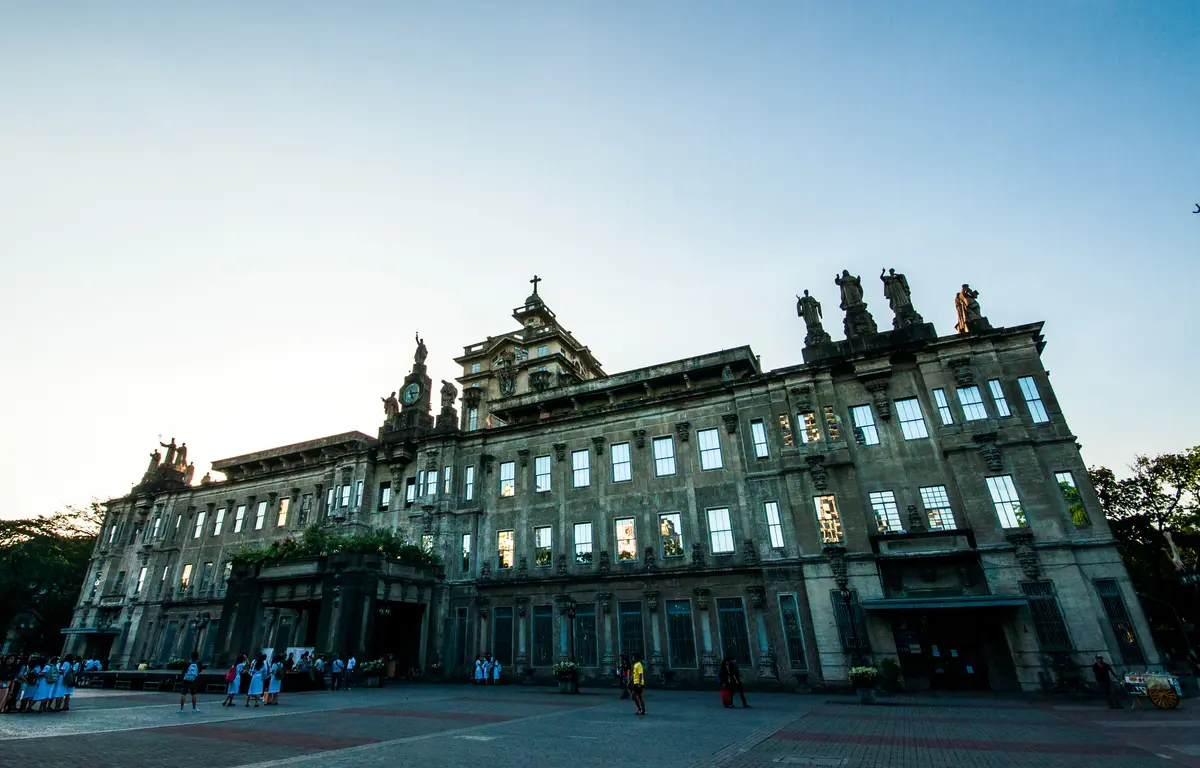
The Dominican college opened on 28 April 1611 inside Intramuros, six years after Archbishop Miguel de Benavides died leaving 1,500 pesos and his library for it; his executors did the founding, not him. The campus that people call haunted is in Sampaloc, and its Main Building was inaugurated on 12 November 1927. Fourteen years later it became the Santo Tomas Internment Camp, where fewer than 4,000 internees were still held when American cavalry reached it on 3 February 1945. Compiled camp records give 390 deaths; the highest monthly toll, 48, came in February 1945, after liberation, and the same compilation puts it down to the lingering effects of near-starvation. The campus legends that are actually documented were collected by the university's own student paper in 2006, along with the history professor who took them apart.
What is the history of University of Santo Tomas?
The campus where the ghost stories are told is not the campus that was founded in 1611. That single fact undoes most of what gets written about the University of Santo Tomas, and it is not hidden: the university says so on its own history page.
The founder never saw the place. Miguel de Benavides, O.P., third Archbishop of Manila, made his will on 24 July 1605 and died two days later, on 26 July. He left 1,500 pesos and his personal library so that somebody else could open a seminary-college to train young men for the priesthood. The executors of that will — the Dominicans Domingo de Nieva and Bernardo de Santa Catalina — did the founding. The college opened on 28 April 1611, six years after Benavides was buried, under the name Colegio de Nuestra Señora del Santísimo Rosario, and was later renamed Colegio de Santo Tomas for Thomas Aquinas. It stood inside Intramuros, the walled city, beside the Dominicans' own Santo Domingo church.
Everything that makes the institution famous happened there, in Intramuros. On 29 July 1619 the college was authorised to confer degrees in theology and philosophy. On 20 November 1645 Pope Innocent X raised it to a university. In 1680 the Spanish crown extended royal patronage to it; in 1681 Innocent XI declared it a public university of general studies, free to confer other degrees. Charles III added the title Royal in 1785, Leo XIII made it Pontifical on 17 September 1902.
The move north is the part everyone skips. Enrolment outgrew the walled city, and in 1927 the university transferred to a 21.5-hectare property in the Sulucan district of Sampaloc. Its centrepiece, the Main Building, was designed by the Dominican engineer Fr. Roque Ruaño, built between 1924 and 1927 and inaugurated on 12 November 1927. According to The Varsitarian, the university's student paper, it was the first earthquake-resistant building in the Philippines, made up of 40 separate and smaller structures.
So the Main Building was fourteen years old when the war reached it. The Intramuros campus kept operating until the fighting destroyed it, and only one piece of it ever made the journey to Sampaloc: the seventeenth-century Puerta del Colegio, dismantled on the orders of rector Jesús Castañón in 1953 and re-erected in 1954 as the Arch of the Centuries. Its campus-facing side is salvaged original stone; the side that looks onto España Boulevard is a 1954 replica.
On 4 January 1942 the Japanese turned the new Sampaloc campus into the Santo Tomas Internment Camp, the largest civilian internment camp in the Philippines. That is the history that belongs to this address.
Timeline: the documented record of University of Santo Tomas
- 24-26 July 1605 Archbishop Miguel de Benavides, O.P., makes his will on 24 July, leaving 1,500 pesos and his personal library for a seminary-college, and dies two days later. He founds nothing himself: his executors, the Dominicans Domingo de Nieva and Bernardo de Santa Catalina, carry it out.
- 28 April 1611 The Colegio de Nuestra Señora del Santísimo Rosario opens inside Intramuros, the walled city, six years after Benavides's death. It is later renamed Colegio de Santo Tomas.
- 20 November 1645 Pope Innocent X raises the Intramuros college to the rank of university. It is this document, and its 1681 confirmation by Innocent XI as a public university of general studies, that underlies the university's own claim to hold the oldest extant university charter in Asia.
- 12 November 1927 The Main Building, designed by the Dominican engineer Fr. Roque Ruaño and built from 1924, is inaugurated on the new 21.5-hectare Sampaloc campus. The university had begun leaving Intramuros that year because enrolment had outgrown the walled city.
- 4 January 1942 Japanese forces convert the fifteen-year-old Sampaloc campus into the Santo Tomas Internment Camp. The date is the one cut into the bronze plaque that the American Association of the Philippines later fixed to the Main Building wall.
- February 1944 The Japanese Army takes the camp over from civilian administrators and cuts outside supply. Rations fall from about 1,500 calories a day to roughly 1,100 by November; a camp doctor later reports an average weight loss of 24 kg among male internees over the three years.
- 5 January 1945 Carroll C. Grinnell, chairman of the internees' executive committee, and three other camp leaders arrested in December are taken out of Santo Tomas and killed. Professor Jose Victor Torres notes that the executions took place at the North Cemetery, not on campus.
- 3 February 1945 The Cavalry Division reaches Manila and begins the liberation of fewer than 4,000 internees, 3,000 of them American. Captain Manuel Colayco, a UST faculty member and guerrilla intelligence officer who guided the troops, is mortally wounded.
- 4 February 1945 The standoff in the Education Building ends. Some 47 Japanese soldiers holding around 200 internees hostage on the upper floors walk out of the campus under a negotiated safe conduct, with an internee acting as interpreter.
- 7 and 10 February 1945 Japanese artillery shells the campus after the liberation, on the day MacArthur visits and again three days later. Published tallies give 28 dead inside the compound, 16 of them internees. February 1945 becomes the deadliest month of the whole internment, after freedom rather than before it.
- 1954 Two pieces of memory arrive the same year: in February the American Association of the Philippines fixes its bronze plaque inside the Main Building, and the seventeenth-century Puerta del Colegio, dismantled in Intramuros in 1953, is re-erected at Sampaloc as the Arch of the Centuries.
- 14 November 2006 The Varsitarian publishes the first systematic inventory of the campus legends. History professor Jose Victor Torres uses it to kill the belief that the site was a burial ground: the archives, he says, show an open field with a swamp.
- 25 January 2010 The National Museum declares the Main Building, the Central Seminary, the Arch of the Centuries and the open spaces around them National Cultural Treasures, the first time buildings of an educational institution enter that roster.
- 3 June 2022 At the Baccalaureate Mass the Rector, Fr. Richard Ang, O.P., contradicts the university's best-known superstition from the pulpit: walking out through the Arch of the Centuries early does not get anyone debarred. "Hindi po totoo 'yun" - that is not true.
Is there a rational explanation for University of Santo Tomas?
The published record on Thomasian ghost stories is unusually good, and it argues against almost everything that circulates.
The Varsitarian, the university's own student paper, inventoried the campus legends on 14 November 2006 in a feature by Rieze Rose T. Calbay. What it found is specific and locatable: a knocking on the forehead felt inside a first-floor toilet cubicle in the Main Building, tied to a student said to have hanged herself there; crying heard from Room 406 of St. Raymund's Building, tied to a Commerce student who jumped from the fourth floor in 1987; a singing woman on the fifth floor of the Music Building; a figure glimpsed in the Ossarium technician's room. The same feature passes on, second-hand, an Accountancy student's account of headless, shackled ghosts in the Main Building halls, which she and her classmates said they had not seen themselves.
The article's most useful source is the sceptic. Jose Victor Torres, a history professor in the Faculty of Arts and Letters, told the paper flatly that the 21.5-hectare campus had never been consecrated ground: "The archives have concrete evidence that UST was not a cemetery, but an open field, with a swamp." (A paraphrase of him earlier in the same article says that many people had been buried on the grounds before the university occupied them in 1927; his words in quotation marks say the opposite.) He also disposed of the assumption that internees were killed on the premises: "There are only four people executed from the camp, but the Japanese did not kill them here. They were brought into the North Cemetery where they were killed and buried." Torres is not a debunker by temperament — he told the same reporter that in 1987 he and two friends greeted a man in a Dominican habit in Benavides Park at midnight and found him gone seconds later — which is exactly why his archival correction carries weight. His verdict on the rest was blunt: "Some people create the stories they fear. And some invent ghost stories just to entertain others."
The university has since done the same thing in public with its best-known superstition. The legend that a student who walks out through the Arch of the Centuries before the Baccalaureate Mass will be debarred was contradicted from the pulpit by the Rector, Fr. Richard Ang, O.P., at the 2022 Baccalaureate Mass: "Hindi po totoo 'yun" — that is not true — adding that as an Arts and Letters undergraduate he and his classmates walked through it all the time. When The Flame surveyed the same superstitions in 2023, the explanation offered by Asst. Prof. Paul Castillo of the UST Publishing House was psychological rather than supernatural: the myths answer "a need to explain certain phenomena" and give students something to hold on to.
What remains, once the folklore is set aside, is a documented mortality that needs no ghost. The compiled camp records give 390 deaths at Santo Tomas between January 1942 and March 1945, with people over sixty making up 18 per cent of the population and 64 per cent of the dead. The highest monthly toll, 48 deaths, came in February 1945, the month the camp was liberated on the 3rd, and the same compilation puts it down to "the lingering effects of near-starvation for so many months".
Can you visit University of Santo Tomas?
The Sampaloc campus of the University of Santo Tomas covers 21.5 hectares of Manila 1008, on a nearly square plot bounded by España Boulevard, P. Noval Street, A.H. Lacson Avenue and Dapitan Street. The university's own note on those streets reads the four names as four inheritances: España for the Hispanic, Forbes — the older name of Lacson Avenue — for the American, Dapitan for the Filipino, Padre Noval for the Dominican. Gates are staffed and entry is controlled by the university.
The UST Museum of Arts and Sciences, founded in 1871 inside the Main Building, is the part of the campus with published hours. Its visitor page, read on 22 September 2026, gives Tuesday to Friday, 8:30 to 16:30; Mondays are closed, and Saturdays open only "by special arrangement subject to the approval of the museum director". The same page states that the museum "adheres to the University of Santo Tomas' academic calendar and is closed during academic breaks, University and religious holidays, national holidays, and during periods of inclement weather that necessitate class suspensions at all levels". Admission is 50 pesos for non-students and 30 pesos for non-Thomasian students with an identity card. Thomasian students, faculty, staff and alumni are admitted free on their cards. So are ICOM members, tour guides with school groups, and non-Thomasian senior citizens and persons with disabilities holding valid identification. Parties of fifteen or more are asked to write to [email protected] two weeks ahead, on +632 8781 1815. The dress code bars sando shirts and rubber slippers, and allows sleeveless blouses provided they are neither spaghetti-strap nor tube cut; photographs are permitted for personal, non-commercial use without flash.
The bronze plaque that the American Association of the Philippines installed in February 1954 is on the Main Building, and its wording is the camp's own epitaph: the internees "suffering great physical privation and national humiliation from January 4, 1942, until liberated February 3, 1945".
The Arch of the Centuries stands in UST Plaza Intramuros on the España side. The stones facing the campus are the seventeenth-century arch of the Intramuros college; the face turned to the street is the replica inaugurated in 1954. The Philippine Star reported that "officially declared as National Cultural Treasures last Jan. 25 were UST's Main Building, its Central Seminary, the Arch of the Centuries and the university's open spaces", the first time the National Museum gave that rank to the buildings of a school. The nearest rail station is Legarda on LRT Line 2; jeepney and bus routes run along España.
Sources consulted
- A. V. H. Hartendorp, «The Santo Tomas Story» — McGraw-Hill Book Company, New York, 1964 book
- University of Santo Tomas, «History» — ust.edu.ph (official university history), 2026 web
- Rieze Rose T. Calbay, «UST's ghost stories» — The Varsitarian (University of Santo Tomas), 2006 newspaper archive
- The Varsitarian staff, «Thou shalt not pass? Rector debunks Arch of the Centuries 'urban legend'» — The Varsitarian (University of Santo Tomas), 2022 newspaper archive
- American Association of the Philippines, «Santo Tomas Internment Camp memorial plaque (transcription)» — US War Memorials Register, memorial no. 1890 (bronze plaque, Main Building, February 1954), 1954 archive
- Cliff Mills, «Santo Tomas Internment Camp, Luzon» — PhilippineInternment.com (camp records compiled from Hartendorp 1964 and Stevens 1946), 2020 web
- Erica Lansberg, «The Child Prisoners of Santo Tomas» — The National WWII Museum, New Orleans, 2025 web
- Diana A. Galang, «Internews: Newspaper of World War II Internees at the Santo Tomas Internment Camp» — National Memory Project, National Historical Commission of the Philippines, 2025 archive
- G. E. Ochoa and F. J. Dilagan, «Of curses and wishes: Why superstitions linger in UST despite its strong Catholic identity» — The Flame (UST Faculty of Arts and Letters), 2023 newspaper archive
- Philstar staff, «UST sites named national treasures» — The Philippine Star, 2010 newspaper archive
- UST Museum of Arts and Sciences, «Visitor Info» — ustmuseum.ust.edu.ph, 2026 web
- The Varsitarian, «Can UST withstand the Big One? — the Main Building, 'the country's first earthquake-resistant building', is 'composed of 40 separate and smaller structures'» — The Varsitarian (University of Santo Tomas), 5 May 2019, 2019 newspaper archive
- Hans Malgapu, «77th anniversary of UST's liberation as an internment camp, Battle of Manila commemorated — Captain Manuel Colayco, UST faculty member and guerrilla intelligence officer, mortally wounded guiding the liberation of 3 February 1945» — University of Santo Tomas (ust.edu.ph), 29 March 2022, 2022 web
Reviewed by V. Serrano on 2026-08-14 · How we verify our content
💬 Field testimonies (0)
No testimonies yet. Add the first.
Add your testimony
🔒 Log in to add a testimony