🦶 CRYPTID SIGHTING · EXP. Nº0555
ACTIVE
Manananggal
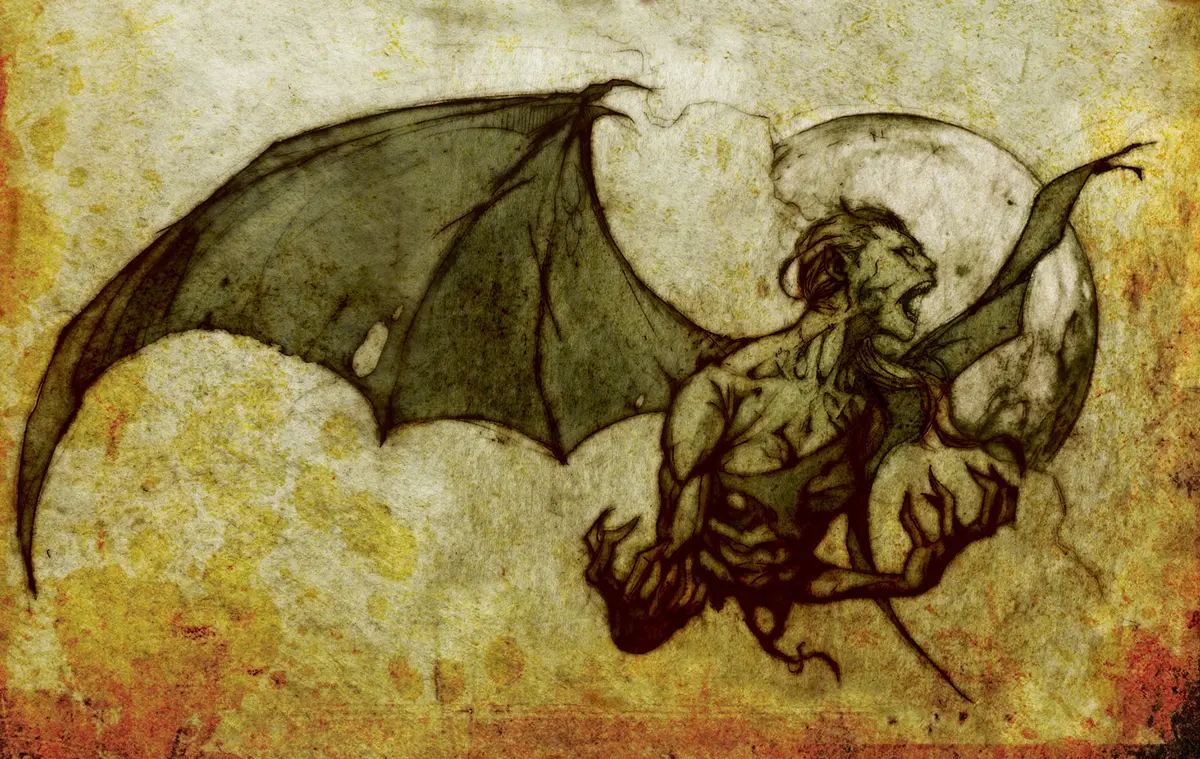
The manananggal of Philippine folklore is a woman who at nightfall detaches at the waist, sprouts bat wings and flies off to feed, leaving her legs standing where she left them; salt on the exposed join is said to stop the halves rejoining, and dawn then kills her.
Where and when was Manananggal sighted?
- Location
- Capiz, Panay, Philippines
- Date sighted
- Unknown
- Coordinates
- 11.56, 122.76
- Last updated
LOCATION
What is Manananggal?
Almost every element of that description can be dated. The Franciscan Juan de Plasencia recorded a magtatangal in 1589, but his creature came apart at the neck, carried its own head, and lived in Catanduanes rather than the Visayas — and Plasencia added that it "seems to me to be a fable". The half-body version was already in a Tagalog dictionary around 1703, under that older name. The form manananggal appears in print later: it is absent from the 1754 Vocabulario de la lengua tagala and present in its 1860 Manila reprint. The whole modern package — the lower half left in a corner of the house, the salt on the join, the appetite for the unborn — was written down in 1889 by the Filipino folklorist Isabelo de los Reyes, who called it asuang. On the same pages he recorded what the accusation cost the people it fell on.
What is the history of Manananggal?
Start with the word, because the word is younger than the creature and the two did not always travel together.
The oldest text anybody quotes is the relation the Franciscan Juan de Plasencia signed at Nagcarlan on 21 October 1589. It lists twelve classes of what he called priests of the devil, and the seventh is the magtatangal, "whose purpose was to show himself at night to many persons, without his head or entrails. In such wise the devil walked about and carried, or pretended to carry, his head to different places; and, in the morning, returned it to his body — remaining, as before, alive." Two details of that sentence rarely survive the retelling. Plasencia's creature comes apart at the neck, not the waist, and it takes its head with it. And he adds, in his own voice: "This seems to me to be a fable, although the natives affirm that they have seen it." He places it in Catanduanes, an island off north-eastern Luzon, some 500 km from Panay. The osuang — the aswang — is the eighth entry on the same list, and Plasencia says it belonged "among the Visayas Islands; among the Tagalos these did not exist."
The waist arrives in the next dictionary. Domingo de los Santos, whose Vocabulario de la lengua tagala is conventionally dated 1703 and which I read in the 1835 Manila reprint, glosses "Brujo. Magtatangal" as one who "they say flies, and eats human flesh; but when it takes flight it carries no more than half the body; and it is called so because it is a metaphor from tangal, which is to unhinge; and this one unhinges half of the body, and takes that half with it, leaving the other half at home." The friar supplies the etymology himself, and it is a carpenter's word: tangal, desencajar, to knock a joint apart. He even gives the sentence a Tagalog speaker would use: Magtatangal ca baga? — "Are you a witch?"
Then the entry vanishes. The Vocabulario de la lengua tagala of Juan Jose de Noceda and Pedro de Sanlucar, printed in Manila in 1754, is the great Tagalog dictionary of its century, and it contains no flying half-body at all. Its Spanish-to-Tagalog index gives six words under Brujo — alasip, hocloban, icqui, asbang, asuang, silagan — and a separate line, "Bruja, que dize el vulgo, que buela de noche: Osuang." Under Tanggal it offers only desclavar, desencajar. The word manananggal is not in the book; searching the whole scan returns nothing for it, while brujo, buela and tangal all return hits on the same pass.
It is in the 1860 Manila reprint of that same dictionary. In the same index, immediately below the Brujo line, stands an entry that was not there in 1754: "Brujo que vuela dexando medio cuerpo. magtatangal. pc. manananggal. pc." That is the earliest printed appearance of the modern name I have been able to date. It arrives second, as a synonym of the older word.
Between those dates the story went into English, and it changed on the way. Sir John Bowring, governor of Hong Kong, published A Visit to the Philippine Islands in 1859. Retelling Plasencia's list for a British readership, he wrote: "The Magtatangal deposited his head and entrails in the evening in some secret place, wandered about doing mischief in the night, and resumed his 'deposit' at break of day." Plasencia's creature carried its head; Bowring's leaves it behind, hidden. That is the version everyone now knows, and the abandoned half is precisely the thing you can pour salt on. Bowring also drops Catanduanes, drops Plasencia's own doubt, and attaches the appetite for pregnant women and newborns not to the magtatangal but to the Osuang.
Thirty years later a Filipino wrote the whole thing down at once. Isabelo de los Reyes, then in his twenties, published El folk-lore filipino in Manila in 1889. Describing the Visayan asuang, he writes: "At midnight it leaves in a corner of the house the half of its body from the waist to the feet, and the other half flies off in search of its daily food. If someone catches the aswang absent and manages to salt the abandoned half at the join, on returning it will no longer be able to put the two halves together." On the same pages are the long tongue, the licking of a pregnant woman's belly to reach the foetus, the liktik bird that announces its approach, and the husband posted with a blade during childbirth. Every component of the modern manananggal is there — under the name asuang, in the Visayas, in 1889.
Welding the Tagalog word to the Visayan creature was the work of the twentieth century. A silent film titled Ang Manananggal, directed by Jose Nepomuceno, is dated to 1927; I have found no surviving print and nothing verifiable about what it showed. The vocabulary was then fixed by the folklorist Maximo Ramos, whose five-part sorting of the aswang field — vampire, entrails-sucker, therianthrope, ogre, sorcerer — Kentaro Azuma still uses in 2012. The manananggal is the entrails-sucker slot.
Timeline: the documented record of Manananggal
- 21 October 1589 At Nagcarlan, the Franciscan Juan de Plasencia lists twelve classes of "priests of the devil". The seventh, the magtatangal, shows itself "without his head or entrails" and carries its head about, returning it at dawn. It detaches at the neck, it is placed in Catanduanes, and Plasencia adds that it "seems to me to be a fable".
- 1703 Domingo de los Santos's Vocabulario de la lengua tagala (read here in the 1835 Manila reprint, p. 191) gives the half-body version and its etymology: the magtatangal "unhinges half of the body, and takes that half with it, leaving the other half at home", from tangal, desencajar, to knock a joint apart.
- 1754 Noceda and Sanlucar's Vocabulario de la lengua tagala is printed in Manila without any flying half-body. Its Spanish index lists six words under Brujo and one line for the Osuang; tanggal means only desclavar, desencajar. Searching the scan for manananggal returns nothing, while brujo, buela and tangal all return hits.
- 1859 Sir John Bowring publishes A Visit to the Philippine Islands. His retelling of Plasencia has the Magtatangal "deposit" its head and entrails "in some secret place" and resume them at daybreak. The original carried its head; from Bowring onwards it leaves it behind — which is what makes the abandoned half something you can salt.
- 1860 The Manila reprint of Noceda and Sanlucar adds an entry absent from 1754: "Brujo que vuela dexando medio cuerpo. magtatangal. pc. manananggal. pc." This is the earliest printed appearance of the modern name that could be dated for this article.
- 1889 Isabelo de los Reyes publishes El folk-lore filipino in Manila. He describes the Visayan asuang leaving "in a corner of the house the half of its body from the waist to the feet" and the salting of the join that stops it rejoining — and, on the same pages, that the Visayans point at "the deformed, the ugly and those of freakish appearance", and that "murders of innocent people are cited".
- 1927 A Filipino silent film titled Ang Manananggal, directed by Jose Nepomuceno, is dated to this year and is usually called the first Philippine horror film. No surviving print has been found for this article and nothing verifiable is known about what it showed.
- 1990 The edition of Maximo Ramos's The Aswang Complex in Philippine Folklore that Azuma cites sorts the field into five kinds — vampire, entrails-sucker, therianthrope, ogre and sorcerer. The manananggal becomes the name of the second slot, and the Tagalog word is fixed to a creature the old Tagalog dictionaries had located elsewhere.
- 1999 The film Sa Piling ng Aswang is released nationwide using the name of Panitan, a real town in Capiz. The town assembly passes a resolution against it. Azuma, reading the provincial weekly's back issues, finds the argument over the "hometown of Aswang" label running every few months since the mid-1990s.
- Halloween 2004 Dugo Capiznon Inc., with young artists, stages the first Aswang Festival in Roxas City as a Halloween event, trying to turn the label into a tourist asset. The idea had begun as a proposal from a Manila travel agency and had been argued over in the provincial assembly through the 1990s.
- October 2006 The third and last Aswang Festival is held. The Archdiocese of Capiz calls it "anti-God" and "anti-Christian" and argues that it makes evil characters look "cool and innocent"; organisers reply that they "only want to change the negative notion of Capiz as a haven of witches". With the Church against it and the city no longer underwriting it, the festival stops.
- September 2012 Kentaro Azuma publishes his account of fieldwork begun in Roxas City around 2000. Two neighbours were rumoured to be aswang: a widow living by petty fishing with no relatives or friends to help her, and a widower disabled by an accident. Azuma will not claim the exclusion caused the rumour, only that gossip and folklore together create "an implicit consent to justify practical discriminations".
- 5 April 2025 Roxas City enters an aswang-themed float in the Maragtas parade of the Capiztahan festival. Residents object online that the city should promote its seafood instead; the city tourism officer defends the float as a metaphor for dungan, and a provincial historical consultant notes that a school of the Archdiocese of Capiz also staged an aswang folk tale.
Is there a rational explanation for Manananggal?
The interesting question about the manananggal is not whether a woman comes apart at the waist. It is what happens to the person a village decides is one, and that has a documentary record older than most of the folklore.
Isabelo de los Reyes, on the same pages of El folk-lore filipino where he describes salting the abandoned half, writes this: "The Visayans tend to designate as such the deformed, the ugly and those of freakish appearance. And woe to the one whom opinion marks as such! Murders of innocent people are cited. The relatives of the deceased, whose death is attributed to an aswang, tend to go by night to murder the suspect." A few pages earlier he is blunter still: in the Tagalog provinces and in Pampanga a suspected mangkukulam might have his ears cut off, be tied down where the fierce hantik ants swarm, or be killed; "in the Visayan islands, and even in the Tagalog provinces themselves, the supposed aswang is exposed to being beaten or murdered when he least expects it." He records the social death that comes first, too: nobody will marry him or his children, everyone flees him, and he is received warmly out of pure fear.
A hundred and eleven years later an anthropologist found the same shape. Kentaro Azuma, of Nagoya University, went to Roxas City in Capiz around 2000 because friends in Manila kept telling him that "Capiz is the hometown of Aswang". In the village on the city's outskirts where he was based, two people were rumoured to be aswang. "One of the two was a widow, earning her living by petty fishing activities. She had neither relatives nor friends who would extend their cooperation to her." The other "was an elderly man, who had lost his wife. Due to an accident, he was a disabled person who had difficulty walking", and neither relatives nor friends had helped him. Azuma is careful, and his caution is worth reproducing rather than improving on: those exclusions, he writes, "do not necessarily have direct causal relations with rumors that they are Aswang." What he does claim is narrower and worse. "Such mere gossip combined with the beliefs and folklores of Aswang can create an implicit consent to justify practical discriminations and exclusions against specific persons."
Two smaller corrections. The first source anybody quotes did not believe it: Plasencia wrote in 1589 that the magtatangal "seems to me to be a fable". And pinning the creature to Capiz is recent. It is in none of the old texts. Bowring names Capiz thirty-two times in his book — he sailed there — and never once in connection with the creature; Isabelo de los Reyes, who describes the belief in detail, never uses the word at all, only "the Visayans". Azuma dates the public argument to the mid-1990s, when the provincial weekly began carrying articles every few months on whether to accept or reject the label of "hometown of Aswang", and to 1999, when the town assembly passed a resolution against the nationally released film Sa Piling ng Aswang for using the name of Panitan, a real town in the province.
As for the remedies: salt is in de los Reyes in 1889, applied to the join, and he adds that the asuang "has a horror of salt". Crushed garlic is on the same pages, but as a healer's poultice rubbed on a patient, not as a weapon. The longer lists that circulate today — ash, vinegar, spices, holy water, a whip made from a stingray's tail — I could not trace to any datable source, so they are not repeated here.
Can you visit Manananggal?
There is no site to visit, because the manananggal is an accusation made about a person rather than a place, and every itinerary built on the word turns out in practice to be an itinerary of Capiz.
Capiz occupies the north coast of Panay, in the Western Visayas. Its capital, Roxas City, has an airport with daily flights to Manila and lies roughly two hours by road from Iloilo City. The city advertises itself as the Seafood Capital of the Philippines, and its main civic festival is the Capiztahan, held in early April.
The Aswang Festival that outsiders still ask about ended twenty years ago. Dugo Capiznon Inc. launched it with young artists as a Halloween event in 2004, hoping to convert the stigma into tourism, and it ran for three editions. The Archdiocese of Capiz called it anti-God and anti-Christian and objected that it made evil characters look cool and innocent; GMA News covered the third and last edition in October 2006. Azuma supplies the mechanism behind the closure: sustained Church disapproval together with a city government that stopped underwriting the event. The festival has not returned, although the argument around it has. When Roxas City entered an aswang-themed float in the Capiztahan parade on 5 April 2025, residents objected online that the city should be promoting seafood instead, and Manila Bulletin reported the row the next day; the city tourism officer, Bryan Mari Argos, defended the float as a metaphor for dungan, the Visayan idea of spirit.
Most of the documentary record costs nothing and needs no plane ticket. Plasencia's relation of 1589 is on Wikisource; Bowring's Visit and both editions of the Noceda and Sanlucar Vocabulario are on the Internet Archive, as is Isabelo de los Reyes's El folk-lore filipino; de los Santos is on Google Books; and Azuma's article is open access at the Kyoto Review of Southeast Asia. All of those were checked in August 2026.
The two people whose cases this article describes were a widow who fished for a living and a disabled widower, poor and already isolated when the accusation reached them. Azuma records meeting open hostility in Capiz for asking about aswang at all, which is the measure of how live the subject remains for the people it names.
Sources consulted
- Fray Juan de Plasencia, O.S.F., «Customs of the Tagalogs (relation signed at Nagcarlan, 21 October 1589)» — In E. H. Blair and J. A. Robertson (eds.), The Philippine Islands, 1493-1898, vol. 7, pp. 173-197. Cleveland: A. H. Clark, 1903 archive
- Fray Domingo de los Santos, O.F.M., «Vocabulario de la lengua tagala, s.v. «Brujo. Magtatangal» (p. 191); leído en la reimpresión manileña de 1835» — Manila (reimpresión de 1835); obra fechada por convención en 1703, 1703 book
- Juan José de Noceda y Pedro de Sanlúcar, «Vocabulario de la lengua tagala, índice hispano-tagalo, s.v. «Brujo» y «Tanggal»» — Manila: Imprenta de la Compañía de Iesus, por D. Nicolás de la Cruz Bagay, 1754 book
- Sir John Bowring, «A Visit to the Philippine Islands (the Magtatangal passage, p. 120)» — London: Smith, Elder & Co., 1859 book
- Juan José de Noceda y Pedro de Sanlúcar, «Vocabulario de la lengua tagala, reimpresión manileña, s.v. «Brujo que vuela dexando medio cuerpo»» — Manila: Reimpreso en la Imprenta de Ramírez y Giraudier, 1860 book
- Isabelo de los Reyes y Florentino, «El folk-lore filipino, cap. «Los curanderos filipinos y sus abominables prácticas», pp. 247-250» — Manila: Imprenta de Santa Cruz, 1889 book
- De La Salle – College of Saint Benilde, «Manananggal reimagined in Filipino silent horror drama (sobre la película Ang Manananggal, 1927, de José Nepomuceno)» — benilde.edu.ph, 2019 web
- Kentaro Azuma (Nagoya University), «In Search of Aswang: A Ghost Story, Monster and Sorcerer in Philippine Society» — Kyoto Review of Southeast Asia, issue 12: The Living and the Dead, 2012 academic
- GMANews.TV, «Church wants to stop 'Aswang Festival' in Capiz» — GMA News, 2006 newspaper archive
- Tara Yap, «Roxas City's 'aswang' float sparks debate» — Manila Bulletin, 2025 newspaper archive
Reviewed by V. Serrano on 2026-08-14 · How we verify our content
📎 Source: Enigma Atlas
💬 Field testimonies (0)
No testimonies yet. Add the first.
Add your testimony
🔒 Log in to add a testimony