👻 HAUNTED PLACE · EXP. Nº9475
ACTIVE
Manila Film Center
The Manila Film Center was meant to be two things at once: the Parthenon-style showpiece of Imelda Marcos's First Manila International Film Festival, and the national film archive of a country where not one film made before 1951 had survived.
Where is Manila Film Center?
- Location
- Metro Manila, Philippines
- Type
- Theater
- Coordinates
- 14.551, 120.982
- Last updated
LOCATION
Why is Manila Film Center said to be haunted?
Construction began in June 1981 with the opening fixed for 18 January 1982, and at about 3 a.m. on 17 November 1981 the rush collected its price: scaffolding collapsed and the night shift fell into quick-drying cement. The site was sealed, rescuers were held back for hours, and under martial-law censorship almost nothing was printed. Into that documentary vacuum grew one of Asia's most famous hauntings. How many died has never been settled — the architect said seven, all recovered; the figure everyone repeats, 169, first appears in print in 1997 as the conclusion of a psychics' séance. The festival opened on time over cement that staff later said was still damp, exorcism rites were held at dawn on opening day, and the building went on to house passport offices, a drag revue and, mostly, silence.
What is the history of Manila Film Center?
The Manila Film Center began as a film archive with a genuinely urgent mission. When First Lady Imelda Marcos launched the project in January 1981, the Philippines had no national film archive at all, and the consequence was stark: of the hundreds of Philippine films made before 1951, not a single one had survived in the country. UNESCO sent consultant Christopher Roads to Manila twice that year — in March, when the project was still being called the "Film Palace", and again from 31 August to 18 September — to design the archival floor of a building architect Froilan Hong was raising on reclaimed land in Manila Bay, on more than nine hundred piles driven about 120 feet down to bedrock.
Construction started in June 1981 with the opening of the First Manila International Film Festival fixed for 18 January 1982, an impossible deadline that put some 4,000 labourers on site in three shifts around the clock; the lobby, a six-week job by normal standards, was finished by a thousand workers in 72 hours. At about 3 a.m. on 17 November 1981, scaffolding on an upper floor gave way and the night shift fell into freshly poured quick-drying cement. Nena Benigno, the festival's public relations officer, was sent to the site by her father, Agence France-Presse bureau chief Teddy Benigno, and later described stretchers carrying men "frozen in cement" and rescuers keeping a half-buried worker conscious by having him sing Christmas songs. The regime sealed the site: by the account of festival staff interviewed by Rogue magazine in 2015, Betty Benitez, the festival's vice-chair for finance who drove the construction schedule, held the requested jackhammers back until an official statement had been issued, and the architectural historian Gerard Lico, in his 2003 book Edifice Complex, puts the delay before rescuers were admitted at nine hours. Under martial-law censorship almost nothing was printed at the time; a UNESCO technical report dated 11 December 1981 — three and a half weeks after the collapse — describes the building's progress without mentioning the accident at all.
The festival opened on schedule on 18 January 1982, hours after elderly Igorot ritualists held a dawn cañao on the steps to send the spirits of the dead on their way. Brooke Shields, Jeremy Irons and George Hamilton walked a red carpet under which, staff later said, the cement was still damp. The glamour did not last: Prime Minister Cesar Virata blocked a five-million-dollar subsidy, and the 1983 festival resorted to screening uncensored soft-core films under Presidential Decree 1986 to recoup its debts, drawing a public letter of denunciation from Cardinal Sin. Staff abandoned the building around the 1986 revolution, and the 1990 Luzon earthquake left it condemned as unstable. After a 300-million-peso rehabilitation, it was leased in December 2001 to the Amazing Philippine Theater, whose drag revue The Amazing Show made the building its home — the lease ran to 2009 and was regained in November 2012, surviving a three-hour fire on 19 February 2013. The show's own website went into "maintenance" during 2017 and its domain lapsed the following year, leaving the concrete Parthenon by the bay once again without a public purpose.
Timeline: the documented record of Manila Film Center
- January–June 1981 Imelda Marcos launches the film centre project; UNESCO consultant Christopher Roads works on the archive design in March, when the project is still called the "Film Palace", and construction begins in June on reclaimed land in Manila Bay.
- 17 November 1981 At about 3 a.m., scaffolding collapses and the night shift falls into quick-drying cement. Festival staff later recount that the site was sealed and jackhammers withheld until an official statement was issued; Gerard Lico's 2003 study puts the delay before rescuers were admitted at nine hours.
- 11 December 1981 UNESCO prints its technical report on the Manila National Film Centre, describing walls 50 feet high and the archive's mission — and never mentioning the accident of three and a half weeks earlier.
- 18 January 1982 After a dawn cañao by Igorot ritualists on the steps, the First Manila International Film Festival opens on schedule; staff later recall damp cement under the red carpet.
- 1986 Festival staff leave the building around the February revolution; marketing head Mila Llorin recalls it already condemned and tilting. Accounts of the 1981 tragedy begin to surface in print only after the fall of the regime.
- 16 July 1990 The Luzon earthquake leaves the centre abandoned, with reported structural damage to load-bearing beams on the west side.
- 1996 More than 80 Spirit Questors hold candlelit séances in the building after sacrificing a rooster on the front steps; they report hearing construction noises. An earlier quest had counted "at least 30 very angry spirits".
- 17 October 1997 Asiaweek prints the earliest datable appearance of the figure 169, explicitly as the Spirit Questors' conclusion: "their investigations show that the bodies of 169 workers were abandoned in the building".
- February–December 2001 The CCP unveils a steel tribute marker and announces a 300-million-peso rehabilitation; its film division head tells the press the building must shed its reputation for "Imelda, ghosts and bomba films". In December the Amazing Show drag revue opens in the leased building.
- 31 October 2005 GMA's i-Witness airs Howie Severino's Halloween documentary: no accident report at the Pasay police or the CCP, no family claiming a missing relative, and the contractor stating "not even a fingernail" remained in the concrete.
- 13 May 2006 The English Wikipedia article is created under the title "Manila Film Center scaffolding collapse", stating "up to 169 workers" were killed while itself flagging the story as a possible urban myth; it is renamed "Manila Film Center" in April 2007.
- 19 February 2013 A three-hour fire damages the building and halts the Amazing Show, which had regained its lease in November 2012.
- 6 November 2017 Former CCP president Baltazar Endriga publishes a letter in the Inquirer: the "30 deaths" estimate attributed to him is false, the psychics' three midnight attempts proved nothing, and architect Froilan Hong told him, plans in hand, that seven workers died and all seven bodies were recovered.
Is there a rational explanation for Manila Film Center?
The famous casualty figure has a traceable biography, and it does not begin in 1981. No contemporary press count exists: reporting was smothered by martial-law censorship, and Rogue's interviewees state that accounts only surfaced after the 1986 revolution. When GMA journalist Howie Severino went looking for paperwork for his 2005 documentary, he found no report on the accident at the Pasay police, none at the Cultural Center of the Philippines, no family claiming a relative left inside the building, and no one still searching for anyone missing. The earliest datable appearance in print of "169" that we could find is Asiaweek of 17 October 1997, and its source is explicit: the Spirit Questors, a Manila group of psychics whose midnight séances at the building — one gathering more than 80 members — produced both that figure ("their investigations show that the bodies of 169 workers were abandoned") and an earlier count of "at least 30 very angry spirits", the likely root of the "30" later misattributed in the press to former CCP president Baltazar Endriga, who denied it in writing in 2017. In that same letter Endriga reported what architect Froilan Hong told him, plans in hand: seven workers fell to their deaths, and all seven bodies were retrieved and given funeral rites. The project's contractor, Eliodoro Ponio, told the 2005 documentary that "not even a fingernail" remained in the concrete. The séance number then hardened into fact by repetition: the English Wikipedia article was created on 13 May 2006 as "Manila Film Center scaffolding collapse", stating "up to 169" and citing Asiaweek, and today's version asserts that "at least 169 workers fell" on the strength of a newspaper column that misdates the tragedy to 1980 and says the workers "were said to have died". Esquire's 2019 retelling gives 168. None of this proves no one is entombed — a nine-hour rescue delay is documented testimony, and the site was never excavated — but every specific number on record is either the architect's seven or a psychic's revelation. The hauntings, meanwhile, have named owners: an usherette's cold draught backstage in January 1982, moans reported by Foreign Affairs night staff in the years the building held the passport office, and hammering heard at séances. In 2001 the CCP's own officials called the entombment stories "unverified" and told the press the building needed to shed its reputation for "Imelda, ghosts and bomba films". Our earlier text's "televised exorcism attempt in the 1980s" conflated two real things: the private rites of January 1982, and television arriving on 31 October 2005, when i-Witness aired its Halloween documentary.
Can you visit Manila Film Center?
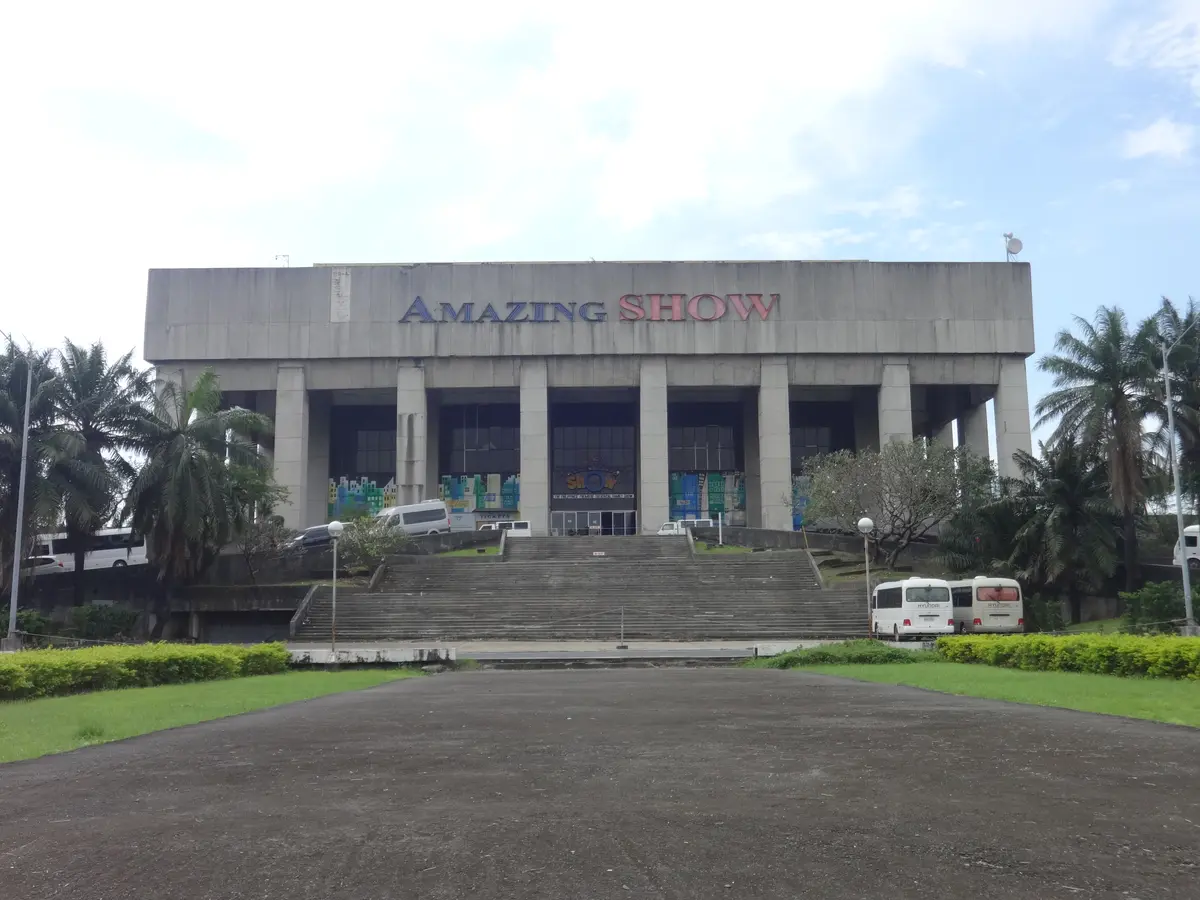
The building stands at the southwest end of the Cultural Center of the Philippines Complex in Pasay, Metro Manila, on the reclaimed land along Roxas Boulevard, about 300 metres south of the Philippine Plaza hotel site. It is government property and is not open to the public: there are no tours of the interior, no ticket office and no posted hours, and the last regular public use we can document is the Amazing Show cabaret, whose own website was already "down for maintenance" by mid-2017 and whose domain lapsed by late 2018. What a visitor can actually do is walk the CCP grounds and view the exterior — the broad ceremonial staircase and the Parthenon-like colonnade — which is how the building appears in our December 2020 photograph, still carrying the revue's signage. The complex is reached from Vito Cruz or Gil Puyat stations on LRT Line 1 followed by a short taxi or jeepney ride toward Star City and the CCP; the seafront promenade nearby is a popular sunset spot. Treat any online claim of ghost tours inside with suspicion: no operator has documented access, and the structure's condition beyond the dates given here is unverified.
Sources consulted
- Christopher Roads, «The Manila National Film Centre (Technical Report RP/1981-83/4/9.4/03)» — UNESCO, Paris, 1981 report
- Tats Manahan, «The enduring nightmare of the Manila Film Center» — Rogue (Cinema Issue, November 2015; online 2016), 2015 interview
- Wilhelmina Paras, «Masters of mumbo jumbo? / Haunted? The case of the trapped workers» — Asiaweek, 1997 newspaper archive
- Howie Severino, «Multo ng Nakaraan (Ghosts of the Past), i-Witness episode of 31 October 2005» — GMA News, 2005 newspaper archive
- Baltazar N. Endriga, «Account on the 1981 Manila Film Center deaths» — Philippine Daily Inquirer, 2017 newspaper archive
- Max Soliven, «By the Way (column mentioning the Film Center collapse; archived under a misleading 2004 path, internal evidence dates it to November 2006)» — The Philippine Star, via Philippine Headline News Online, 2006 newspaper archive
- Eric Catipon / Sol Jose Vanzi, «Manila Film Center to Shine Again» — Philippine Headline News Online, 2001 newspaper archive
- Nicai de Guzman, «The Mysterious Curse of the Manila Film Center» — Esquire Philippines, 2019 web
- Wikipedia contributors, «Manila Film Center scaffolding collapse (founding revision, 13 May 2006) and revision history» — Wikipedia, 2006 web
Reviewed by V. Serrano on 2026-08-17 · How we verify our content
💬 Field testimonies (0)
No testimonies yet. Add the first.
Add your testimony
🔒 Log in to add a testimony