👻 HAUNTED PLACE · EXP. Nº9476
ACTIVE
Fort San
Fort San is a Saskatchewan village named after a building that no longer stands there.
Where is Fort San?
- Location
- Saskatchewan, Canada
- Type
- Hospital / asylum
- Coordinates
- 50.8, -103.819
- Last updated
LOCATION
Why is Fort San said to be haunted?
The Fort Qu'Appelle Sanatorium opened on the shore of Echo Lake in October 1917 as the province's first tuberculosis hospital: 60 beds that grew to some 350, a self-sufficient estate with its own power house, farm, band and patient-written magazine. Its superintendent, Dr R.G. Ferguson, helped make Saskatchewan the first jurisdiction in North America to treat tuberculosis free of charge, and also ran a BCG vaccine trial among infants on the neighbouring First Nations reserves, whose tuberculosis death rate the League's own reports put at more than twenty times the settler figure. The last patients left at the start of the 1970s. From 1967 the wards filled each summer with teenagers and artists at the Saskatchewan Summer School of the Arts, and it is from that period — not from the hospital — that the ghost stories date: a nurse folding linen, shadows of wheelchairs on half-closed doors, voices calling for doctors. There is nothing to visit. The buildings were demolished, the heritage designation failed to save them, and the National Trust for Canada files Fort San as lost.
What is the history of Fort San?
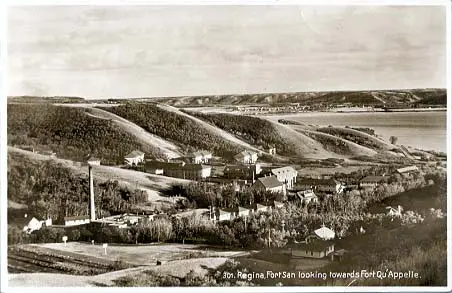
Fort San is a village named after an institution: "San" is short for sanatorium. The Saskatchewan Anti-Tuberculosis League was founded in Regina on 17 February 1911 by a group of eighteen men, with Dr M.M. Seymour, the provincial Commissioner of Health, as its driving force. Construction of the province's first sanatorium began in 1912 on a 230-acre site in a coulee on the north shore of Echo Lake, in the Qu'Appelle Valley. The site was chosen for shelter, sunlight and clean air, which before antibiotics were the whole of the treatment. The buildings — Tudor Revival and Arts and Crafts, by the Regina architects J.H. Puntin and W.G. Van Egmond, with the Dr Jenner Residence by provincial architect Maurice Sharon — were set on landscaped grounds with a bandstand and walking paths, in the belief, recorded in the site's heritage listing, that physical health was tied to mental well-being.
The First World War delayed the work, and the sanatorium did not open until October 1917. In its golden-jubilee report the League described that first decade as ending with provincial and federal money "to complete a tuberculosis treatment unit at Fort San in 1917 for tuberculous returned soldiers in Saskatchewan". It began with around 60 beds, reached 260 in 1918, and by the mid-1920s was a self-sufficient village of roughly 350 beds with its own power house, farm, gardens, a library assembled by veterans, a drama club, a band and a post office opened on the grounds in 1926. Patients produced a monthly magazine, The Valley Echo, which ran for decades and is the closest thing the place has to a diary.
Its first medical superintendent, Dr R.G. Ferguson — appointed acting superintendent in 1917 — went on to direct the League's programme for more than thirty years. Under him Saskatchewan had the lowest tuberculosis death rate in Canada from 1921 to 1940 and, in January 1929, became the first jurisdiction in North America to treat tuberculosis free of charge.
The other half of that history is told less often. First Nations patients were not admitted at the start: their inclusion at the Fort Qu'Appelle Sanatorium dates from 1927. From 1933 Ferguson ran a trial of the BCG vaccine among infants on the Qu'Appelle reserves; the historian Maureen Lux has shown that while the vaccine gave some protection against tuberculosis, close to a fifth of the children in the trial died of gastroenteritis and pneumonia — the diseases of the poverty in which they were left to live. In 1961 the League's own president reported a tuberculosis death rate of 2 per 100,000 among non-Indigenous people in Saskatchewan and 39 among "Indians".
By then the beds were emptying. Prince Albert Sanatorium closed in 1960 and its patients were moved to Fort Qu'Appelle; by the mid-1960s Fort San was only in partial use. Rather than leave it empty, Ross Thatcher's Liberal government had it renovated as the Saskatchewan Summer School of the Arts, which Thatcher opened on 29 July 1967 — while the sanatorium was still treating patients. Over 1,200 children and adults attended the seven-week programme in the summer of 1968. Sources differ on when the last tuberculosis patients left: some date the closure to 1 April 1971, the Encyclopedia of Saskatchewan to 1972.
The arts school ran until 1991, when it closed for lack of funding; the writers' programme survived as the Sage Hill Writing Experience, which moved away from the valley. From 1992 to 2004 the property was the provincially run Echo Valley Conference Centre, and on 30 September 2004 the Saskatchewan Property Management Corporation decided to shut it and put it up for sale.
What happened next is the part the ghost stories never mention. The province disposed of Fort San in 2005; the property changed private hands several times. In 2007 the Village of Fort San designated four buildings — the Main Lodge, Dr Jenner's Residence, the Administration Building and the Nurse's Residence — plus the landscaped front lawn as Municipal Heritage Property. It did not save them. By 2012 the undesignated buildings had been demolished; in 2013 the National Trust for Canada put Fort San on its Top Ten Endangered Places list and reported that the Village's inspectors, refused entry by the owner in breach of the Heritage Property Act, were reduced to assessing the buildings from the public road. The National Trust file on Fort Qu'Appelle Sanatorium is now marked, simply, "Lost".
Timeline: the documented record of Fort San
- 17 February 1911 Eighteen men meet in Regina and found the Saskatchewan Anti-Tuberculosis League, driven by Dr M.M. Seymour, the provincial Commissioner of Health. The League's own golden-jubilee report, printed fifty years later, names the founders and dates the meeting.
- October 1917 The Fort Qu'Appelle Sanatorium opens on Echo Lake after five years of building delayed by the First World War, completed with federal help as a treatment unit for tuberculous soldiers returning to Saskatchewan. Dr R.G. Ferguson takes charge of the new sanatorium and will direct the League's programme for more than thirty years.
- 1927 First Nations patients begin to be admitted to the Fort Qu'Appelle Sanatorium. Until then the province's flagship tuberculosis hospital had treated settlers while Indigenous people, whose death rates were more than twenty times higher, were dealt with separately.
- 1933 Dr R.G. Ferguson, superintendent at Fort San, begins a BCG vaccine trial among infants on the Qu'Appelle reserves. The historian Maureen Lux later documents that the vaccine offered some protection but that close to one fifth of the children died of gastroenteritis and pneumonia caused by conditions on the reserves.
- August 1961 The Valley Echo, the magazine written at the sanatorium, prints the League's annual report for 1960: 388 patients under care across the three provincial sanatoria, 34 tuberculosis deaths in the year, and a death rate of 2 per 100,000 among non-Indigenous people against 39 among "Indians".
- 29 July 1967 Premier Ross Thatcher opens the Saskatchewan Summer School of the Arts in the renovated buildings — while the sanatorium is still treating patients in the wings not yet emptied. Over 1,200 children and adults attend the seven-week programme the following summer.
- 1971-1972 The last tuberculosis patients leave. Sources split on the date: several accounts give 1 April 1971, while the Encyclopedia of Saskatchewan, written by the League's own former medical director, dates the closure of the Fort San beds to 1972.
- 1991 The Saskatchewan Summer School of the Arts closes for lack of funding after twenty-four summers. Its writing programme survives as the Sage Hill Writing Experience, which leaves the valley.
- 1995 Jo-Anne Christensen publishes Ghost Stories of Saskatchewan, the first book to gather the Fort San accounts — including the tale of writers who took a Ouija board to a retreat in the old sanatorium. It is from this point that "Nurse Jane" circulates in print, two decades after the last patient left.
- 2004 The province closes the Echo Valley Conference Centre, which it had run on the site since 1992, and puts the property up for sale, ending eighty-seven years of continuous public use.
- 30 May 2007 The Village of Fort San designates the Main Lodge, Dr Jenner's Residence, the Administration Building, the Nurse's Residence and the front lawn as Municipal Heritage Property under Saskatchewan's Heritage Property Act.
- 2013 The National Trust for Canada lists Fort San among the country's Top Ten Endangered Places. Its 2015 update reports that the owner had repeatedly refused entry to the Village's inspectors in breach of the Heritage Property Act. The Trust's file on the sanatorium now reads "Lost".
Is there a rational explanation for Fort San?
Fort San's ghost stories have a documented history, and it is not the one usually implied. They do not come from the wards. They come from the summer camp that took over the wards.
The best-known figure is "Nurse Jane", a nurse said to have killed herself at the sanatorium and to be seen folding bed linen or pushing a wheelchair. No account of her — in any of the books that repeat the story — gives a surname, a date, an inquest, a newspaper report or an archival reference. The name itself appears in print only in the 1990s, two decades after the last patient left, in the era of the arts school and the conference centre.
The books also disagree about the building's basic facts, which is a useful measure of how carefully the anecdotes travelled. Joel A. Sutherland dates the opening to 10 October 1917 and the closure to 1 April 1971; Jo-Anne Christensen says the place closed in 1972; Glenda MacFarlane, in the same paragraph in which she reports the ghosts, dates the sanatorium's opening to 1919. If the year on the front door is unstable, the unnamed witness in the corridor deserves at least the same caution.
There is also a documented origin for part of the folklore. Both Christensen (1995) and MacFarlane (2009) describe writers at a Fort San retreat producing a Ouija board and holding a séance in the old sanatorium — a group of people who tell stories for a living, in a decommissioned hospital, at night, deliberately trying to raise its dead. From 1967 the corridors were full of teenagers and artists sleeping in a half-empty institutional building, in wings that had held tuberculosis patients within living memory, and being told so on arrival. That is a near-perfect machine for producing accounts of coughing in empty rooms.
The physical setting supplied the rest. Long institutional corridors, hard floors, steam heating and a valley wind carry sound a long way and detach it from its source; a building designed for maximum sun and cross-ventilation is a building full of moving air, slamming doors and unexplained draughts.
One last point matters more than any of the above: there is nothing left to test. The undesignated buildings were demolished by 2012, the four protected ones were left to rot, and the National Trust for Canada now files the sanatorium as "Lost". Any story told today about walking those corridors describes a place that no longer stands.
What is documented needs no ghost. In the League's report for 1960, printed in The Valley Echo, 388 patients were under care across the province's three sanatoria and 34 people died of tuberculosis that year. The same report gives a death rate of 2 per 100,000 among non-Indigenous people and 39 among "Indians", against "the 800's fifty years ago". Fort San's real horror is a matter of public record, and it is a horror of numbers, not of nurses in the hallway.
Can you visit Fort San?
Fort San is a resort village on the north shore of Echo Lake in the Qu'Appelle Valley, served by Highway 56. The village's website, consulted on 24 September 2026, says that it stretches for about 5 km along the shore, was incorporated in 1987, has about 233 residents and lies 75 km north-east of Regina. The pin on this file, 50.8° N 103.819° W, is the coordinate Wikipedia gives for the village; measured between the two Wikipedia coordinates, it lies about 4.5 km north-west of the centre of the town of Fort Qu'Appelle.
The sanatorium grounds are private land. The village's website says that the former sanatorium site "was purchased by a developer and remains private green space". The National Trust for Canada put the sanatorium on its Top Ten Endangered Places list in 2013 and reported that many of the remaining buildings had been demolished in 2012, leaving the four designated as municipal heritage property in 2007: the Main Lodge, Dr Jenner's Residence, the Administration Building and the Nurse's Residence. Its 2015 update adds that the owner had repeatedly refused entry to the village's inspectors, who had to assess the buildings from the public road. The Trust's page now gives the sanatorium's status as "Lost".
A walking path that forms part of the Trans Canada Trail runs the length of the village, according to the Encyclopedia of Saskatchewan; the village's website describes it as a trail with rest points that presents the history of the Qu'Appelle Valley.
The Valley Echo, the magazine produced at the sanatorium, is the fullest surviving record of daily life there. Issues digitised by the University of Alberta are available on the Internet Archive in the Peel's Prairie Provinces collection. The August 1961 number (volume 42, number 8) prints the League's annual report for 1960 with the account of its golden jubilee; the report gives the tuberculosis death rate as 2 per 100,000 among non-Indigenous people and 39 among "Indians". The Provincial Archives of Saskatchewan hold the Saskatchewan Anti-Tuberculosis League fonds, which its catalogue says includes bound copies of The Valley Echo.
Sources consulted
- Saskatchewan Anti-Tuberculosis League, «Annual Report of the Saskatchewan Anti-Tuberculosis League for the year 1960, with the report of the Golden Jubilee Celebration (The Valley Echo, vol. XLII, no. 8)» — Fort Qu'Appelle Sanatorium, 1961 report
- David McLennan, «Fort San» — The Encyclopedia of Saskatchewan, University of Regina, 2006 book
- Holden Stoffel, «Saskatchewan Summer School of the Arts» — The Encyclopedia of Saskatchewan, University of Regina, 2006 book
- G. Dudley Barnett, «Tuberculosis Control» — The Encyclopedia of Saskatchewan, University of Regina, 2006 book
- Canadian Register of Historic Places, «Echo Valley Conference Centre (Fort San)» — Parks Canada / Saskatchewan Heritage Property Act register, 2009 archive
- National Trust for Canada, «Fort Qu'Appelle Sanatorium — Top Ten Endangered Places 2013 (status: Lost)» — Endangered Places List, 2015 report
- Maureen K. Lux, «Perfect Subjects: Race, Tuberculosis, and the Qu'Appelle BCG Vaccine Trial» — Canadian Bulletin of Medical History 15(2), pp. 277-295, 1998 academic
- Jo-Anne Christensen, «Ghost Stories of Saskatchewan» — Hounslow Press, 1995 book
- Glenda MacFarlane, «Weird Places in Saskatchewan and Manitoba» — Blue Bike Books, 2009 book
- Joel A. Sutherland, «Haunted Canada 6: More Terrifying True Stories» — Scholastic Canada, 2016 book
- CKOM News, «Saskatchewan a hot bed for hauntings (interview with Jo-Anne Christensen)» — 650 CKOM, Saskatoon, 2019 newspaper archive
- Resort Village of Fort San, «Resort Village of Fort San — official municipal website» — Municipal information, 2026 web
- Sage Hill Writing, «How Sage Hill Happened — History» — Sage Hill Writing Experience, 2026 web
- Christian Thompson (ed.), «Saskatchewan First Nations: Lives Past and Present» — Canadian Plains Research Center, University of Regina, 2004 book
Reviewed by V. Serrano on 2026-08-11 · How we verify our content
💬 Field testimonies (0)
No testimonies yet. Add the first.
Add your testimony
🔒 Log in to add a testimony