👻 HAUNTED PLACE · EXP. Nº9476
ACTIVE
Tranquille, Kamloops
Tranquille had four lives on the same Secwépemc flats by Kamloops Lake: a place called Spelemtsin, occupied for at least 7,500 years; the King Edward Memorial Sanatorium, opened in 1907 as the first tuberculosis sanatorium west of Ontario; the provincial Tranquille Sanatorium from 1921, a self-contained village of 360 beds with its own farm, bakery, power plant and two kilometres of delivery tunnels; and, from 1959, an institution for people with intellectual disabilities that held some 700 residents.
Where is Tranquille, Kamloops?
- Location
- British Columbia, Canada
- Type
- Hospital / asylum
- Coordinates
- 50.722, -120.515
- Last updated
LOCATION
Why is Tranquille, Kamloops said to be haunted?
Its closure was announced on 7 July 1983 and answered by a twenty-two-day workers' occupation; the last residents left in 1985. The ghost reputation is younger than any of that, and it can be dated: an MTV dare show filmed there in 2002 under an invented name, after which the site's own manager spent a decade turning paranormal investigators away because, he said, the real history was more interesting. The property is private, its cemetery was moved to Kamloops, and in June 2026 the whole estate went up for sale.
What is the history of Tranquille, Kamloops?
The flats where the Tranquille River spreads into Kamloops Lake were a Secwépemc place long before they were an institution. The settlement is called Spelemtsin in Secwépemctsín, and the wider area Pellqweq'wíle — "has biscuitroot", after the root harvested on the alluvial fan. The oldest dated archaeological material from Tranquille is roughly 7,500 years old. Independent archaeologist Joanne Hammond told The Wren in 2023 that preliminary shovel testing at the site returned positive results "extremely high" compared with regional averages, and was blunt about what lies under the fields: "There's no doubt that the site includes ancestral burial grounds." Tk'emlúps te Secwépemc Elder Jeanette Jules described the consequence in the same report: "Every so often somebody disturbs an ancestral burial. Then we have to go and do the ceremonies."
Even the name is borrowed. French-speaking fur traders nicknamed the Secwépemc leader Piqwemús (Pacamoos) "Tranquille" for his manner; Archibald McDonald's 1827 map already carries the name on the river. Piqwemús died around 1841. In 1869 William Fortune acquired roughly 320 acres by pre-emption for about $140, and Charles Cooney — married to a Carrier woman, Elizabeth Allard — took the adjoining half. By the 1890s both ranches were taking in tuberculosis sufferers as paying boarders, drawn by dry air, sunshine and distance from the Kamloops mills.
That informal trade became an institution in 1907, when Fortune sold to the British Columbia Anti-Tuberculosis Society and the King Edward Memorial Sanatorium opened on his land: the first tuberculosis sanatorium west of Ontario. Dr J. C. Fagan, the province's medical health officer, was its first director; Dr R. M. Irving served as first medical superintendent from 1907 to 1909. By 1910 it held about 49 patients with four nurses and twelve attendants. After the First World War the federal government added buildings for soldiers who had contracted tuberculosis overseas, and in 1919 the sanatorium started its own newspaper, The Tranquillian — the Kamloops Museum and Archives still holds three copies of volume 1, number 1, dated 1 August 1919.
The Society could not pay for what it had built. In 1921 the province took over management to settle mounting debts and renamed the place Tranquille Sanatorium; in 1922 it bought the neighbouring 580-acre Cooney property for $47,356 and expanded. By 1932 the sanatorium could accommodate 360 patients. What grew there was not a hospital but a company town with a hospital in it: farm, dairy, bakery, power plant, laundry, gymnasium, auditorium, tennis courts and a school. The laundry alone processed some 682 kilograms of textiles a day, serving other health facilities including Royal Inland Hospital.
Underneath it ran about two kilometres of tunnels, built in stages between the 1920s and the mid-1970s and measuring roughly 2.4 metres square. They were utility corridors and a delivery system: electric carts nicknamed "Tuggers" pulled trailers of food and laundry between buildings, and staff and patients used them to move about in winter. Rooms opened off them — a barbershop, storerooms, dining halls, offices, showers and a morgue.
Effective drug therapy ended the sanatorium's reason to exist. It closed in 1958, the buildings passed to the province's Mental Health Services Branch, and from 1959 the site operated as an institution for people with developmental and intellectual disabilities. At its peak it held roughly 700 residents — about a quarter of everyone institutionalised on those grounds in British Columbia — across more than forty buildings, and employed around 600 people, making it the third-largest employer in Kamloops.
Its end was a political event, not a quiet wind-down. On 7 July 1983 the Bennett government's restraint budget announced the closure, with no community placement plan for the residents. On 19 July members of the BC Government Employees' Union occupied the institution: they changed the locks, evicted management, raised a hand-painted union flag, elected a council with representatives from each shift and ran the place themselves while keeping every essential service going. The occupation lasted twenty-two days and ended on 9 August with a government agreement; Diane Purvey's account dates it a day later at each end, 20 July to 10 August. The institution nonetheless closed; the last residents were discharged in 1985, about eighty of them placed locally in Kamloops. Diane Purvey's study of the closure records that a June 1984 poll found 75 per cent of surveyed residents opposed it, and that follow-up research found "invisible walls" still isolating people who had been physically relocated.
One point deserves care, because it is routinely blurred online. The formal finding of systemic physical, emotional and sexual abuse in a British Columbia institution belongs to Woodlands in New Westminster, in Dulcie McCallum's report The Need to Know, submitted in August 2001 and released in July 2002 — not to Tranquille. What the province did extend to Tranquille was its response: the 2002 apology delivered by Gordon Hogg, then Minister of Children and Family Development, and a $2-million trust fund for support and counselling covering former residents of Woodlands, Tranquille, Glendale and Endicott. No equivalent public inquiry into Tranquille has been published.
The property has changed hands, and stories, ever since. In September 1991 Giovanni Camporese, president of A&A Foods, bought it for about $8 million and renamed it "Padova City" after his birthplace; his golf course and marina never appeared and the province repossessed the land after a 1997 foreclosure. In 2000 B.C. Wilderness Tours took it through a court-ordered sale for $1.5 million and hired Tim McLeod as development manager for a scheme called Tranquille on the Lake. By 2013 fourteen buildings had been restored, heritage tours ran, and an oral-history project with Thompson Rivers University and the Kamloops Heritage Society had interviewed roughly a hundred former staff and patients. The Agricultural Land Commission has repeatedly refused to release the farmland: in 2022 it turned down an application to exclude about 51 hectares, saying prime agricultural land should stay in farming. On 17 June 2026 Castanet reported that the whole 476-acre property at 4600 Tranquille Road — five titles and more than three kilometres of lakefront — had been listed for a little under $15 million, the conditional development contract having lapsed.
Timeline: the documented record of Tranquille, Kamloops
- 1827 Archibald McDonald's map already names the river after the Secwépemc leader Piqwemús, nicknamed "Tranquille" by French-speaking fur traders. He died around 1841.
- 1869 William Fortune pre-empts about 320 acres for roughly $140; Charles Cooney takes the adjoining half. By the 1890s both ranches board tuberculosis patients.
- 1907 The King Edward Memorial Sanatorium opens on Fortune's land, run by the British Columbia Anti-Tuberculosis Society. Dr J. C. Fagan is first director, Dr R. M. Irving first medical superintendent.
- 1921 The province takes over management to settle the Society's debts and renames the institution Tranquille Sanatorium; it buys the Cooney ranch in 1922 and reaches 360 beds by 1932.
- 1958 Drug therapy ends the sanatorium. The buildings pass to the Mental Health Services Branch and, over 1958–59, reopen as an institution for people with developmental and intellectual disabilities.
- 7 July 1983 The Bennett government's restraint budget announces Tranquille's closure with no community placement plan for its roughly 700 residents and 600 staff.
- 19 July – 9 August 1983 BCGEU members occupy the institution for twenty-two days: locks changed, managers evicted, a union flag raised and an elected shift council running every essential service until a government agreement ends the sit-in.
- 1985 The last residents are discharged and Tranquille closes; about eighty are placed in community care in Kamloops. The site never reopens as an institution.
- September 1991 Giovanni Camporese of A&A Foods buys the property for about $8 million and renames it "Padova City". The resort never materialises; the province repossesses after a 1997 foreclosure.
- 21 April 2002 MTV's dare show Fear airs "Serenity Lake Sanitorium", filmed at Tranquille under an invented name — the earliest datable mass-media haunting claim about the site.
- July 2002 Dulcie McCallum's report on systemic abuse at Woodlands is released. The province's apology and a $2-million counselling trust fund extend to former residents of Tranquille, Glendale and Endicott; no comparable inquiry into Tranquille has been published.
- 27 August 2013 Development manager Tim McLeod tells the Kamloops Daily News that after the MTV episode paranormal groups queued up to investigate, and that management refused: "the real history is more fascinating than the legends".
- 15 December 2023 The Wren reports that archaeologist Joanne Hammond finds "no doubt that the site includes ancestral burial grounds", and that Tk'emlúps te Secwépemc Elder Jeanette Jules must hold ceremonies whenever one is disturbed.
- 17 June 2026 Castanet reports the entire 476-acre property at 4600 Tranquille Road listed for just under $15 million after Ignition Tranquille Developments' conditional contract lapsed.
Is there a rational explanation for Tranquille, Kamloops?
Tranquille's ghost reputation can be dated, and it is younger than the ruins. The first mass-media treatment I have been able to fix is an episode of the MTV dare show Fear, season two, episode five, which aired on 21 April 2002. The programme dropped six contestants overnight into a building it called "Serenity Lake Sanatorium" — a name it invented; the location was Tranquille. The format required participants to walk unlit corridors alone and report what they felt, which is a machine for producing testimony rather than evidence.
The consequences are documented by the man who had to answer the phone. In the Kamloops Daily News of 27 August 2013, Tim McLeod, then development manager on the site, said the show prompted a stream of calls from paranormal societies and individuals wanting to explore or "debug" what had come to be called "the most haunted place in Canada". His answer is worth quoting in full, because it is the opposite of what a haunted attraction usually says: "We've just gone back and said, 'Thanks for your interest but the real history is more fascinating than the legends. And out of respect for all the people who worked, lived and died here, we just don't want to go down that path of ghost and goblins because there aren't any.'"
The operator's own pages held that line. The tunnel-tour page archived in October 2013 sells mystery and then dismantles it: it explains that the tunnels carried laundry and food on electric "Tugger" carts and served as utility corridors, and it describes the stories as folklore — "Urban legends about the Tranquille tunnels have grown to epic proportions over the last 30 thirty years", which dates them to the emptying of the site in the mid-1980s rather than to anything that happened while it was working. Across 778 archived pages of tranquillefarmfresh.ca and 1,710 of tranquille.ca, the words "ghost", "haunted", "Halloween" and "paranormal" appear in no address at all, while "tour" appears in 32 and "event" in 77 — the sweep was working; the vocabulary simply was not there. From 2014 the site did run autumn productions with Chimera Theatre, but the surviving scripts are historical: the 2015 show, "Cross Roads", written by Andrew G. Cooper, dramatised a real employee facing the 1958 closure.
Local sceptics have named names. In The Superstitious Times of 1 March 2020, co-owner Russell Cundari told Brian Baker that "although we've seen some weird stuff, we have never seen anything that's a total mystery", and gave two solutions: a hanging "body" that was a dummy left by a previous intruder, and tunnel noises traced to a coyote chasing bats. The historian Wayne Norton, author of the standard account of the sanatorium, put the stories down to generations of local students imagining aliens, ghosts and moved corpses. McLeod told the same paper that "the internet has turned an unfounded rumour into an internet 'truth'", and that this disrespects thousands of local residents.
One widely repeated premise is simply wrong. Ghost-tour lore holds that the tunnels carried bodies to graves that are still under the fields. Bodies did move underground — a morgue opens off the tunnel system, as it would in any 360-bed hospital — but the sanatorium's own burial ground did not stay put: as Ken Favrholdt recorded in Kamloops This Week on 18 November 2020, caskets of men and women from the Tranquille Sanatorium cemetery were exhumed and reinterred in trenches at the Old Men's Provincial Cemetery in Kamloops. What is genuinely buried at Tranquille is older and is not a ghost story: registered archaeological sites and, on Hammond's assessment, ancestral Secwépemc burials, which are a live matter of heritage law and consent rather than entertainment.
I have found no published parapsychological survey of Tranquille and no named witness whose account predates the 2002 broadcast. That is the state of the evidence as of August 2026; it is not proof that nobody saw anything, only that the record starts with a television show.
Can you visit Tranquille, Kamloops?
Tranquille stands at 4600 Tranquille Road, on the north shore of Kamloops Lake, west of Kamloops in British Columbia. It is private property and has never been a public park.
The visitor operation that used to run there has gone silent. The domain that carried the farm market and the tunnel tours, tranquillefarmfresh.ca — the Wayback Machine holds its Tunnel Tours page captured on 18 October 2013 — no longer resolves in DNS at all; a request for it on 9 September 2026 failed to find the host. The surviving domain, tranquille.ca, served on that same date a single promotional page for the Tranquille on the Lake development, carrying the line "Urban + Lake + Agriculture" and an email sign-up form, and advertising neither tours nor market nor events. Castanet reported the estate on the market at $15 million under the headline "Historic Tranquille sanatorium property on Kamloops Lake hits market for $15M"; the Internet Archive's capture of that report is timestamped 17 June 2026.
The buildings are derelict and the ground beneath them is protected. The Wren's investigation into the site records registered archaeological sites on the flats and, on expert assessment, ancestral Secwépemc burial grounds, which places the delta under heritage law as well as under the law of trespass. The tunnels themselves are unlit and are reached by stairs.
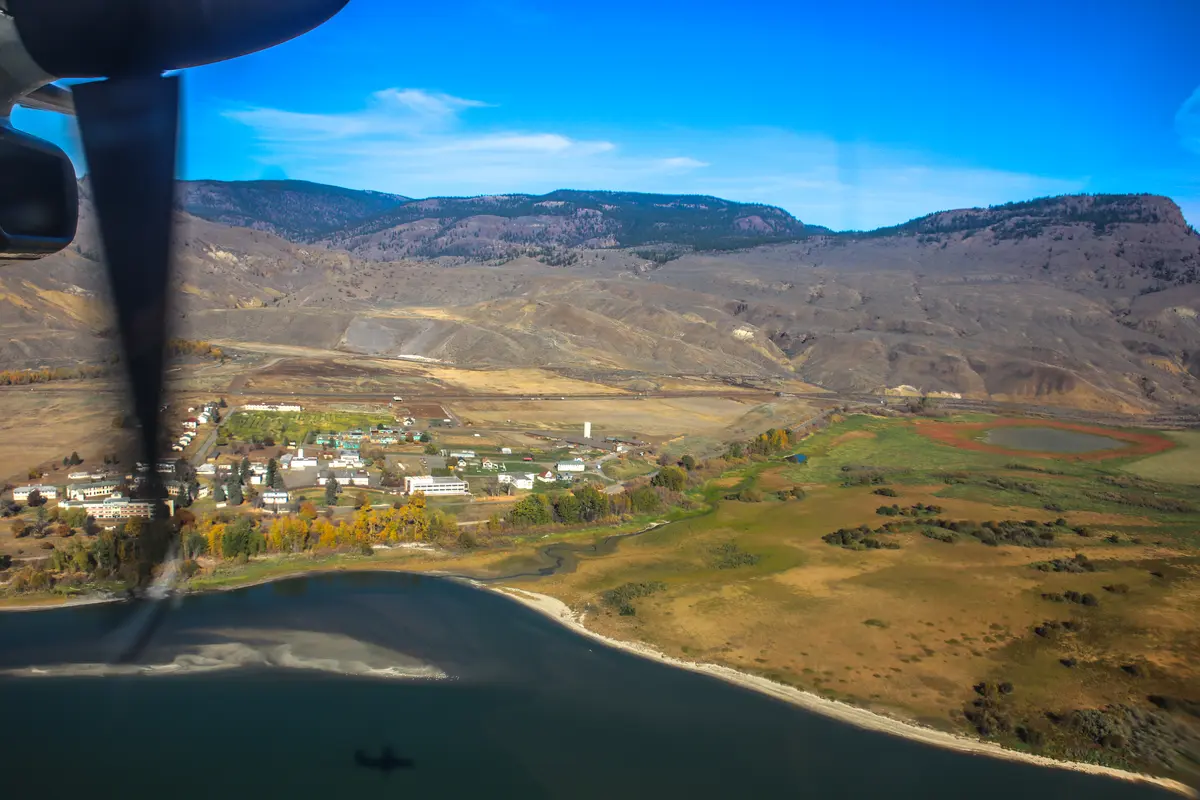
The complex is plainly visible from Tranquille Road and from the lakeshore, and it photographs as what it was: a white-painted company village on a green delta. The documentary record is held elsewhere: the Kamloops Museum and Archives keeps the Tranquille Sanatorium collection, accessions running from 1907 to 1984, described in a finding aid prepared by Robb Gilbert and revised by Jaimie Fedorak.
Sources consulted
- Robb Gilbert; rev. Jaimie Fedorak, «Tranquille Sanatorium collection — finding aid (accessions 1988.023 et al., 1907–1984)» — Kamloops Museum and Archives, 2019 archive
- Kamloops Daily News staff, «Tour opens 'spooky' Tranquille tunnels» — Kamloops Daily News, 2013 newspaper archive
- Josh Dawson, «Historic Tranquille sanatorium property on Kamloops Lake hits market for $15M» — Castanet Kamloops, 2026 newspaper archive
- Kallan Lyons, «The buried history of Tranquille (with the accompanying feature 'Tranquille: A Timeline')» — The Wren (Kamloops), 2023 newspaper archive
- Diane Purvey, «"Thrown Out into the Community": The Closure of Tranquille, in Small Cities, Big Issues» — AU Press, Athabasca University, 2018 academic
- BC Labour Heritage Centre, «Chapter 6 — The Tranquille Occupation, in Solidarity: The Largest Political Protest in British Columbia's History» — Community Stories / Digital Museums Canada, 2021 report
- MTV, «Fear (American TV series) — season 2, episode 5, "Serenity Lake Sanitorium", filmed at Tranquille, aired 21 April 2002» — Wikipedia and TheTVDB episode records, 2002 web
- Inclusion BC, «Institutions and People with Intellectual Disabilities — the McCallum report, the 2002 provincial apology and the trust fund for former residents of Woodlands, Tranquille, Glendale and Endicott» — Inclusion BC, 2018 report
- Brian Baker, «Is Tranquille the victim of wild imaginations?» — The Superstitious Times, 2020 interview
- Ken Favrholdt, «Kamloops History: The cemeteries of Kamloops and Tk'emlups» — Kamloops This Week, 2020 newspaper archive
- Jamie Shinkewski, «Tranquille Tunnel Tour Will Tell Story of Closing the Sanatorium» — KamloopsBCNow, 2015 newspaper archive
- Tranquille Farm Fresh, «Tunnel Tours — Tranquille Farm Fresh (archived 18 October 2013)» — Internet Archive Wayback Machine, 2013 archive
- Wayne Norton, «A Whole Little City by Itself: Tranquille and Tuberculosis» — Plateau Press, Kamloops, 1999 book
Reviewed by V. Serrano on 2026-08-14 · How we verify our content
💬 Field testimonies (0)
No testimonies yet. Add the first.
Add your testimony
🔒 Log in to add a testimony