📜 LEGEND · EXP. Nº0270
ACTIVE
Robin Hood of Sherwood
The rhymes were medieval; almost nothing else about them is. Robin Hood is first mentioned around 1377, in Piers Plowman, by a slothful priest who knows his rhymes better than his paternoster - and not one of those rhymes survives.
Where does the legend of Robin Hood of Sherwood come from?
- Location
- Sherwood Forest, Nottinghamshire, United Kingdom
- Kind of legend
- Folk tale
- Coordinates
- 53.205, -1.072
- Last updated
LOCATION
What is the legend of Robin Hood of Sherwood?
When the ballads finally appear in writing, they do not agree with the story we tell. A Gest of Robyn Hode names Barnsdale, in Yorkshire, nine times and Sherwood not once; in Robin Hood and Guy of Gisborne the hero calls himself "Robin Hood of Barnesdale". The Gest's one mention of Lincoln green dresses the king, not the outlaws. Robin does not split a rival's arrow: he splits a peeled wand set up as a mark, and the split arrow belongs to chapter XIII of Walter Scott's Ivanhoe, in 1819. Maid Marian, Friar Tuck and Alan-a-Dale each arrive later, on datable pages, and "robbing the rich to give to the poor" is first put in those words by a Scottish historian writing in Latin in 1521. Here is the legend with its dates restored.
What is the history of Robin Hood of Sherwood?
Begin with the sentence that stopped anyone from checking. The old entry said that medieval ballads tell of Robin Hood, and that "the earliest surviving rhymes date from the fourteenth and fifteenth centuries". Both statements are true. Together they quietly licence everything around them: if the rhymes are medieval, then so, apparently, are Maid Marian, Friar Tuck, Alan-a-Dale, Lincoln green, the split arrow and Sherwood itself. They are not. Every one of those pieces has a first datable appearance, the dates are spread over four and a half centuries, and on two of them the oldest texts say the opposite of what we said.
The earliest known mention is a boast by a character who cannot say his prayers. In the B-text of Piers Plowman, written around 1377, Sloth confesses to Repentance: "I kan noght parfitly my pater-noster, / As the preest it syngeth; / But I kan rymes of Robyn Hood, / And Randolf erl of Chestre." Thomas Wright, printing the passage in 1842, noted that "This seems to be the earliest mention of the ballads of Robin Hood which can now be found", and threw out the two older candidates then in circulation. Notice what the line proves and what it does not: by 1377 the rhymes were current enough to stand for everything an idle priest knows instead of scripture. Not one of those rhymes survives.
Where was he? The oldest datable answers do not say Sherwood. Andrew of Wyntoun, writing his Scottish chronicle about 1420, enters Little John and Robin Hood under the year 1283 as outlaws well spoken of, and gives their ground in two lines: "In Vngilwode and Barnysdale / Thai oysyd all this tyme thare trawale" — Barnsdale in the West Riding of Yorkshire and, on the usual reading of the first name as printed, Inglewood in Cumberland. The first surviving line that does put him in Sherwood is a scribble, four lines of doggerel on a blank leaf of Lincoln Cathedral Library MS 132, f. 100v, catalogued by the Digital Index of Middle English Verse as no. 4509 and transcribed there as "Robyn hod in schere wod stod / hodud & hathud hosut & schod / four & thuynti arowne / he bar in hitz honde", with a Latin version copied after it. DIMEV gives it no date; published estimates for the leaf run from about 1400 to about 1425.
Then the ballads themselves, and here the entry can be measured rather than argued with. In A Gest of Robyn Hode, the compilation of 456 stanzas printed around 1500, Barnsdale is named nine times (spelled Bernysdale seven times and Bernesdale twice) and Sherwood not once; Nottingham appears twenty-one times in four spellings and the sheriff forty-seven times in nine, so the text is not short of Nottinghamshire, it simply does not put Robin in the forest. Robin Hood and Guy of Gisborne is blunter still: the hero introduces himself as "Robin Hood of Barnesdale". Only Robin Hood and the Monk, the ballad copied about 1450, has "mery Scherwode", and it has it twice. The Robbins Library at Rochester states the pattern plainly: before 1500 Barnsdale is far more commonly named, and Sherwood gains its prominence in the seventeenth century.
The Gest also states Robin's programme, and it is narrower than "rob the rich to give to the poor". Little John asks where they shall rob and beat and bind; Robin answers: "But loke ye do no husbonde harme, / That tilleth with his ploughe", nor any good yeoman, knight or squire that will be a good fellow; "These bisshoppes and these archebishoppes, / Ye shall them bete and bynde; / The hye sherif of Notyingham, / Hym holde ye in your mynde." The poem's last line grants him the credit — "For he was a good outlawe, / And dyde pore men moch god" — but the money he is actually shown handing over in the poem goes to a knight, Sir Richard at the Lee, four hundred pounds of it. The familiar formula is not medieval English at all. It is Latin, Scottish and dated: John Major's Historia Majoris Britanniae, printed at Paris in 1521, reports that Robin "would allow no woman to suffer injustice, nor would he spoil the poor, but rather enriched them from the plunder taken from the abbots", and adds the sentence that ought to travel with the rest — "The feats of this Robert are told in song all over Britain." Major is also the man who moved Robin to the reign of Richard I and King John. Before him, nobody had.
Lincoln green is the same kind of surprise. The phrase occurs once in the whole Gest, in the eighth fytte, and it is not Robin who wears it: the king, having decided to go among the outlaws, "kest of his coll then, / A grene garment he dyde on", and "Whan they were clothed in Lyncolne grene, / They keste away theyr graye".
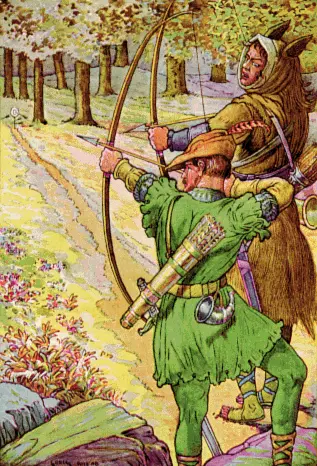
The archery contest survives the check; the split arrow does not. In the Gest the sheriff proclaims a shoot for an arrow whose "shaft of syluer whyte" carries a head and feathers "of ryche red golde"; Robin goes to it openly, with seven score men at his back and six shooting beside him, and "Thrys Robyn shot about, / And alway he slist the wand". Little John does the same earlier in the poem, and in Guy of Gisborne "he cloue the good pricke-wande". A wand is a peeled rod set up as the mark. Splitting a rival's arrow enters the story in a book, in a chapter that can be named: Walter Scott's Ivanhoe, 1819, chapter XIII, where Locksley says "I will notch his shaft for him, however", and his arrow lights "right upon that of his competitor, which it split to shivers" — and then, a page later, he splits the willow rod as well. Scott kept the medieval wand and added the arrow on top of it.
The companions arrived one at a time and late. Little John is there from the beginning, in Wyntoun and in every early ballad, but the quarterstaff duel on the narrow bridge — in which Robin is knocked into the brook and loses — is a broadside: its title is entered in the Stationers' Register in 1624 and the earliest surviving copy was printed by W. Onley before 1685. Friar Tuck's name appears in English royal writs of 1417 and 1429, where it is the alias of Robert Stafford, chaplain of Lindfield in Sussex, an outlaw with no traceable connection to Robin Hood; within the Robin Hood tradition the friar belongs to the play texts, and is labelled Tuck in the marginal notes of William Copland's printing in the 1560s. Maid Marian comes from the French Whitsun games, where Robin and Marion were already a pair, and the earliest English text that names her beside Robin keeps them apart: Alexander Barclay's eclogue, appended to his Ship of Fools, offers "some mery fit of Maide Marian or els of Robin Hood" — or else. She becomes his beloved, and Matilda Fitzwalter into the bargain, in Anthony Munday's plays about the Earl of Huntington, printed in 1601. Alan-a-Dale is later than any of them: the Traditional Ballad Index dates his ballad to a garland of 1663.
As for the man, the archives hold names rather than a life. A Robert Hod appears as a fugitive in the Yorkshire records of the 1220s and as Hobbehod in the Exchequer between 1228 and 1232; a Gilbert Robynhod turns up in Sussex in 1296; Joseph Hunter found in 1852 that a "Robyn Hode" was paid as a porter of the chamber in Edward II's household between 24 March and 22 November 1324, and that on the last of those days "Robyn Hode, jadys un des porteurs, pour cas qil ne poait pluis travailler" was given five shillings and let go. The record that tells us most, though, is the one that disqualifies its own man. In 1262 a Berkshire clerk copying an entry about William, son of Robert le Fevere of Enborne, wrote him down instead as William Robehod. The find is credited to the archivist David Crook and dated to 1984; this review has it at second hand, from the Robbins Library's account, not from Crook's own pages. Nobody had renamed that man after an outlaw who did not yet exist. By 1262 "Robehod" was already what you called a robber.
Timeline: the documented record of Robin Hood of Sherwood
- 1262 A Berkshire clerk, copying an entry about William, son of Robert le Fevere of Enborne, writes him down instead as "William Robehod". The record identifies no outlaw: it shows that by 1262 the name was already a byword for one, which is stronger evidence about the age of the legend than any of the flesh-and-blood candidates it disqualifies. The find is credited to the archivist David Crook, who published it in 1984; it is reported here from the Robbins Library's account, not from Crook's own pages.
- c. 1377 In the B-text of Piers Plowman, Sloth tells Repentance that he cannot say his paternoster properly "But I kan rymes of Robyn Hood, / And Randolf erl of Chestre". It is the earliest mention of the rhymes anybody has been able to find, and it is spoken by a character, not by the poet. None of the rhymes it refers to survives.
- c. 1400-1425 A scribe fills a blank leaf of Lincoln Cathedral Library MS 132, f. 100v, with four lines of doggerel: "Robyn hod in schere wod stod / hodud & hathud hosut & schod / four & thuynti arowne / he bar in hitz honde", followed by a Latin version of the same. It is the earliest surviving line that puts Robin Hood in Sherwood. DIMEV, which catalogues it as no. 4509, assigns it no date; published estimates for the leaf range from about 1400 to about 1425.
- 1417 and 1429 English royal writs order the arrest of an outlaw calling himself Frere Tuk; the second, of 1429, gives his name as Robert Stafford, chaplain of Lindfield in Sussex. The Robbins Library notes that this man has no verifiable contemporary connection to the Robin Hood tradition. The friar joins Robin in the play texts, and is labelled Tuck in the marginal notes of William Copland's printing in the 1560s.
- c. 1420 Andrew of Wyntoun's Scottish chronicle enters the outlaws under the year 1283: "Lytill Ihon and Robyne Hude / Waythmen ware commendyd gude, / In Vngilwode and Barnysdale / Thai oysyd all this tyme thare trawale." Barnsdale is in Yorkshire and the other name is read as Inglewood, in Cumberland. Sherwood is not in the stanza.
- c. 1450 Robin Hood and the Monk is copied into a Cambridge manuscript. It is the earliest full ballad of the cycle to survive, it is the only one of the four early ballads that names Sherwood (twice, as "mery Scherwode"), and it turns on Little John rescuing Robin from Nottingham gaol after Robin has struck him in a quarrel.
- c. 1500 A Gest of Robyn Hode is printed. Across its 456 stanzas Barnsdale is named nine times and Sherwood never; Nottingham appears sixteen times and the sheriff thirty-five. The one occurrence of "Lyncolne grene" is the king's disguise, not Robin's livery; the archery prize is an arrow with a silver shaft and a head of red gold, and Robin wins it by splitting the wand three times, in the open, with seven score men behind him.
- c. 1500 (dating disputed) Alexander Barclay, in an eclogue appended to his Ship of Fools, writes of "some mery fit of Maide Marian or els of Robin Hood" - the earliest English text to name the two together, and it separates rather than joins them. The Dictionary of National Biography dates it "about 1500" and states that no trace of the lady has been recovered in English literature earlier; other datings put the eclogues around 1513-14.
- 1521 John Major's Historia Majoris Britanniae is printed at Paris. Robin "would allow no woman to suffer injustice, nor would he spoil the poor, but rather enriched them from the plunder taken from the abbots" - the earliest statement of the formula the whole legend now runs on. Major adds that "the feats of this Robert are told in song all over Britain", and he is the first writer to place him in the reign of Richard I and King John.
- 1601 Anthony Munday's The Downfall of Robert, Earl of Huntington, afterward called Robin Hood of Merrie Sherwood is printed, with its sequel written with Henry Chettle. These are the plays that make Robin a nobleman, make Marian his beloved, identify her with Matilda, daughter of Robert Fitzwalter, and set the whole thing in Sherwood.
- 1624 and before 1685 The title of Robin Hood and Little John is entered in the Stationers' Register in 1624; the earliest surviving copy is a broadside printed by W. Onley before 1685. This is the ballad of the quarterstaff duel on the bridge, in which Robin is knocked into the brook. The Traditional Ballad Index dates Robin Hood and Allen a Dale to a garland of 1663 and the disguised archery contest of Robin Hood and the Golden Arrow to a manuscript of about 1670 and a garland of 1777.
- 1790 Major Hayman Rooke measures the great oak at Edwinstowe at twenty-seven feet four inches round, according to an anonymous comment posted in 2007 on its Ancient Tree Inventory record, which also gives 1,059 centimetres for 1990. The Inventory itself records a girth of 10.66 metres. Nothing links it to the ballads.
- 1819 In chapter XIII of Ivanhoe, Walter Scott has Locksley say "I will notch his shaft for him, however", and his arrow lights on his rival's "which it split to shivers"; on the following page he splits a willow rod as well. The wand is the medieval ballads' trick; the split arrow is Scott's, and it is now the first thing anyone can tell you about Robin Hood.
- 18 June 2026 The RSPB announces that the Major Oak, the tree the whole Sherwood industry is built around, failed to come into leaf that spring and is believed to have died. It blames soil compacted by visitors, a root system found since 2021 to be far smaller and weaker than expected, past preservation work with bracing, props and concrete that stopped the tree ageing naturally, and heat and drought. Natural England confirms the news in July. The trunk will stand for years yet as habitat.
Is there a rational explanation for Robin Hood of Sherwood?
No man can be got out of this. The archives hold a scatter of Robert Hoods and a nickname, and the nickname is the argument: when a clerk in 1262 turned William son of Robert le Fevere into "William Robehod", he was using a word his readers already understood. That dates the legend and disqualifies the candidates in the same stroke.
The death dates are worth looking at, because they were made rather than found, and they do not agree. Martin Parker, in A True Tale of Robin Hood printed about 1632, was the first to name a day — 4 December 1198 — and supplied an epitaph he said had once been readable at Kirklees. Ralph Thoresby went to look, and in his Ducatus Leodiensis of 1715 described a tombstone near Kirklees whose inscription was illegible; in his appendix he printed a different epitaph, with a different date, 18 November 1247, which he reported had turned up among the papers of Thomas Gale, dean of York. Two antiquaries, two dates forty-nine years apart, and a stone that could not be read by the man who published the second of them.
Three checks on our own text should be stated, since the whole of this entry rests on counting.
Sherwood in the Gest: zero. That is a real zero and not a bad search. The word "wode" occurs thirty-six times in the same poem, so the corpus is not silent about woods; none of those thirty-six carries a Sher- in front of it. Barnsdale gives nine, but only after the query is fixed — the spelling that dominates the text is Bernysdale, and a search for Barnsdale alone returns two. The sheriff is worse: he is there forty-seven times under nine different spellings, from sherif to shyref to sherief, and the first count made for this entry missed a third of them. The same trap caught Robin Hood and the Potter, where a search for "sheriff" in modern spelling returns nothing at all and the word in the manuscript is screffe, twenty-five times.
What could not be read. Child's headnotes to the Robin Hood ballads were out of reach: the Internet Archive returned 1,232-byte error pages for three separate volume identifiers, files that grep as cleanly as a book and prove nothing. The International Robin Hood Bibliography and the Corpus of Middle English Prose and Verse both answered with a Cloudflare challenge. Where a ballad's date is given here it comes from the Traditional Ballad Index, which cites its sources, and it is labelled as such rather than smoothed into fact.
Finally, the entry claimed that several real outlaws have been proposed and none can be proven. That is right about the conclusion and wrong about the shape: the proposals are not vague, they are documents with dates, and naming them is more useful than the shrug.
Can you visit Robin Hood of Sherwood?
The tree everybody comes to see died this year. On 18 June 2026 the RSPB announced that "this spring, the Major Oak failed to come into leaf and is now believed to have died". The causes it lists are not the weather alone. For more than a century, efforts to hold the tree's shape with metal bracing, props, concrete and coverings "prevented it from ageing naturally"; millions of visitors compacted the sandy soil around the roots; and the investigations the RSPB has run with soil and tree specialists since 2021 found the root system "far smaller and weaker than earlier scans suggested". Heat waves and drought compounded it. Natural England's East Midlands team confirmed the news on 14 July, adding that the decaying trunk will give habitat to scarce invertebrates "such as darkling beetles and flies" and roosts to brown long-eared bats. The RSPB expects the tree to "remain standing for many years", and says that saplings grown from its acorns and cuttings are planted "right around the world". Nothing ever connected it to the ballads. The Woodland Trust's Ancient Tree Inventory lists it as tree number 1, gives its girth as 10.66 m at 0.90 m from the ground and its position as grid reference SK 62053 67902 — 53.2046 N, 1.0724 W — and on 23 September 2026 already recorded its living status as "Dead". An anonymous comment posted on the same record in 2007 gives the girth Major Hayman Rooke recorded in 1790 as 27 feet 4 inches.
The forest around it is a National Nature Reserve, managed by a team the RSPB leads on behalf of Nottinghamshire County Council; its visitor centre, at Forest Corner, Edwinstowe, Mansfield, Nottinghamshire NG21 9QB, opened in 2018. The RSPB's pages, consulted on 23 September 2026, give entry as free for everyone and parking as £7 a day for non-members and free for members. On special event days all visitors pay, members included: in 2026 that meant £10 or £15 a vehicle, £8 or £12 for members. For the week from 23 September the visitor centre, café and shop are listed as open from 10:00 to 15:00 and the car park from 09:00 to 16:00. Besides two accessible toilets there is a Changing Places facility, and a mobility scooter can be hired for £3 an hour if booked in advance.
The oldest texts point somewhere else. The Gest's country is Barnsdale, the wooded ground on the Great North Road, now the A1, between Doncaster and Pontefract. The monument called Robin Hood's Grave stands in private woodland on the Kirklees Park estate at Clifton, near Brighouse in West Yorkshire, about 650 metres from the surviving gatehouse of Kirklees Priory. The priory — a nunnery probably founded in the reign of Henry II, with eight nuns when it was dissolved in 1539, excavated by Sir George Armytage between 1902 and 1905 and surveyed by geophysics in 2007 — is scheduled ancient monument 1417240. Kirklees Council's community directory, last updated on 1 September 2025, says the site is privately owned and that visits are made through the programme of Calderdale Heritage Walks, which usually runs one walk there each summer, with booking required.
Sources consulted
- Francis James Child (ed.), «A Gest of Robyn Hode (Child ballad 117), full Middle English text» — The English and Scottish Popular Ballads, Part V, Boston (text via Wikisource), 1888 book
- Francis James Child (ed.), «Robin Hood and Guy of Gisborne (Child ballad 118), full text; "My name is Robin Hood of Barnesdale" and "he cloue the good pricke-wande"» — The English and Scottish Popular Ballads, Part V, Boston (text via Wikisource), 1888 book
- Francis James Child (ed.), «Robin Hood and the Monk (Child ballad 119), full text; the two occurrences of "mery Scherwode"» — The English and Scottish Popular Ballads, Part V, Boston (text via Wikisource), 1888 book
- Thomas Wright (ed.), «The Vision and Creed of Piers Ploughman, Passus V (lines 3277-78) and editorial note to those lines» — London (text and notes via Wikisource), 1842 book
- Sidney Lee, «"Hood, Robin", Dictionary of National Biography, vol. 27, pp. 258-61» — Smith, Elder & Co., London (pages via Wikisource), 1891 book
- Digital Index of Middle English Verse, «Record 4509: "Robyn hod in schere wod stod", Lincoln, Lincoln Cathedral Library 132, f. 100v» — DIMEV: An Open-Access, Digital Edition of the Index of Middle English Verse, 2026 archive
- John Major, ed. Stephen Knight and Thomas Ohlgren, «From John Major's Historia Majoris Brittaniae (1521), in Constable's translation of 1892, pp. 156-67» — Middle English Texts Series, Robbins Library, University of Rochester, 1521 book
- Walter Scott, «Ivanhoe, chapter XIII (the archery contest at Ashby)» — Edinburgh (text via Project Gutenberg), 1819 book
- Robbins Library Digital Projects, University of Rochester, «Robin Hood (theme essay) and Friar Tuck (theme essay), The Robin Hood Project» — University of Rochester, 2026 web
- Robert B. Waltz and David G. Engle, «The Traditional Ballad Index, entries C125 (Robin Hood and Little John), C138 (Robin Hood and Allen a Dale) and C152 (Robin Hood and the Golden Arrow)» — California State University, Fresno, 2026 web
- Woodland Trust, «Major Oak, tree record 1, Ancient Tree Inventory (grid reference SK 62053 67902; girth 10.66 m; an anonymous comment of 2007 on the record gives 1,059 cm in 1990 and 27 ft 4 in by Rooke in 1790)» — Ancient Tree Inventory, 2026 report
- Royal Society for the Protection of Birds, «Sherwood Forest Visitor Centre and Nature Reserve: opening, charges and accessibility» — RSPB, 2026 web
- Calderdale Council, register of ancient monuments, «Kirklees Priory medieval nunnery, scheduled ancient monument, reference 1417240» — Calderdale Council, 2026 report
- Royal Society for the Protection of Birds, «The Major Oak: A new chapter for a legend of Sherwood Forest (announcement that the tree has died)» — RSPB news, 18 June 2026, 2026 report
- Karyn Haw, Senior Officer, Nature Recovery Network, East Midlands Area Team, «Sherwood Forest's Major Oak: an ending and a beginning» — Natural England blog, 14 July 2026, 2026 report
Reviewed by V. Serrano on 2026-08-17 · How we verify our content
📎 Source: Enigma Atlas
💬 Field testimonies (0)
No testimonies yet. Add the first.
Add your testimony
🔒 Log in to add a testimony