👻 HAUNTED PLACE · EXP. Nº9046
ACTIVE
Highgate Cemetery
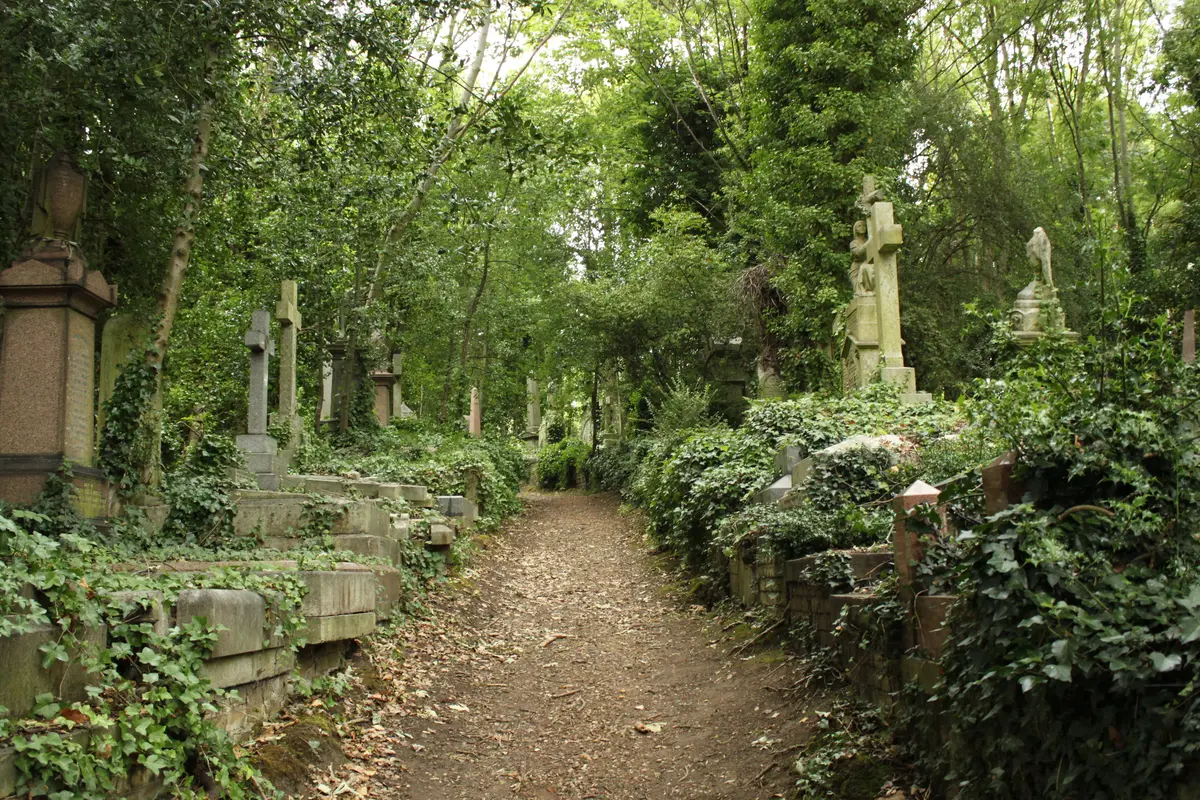
Opened in 1839 as one of London's "Magnificent Seven" Victorian cemeteries, Highgate's overgrown Gothic tombs and Egyptian Avenue became the backdrop for one of Britain's strangest modern folk panics.
Where is Highgate Cemetery?
- Location
- London, United Kingdom
- Type
- Cemetery
- Coordinates
- 51.567, -0.147
- Last updated
LOCATION
Why is Highgate Cemetery said to be haunted?
In 1970, David Farrant reported a grey figure inside the cemetery gate and Seán Manchester declared it a vampire, soon dubbed the "Highgate Vampire", and their dueling television appearances and public feud drew hundreds of amateur ghost hunters to storm the gates on Friday the 13th of March that year, followed by years of vandalized tombs as people searched for a body to stake. The rivalry between Manchester and Farrant continued in print and court for decades afterward.
What is the history of Highgate Cemetery?
Highgate Cemetery's fame as a haunted place rests almost entirely on the events of 1970, and the sequence of events is documented well enough to follow almost day by day.
In February 1970, a young Londoner named David Farrant wrote to the local paper, the Hampstead and Highgate Express, describing a "grey figure" he said he had seen near the cemetery on Christmas Eve 1969 and which he took to be supernatural. It was a modest letter to a local newspaper. Other correspondents wrote in with ghosts of their own, and the newspaper invited more letters.
Into this stepped Seán Manchester, who supplied something Farrant's letter had not mentioned: a vampire. Manchester's claim was elaborate and specific. A "King Vampire of the Undead" — a medieval nobleman who had practised black magic in Wallachia — had been brought to England in a coffin in the early eighteenth century and buried on the land that later became Highgate Cemetery, and modern Satanists had woken him.
On the evening of 13 March 1970 ITV broadcast interviews with Manchester and Farrant, among other people who said they had seen figures in the cemetery. Within two hours of the broadcast, a mob of amateur vampire hunters had gathered outside the cemetery gates. Many came over the gates and walls, some of them armed. The Victorian cemetery — by then badly neglected, overgrown and with vaults already broken open — was invaded repeatedly over the following months, and the damage was real.
What followed was a public feud between the two men that outlasted the panic by decades. In 1974 Farrant was jailed after being convicted of interfering with remains and vandalising memorials in the cemetery, damage he blamed on Satanists. The rivalry between Farrant and Manchester continued, in print and in public, until Farrant's death in April 2019.
Timeline: the documented record of Highgate Cemetery
- 24 December 1969 David Farrant later says he saw a "grey figure" near Highgate Cemetery on this night. His account contains no vampire.
- February 1970 Farrant writes to the Hampstead and Highgate Express describing the figure. Readers reply with their own ghost accounts and the correspondence grows.
- 13 March 1970 Seán Manchester, interviewed on ITV with Farrant and others, repeats his claim that a Wallachian "King Vampire of the Undead", brought over in a coffin in the eighteenth century, lies in the cemetery. Within two hours a mob of amateur vampire hunters gathers at the gates.
- 1974 Farrant is jailed after being convicted of interfering with remains and vandalising memorials in Highgate Cemetery, damage he blamed on Satanists. The feud between him and Manchester will continue in public for decades.
- Academic analysis Folklorist Bill Ellis analyses the affair in the journal Folklore as a case of legend formation: how rumour, selection, exaggeration and stereotyping shape public perception into a narrative.
Is there a rational explanation for Highgate Cemetery?
The Highgate vampire can be followed from a letter in February 1970 to a crowd at the gates on 13 March, and most of the steps were printed as they happened, which is why the folklorist Bill Ellis could devote a 27-page article in Folklore (1993) to the hunt.
The first step was a ghost: David Farrant's letter to the Hampstead and Highgate Express described "a grey figure" seen for a few seconds inside the top gate of Swain's Lane and asked whether anyone else had seen anything; in his own account of 2010 he says he had "deliberately omitted any reference to a 'vampire'". The replies that followed described different things, and David Castleton, in his reconstruction of the affair, lists a tall man wearing a hat, a ghostly cyclist, a lady dressed in white, a face grimacing through the bars of a gate, a person wading into a pond and a pale gliding entity, and concludes that "there was little coherence in the types of spectres people claimed to have seen".
The vampire came from Seán Manchester: on 27 February 1970 the same newspaper published an interview with him, "Does a Wampyre Walk in Highgate?", in which he said that "a King Vampire of the undead", an aristocrat who had practised black magic in medieval Romania, had been brought to England in a coffin in the early eighteenth century and buried on the site, and that recent Satanist rituals had woken him. Manchester later called the eastern European part a journalistic embellishment, although his book of 1985 still mentions a foreign nobleman's coffin. Farrant moved towards the same vocabulary a week later: on 6 March the paper reported that he had found dead foxes in the cemetery and thought a vampire might have been responsible.
Television did the rest when, on the evening of Friday 13 March 1970, ITV broadcast interviews with Farrant and Manchester, among others who said they had seen figures in the cemetery, with live reporting from Highgate; according to IanVisits the two rivals said they were determined to seek out the vampire and exorcise it with a wooden stake through the heart. Within two hours, Castleton writes, hundreds of would-be vampire hunters were arriving and climbing the gates and walls despite the police. IanVisits puts the crowd at nearly 100 people, held back without success by some 40 officers. The crowd formed within two hours of the programme, and that timing places the trigger of the hunt in the broadcast.
Farrant's position kept moving, and Castleton writes that, as the crowd searched, Farrant "complained that media hysteria and local superstition had turned the Highgate entity into a vampire", while still believing in the entity. Later that year he was caught at night in St Michael's churchyard, next to the cemetery, carrying a stake, and in September a court at Clerkenwell found him not guilty because the ground was not an enclosed area in the legal sense. His later theory was an evil presence travelling along a ley line.
The setting supplied the physical evidence, and the hunts added to it. By the 1960s, Castleton writes, the cemetery was overgrown and neglected, vandals had pulled doors off vaults and holes in tombs showed coffins and in some cases bodies; Farrant, visiting before his vigil of December 1969, found vaults broken open, one coffin set alight and a skeleton wrenched from another. On the night of 13 March Manchester's group climbed into a catacomb through a window to perform an exorcism, and in August 1970, by Manchester's own account, they forced the doors of a family vault and opened a coffin. In 1974 Farrant was jailed after being convicted of interfering with remains and vandalising memorials in the cemetery, damage he attributed to Satanists. Part of the damage that seemed to confirm the story was done by the people hunting it.
Can you visit Highgate Cemetery?
Highgate Cemetery lies on both sides of Swain's Lane, London N6 6PJ, and is still an active burial ground, run by a charity, the Friends of Highgate Cemetery Trust. The Trust's visitor page, consulted on 23 September 2026, says the charity receives virtually no government funding and that keeping the cemetery open costs at least £1.4 million a year; the entrance fee for sightseers was introduced in June 1990.
Opening hours on that page are 10:00 to 17:00 daily from March to October, last entry 16:30, and 10:00 to 16:00 from November to February, last entry 15:30. The cemetery closes on Christmas Day and Boxing Day, and access may be restricted during funerals and bad weather. One admission ticket covers the East and the West Cemetery for the whole day. The same page states that no guided tour has been needed to see the West side since 2020, so the older rule under which the Egyptian Avenue, the Circle of Lebanon and the catacombs could only be seen with a guide no longer applies. Guided tours still run with volunteer guides: the Highlights tour takes 70 to 75 minutes, covers the West side only, and its dates are released four weeks ahead. Individual tickets are sold through the Trust's online booking system. The visitor page itself quotes group rates: a private group tour at £18 an adult, £9 for children aged 8 to 17 and £9.50 for students, with a minimum of ten people, and a self-guided group visit at £10, £5 and £8, with a minimum fee of £100.
Karl Marx's monument is in the East Cemetery, as are the graves of George Eliot and Douglas Adams. The East side is on the gentler slope, with no steps and mostly tarmac paths, and the Trust describes it as the more easily wheelchair-accessible; on the West side there are two steps up from the entrance into the courtyard and some steep paths. There is no visitor parking.
On the vampire, the cemetery's own rules say what it thinks. Its FAQ forbids filming and photo shoots involving "anything to do with ghosts, vampires, or the undead", and the visitor page lists subjects "with a supernatural element" among those that need a permit, adding that permission is "most unlikely to be granted". The hunts of 1970 took place in a West Cemetery that was by then neglected and already vandalised, and the intruders added damage of their own. The Trust's events for the autumn of 2026 are talks and performances in the chapel, among them Beyond the Veil, a one-man adaptation of George Eliot's gothic tale The Lifted Veil, on 27 October and a talk on Highgate on film and television on 17 November.
Sources consulted
- David Castleton, «The Highgate Vampire — crónica documentada del caso: el avistamiento de Farrant, la carta al Ham & High, el "King Vampire" de Manchester y el juicio de 1974» — The Serpent's Pen — David Castleton Blog, 2018 web
- Bill Ellis, «The Highgate Cemetery Vampire Hunt: The Anglo-American Connection in Satanic Cult Lore — análisis folclorístico del caso» — Folklore, vol. 104, n.º 1-2, pp. 13-39 (The Folklore Society / Taylor & Francis), 1993 academic
- David Farrant, «The Highgate Vampire — how it all began» — Mysterious Britain & Ireland, 2010 interview
- Highgate Cemetery, «Visitor information — entradas, visitas guiadas y horarios» — Información oficial de visita, 2026 archive
- IanVisits, «Today's the 50th anniversary of the Highgate Vampire» — IanVisits, 2020 newspaper archive
Reviewed by V. Serrano on 2026-07-28 · How we verify our content
💬 Field testimonies (0)
No testimonies yet. Add the first.
Add your testimony
🔒 Log in to add a testimony