👻 HAUNTED PLACE · EXP. Nº9046
ACTIVE
Busby Stoop Chair
The Busby Stoop Chair is an oak armchair that hangs out of reach on a wall of Thirsk Museum, in North Yorkshire, kept there because of a story that whoever sat in it died.
Where is Busby Stoop Chair?
- Location
- North Yorkshire, England, United Kingdom
- Type
- Museum
- Coordinates
- 54.233, -1.344
- Last updated
LOCATION
Why is Busby Stoop Chair said to be haunted?
The subject is an object rather than a place, which is why the pin marks a museum and not a haunted building. Thomas Busby was hanged in 1702 for the murder of Daniel Auty, a coiner who was also his father-in-law; the Leeds antiquary Ralph Thoresby passed the gibbet on 17 May 1703 and wrote down what he saw. The story that Busby cursed his chair, and that whoever sat in it afterwards died, is in neither of the two oldest printed accounts of the crime: the anonymous History of Thirsk of 1821 and William Grainge's Vale of Mowbray of 1859 tell the murder at length and never mention a chair. The museum's curator told The Northern Echo in 2014 that no contemporary record of any curse has been found and that the 1702 assize papers are lost. The furniture historian Adam Bowett examined the chair, found machine-turned spindles, and dated it Caistor-style and after 1840 — at least 138 years after Busby died.
What is the history of Busby Stoop Chair?
The Busby Stoop Chair is an object with a criminal case attached to it, and the two have separate paper trails. The case is documented from within a year of the crime. The chair is not documented at all until the twentieth century.
The earliest datable witness is Ralph Thoresby, the Leeds antiquary. Riding from Topcliffe towards Northallerton on 17 May 1703, he wrote that a few miles past Sir William Robinson's gardens on the Swale he had come upon "a more doleful object of Mr. Busby hanging in chains, for the murder of his father-in-law, Daniel Auty, formerly a Leeds clothier, who having too little honesty to balance his skill in engraving, &c. was generally suspected for coining, and other indirect ways of attaining that estate which was the occasion of his death, even within sight of his own house". Thoresby knew the victim's trade because Auty had been a Leeds man like himself. He gives Busby no forename, and he says nothing about how Busby was caught, tried or sentenced.
The story reaches print in 1821, in the anonymous History of Thirsk, printed and sold in the town by R. Peat. Half a mile west of Kirby Wiske, it says, stood Dannoty Hall, "formerly the residence of a man of that name, who is said to have been a counterfeiter of the current coin of the realm", with rooms fitted up "in a very secret manner". A man named Busby married his daughter and joined the business; wanting the whole of it to himself, he quarrelled with his father-in-law and murdered him, "for which he was tried, and condemned, and hung in chains, near Carlton, and the place is called Busby Stoop to this day". The 1821 book never names the victim.
William Grainge completed the account in The Vale of Mowbray (1859), pp. 157-158. He fixed the spot — the crossroads where the Ripon-to-Thirsk road meets the Topcliffe-to-Northallerton road, near Sand Hutton, with the public house that takes its name from the gibbet post or stoop. He identified the victim as "Daniel Autie, corrupted into Dan. Auty or Dannoty", which is where Thoresby's name and the farmhouse name are welded together. And he printed the Thoresby diary extract as a footnote, dating it to 1703. Grainge also recorded that by 1859 "not a vestige of the gibbet post exists, nor has done in the memory of 'the oldest inhabitant'".
The chair appears only at the end of that chain. Thirsk Museum's own account is deliberately flat: "a chair at the inn gained a sinister reputation", wartime bomber pilots "thought it unlucky to sit there", "in the 1970s some fatal accidents were linked with the chair", and in 1978 the landlord — named by The Northern Echo as Tony Earnshaw — asked for it to be removed to the museum and hung out of harm's way. It has not been sat on since. Everything a visitor now hears about it — the curse, the chimney sweep, the airmen, the beer delivery driver — was already circulating when the chair arrived in Kirkgate, and none of it is in the 1821 or the 1859 account of the murder.
Timeline: the documented record of Busby Stoop Chair
- 1702 Thomas Busby is tried, condemned and hanged for the murder of Daniel Auty. The year is given by the 1821 History of Thirsk, by Grainge in 1859 and by Thirsk Museum; the assize papers that would fix the date and place are lost.
- 17 May 1703 Riding from Topcliffe to Northallerton, the Leeds antiquary Ralph Thoresby records passing "Mr. Busby hanging in chains, for the murder of his father-in-law, Daniel Auty, formerly a Leeds clothier". It is the earliest datable witness to the case and it mentions no chair.
- 1821 The anonymous History of Thirsk, printed by R. Peat, publishes the story for the first time: Dannoty Hall, the secret coining rooms, the quarrel and the gibbet "near Carlton". It does not name the victim and it does not mention a chair or a curse.
- 1859 William Grainge prints the fullest early account in The Vale of Mowbray, joins Thoresby's "Daniel Autie" to the house name Dannoty, quotes the diary in a footnote, and notes that no vestige of the gibbet post survives or has within living memory.
- 1894 The date given for the most repeated death: a chimney sweep supposedly found hanged beside Busby's stoop. Thirsk Museum's curator notes that the inquest returned a verdict of suicide, and Grainge had already reported in 1859 that no stoop remained.
- 1943 The Canadians of No. 433 Squadron are stationed in the Thirsk area, flying night bombing missions in Halifaxes and Lancasters. The pub stories about airmen and the chair are attached to this period, but no source names an airman or a date.
- 1978 The landlord Tony Earnshaw gives the chair up to Thirsk Museum. The museum's own account says it was to be "hung out of harm's way"; The Northern Echo says his condition was that it hang from the ceiling so nobody could sit in it again.
- 2005 A Darlington & Stockton Times restaurant column describes the pub trading on the tale: a board in the dining room explaining it and adding that "strange things continue to happen", the chair painted on the pub sign, and the hangman Albert Pierrepoint's autograph framed in the gents.
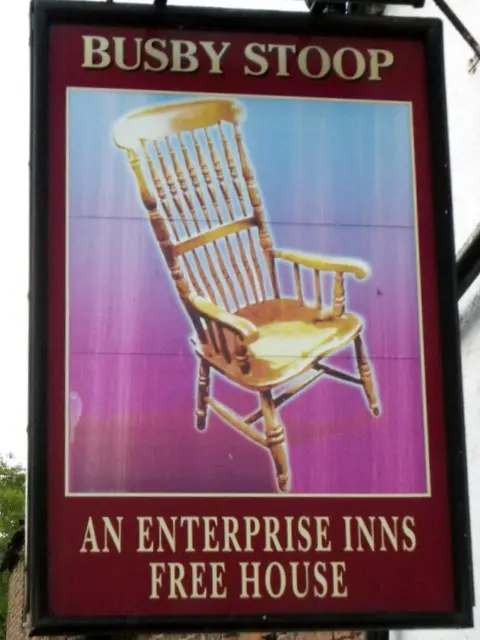
- 5 October 2010 The pub sign illustrating this file is photographed at the crossroads, grid reference SE 38258 80846. It shows a turned-spindle Windsor armchair and the words "an Enterprise Inns free house" — the trading name the site no longer uses.
- 2013 According to CAMRA's pub records, the Busby Stoop at the A61/A167 crossroads west of Thirsk stops trading as a pub and becomes an Indian restaurant.
- 29 October 2014 The Northern Echo publishes the fullest modern account: curator Cooper Harding says the 1702 assize records are lost and no contemporary evidence of a curse has been found, and furniture historian Adam Bowett dates the chair, from its machine-turned spindles, to after 1840.
Is there a rational explanation for Busby Stoop Chair?
The strongest argument against the chair is the chair itself. The furniture historian Adam Bowett examined it and found that its spindles are machine-turned, whereas seventeenth-century chairs were made on a pole lathe; he concluded that it is a Caistor-style chair made after 1840, at least 138 years after Busby died. The photograph on this file is consistent with that: it shows the pub sign, painted with a turned-spindle Windsor armchair of exactly the sort Bowett describes.
The second argument is a silence that can be measured. The 1821 History of Thirsk tells the whole murder without a chair and without a curse; the word "chair" occurs once in the entire volume, in an unrelated passage about "substantial smoking chairs", so the word is in the book's vocabulary and simply is not in the Busby story. Grainge's 1859 account is the same: in a book where "chair" appears 16 times, "curse" twice and "Thirsk" 435 times, the Busby passage has none of them. What Grainge does report is a different superstition altogether — that "tradition yet tells awful tales of night wanderers being terrified when passing those dreaded spots", meaning gibbets in general.
The museum agrees. Its curator, Cooper Harding, told The Northern Echo in 2014 that no contemporary documentary evidence of Busby issuing a curse has been unearthed, that he found no reference to Busby being married to Auty's daughter, and that the assize records for 1702 have been lost, so even the place and date of the hanging are unclear. That last point is confirmed independently at The National Archives: the description of series ASSI 44, the indictment files of the Northern and North-Eastern Circuits, states that the run "is substantially complete from 1607, except for large gaps from 1700 to 1721". The paperwork that would settle the case is inside the gap.
Individual deaths dissolve on contact. The most-repeated one, a chimney sweep found hanged in 1894 beside Busby's gibbet post, is undercut by Grainge, who had recorded thirty-five years earlier that no gibbet post survived; the curator adds that the inquest returned a verdict of suicide. The wartime story is told three incompatible ways by the three sources that tell it: the museum says only that bomber pilots thought the chair unlucky, the Darlington & Stockton Times column speaks of "young RAF crew" from Skipton-on-Swale, and The Northern Echo says Canadian airmen — pub regulars, it notes, were the ones claiming that those who sat in the chair never came back. Nobody offers a name or a date.
There is also money in the story, and it is visible. The pub explained the tale on a board in its restaurant, adding that "strange things continue to happen"; it hung a framed autograph of the hangman Albert Pierrepoint in the gents; its sign carried a picture of the chair; and CAMRA's own entry still calls it "reputedly Yorkshire's most haunted pub" — while getting the basic fact wrong, since Busby was a coiner who was gibbeted at the crossroads, not, as that entry says, a landlord of the inn. The museum shows the same split in miniature: the text of its Busby Stoop Chair display has never mentioned a curse, but the slideshow on its own website invites visitors to "discover the legend behind one of Thirsk's most intriguing artefacts: the Busby Stoop Chair, cursed by Thomas Busby in 1702".
Finally, the wording. The curse line in circulation, printed by The Northern Echo as "May sudden death come to anyone who dare sit in my chair", is introduced there with "it is said" and attached to no source. An earlier version of this file quoted a different wording again, which nothing supports; it has been removed rather than replaced. Harding's own summary is the fairest one available: "there are as many versions of the story as people who have told it", and "it is a great example of a folk tale that people add to".
Can you visit Busby Stoop Chair?
The chair is in Thirsk Museum, 14-16 Kirkgate, Thirsk, North Yorkshire YO7 1PQ, telephone 07596 483416. The pin on this file, at 54.2332, -1.3443, falls on the museum: OpenStreetMap places the building at 54.23322, -1.34433. The museum's displays page puts the chair in the Thomas Lord Room, with the cricket memorabilia, and says that in 1978 the landlord asked for it "to be removed to the Museum, and hung out of harm's way"; "The Busby Stoop Chair has not been sat on since."
The museum is run by volunteers and opens by season. Its home page, read on 23 September 2026, says it is "open daily except Sundays until 31st October": Monday to Friday from 10.30 am to 3.30 pm with last admission at 3.00 pm, and Saturday from 10.30 am to 1.00 pm with last admission at 12.30 pm. Admission is free, with donations asked for in lieu of a charge. Groups and school parties of up to 30 can be taken by prior arrangement, during or outside normal opening times, and guided tours are available on request.
The same page covers access. There is a ramped entrance to the ground floor for wheelchair users; the first floor is reached only by narrow stairs, and for visitors who cannot manage them the museum keeps an iPad with slides and commentary on the upstairs displays. Assistance dogs are welcome. In the museum's directions, Kirkgate is the road on the right from the clock tower in the Market Place, looking towards Bianco's Italian restaurant, and the museum stands on the right-hand side opposite the Zillah Bell Gallery; the World of James Herriot is across the road. Parking in the Market Place is limited to two hours, the first of them free, and there are short-stay and long-stay car parks in Marage Road.
The crossroads that named the chair is 4.7 km (2.9 miles) west-south-west of the museum in a straight line, measured to the former inn; The Northern Echo gives the distance as three miles. CAMRA's record places the building "at cross roads of A61/A167 west of Thirsk", at Busby Stoop Road, YO7 4EQ, and says it became an Indian restaurant in 2013, now called Jaipur Spice. It is a private business and does not hold the chair. Of the gibbet, Grainge reported in 1859 that "not a vestige of the gibbet post exists, nor has done in the memory of 'the oldest inhabitant'".
Sources consulted
- Ralph Thoresby (ed. Joseph Hunter), «The Diary of Ralph Thoresby, F.R.S. (1677-1724), vol. I, p. 425 (entry of 17 May 1703)» — Henry Colburn and Richard Bentley, London, 1830 book
- Anonymous, «The History of Thirsk, including an account of its once celebrated castle, pp. 145-146» — Printed and sold by R. Peat, Thirsk, 1821 book
- William Grainge, «The Vale of Mowbray: a historical and topographical account of Thirsk and its neighbourhood, pp. 157-158» — Simpkin, Marshall & Co., London, 1859 book
- Stuart Minting, «18th Century murderer's chair continues to captivate supernatural fans» — The Northern Echo, 2014 newspaper archive
- «Eating Owt... at The Busby Stoop (archived copy; the capture carries no date line, the year is that of the citation in circulation and of the newly published book the column reviews)» — Darlington & Stockton Times, 2005 newspaper archive
- Thirsk Museum, «The Busby Stoop Chair (museum displays page; text unchanged since the 2006 capture)» — thirskmuseum.org, 2026 web
- The National Archives, «ASSI 44 — Assizes: Northern and North-Eastern Circuits: Indictment Files, 1607-1971 (series description: gaps 1700-1721)» — Discovery catalogue, Kew, 1971 archive
- Maigheach-gheal, «Sign for the Busby Stoop (photograph, grid reference SE 38258 80846)» — Geograph Britain and Ireland, CC BY-SA 2.0, 2010 web
- CAMRA, «Busby Stoop, Busby Stoop (pub record: became an Indian restaurant in 2013)» — WhatPub / camra.org.uk, 2026 web
Reviewed by V. Serrano on 2026-08-21 · How we verify our content
💬 Field testimonies (0)
No testimonies yet. Add the first.
Add your testimony
🔒 Log in to add a testimony