👻 HAUNTED PLACE · EXP. Nº9474
ACTIVE
Broad Haven
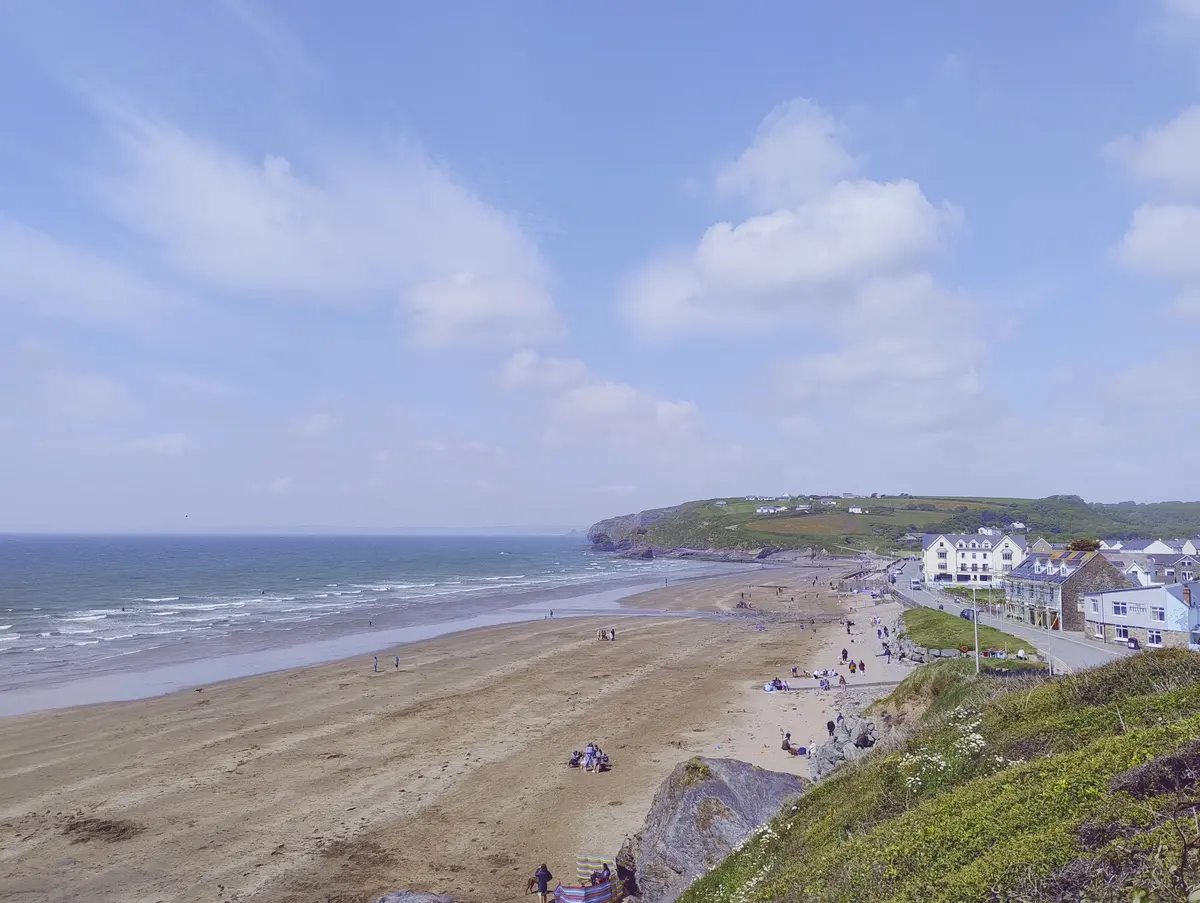
Broad Haven is a small seaside village on St Bride's Bay, in Pembrokeshire, and its place in mystery writing rests on a single school lunch break.
Where is Broad Haven?
- Location
- Pembrokeshire, Wales, United Kingdom
- Type
- Village / settlement
- Coordinates
- 51.78, -5.1
- Last updated
LOCATION
Why is Broad Haven said to be haunted?
On Friday 4 February 1977, a group of pupils at Broad Haven C.P. School - mainly ten-year-old boys, playing football in the rain - said a shiny, cigar-shaped object was sitting in the field behind the school, and six of them said a tall figure in a silver suit stood beside it. Their head-teacher, Ralph Llewellyn, interviewed them separately and had them draw what they had seen, but not until the Monday, three days later. Reports of silver-suited figures and landed craft spread along the coast that spring, a Member of Parliament wrote to the Ministry of Defence, and the tabloids christened the area the Welsh Triangle. The files survive at The National Archives; so does an official note suspecting a hoaxer, and a businessman's later admission that he had walked the lanes in a silver suit for fun. What was in the school field has never been identified.
What is the history of Broad Haven?
Broad Haven is a village of a few hundred people on St Bride's Bay, on the western edge of Pembrokeshire. In 1977 it sat between two very modern neighbours: the RAF station at Brawdy, a few miles north, and the oil refineries and tanker terminals of Milford Haven, a few miles south. Both matter to the story.
What happened on Friday 4 February 1977 is best documented not by any ufologist but by the school itself. According to David Clarke, the folklorist who curated the transfer of the Ministry of Defence's UFO files to The National Archives between 2009 and 2013, a group of children — mainly ten-year-old boys — were playing football in the rain at lunchtime when someone pointed at the field behind Broad Haven C.P. School. They described a shiny, cigar-shaped object sitting on the ground, partly screened by trees and shrubs; two of them said it had a silver dome with a flashing light on top, and six said a tall man in a silver suit was standing beside it. The children ran back inside and, at first, the adults did not believe them. After school, groups of pupils went out looking for the object again, and later, with their parents behind them, they went to the local police station.
The head-teacher, Ralph Llewellyn, interviewed the children separately and had them write and draw what they had seen. Clarke, who has read the school's own diary account, dates that exercise to Monday 7 February — three days after the sighting. Llewellyn's diary entry, written in the third person, concludes that he "is loathe to believe that the children are capable of a sustained sophisticated hoax; that they did see something they hadn't seen before he is prepared to accept", while adding that he himself was "seeking a natural explanation of the incident" and "prepared to keep an open mind". The children were interviewed on national television at the scene, and Llewellyn told the BBC's Newsround that all the descriptions were similar.
The village then had a very strange spring. In April, Rosa Granville, who ran the Haven Fort Hotel at nearby Little Haven, wrote to her MP, Nicholas Edwards, describing an object like an "upside-down saucer" in the field beside the hotel and two faceless figures; the encounter, she wrote, left her "agitated and disturbed and not the least bit desirous of another encounter". Around the Marloes peninsula, Mark Morston said a seven-foot figure in a silver suit with a motorcycle-style visor stepped out of a hedge in front of him. Farming families reported silver figures outside isolated farmhouses. Edwards told the Ministry of Defence that he was "being inundated at the present time with representations about UFOs said to have been seen in Pembrokeshire".
The press supplied the branding. Clarke records that the wave was dubbed the "Welsh Triangle" by the tabloids, in the manner of the Bermuda Triangle then in fashion; "Dyfed Triangle" and "Broad Haven Triangle" followed, Dyfed being the county created in the 1974 local-government reorganisation. The first book-length treatment, The Dyfed Enigma: Unidentified Flying Objects in West Wales, was published by Faber & Faber in 1979 by the local investigator Randall Jones Pugh together with F. W. "Ted" Holiday, the Loch Ness writer, who died that same year in Haverfordwest. Pugh's case files stayed out of sight for decades; the BBC Three series Paranormal: The Village That Saw Aliens, first broadcast on 14 June 2024, traced them and reported that they had been locked away for more than thirty years.
Timeline: the documented record of Broad Haven
- 1 April 1974 Local-government reorganisation creates the county of Dyfed out of Pembrokeshire, Carmarthenshire and Cardiganshire. The name is barely three years old when the press attaches it to the 1977 sightings as the 'Dyfed Triangle'.
- Friday 4 February 1977 At lunchtime, in the rain, a group of pupils of Broad Haven C.P. School - mainly ten-year-old boys - report a shiny cigar-shaped object standing in the field behind the school. Two describe a silver dome with a flashing light; six describe a tall figure in a silver suit beside it. The adults do not believe them at first.
- Monday 7 February 1977 Head-teacher Ralph Llewellyn interviews fifteen children separately and has them write and draw what they saw - three days after the event, with a weekend in between. His diary entry concludes he is 'loathe to believe that the children are capable of a sustained sophisticated hoax'.
- Spring 1977 Reports spread along the coast: silver-suited figures near isolated farmhouses, and a seven-foot figure with a visor that Mark Morston says stepped out of a hedge on the Marloes peninsula. MP Nicholas Edwards tells the Ministry of Defence he is 'being inundated at the present time with representations about UFOs said to have been seen in Pembrokeshire'.
- April 1977 Rosa Granville, of the Haven Fort Hotel in Little Haven, writes to her MP describing an 'upside-down saucer' in the neighbouring field and two faceless figures. Flight Lieutenant Cowan of RAF Brawdy inspects the site, finds no evidence of a landing, and signs off by offering to charge a UFO normal landing fees.
- 1977 The Ministry of Defence's UFO desk, S4, files a note recording that 'there is general speculation in the neighbourhood that a practical joker may be at work' and that a local factory manufactures silver protective clothing for the Milford Haven oil installation.
- 1979 Faber & Faber publish The Dyfed Enigma: Unidentified Flying Objects in West Wales, by local investigator Randall Jones Pugh and the Loch Ness writer F. W. 'Ted' Holiday, who dies that year in Haverfordwest. It is the first book-length account of the flap.
- 1996 The Western Mail reports that Glyn Edwards, a 44-year-old businessman, has admitted walking around the area in a silver suit in 1977 as a prank: 'Alien sightings were all the rage, so I took a stroll around for a bit of fun.' The admission is not tied to any dated sighting.
- 5 July 2007 With the Ministry of Defence papers released at Kew, the BBC revisits the case. Flight Lieutenant Cowan says the descriptions 'fitted exactly the type of protective suit that would be used in the event of a fire at one of the local oil refineries at Milford Haven'. Rosa Granville still rejects the hoax explanation for her own sighting.
- 14 June 2024 BBC Three broadcasts the first episode of Paranormal: The Village That Saw Aliens, in which Sian Eleri traces the original drawings and the case files of Randall Jones Pugh, reported to have been locked away for more than thirty years.
Is there a rational explanation for Broad Haven?
The single most quoted detail of this case is also the one that does not survive contact with the record. Broad Haven is famous for children who "drew the same thing independently, straight away". They did not draw it straight away. David Clarke, working from the school's own diary, places Ralph Llewellyn's separate interviews and the drawing exercise on Monday 7 February, three days after the Friday sighting — an entire weekend in which fifteen classmates in a small village could, and almost certainly did, talk about nothing else. Separating children at their desks controls for copying in the room; it does not undo three days of conversation.
That matters because the effect is measurable. Fiona Gabbert, Amina Memon and Kevin Allan showed in 2003 that witnesses who discuss an event before being questioned import each other's details into their own accounts and later report them as personal memories — "memory conformity". Gabrielle Principe, Tomoe Kanaya, Stephen Ceci and Mona Singh showed in 2006 that a rumour circulating in a classroom is enough to make children report, in good faith, having seen an event that never happened. Neither study is about Broad Haven and neither proves anything about these particular boys; what they establish is that shared, sincere and internally consistent testimony is exactly what a group of talking witnesses produces, so consistency on its own cannot be used as evidence that the object was real.
The Ministry of Defence reached a mundane conclusion at the time, and the reasoning is on file. Officials at S4, the MoD's UFO desk, noted that "there is general speculation in the neighbourhood that a practical joker may be at work" and added that "RAF Brawdy have had other enquiries about men in silver suits and it is perhaps not irrelevant that a local factory manufactures clothing of this type for the oil installation at Milford Haven". Flight Lieutenant Cowan of RAF Brawdy, sent to inspect Rosa Granville's field, found no evidence of a landing; interviewed by the BBC thirty years later he said the witnesses' descriptions "fitted exactly the type of protective suit that would be used in the event of a fire at one of the local oil refineries at Milford Haven".
There is also a confession, and it needs to be stated at exactly its true size. The BBC reported in 2007 that the Western Mail had carried a report in 1996 in which a 44-year-old businessman, Glyn Edwards, admitted walking around the area in a silver suit in 1977 as a prank — "Alien sightings were all the rage, so I took a stroll around for a bit of fun." That admission is undated within 1977 and is not tied to any specific report. It bears directly on the wave of silver-figure sightings that ran through the spring; it does not account for a cigar-shaped object sitting in a field, and Rosa Granville rejected it flatly as an explanation for what she saw: "You will always get silly people pretending, but what I saw was definitely humanoid." Nobody has produced a hoaxer for the schoolyard object. Some accounts point instead at air traffic to and from RAF Brawdy; no physical trace was ever recovered from either site.
A last, quieter caution about how this story is told. Even the head count is unstable: fifteen children in Clarke's reading of the school diary, fourteen in the BBC's 2024 series and in most later summaries, sixteen in a BBC news article of 2023. The witnesses were children, they are identifiable adults now, and telling the story cost at least one of them something real — David Davies told the BBC in 2023 that he was assaulted almost daily during his first four years of secondary school by classmates who wanted him to say he had lied. Whatever was or was not in that field, the reports were made in good faith by people who gained nothing by making them.
Can you visit Broad Haven?
Broad Haven is a seaside village on St Bride's Bay in Pembrokeshire, 9.1 kilometres (5.7 miles) west-south-west of Haverfordwest castle in a straight line. The beach of the same name should not be confused with Broad Haven South, near Bosherston, some 23 kilometres away in the south of the county.
Visit Pembrokeshire describes the beach as "a long, narrow sandy and pebble beach at high tide but at low tide a huge expanse of firm sand is revealed", patrolled by lifeguards from the end of June to the beginning of September. It lists two car parks with up to 200 spaces between them, the smaller one on the seafront filling up very quickly, plus toilets and a slipway. In the village it names a general store and post office, three pubs, tea rooms and a café, and shops that sell and hire watersports gear. At the southern entrance a concrete slipway runs at gradients of 1:12 to 1:7 for 29 metres, beside a ramp of 1:12 to 1:6 for 19 metres; the northern ramp runs at 1:12 to 1:9 for 25 metres and then 1:5 for 3 metres, onto a base that can be pebbly. Dog restrictions apply to the northern third of the beach from 1 May to 30 September. At low tide the beach connects on foot with The Settlands and Little Haven, and the page warns that the incoming tide can cut walkers off.
The 1977 sighting was reported by pupils of Broad Haven CP School, Webbs Hill, Broad Haven, Haverfordwest SA62 3JT, in the field behind it. The school is still open: the Welsh Government's My Local School lists it as an English-medium nursery, infants and junior school with 105 pupils in 2025.
The children's drawings went to the Ministry of Defence. David Clarke wrote in 2017 that the originals were kept in a scrapbook at the school, and the first episode of the BBC Three series Paranormal: The Village That Saw Aliens, broadcast on 14 June 2024, followed Sian Eleri as she traced them. The National Archives' Discovery catalogue, consulted on 24 September 2026, shows DEFE 24/2879 (UFO reports and correspondence, 19 November 1976 to 1 April 1977) closed until 2062 under a Freedom of Information exemption for personal information. A redacted copy, DEFE 24/2879/1, has been open since 22 June 2017. DEFE 24/1535, the Parliamentary correspondence of 1977 and 1978, is open. The catalogue marks none of the three as digitised, so they are read at Kew or ordered as copies.
Sources consulted
- Ministry of Defence, «DEFE 24/2879 - UFOs: reports; correspondence (19 November 1976 - 1 April 1977)» — The National Archives, Kew (Discovery catalogue), 1977 archive
- Ministry of Defence, «DEFE 24/1535 - UFOs: Parliamentary correspondence, 1977-1978» — The National Archives, Kew (Discovery catalogue), 1978 archive
- David Clarke, «Close Encounters of the Playground Kind» — drdavidclarke.co.uk (curator of the MoD UFO files project, The National Archives, 2009-2013), 2017 academic
- Tom Bourton, «New details on UFO case released» — BBC Wales news website, 2007 newspaper archive
- George Herd, «UFO Wales: New X-files shed light on 'alien' sightings» — BBC News, 2012 newspaper archive
- Randall Jones Pugh and F. W. Holiday, «The Dyfed Enigma: Unidentified Flying Objects in West Wales» — Faber & Faber, London (ISBN 0-571-11412-1), 1979 book
- Sian Eleri (presenter), Rory Jackson (director), «Paranormal: The Village That Saw Aliens, episode 1, 'First Encounters'» — BBC Three, first broadcast 14 June 2024, 2024 report
- Aled Scourfield and Peter Shuttleworth, «Alien and UFO 'Bermuda Triangle' explored in Netflix doc» — BBC News, 2023 newspaper archive
- Fiona Gabbert, Amina Memon and Kevin Allan, «Memory conformity: can eyewitnesses influence each other's memories for an event?» — Applied Cognitive Psychology 17(5), 533-543 (doi:10.1002/acp.885), 2003 academic
- Gabrielle F. Principe, Tomoe Kanaya, Stephen J. Ceci and Mona Singh, «Believing Is Seeing: How Rumors Can Engender False Memories in Preschoolers» — Psychological Science 17(3), 243-248 (doi:10.1111/j.1467-9280.2006.01692.x), 2006 academic
- Welsh Government, «Broad Haven CP School (ref. 6682271): pupil numbers and school details» — My Local School / Fy Ysgol Leol, 2025 report
- Visit Pembrokeshire, «Broad Haven beach: access, parking, facilities and dog restrictions» — visitpembrokeshire.com, 2026 report
Reviewed by V. Serrano on 2026-08-11 · How we verify our content
💬 Field testimonies (0)
No testimonies yet. Add the first.
Add your testimony
🔒 Log in to add a testimony