👻 HAUNTED PLACE · EXP. Nº8141
ACTIVE
Tower of London
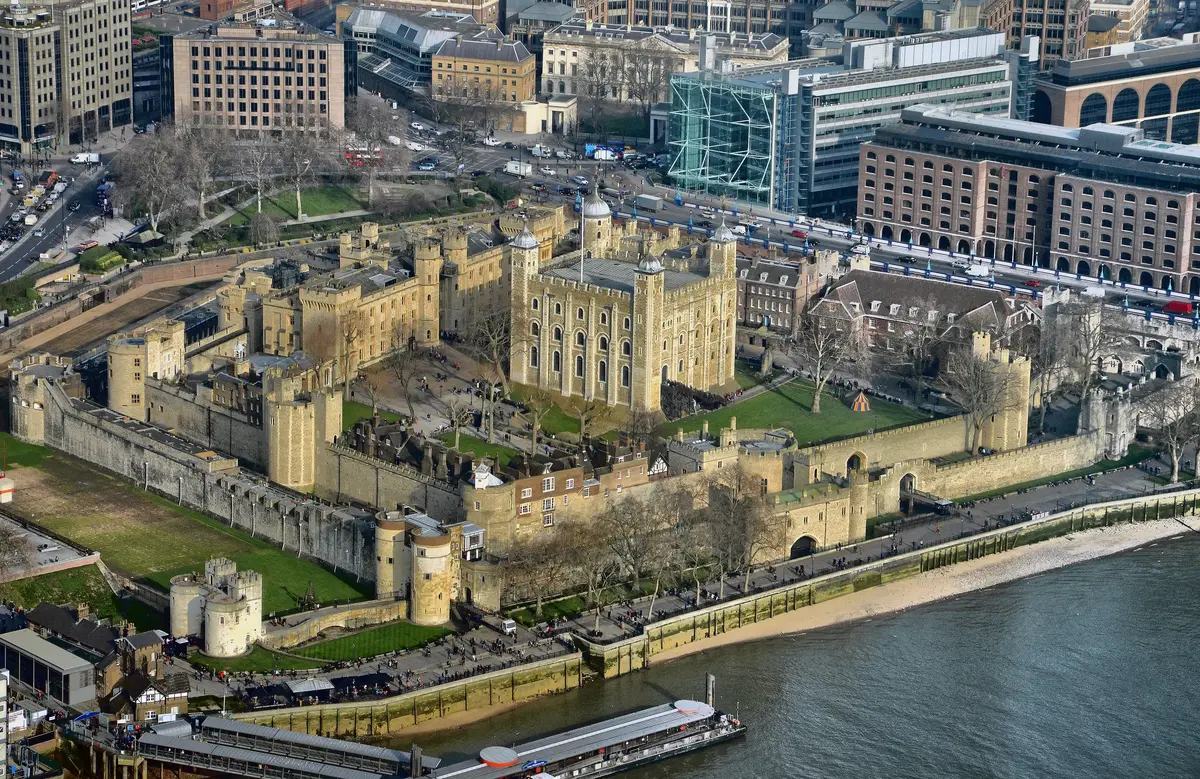
The Tower of London is remembered as England's great place of execution, and its own record is far smaller.
Where is Tower of London?
- Location
- London, United Kingdom
- Type
- Castle
- Coordinates
- 51.508, -0.076
- Last updated
LOCATION
Why is Tower of London said to be haunted?
Historic Royal Palaces counts ten people executed on or near Tower Green, seven of them beheaded, among them Anne Boleyn in 1536 and Lady Jane Grey in 1554; most condemned prisoners died in public outside the walls on Tower Hill, where historians estimate that around 125 people were executed. The ghost tradition is centuries younger than the executions. Its most cited account dates from 1864, when Captain J. D. Dundas described a sentry charging a whitish female figure with his bayonet in the courtyard where Anne Boleyn had been beheaded; two guardsmen reported a shapeless white form on the roof of the Salt Tower in 1957, and a Yeoman Warder described a glow from a prison chamber and a touch on the back of his neck in 1973. Today those accounts are retold by Historic Royal Palaces, the charity that runs the Tower and sells its tickets.
What is the history of Tower of London?
The Tower's reputation rests on executions, and the number that actually took place inside its walls is small.
Across roughly a thousand years, only about twenty-two people were executed inside the Tower of London. On or near Tower Green the count is ten: seven by beheading and three by firing squad. That is the whole of it.
Dying inside the walls was not a punishment but a privilege. It was reserved for prisoners of very high rank, or for those with dangerously strong popular support whom the Crown preferred to keep away from a crowd. Everyone else was taken out to Tower Hill, beyond the battlements, or across the city to Tyburn, and killed in public in front of as many spectators as could be assembled. Historians put the Tower Hill total at around one hundred and twenty-five.
Three of the seven beheaded on Tower Green were queens of England, two of them wives of Henry VIII. Anne Boleyn was executed there on 19 May 1536, convicted of treason, adultery and incest, and buried a few metres away in the Chapel of St Peter ad Vincula, inside the walls. Lady Jane Grey followed in 1554. Historic Royal Palaces also counts fifteen men convicted of desertion or espionage among those executed within the walls.
The ghost tradition accumulated much later, and it is unusually well recorded. In 1864 Captain J. D. Dundas, then living in the Tower, described watching a sentry in the courtyard where Anne Boleyn had been beheaded: a "whitish female figure" appeared to slide towards the man, who charged through it with his bayonet and collapsed. In 1957 two guardsmen reported a shapeless white form high on the roof of the Salt Tower. In 1973 a Yeoman Warder described a glow coming from a prison chamber and the sensation of something touching the back of his neck. Historic Royal Palaces itself recounts the best-known version: Anne gliding across the grounds at the head of a silent procession, from Tower Green to the chapel where she lies.
Timeline: the documented record of Tower of London
- 19 May 1536 Anne Boleyn is beheaded on Tower Green, convicted of treason, adultery and incest, and buried in the Chapel of St Peter ad Vincula inside the walls. Hers becomes the most reported apparition in the Tower's history.
- 1554 Lady Jane Grey is executed on Tower Green. She is one of only seven people ever beheaded inside the Tower, and one of three queens among them.
- 1864 Captain J. D. Dundas, living in the Tower, reports watching a sentry charge a "whitish female figure" with his bayonet in the courtyard where Anne Boleyn was beheaded, and then collapse. It is the most cited account of the Tower haunting.
- 1957 Two guardsmen report a shapeless white form high on the roof of the Salt Tower.
- 1973 A Yeoman Warder describes a glow emanating from a prison chamber, followed by the sensation of something touching the back of his neck.
Is there a rational explanation for Tower of London?
The most useful sceptical observation about the Tower is not about any individual sighting. It is that the Tower's blood-soaked reputation is largely borrowed from executions that happened somewhere else.
About twenty-two people died by execution inside the walls in a thousand years. Around a hundred and twenty-five died on Tower Hill, outside them, in front of crowds. The Tower is remembered as the great English killing ground because it is the building still standing; the scaffold on the hill is now a memorial in a small garden that most visitors walk past. A reputation for mass death attached itself to the site with the best surviving architecture rather than the highest body count.
The timing of the sightings is the second problem. The famous accounts are dated 1864, 1957 and 1973. Anne Boleyn was beheaded in 1536 and Lady Jane Grey in 1554, so even the earliest of the three comes more than three centuries after the deaths it is linked to.
The 1864 case deserves a closer look, because it is the one most often cited as evidence. A sentry on solitary night duty was found collapsed at his post. For a soldier, being discovered unconscious or asleep on guard was a serious military offence; a supernatural explanation, corroborated by an officer, is a remarkably convenient one. That does not prove the man invented it — but it is exactly the circumstance in which a striking explanation becomes valuable to the person offering it.
Finally, the dated accounts are retold today by the organisation with the most at stake in them: Historic Royal Palaces, the charity that runs the Tower and sells its tickets, publishes all three on its blog, on the same website as its opening hours.
Can you visit Tower of London?
Tower Hill Underground station is opposite the Tower and is served by the District and Circle lines. It has had step-free access from street to platform since August 2016, when Transport for London put in the lifts that made it the sixty-eighth step-free station on the network.
The gates open at 09:00 from Tuesday to Saturday and at 10:00 on Sunday and Monday. Closing is 17:30 from March to October and 16:30 from November to February, with the last admission an hour earlier. Children under five enter free. Historic Royal Palaces also sells a one-pound ticket to households on Universal Credit or six other named benefits, for up to four people, with one member of the household showing the paperwork.
The Yeoman Warder tour is included in the admission and cannot be booked in advance; it forms at the main entrance and sets off every forty-five minutes, a walk of about an hour. The first goes at 10:00 from Tuesday to Saturday and at 10:45 on Sunday and Monday; the last goes at 15:15. A Yeoman Warder has to be a former warrant officer with twenty-two years in the regular armed forces. The post also requires the Medal for Long Service and Good Conduct, with an age under fifty on appointment. The Warders live inside the fortress, and their tour is where the Tower's ghost stories are told out loud.
Two execution sites belong to this story and only one of them is inside the ticketed area. On Tower Green the scaffold site is marked by a circular glass sculpture made in 2006 by Brian Catling, who cut into it the names of those beheaded within the walls together with a poem of his own. The classic list runs to seven: Lord Hastings in 1483; Anne Boleyn in 1536; Margaret Pole in 1541; Jane Boleyn and Catherine Howard in 1542; Lady Jane Grey in 1554; Robert Devereux in 1601.
The other site is outside the walls, in Trinity Square Gardens a few yards west of the Underground station, and it costs nothing to approach. The memorial there stands roughly where the scaffold stood and names twenty-nine of the dead; more than a hundred people were killed on the hill, and the last public execution on it was in 1747.
A third set of executions is easy to miss. Eleven German agents were shot in the Tower between November 1914 and April 1916 at the miniature rifle range between the inner and outer walls, and the last man executed on the site was Josef Jakobs, on 15 August 1941 at 7:12 in the morning.
Sources consulted
- Historic Royal Palaces, «Tower Green and Scaffold Site — quiénes fueron ejecutados dentro de la Torre» — Información institucional, 2026 archive
- Historic Royal Palaces, «Famous ghost stories of the Tower of London» — Blog institucional, 2023 archive
- Historic Royal Palaces, «Tower Hill Execution Memorial — las ejecuciones públicas fuera de las murallas» — Información institucional, 2026 archive
- Free Tours by Foot, «Executions at Tower Hill and the Tower of London — recuento histórico» — Guía histórica, 2024 web
- Historic Royal Palaces, «Yeoman Warder Tours — condiciones y horarios» — Información oficial de visita, 2026 archive
Reviewed by V. Serrano on 2026-07-28 · How we verify our content
💬 Field testimonies (0)
No testimonies yet. Add the first.
Add your testimony
🔒 Log in to add a testimony