🦶 CRYPTID SIGHTING · EXP. Nº6501
ACTIVE
Selkie
Selkie is the Orkney and Shetland word for seal, and the folklore attached to it is narrower than the version that circulates online.
Where and when was Selkie sighted?
- Location
- Orcadas, Shetland y Hébridas, Escocia, United Kingdom
- Date sighted
- Unknown
- Coordinates
- 59.0, -3.2
- Last updated
LOCATION
What is Selkie?
Walter Traill Dennison, collecting on Sanday, wrote in 1893 that only the larger seals were called "selkie folk" — the common seal could not change shape — and that his informants held them to be a wholly different race from the Finfolk. The tales turn on a stolen skin: a man hides it, marries its owner, and loses her the day a child finds it. The earliest printed telling we can date is neither Orcadian nor a ballad: it is Samuel Hibbert's account of Shetland in 1822, thirty years before The Great Silkie of Sule Skerry, which Captain F. W. L. Thomas wrote down from a lady of Snarra Voe — in Shetland, not Orkney, whatever the song's setting. Child printed it in 1886 as ballad 113, and stanza three reads exactly: "I am a man, upo the lan, / An I am a silkie in the sea." The seals are real; some of the Victorian collectors improved their texts. The two are best kept apart.
What is the history of Selkie?
The selkie is not one story. It is a word from the Northern Isles, a bundle of tales that were written down between 1822 and 1894 by four men who disagreed with each other, and a ballad whose provenance has been misreported for a very long time.
Start with the word. Walter Traill Dennison, a farmer of Sanday who spent his life collecting from his Orkney neighbours, put it plainly in The Scottish Antiquary in 1893: "In Orkney, selkie was the popular name for seal." Not for a monster — for the animal. Dennison then drew the line his informants drew: the common seal, called tang fish, had no power to change shape; only the larger seals "were called 'selkie folk,' because they had the power of assuming the human form." And he insisted on a second distinction that later writers keep collapsing: "my old informants regarded the selkie folk as a wholly different race of beings from the Finfolk."
The earliest printed appearance I have been able to date is not the ballad and not Orkney. It is Samuel Hibbert's A Description of the Shetland Islands (1822), pages 566-571, thirty years earlier. Hibbert gives two Shetland tales: the boat's crew stranded on the Ve Skerries off Papa Stour, ferried home by the seal-woman Gioga in exchange for her son Ollavitinus's stolen skin; and a man of Unst who hid a skin, married its owner, and lost her years later when a child found it under a stack of corn. Her parting line is the oldest verified selkie quotation in English: "Farewell, and may all good attend you. I loved you very well when I resided upon earth, but I always loved my first husband much better." Hibbert calls these beings mermen and merwomen, never selkies. Dennison, seventy years on, said so bluntly: "Hibbert in his valuable work on Shetland has fallen into this error, and has been followed by most others whose writings on the subject I have seen."
Now the ballad, and the correction that matters. The Great Silkie of Sule Skerry is Child 113. Francis James Child's headnote states the chain exactly: "Proceedings of The Society of Antiquaries of Scotland, I, 86, 1852. Communicated by the late Captain F. W. L. Thomas, R. N.; written down by him from the dictation of a venerable lady of Snarra Voe, Shetland." Child then calls it, twice, "this Shetland ballad." Snarra Voe is on the west Mainland of Shetland. Sule Skerry — a bare rock some 60 km west of the Orkney Mainland — is the setting of the song, not the place it was collected. Dennison, an Orkneyman with every reason to claim it, agreed: the stanzas, he wrote in 1894, were "communicated by Captain Thomas, R.N., and heard by him in Shetland." Child adds a footnote of his own: "The ballad was pointed out to me by Mr Macmath, and would have followed No 40 had I known of it earlier."
Orkney's own great selkie texts came last, from Dennison and in the final two years of his life. In 1893 he printed the tale of the goodman of Wastness, who stole a skin and married its owner, and the tale of "Ursilla", a laird's daughter said to have summoned a selkie lover by shedding seven tears into the sea at high tide. In 1894, in the same journal, he published The Play o' de Lathie Odivere, a ninety-stanza ballad-drama of a selkie lover, which he had been assembling from fragments for forty years.
Timeline: the documented record of Selkie
- 1700 (events of 1682 and 1684) Dr James Wallace prints the Orkney "Finn-men" sightings: "In the year 1682, one was seen in his little Boat, at the South end of the Isle of Eda", and another off Westray in 1684. He adds that a captured boat "was sent from thence to Edinburgh, and is to be seen in the Physicians Hall, with the Oar and Dart he makes use of for killing Fish". These are Inuit kayaks, not seal-people, but every later euhemerist theory rests on this page.
- 1822 Samuel Hibbert publishes the earliest datable printed selkie tales, in Shetland and under another name: the Ve Skerries rescue by Gioga, and the Unst seal-wife whose descendants were said to keep a web between their fingers. Hibbert calls them mermen and merwomen. Her farewell — "I loved you very well when I resided upon earth, but I always loved my first husband much better" — is the oldest verified quotation in the tradition.
- 1852 Captain F. W. L. Thomas RN writes down The Great Silkie of Sule Skerry "from the dictation of a venerable lady of Snarra Voe, Shetland" and communicates it to the Society of Antiquaries of Scotland; it appears in their Proceedings, vol. I, p. 86. Not Orkney: Sule Skerry is the song's setting, Shetland is its source.
- April 1864 The ballad is reprinted in Colburn's New Monthly Magazine. Child notes the reprint was made "with spelling Scotticized, and two or three other uncalled-for changes" — the first documented step in the drift of the text away from what Thomas heard.
- 1881 Karl Blind, in the Contemporary Review, vol. XL, argues that the seal-people of the Shetland tales "in reality are human in a higher sense, are called Finns", and that their change of shape "seems to be more a kind of deception they practise". It is the first influential attempt to turn the selkie into a memory of real foreigners.
- 1886 Francis James Child prints the ballad as no. 113 in Part IV of The English and Scottish Popular Ballads, p. 494, calling it twice "this Shetland ballad". Stanza 3 reads, exactly: "I am a man, upo the lan, / An I am a silkie in the sea; / And when I'm far and far frae lan, / My dwelling is in Sule Skerrie." Child credits the find to his collaborator William Macmath.
- 1890 David MacRitchie's The Testimony of Tradition turns Blind's hint into a system, opening with "Shetland Finns — Orkney Finnmen — Kayaks and Kayak-men — An Orkney Kayak of 1696". On pp. 3-4 he quotes his Shetland informant by name, George Sinclair, who supplies the variant stanza "I am a man upo' da land; I am a selkie i' da sea".
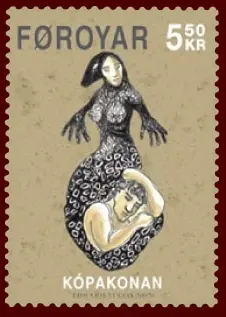
- 1891 V. U. Hammershaimb prints the Faroese seal-woman, Kópakona, in his Færøsk Anthologi (vol. I, pp. 345-348): the boy of Mikladalur on Kalsoy who takes the skin, the marriage, the recovered skin, and the seal-hunt that follows. It is a separate tradition from the Scottish one, in a separate language, and the two should not be told in one voice.
- 1893 Walter Traill Dennison publishes "Orkney Folk-Lore — II. Selkie Folk" in The Scottish Antiquary, vol. VII, p. 171: the goodman of Wastness, the Ursilla story, and the two distinctions everyone else blurs — selkie folk are not Finfolk, and the common seal is not a selkie at all.
- 1894 Dennison publishes The Play o' de Lathie Odivere in The Scottish Antiquary, vol. VIII, p. 53, and states in the introductory note that he had "often had to fill in a word, sometimes a line, in order to make the sense clear or to complete the stanza". In the same note he confirms that Captain Thomas heard his stanzas in Shetland. Dennison died that year.
- 1954 Ian Whitaker publishes "The Scottish Kayaks and the 'Finn-men'" in Antiquity 28 (110), pp. 99-104, weighing the surviving craft against the seventeenth-century sightings and noting that a skin kayak waterlogs after about two days afloat — which makes an unaided Atlantic crossing very hard to defend. The same year, David Thomson published The People of the Sea, the book that carried the seal legend to a general readership.
- 1 August 2014 The Kópakonan of Mikladalur, by the Faroese sculptor Hans Pauli Olsen, is unveiled on the shore of Kalsoy: 2.6 m of bronze and stainless steel, about 450 kg, built to take breaking waves. The Faroese seal woman had already appeared on a Postverk Føroya stamp designed by Edward Fuglø in 2007 — the image used on this file.
- 2019 The Shetland archivist Brian Smith argues in Northern Studies 50, pp. 72-86, that the "Unst Lay" — the Odinic fragment Karl Blind published in 1878 — was "a glorious hoax, the creation of a brilliant young Shetland housepainter around 1877", and names him: George Sinclair, the same Lerwick correspondent who supplied the selkie material quoted by MacRitchie.
- 1 February 2021 Shooting seals to protect fisheries or fish farms becomes illegal in Scotland: the Animals and Wildlife (Penalties, Protections and Powers) (Scotland) Act 2020 removed those grounds for a licence under Part 6 of the Marine (Scotland) Act 2010. The taboo the ballads dramatise is now, in part, statute.
Is there a rational explanation for Selkie?
Three explanations have been offered, and they are not equally solid. They should be named rather than attributed to "folklorists".
The first is euhemerism: the selkie was a real person. Karl Blind pushed it in the Contemporary Review in 1881, writing that the beings of the Shetland tales "in reality are human in a higher sense, are called Finns", and that their transformation "seems to be more a kind of deception they practise". David MacRitchie built a book on it, The Testimony of Tradition (1890), whose first chapter runs "Shetland Finns — Orkney Finnmen — Kayaks and Kayak-men". The documentary anchor is genuine: Dr James Wallace's An Account of the Islands of Orkney (1700) records that "in the year 1682, one was seen in his little Boat, at the South end of the Isle of Eda", another off Westray in 1684, and that a captured boat "was sent from thence to Edinburgh, and is to be seen in the Physicians Hall". Those were Inuit kayaks. But Ian Whitaker, reviewing the surviving craft in Antiquity in 1954, pointed out that a skin kayak becomes waterlogged after roughly two days afloat, which makes an unaided crossing from the Davis Strait very hard to defend; the likeliest route for the boats is a whaling ship. So the kayaks are real and the inference from them is weak.
The second explanation is the one the collectors themselves gave. Dennison, having told the Ursilla story, stopped and separated fact from fiction in his own text: "So far I have given what I believe to be a true account of Ursilla... What follows I believe to be an imaginary tale, invented by gossips, in order to account for a strange phenomenon visibly seen on her descendants." The phenomenon was a horny thickening of palms and soles that ran in one Orkney family — an inherited skin condition, in modern terms, and exactly the sort of visible oddity that recruits a legend to explain it.
The third is textual, and it cuts closest. The verse evidence for the selkie passed through a small number of Victorian intermediaries. Dennison admitted in print that in assembling the Lathie Odivere he "often had to fill in a word, sometimes a line, in order to make the sense clear or to complete the stanza". And the widely quoted Shetland variant of the ballad's key stanza — "I am a man upo' da land; I am a selkie i' da sea" — reaches us through Karl Blind's Lerwick correspondent George Sinclair, quoted by name in MacRitchie (1890). In 2019 the Shetland archivist Brian Smith argued in Northern Studies that the same George Sinclair had fabricated the "Unst Lay", the Odinic fragment Blind published in 1878, and that "George Sinclair had been rumbled". That does not prove the selkie stanza was invented — the main ballad text came from a different informant, in Shetland, before Sinclair was born — but it is a reason to quote the variant with care.
What needs no explaining is the animal. Around a third of the world's grey seals breed in Scotland, heavily in Orkney and the Outer Hebrides; they haul out on the same skerries the tales name, they look at people, and they moan.
Can you visit Selkie?
The places named in the sources are real, and two of them can be visited.
Sule Skerry, the dwelling of the ballad, is a low island about 61 km (38 miles) west of Yesnaby, on the west coast of the Orkney Mainland, by our own calculation; the Northern Lighthouse Board puts it "some 40 miles west of Orkney". Its lighthouse was built in 1892–94 by David A. Stevenson and his brother Charles. The board says the tower was completed during the exceptionally fine summer of 1893, since winter work was ruled out. The keepers' families lived in Stromness from 1895 until the station was automated in 1982. The island is a Site of Special Scientific Interest and, with Sule Stack, a Special Protection Area for breeding seabirds. NatureScot's management statement for the site, last reviewed on 11 August 2011, says that because of the island's remoteness and the difficulty of landing, recreational visits are rare.
Mikladalur, on the Faroese island of Kalsoy, has the one monument made for this legend: the statue Kópakonan by Hans Pauli Olsen, which Visit Faroe Islands says was unveiled on 1 August 2014. The same page recommends leaving cars at the harbour in Klaksvík and using the bus on Kalsoy.
For the animals themselves, Scottish Ministers can designate seal haul-out sites under section 117 of the Marine (Scotland) Act 2010, to give the seals there extra protection from intentional or reckless harassment. The Scottish Government says 194 sites were designated by an order that came into force on 30 September 2014. It also says that since 1 February 2021 licences to kill or take seals can no longer be granted to protect the health and welfare of farmed fish or to prevent serious damage to fisheries and fish farms. Killing or injuring a seal is an offence unless it is done under licence or to alleviate suffering.
The older texts are scanned and free to read online, with links in the references. Hibbert's description of Shetland (1822) and Wallace's account of Orkney (1700) are on the Internet Archive; so are Child's Part IV (1886) and the two Dennison papers in The Scottish Antiquary. Hammershaimb's Færøsk Anthologi is there too, and MacRitchie's book of 1890 is on Project Gutenberg.
Sources consulted
- Samuel Hibbert, «A Description of the Shetland Islands, comprising an account of their geology, scenery, antiquities and superstitions (Iter IV, 'Superstitions of the Shetland Seas', pp. 566-571)» — Archibald Constable & Co., Edinburgh, 1822 book
- Francis James Child, «The English and Scottish Popular Ballads, Part IV — no. 113, 'The Great Silkie of Sule Skerry', p. 494 with headnote» — Houghton, Mifflin and Company, Boston, 1886 book
- Walter Traill Dennison, «Orkney Folk-Lore — II. Selkie Folk (The Scottish Antiquary, or Northern Notes & Queries, vol. VII, no. 495, p. 171)» — T. and A. Constable, Edinburgh, 1893 academic
- Walter Traill Dennison, «The Play o' de Lathie Odivere, with Introductory Note (The Scottish Antiquary, vol. VIII, no. 527, p. 53)» — T. and A. Constable, Edinburgh, 1894 academic
- James Wallace, «An Account of the Islands of Orkney (chapter III, the Finn-men of 1682 and 1684)» — Jacob Tonson, London, 1700 book
- David MacRitchie, «The Testimony of Tradition (chapter I: Shetland Finns, Orkney Finnmen, Kayaks and Kayak-men — quoting Karl Blind, Contemporary Review XL, 1881, and George Sinclair)» — Kegan Paul, Trench, Trübner & Co., London, 1890 book
- Ian Whitaker, «The Scottish Kayaks and the 'Finn-men' (Antiquity, vol. 28, no. 110, pp. 99-104)» — Antiquity Publications, 1954 academic
- Brian Smith, «The Unst Lay; ancient verse, or the earliest Shetland dialect poem? (Northern Studies, vol. 50, pp. 72-86)» — Scottish Society for Northern Studies, 2019 academic
- V. U. Hammershaimb, «Færøsk Anthologi, vol. I — 'Kópakona', pp. 345-348» — Samfund til Udgivelse af gammel nordisk Litteratur, Copenhagen, 1891 book
- Visit Faroe Islands, «Kópakonan — the Selkie statue, Mikladalur, Kalsoy (unveiled 1 August 2014, sculptor Hans Pauli Olsen)» — Visit Faroe Islands, 2014 web
- Marine Directorate, «Seal licensing: guidance and forms (changes to Part 6 of the Marine (Scotland) Act 2010 in force from 1 February 2021)» — Scottish Government (gov.scot), 2021 report
- Northern Lighthouse Board, «Sule Skerry lighthouse: built 1892-94 by David A and Charles Stevenson, tower completed in the summer of 1893, keepers' families in Stromness from 1895 until automation in 1982» — nlb.org.uk (consulted 24 September 2026), 2026 web
- Scottish Natural Heritage (NatureScot), «Sule Skerry Site of Special Scientific Interest: Site Management Statement (SPA with Sule Stack; recreational visits rare owing to remoteness and difficulty of landing)» — nature.scot, SSSI 1506, date last reviewed 11 August 2011, 2011 report
- Marine Directorate, «Seal haul-out sites: designation under section 117 of the Marine (Scotland) Act 2010; 194 sites designated by the Protection of Seals (Designation of Haul-Out Sites) (Scotland) Order 2014, in force 30 September 2014» — Scottish Government (gov.scot), policy page (consulted 24 September 2026), 2026 web
Reviewed by V. Serrano on 2026-08-14 · How we verify our content
📎 Source: Enigma Atlas
💬 Field testimonies (0)
No testimonies yet. Add the first.
Add your testimony
🔒 Log in to add a testimony