🦶 CRYPTID SIGHTING · EXP. Nº6501
ACTIVE
Owlman of Mawnan
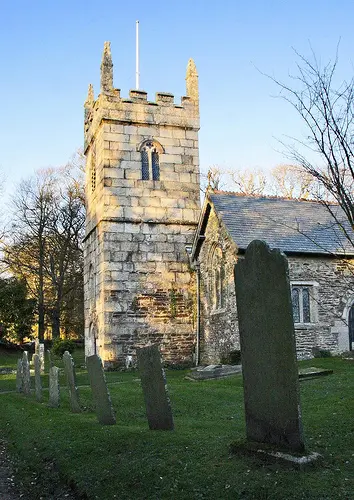
The Owlman of Mawnan is a winged, man-sized figure with owl-like features said to have been seen in 1976 above the tower of St Mawnan church, a medieval building on the headland where Cornwall's Helford river meets the sea.
Where and when was Owlman of Mawnan sighted?
- Location
- Cornwall, United Kingdom
- Date sighted
- Unknown
- Coordinates
- 50.104, -5.095
- Last updated
LOCATION
What is Owlman of Mawnan?
The founding account is dated Easter Saturday, 17 April 1976, when two sisters named Melling, on holiday in the area, were reported to have seen the figure while in the churchyard. The sisters never spoke publicly: their father passed the account and a sketch to Tony 'Doc' Shiels, a Salford-born painter, stage magician and street performer who billed himself as 'The Wizard of the West', and the first printed description appeared that June in Fortean Times, in a bulletin of Cornish reports supplied by Shiels himself. The story then travelled inside an eighteen-page pamphlet about a different creature, Morgawr, the sea serpent whose photographs the Falmouth Packet had published six weeks earlier over the signature 'Mary F'. No witness in the case has ever been traced or interviewed by anyone other than Shiels, and folklorists who have examined it treat it as invention rather than tradition. Shiels denied hoaxing anything until his death in 2024, but transcripts of tapes he recorded in the winter of 1975-76 have him calling himself 'a born hoaxer' and planning a wave of sightings of a winged creature.
What is the history of Owlman of Mawnan?
Most cryptid files begin with a creature. This one has to begin with a man, because everything the world knows about the Owlman of Mawnan reached print through a single person, and that person spent his life telling anyone who asked that he was a cheat.
The founding account is dated Saturday 17 April 1976 — Easter Saturday. Two sisters named Melling, on holiday in Cornwall, were in the churchyard of St Mawnan, a medieval church at the end of a lane on the headland where the Helford river meets the sea. According to the story, they saw a winged, man-like figure above the tower and were frightened enough that the family cut the holiday short. The girls themselves never spoke to the press. Their father took the account, and a sketch one of them had drawn, to a local figure who collected such things: Tony "Doc" Shiels.
The first place the story appeared in print was Fortean Times no. 16, June 1976, in a bulletin of Cornish reports supplied by Shiels — whom the magazine's editor introduced as "our Cornish correspondent" — illustrated with the girl's sketch. That is documented by Shiels's biographer, Rupert White, who reproduces the page in Monstermind (2015). It is the earliest description of the creature anyone has been able to point to.
Who Shiels was matters more than what the sketch showed. Born in Salford in 1938, art school in London, in Cornwall from 1959, he exhibited with the Penwith Society of Arts in St Ives alongside Peter Lanyon, Roger Hilton and Terry Frost, and scraped a living as a painter, writer and street performer specialising in stage magic and psychic effects. He billed himself as "The Wizard of the West". The folklorist Ronald M. James, in a peer-reviewed study of the affair, calls him "a local trickster, an artist, magician, psychic performer and sometimes puppet master". Shiels himself, interviewed by White in 2014, was blunter: "I claimed to be a wizard. Which I'm not of course I'm just a painter." Of the occultist Ithell Colquhoun he said she "recognised the fact — as I always admitted — that I was a charlatan… I am a cheat you see — or I pretend that I am."
The Owlman did not arrive alone, and it did not arrive first. Six weeks earlier, on 5 March 1976 — St Piran's day, Cornwall's national saint — the Falmouth Packet had run on its front page a handwritten letter signed "Mary F", opening "Sir: kindly find one enclosed sea serpent", with two grainy photographs taken off Rosemullion Head. A reporter on the paper, Noel Wain, gave the animal the name Morgawr. James's study establishes that the images no longer exist and that Mary F "is likely a fabrication".
The Owlman's first home of its own was inside that campaign. Later in 1976 an eighteen-page pamphlet, Morgawr: The Monster of Falmouth Bay, appeared in Falmouth bookshops, credited to A. Mawnan-Peller and published by "Morgawr Productions". White calls the byline "a blatant pseudonym" and notes that peller is a Cornish word for a witch: the name reads, roughly, as "the conjuror of Mawnan". Friends of Shiels — including the fisherman Paul Francis and Tony Shaw — told White the booklet was his work; Shiels never admitted it; the journalist Mike Truscott told White he doubted it. Nobody has ever attached the name to a documented person.
The second wave followed the pamphlet. Fortean Times no. 17, August 1976 carried Shiels's report of two more girls, Sally Chapman and Barbara Perry, terrified by the bird-man on 3 July 1976, with fresh sketches. Shiels added a caveat that has been quietly dropped from most retellings since: "It's a fact that the girls had read the Morgawr booklet and seen me interviewed on the telly, so they both knew, in advance, about the 'thing' and had a fair idea of what it was supposed to look like."
What followed made Shiels nationally famous. On 21 May 1977, from the tower of Urquhart Castle, he took two colour photographs at Loch Ness that ran in the national press. In 1978, while Janet and Colin Bord were in Cornwall researching Alien Animals, Shiels and two of his daughters carried out further "invocational experiments" — and, White records, "there were two more sightings of the Owlman".
In 1991 the American periodical Strange Magazine devoted its eighth issue to him, including transcripts of tapes he had posted to a collaborator in the winter of 1975-76. In 1997 the writer Jon Downes published The Owlman and Others, the book that carried the case to a wide audience — and which White describes as "something of a riposte" to those transcripts. In February 2001 the Falmouth Packet itself printed a retrospective piece, reputedly by Wain, saying the 1976 monster had been "none other than a huge model, made by the then-students of Falmouth School of Art aided and abetted by a reporter from the Falmouth Packet and of course Doc himself". Shiels died in Ireland on 11 July 2024, aged 86, having never conceded that any of the monsters were faked.
Timeline: the documented record of Owlman of Mawnan
- 1938 Tony "Doc" Shiels is born in Salford. He studies at art school in London, settles in Cornwall from 1959, exhibits with the Penwith Society of Arts in St Ives and works as a painter, writer and street performer billed as "The Wizard of the West".
- 4 February 1976 On a correspondence tape posted to Michael McCormick, Shiels sets out his aim of "genuine photographs of a winged sea dragon", combining a sea monster with "the whole thing of a flying dragon" so as to "create a flap centered around a beastie of that particular nature".
- 19 February 1976 The last of the tapes. Shiels describes his method — word-of-mouth reports first, a photograph later — and says he will stay out of the press at the start and "step in and offer my services as a psychic" once the story is moving. He calls himself "a born hoaxer".
- 5 March 1976 The Falmouth Packet prints on its front page a handwritten letter signed "Mary F" — "Sir: kindly find one enclosed sea serpent" — with two photographs taken off Rosemullion Head. The reporter Noel Wain names the animal Morgawr.
- 17 April 1976, Easter Saturday The founding account: two sisters named Melling see a winged figure above the tower of St Mawnan church. Their father relays the story, and a sketch, to Shiels. The girls are never interviewed by anyone else.
- June 1976 Fortean Times no. 16 carries the first printed description of the creature, inside a bulletin of Cornish reports supplied by Shiels, whom the editor calls "our Cornish correspondent", illustrated with the girl's sketch.
- 3 July 1976 Sally Chapman and Barbara Perry report a second encounter, published by Fortean Times in August with their sketches. Shiels notes that both girls had read the Morgawr booklet and seen him on television, and "knew, in advance, about the 'thing'".
- Late 1976 — the pamphlet An eighteen-page pamphlet, Morgawr: The Monster of Falmouth Bay, credited to A. Mawnan-Peller and published by Morgawr Productions, appears in Falmouth bookshops. It is the Owlman's first appearance outside Shiels's own bulletins.
- 21 May 1977 From the tower of Urquhart Castle, Shiels takes two colour photographs at Loch Ness which reach the national press and make him famous well beyond Cornwall.
- 1978 While Janet and Colin Bord are in Cornwall researching Alien Animals, Shiels and two of his daughters carry out further "invocational experiments", and two more Owlman sightings are recorded.
- Autumn 1991 Strange Magazine devotes its eighth issue to Shiels, including Mark Chorvinsky's investigation of the "Mary F" photographs and transcripts of the 1975-76 tapes, published, Chorvinsky states, with Shiels's permission.
- February 2001 The Falmouth Packet prints a retrospective piece, reputedly by Noel Wain, describing the 1976 monster as "a huge model, made by the then-students of Falmouth School of Art aided and abetted by a reporter from the Falmouth Packet and of course Doc himself".
- 11 July 2024 Shiels dies in Ireland aged 86. His obituary records that he maintained to the end that the creatures were real, and notes the 1991 transcripts in which he discussed hoaxing Falmouth with monsters carved from expanded polystyrene.
Is there a rational explanation for Owlman of Mawnan?
The usual skeptical move with a cryptid is to propose a mundane animal. Here that move comes too late, because the case has a problem one step earlier: there is no independent evidence that anybody saw anything. No witness in the Owlman story has ever been traced, interviewed or identified by anyone other than Shiels, and every account of every sighting reached the public through him.
The method was written down before the event. Between December 1975 and 19 February 1976, Shiels posted a series of correspondence tapes to a collaborator in New Mexico, Michael McCormick. Mark Chorvinsky published transcripts in Strange Magazine no. 8 (Fall 1991) — with, he states, Shiels's own permission. In them Shiels says flatly, "I'm a born hoaxer", and lays out a plan: "I am hoping to hoax the people of Falmouth, and thereabouts, here in Cornwall, into thinking that there is a Cornish sea monster on the loose."
Three details of that plan matter for Mawnan. First, the sequence: "I think the best thing is to go by word of mouth reports, and then, after a suitable period, for someone to come up with a photograph or two of the thing… word of mouth reports are the important and most potent thing." Second, the role he reserved for himself: "I am going to have nothing to do with it as far as the press is concerned at the beginning. It's only when things have started to move properly that I will step in and offer my services as a psychic in order to try and solve the mystery." Third, and most awkward of all, on 4 February 1976 — ten weeks before Easter Saturday — he described the creature he wanted: "I like the idea of obtaining what seem like genuine photographs of a winged sea dragon… to combine the concept of a sea monster with the whole thing of a flying dragon, you get the best of both worlds… if you can create a flap centered around a beastie of that particular nature."
The tapes stop on 19 February 1976 and never mention Mawnan, an owl or a bird-man. They are not a confession to this case. What they are is a dated statement of intent to manufacture exactly this kind of case, by exactly the route this one took.
He also recruited people to see things. On the same February tape he describes arranging for a mackerel fisherman, Paul Francis, to report a forty-foot serpent: "Paul has agreed to see something strange within the next few days when he is fishing… Whether he is believed or not is immaterial." And Vernon Rose, a long-time collaborator interviewed by White, remembered the mechanics from inside: "Monster-raising lived through its own publicity. Tony would have organised for things to be sent to the papers… The Owlman wasn't so big but several people wrote to the paper, probably mostly members of Tony's family."
The later witnesses were primed, on the promoter's own admission. Shiels told Fortean Times that Sally Chapman and Barbara Perry had read the Morgawr booklet and seen him on television before their July 1976 encounter. And the 1978 sightings, per White, happened while Shiels and his daughters were conducting invocation rituals with two visiting authors in the county.
The literature is not independent either. Jon Downes's The Owlman and Others is the source of most of what circulates today, and it is a partisan document by the case's chief promoter; White quotes Jools Andrews, a member of Shiels's circle, saying of material reproduced in it: "Some of those postcards are in Jon Downes' Owlman book. It's my handwriting on those postcards." The Cornish folklorists Tony Deane and Tony Shaw, quoted by James, looked at the Owlman and concluded that "the soubriquet 'fakelore', rather than folklore, springs to mind".
In fairness, three things cut the other way. Shiels denied faking anything for the rest of his life — on Fox television in December 1998 he said "I don't lie. I never did… It's not in my nature" — and White, no apologist, is careful to write "if the transcripts are genuine". Second, nothing in the record proves the Melling sisters did not see something: a wooded clifftop churchyard at dusk is owl country, and Britain's commonest owl, the tawny, is a nocturnal woodland bird that is far more often heard than seen, while the barn owl hunts on silent flight. Neither is remotely man-sized, but a pale shape crossing a tower at last light needs no conspiracy to be frightening. Third, and most interesting, James's study argues that whatever began as a stunt did not stay one: an invention that fits a place well enough gets adopted, and the Cornish monsters of 1976 slid from fabrication into something people genuinely tell each other.
The honest summary is narrower than either the believers' or the debunkers' version. Nobody has demonstrated that the Owlman of Mawnan was hoaxed. What has been demonstrated is that the only person who ever handled the evidence had, in writing and on tape, planned a campaign of this exact shape ten weeks earlier — and that a case in which not one witness has ever been independently found is not a case at all.
Can you visit Owlman of Mawnan?
Mawnan has no Owlman museum, and no trail or festival has grown up around the 1976 story. The site is a parish church on a headland.
St Mawnan church stands at the very end of Church Road, Mawnan, Falmouth, postcode TR11 5HY, where the Helford river meets the open sea. The parish states that "St Mawnan is open to visitors and for private prayer on most days between 9am and 5pm". The church "is built within the confines of an ancient earthwork, which was still in an excellent state of preservation when the churchyard was enlarged in 1920", which is why the enclosure reads as roughly circular on the ground. The parish also notes that the church "is accessible from the South West Coast Path and attracts many walkers and other visitors".
Parking sits immediately below the church, at the end of the lane. The parish page asks that "other visitors to the area are welcome to park their cars for a £2 donation, or £4 all day, but we cannot guarantee that spaces will be available", and the car park closes during services and events, weddings and funerals among them. Burials continue in the churchyard, which remains in use. The parish office is at St Michael's Church, Carwinion Road, Mawnan Smith, TR11 5JF.
Buses 35 and 63 run from Falmouth Moor to Mawnan Smith, giving an hourly service together from Monday to Saturday with nothing on Sundays or bank holidays; they stop at the entrance to Glendurgan Garden.
Two of Cornwall's subtropical gardens are within walking distance of the village. Glendurgan Garden (National Trust), Mawnan Smith, TR11 5JZ, opened 10.30 to 17.00 on 22 September 2026; admission was £14 for an adult, £7 for a child aged 5 to 17 and £35 for a family of two adults, with free entry for National Trust members, and the car park charged £5 all day or £2.50 for four hours. Trebah Garden stands next door at the same postcode, independently run, and states that it is "Open every day from 9.30am, no pre-booking required". The Helford estuary can be crossed by the seasonal Helford Passage ferry.
The coast path here runs along a cliff edge above the sea and is unlit after dark. Britain's commonest owl, the tawny, is a nocturnal woodland bird that the RSPB describes as far more often heard than seen.
Sources consulted
- Rupert White, «Monstermind: The Magical Life and Art of Tony 'Doc' Shiels — the Owlman chapters: the Melling sisters' account of 17 April 1976, its first publication in Fortean Times no. 16 (June 1976), the Chapman and Perry report in no. 17, the A. Mawnan-Peller pamphlet, the 1977 Loch Ness photographs, the 1978 sightings, and interviews with Shiels, Vernon Rose, Paul Francis and Jools Andrews» — Antenna Publications; copy consulted at the Internet Archive, 2015 book
- Ronald M. James, «Morgawr and the Folkloresque (A study of a whopping fish tale), Shima, vol. 16, no. 2, pp. 160-172 — the 5 March 1976 'Mary F' letter in the Falmouth Packet, the Mawnan-Peller pamphlet, Shiels's role in 'discovering' the Owlman, the Falmouth Packet's 2001 retrospective admission, and Deane and Shaw's 'fakelore' verdict» — Shima: The International Journal of Research into Island Cultures (ISSN 1834-6057), 2022 academic
- Mark Chorvinsky, «The Shiels Tapes: Tony 'Doc' Shiels On His Monster Hoaxing — transcripts of correspondence tapes sent by Shiels to Michael McCormick between December 1975 and 19 February 1976, published in Strange Magazine no. 8 (Fall 1991)» — Strange Magazine, Rockville, Maryland; archived copy, 1991 report
- Obituaries desk, «Tony Shiels, hard-drinking bohemian artist who claimed to have raised the Loch Ness Monster — obituary» — The Daily Telegraph, 31 July 2024 (syndicated text), 2024 newspaper archive
- Cornwall Artists Index, «Tony 'Doc' Shiels — biography, St Ives years, exhibitions with the Penwith and Newlyn galleries and later solo shows» — cornwallartists.org, 2026 web
- Parish of Mawnan, «St Mawnan — opening hours, address and postcode, parking donations, the churchyard's ancient earthwork and access from the South West Coast Path» — stmawnan.org, 2026 web
- National Trust, «Glendurgan Garden — opening times, admission prices, parking charges and bus routes 35 and 63 from Falmouth Moor» — nationaltrust.org.uk, 2026 web
- RSPB, «Tawny Owl — Britain's commonest owl, a nocturnal broadleaved-woodland bird far more often heard than seen» — rspb.org.uk, 2026 web
Reviewed by V. Serrano on 2026-08-01 · How we verify our content
📎 Source: Enigma Atlas
💬 Field testimonies (0)
No testimonies yet. Add the first.
Add your testimony
🔒 Log in to add a testimony