🦶 CRYPTID SIGHTING · EXP. Nº0555
ACTIVE
Spring-heeled Jack
Spring-heeled Jack was the cloaked attacker of the London scare of 1837 and 1838, said to leap walls, breathe blue and white flame and tear at his victims with metal claws.
Where and when was Spring-heeled Jack sighted?
- Location
- London, United Kingdom
- Date sighted
- Unknown
- Coordinates
- 51.507, -0.128
- Last updated
LOCATION
What is Spring-heeled Jack?
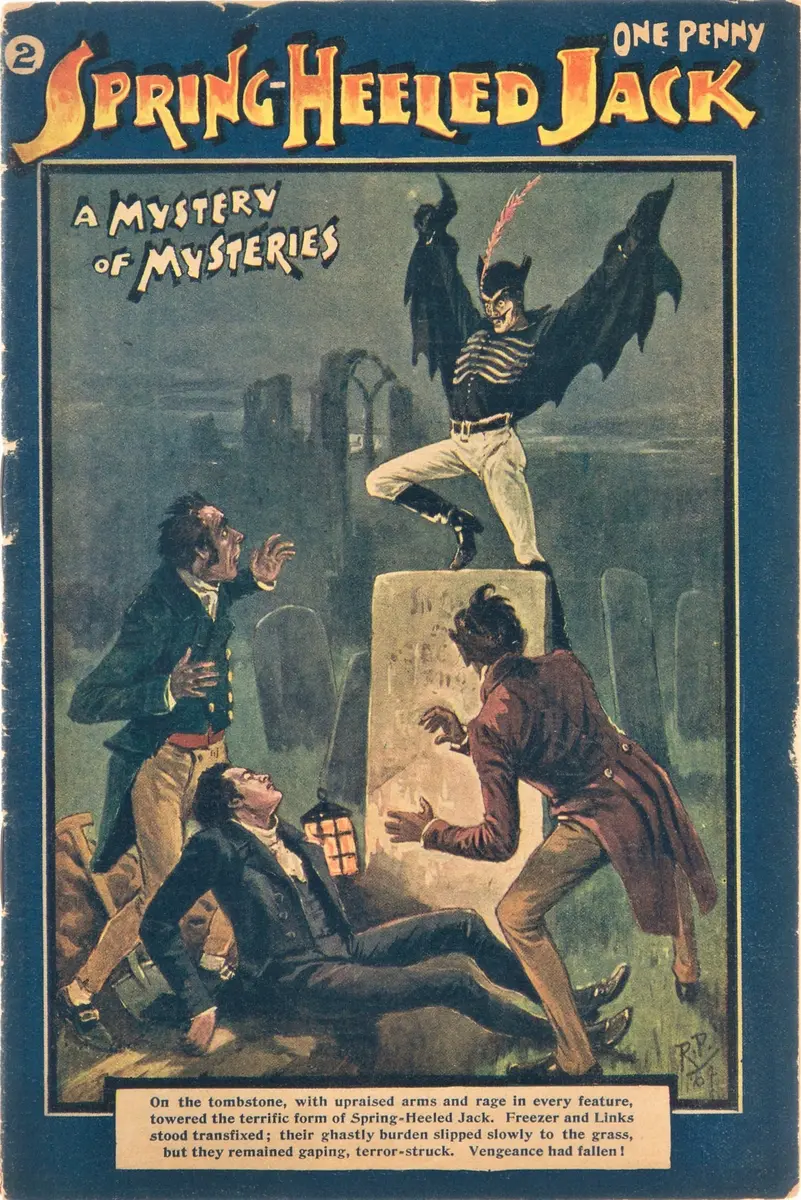
Rumours of a ghost, bear or devil attacking women spread through the villages south and west of London from the autumn of 1837 and reached The Times in January 1838, when it printed a letter to the Lord Mayor, Sir John Cowan, blaming a wager among men of high rank. In February 1838 Jane Alsop near Old Ford and Lucy Scales in Limehouse described attacks by a cloaked figure who spat blue flame; Jane Alsop said his eyes resembled red balls of fire. No one was convicted; the police concluded that the Alsop attack was a drunken frolic, and imitators appeared within weeks. The name lived on in penny dreadfuls and in later scares at Aldershot in 1877 and Liverpool in 1904, before ending as a bogeyman to frighten children.
What is the history of Spring-heeled Jack?
Spring-heeled Jack reached the London papers in the last week of December 1837, according to the writer Mike Dash, and became a public matter in January 1838. On 9 January The Times printed an anonymous letter to the Lord Mayor, Sir John Cowan, signed "a resident of Peckham", together with Cowan's response. In the transcription Dash gives in Fortean Studies (1996), it claimed that "some individuals (of, as the writer believes, the higher ranks of life) have laid a wager with a mischievous and foolhardy companion" that he would not dare to visit "many of the villages near London in three disguises – a ghost, a bear and a devil", and that "the unmanly villain has succeeded in depriving seven ladies of their senses". Cowan's view, as The Times reported it, was that the writer had been "terrified by some burglars into this method of obtaining retribution at the hands of the Lord Mayor".
Dash traces the rumours back to Barnes, then a village south-west of London, in early September 1837, where a "ghost, imp or devil" in the shape of "a large white bull" was said to have attacked people, women in particular. Over the next two months the stories reached some two dozen villages to the south and west of the city. The Times of 9 January reported that "servant girls about Kensington, and Hammersmith, and Ealing, told dreadful stories of a ghost, or devil, who, on one occasion, was said to have beaten a blacksmith, and torn his flesh with iron claws". Two days later the same paper carried the claim that residents of Stockwell, Brixton, Camberwell and Vauxhall had died of terror, which Dash judges an exaggeration.
The best-attested attack came on the evening of Tuesday 20 February 1838 at Bearbinder Cottage, in Bearbinder Lane near Old Ford. Jane Alsop went to the gate to a man who said he was a policeman and asked her to "bring me a light, for we have caught Spring-heeled Jack here in the lane". In her statement at the Lambeth Street police office the next day, printed in The Times of 22 February, she said that once she had handed him a candle he "threw off his outer garment", "presented a most hideous and frightful appearance" and "vomited forth a quantity of blue and white flames from his mouth, and his eyes resembled red balls of fire". He tore at her gown with claws "which she was certain were of some metallic substance", and then at her neck and arms, until one of her sisters pulled her free.
On 28 February, at about 8.30 in the evening, Lucy Scales and her sister were walking through Green-dragon-alley in Limehouse when a tall, thin figure in a large cloak stunned her with a flash of blue flame. She was left temporarily blinded and "in violent fits"; the attacker "did not attempt to lay a hand on them, but walked away in an instant". Dash found a single press account of this attack. James Lea of the Lambeth Street office, the officer who had tracked down the murderer of Maria Marten at the Red Barn in 1827, looked into both attacks.
Timeline: the documented record of Spring-heeled Jack
- 9 January 1838 At the Mansion House, Lord Mayor Sir John Cowan reads out an anonymous letter signed "a resident of Peckham" alleging a wager among men "of, as the writer believes, the higher ranks of life" to tour the villages near London disguised as a ghost, a bear and a devil. Cowan suggests the writer had been "terrified by some burglars"; The Times prints the letter and his reply on 9 January.
- January 1838 The Times reports that servant girls about Kensington, Hammersmith and Ealing tell "dreadful stories of a ghost, or devil", and two days later that residents of Stockwell, Brixton, Camberwell and Vauxhall are said to have died of terror. Mike Dash traces the rumours back to Barnes in early September 1837.
- 20 February 1838 Jane Alsop testifies that at her father's house in Bearbinder Lane, near Old Ford, a man claiming to be a police officer asked for a light saying "we have caught Spring-heeled Jack here in the lane", then threw off his outer garment, vomited blue and white flame and tore her neck and arms with claws she believed were "of some metallic substance".
- 28 February 1838 At about 8.30 in the evening Lucy Scales, walking with her sister through Green-dragon-alley in Limehouse, is stunned by a flash of blue flame from a tall, thin figure in a large cloak, and left temporarily blinded and "in violent fits". The attacker walks away.
- 28 February – 2 March 1838 The Lambeth Street magistrates hear two suspects in the Alsop case, a bricklayer named Payne and a carpenter named Millbank, neither formally charged. Millbank admits being very drunk that night; the chief magistrate, Mr Hardwick, ends by telling him he now believes him innocent, and no one is brought to trial.
- 1867 The Newsagents' Publishing Company issues "Spring-Heel'd Jack: A Romance of the Nineteenth Century", opening with the line that "it is now a little over a quarter of a century since the inhabitants of London and its suburbs were kept in a continual state of terror". In it Jack is no longer the attacker but the avenger, breaking in on a man coercing a woman with the cry "Villain! villain!".
- 1887 The folklorist M. A. Courtney records in The Folk-Lore Journal that a stretch of Penzance shore "in my childhood… was said to be one of the resorts of 'Spring-heeled Jack', of whom I then lived in mortal dread". A London press panic has become a children's bogey 450 km away in Cornwall.
- 1908 Chambers's Twentieth Century Dictionary lists him as a common noun: "Spring-heeled Jack, one supposed capable of leaping a great height or distance in carrying out mischievous or frolicsome tricks". The demon has ended up as a definition.
- 2012 Karl Bell publishes "The Legend of Spring-Heeled Jack: Victorian Urban Folklore and Popular Cultures" (Boydell & Brewer), reconstructing the case from folklorist accounts, street ballads, penny dreadfuls, newspapers, court records and theatrical material between 1837 and 1904.
Is there a rational explanation for Spring-heeled Jack?
Nobody was ever convicted of the attacks: on 28 February 1838 the Lambeth Street magistrates heard two suspects in the Alsop case, a bricklayer named Payne and a carpenter named Millbank, though neither was formally charged. A witness said he had met the two men walking away from the house; Millbank, who admitted being so drunk that he remembered little of the evening, had been wearing a white hat and a white fustian shooting jacket, which James Lea took for the "white oil skin" Jane Alsop had described. Jane and her sisters said that their attacker was not drunk. At the end of the second day of hearings the chief magistrate, Mr Hardwick, told Millbank that he now believed him innocent, and Dash found no sign that anyone was ever tried for the assault.
The police reached their own conclusion: Superintendent Young of K division, who ran the inquiry with Lea, found that "in her fright the young lady had much mistaken the appearance of her assailant" and that the affair "was merely the result of a drunken frolic". Lea, for his part, said he was "perfectly satisfied of the truth of the statement of Miss Alsop as to the violence inflicted upon her".
The rumours before February dissolved when they were checked. Dash reports that investigations by local reporters and the police failed to find any first-hand witness; one "ghost" turned out to be a police inspector on a white horse, and another a white-faced heifer. A search of five local papers published near London, he adds, found nothing about the attacker for September to December 1837.
The leaps that gave Jack his name are missing from the first-hand reports. In Dash's reading, Jane Alsop's family watched her assailant escape by "scampering across the fields", and Lucy Scales's attacker left "walking away". The Morning Chronicle had credited him with "spring shoes" on 10 January, before either attack.
Imitators appeared within weeks, and Dash records a youth named Daniel Granville caught in Kentish Town in a mask with blue glazed paper at the mouth "to simulate Jack's fiery breath", and a man named James Painter fined £4 for his exploits around Kilburn in a bearded mask and a sheet. Karl Bell's study of 2012 follows the figure from oral rumour to "metropolitan press sensation" and finally to "a nursery lore bogeyman to frighten children", between 1837 and 1904.
Can you visit Spring-heeled Jack?
Spring-heeled Jack has no address to put on a map, because the places the 1838 reports name are spread across London; the point used for this entry is the conventional centre-of-city coordinate, 51.5074, -0.1278.
Bow, where Jane Alsop lived, is served by Bow Road station on the District and Hammersmith & City lines, and by Bow Church on the Docklands Light Railway. Limehouse, where Lucy Scales was attacked, has a station on the DLR; the c2c line out of Fenchurch Street stops there too, and Clapham Common sits on the Northern line. No plaque or marker in any of the three districts records the case, and nothing on those streets looks Victorian any more.
The Mansion House, where the letter was read out on 9 January 1838, stands at Walbrook, EC4N 8BH. It remains the official residence of the Lord Mayor of the City of London; Bank and Mansion House are the nearest Underground stations, with Cannon Street the next closest. For the Open House Festival it admits visitors on Saturday 12 and Sunday 13 September 2026, in guided tours of 45 minutes with the first slot at 11:00. Booking goes through programme.openhouse.org.uk and needs a free festival account; it opened at midday on 19 August 2026. The festival listing warns that "due to enhanced security measures ID will be required on the day for entry and security screening will be in place".
The surviving material for the case is newsprint, and it sits in two places. The St Pancras reading rooms admit anyone aged 18 or over on a free pass; they run from 10:00 to 20:00 on Mondays, from 09:30 to 20:00 from Tuesday to Thursday and from 09:30 to 17:00 on Fridays and Saturdays, and close on Sundays. Online, the British Newspaper Archive works by subscription, and its own blog of 16 February 2026 records the collection passing 100 million pages; the London papers of 1838 are among its holdings.
London Museum Docklands occupies No. 1 Warehouse, West India Quay, London E14 4AL; entry is free and the museum opens every day from 10:00 to 17:00. Its new building at Smithfield, EC1 9AG, opens on 28 November 2026.
Sources consulted
- Karl Bell, «The Legend of Spring-Heeled Jack: Victorian Urban Folklore and Popular Cultures» — Boydell & Brewer, 2012 academic
- Anonymous, "by the Author of 'The Confederate's Daughter'"; catalogued as Alfred Coates, «Spring-Heel'd Jack: A Romance of the Nineteenth Century (Spring-Heel'd Jack, The Terror of London)» — Newsagents' Publishing Company, London, 1867 book
- M. A. Courtney, «Cornish Folk-Lore» — The Folk-Lore Journal, vol. 5, pp. 85-112, 1887 academic
- Thomas Davidson (ed.), «Entry: Spring-heeled Jack» — Chambers's Twentieth Century Dictionary, 1908 book
- Thomas Davidson (ed.), «Chambers's Twentieth Century Dictionary, parte 4 (S–Z) — texto íntegro de la edición de 1908 con la entrada "Spring-heeled Jack"» — Project Gutenberg (transcripción de la edición de W. & R. Chambers, 1908), 1908 book
- Findmypast and the British Library, «The British Newspaper Archive» — Digitised newspaper archive, 106 million pages from 2,911 titles since 1699, 2026 archive
- Mike Dash, «Spring-heeled Jack: To Victorian Bugaboo from Suburban Ghost, part 1 — 'What really happened': the rumours from Barnes in September 1837, the Peckham letter and the Lord Mayor's reply (The Times, 9 January 1838), the Alsop and Scales statements, the Lambeth Street hearings and the imitators, from contemporary newspapers» — Fortean Studies, vol. 3, pp. 7–125 (author's web edition, archived by the Wayback Machine), 1996 academic
- Mike Dash, «Spring-heeled Jack: To Victorian Bugaboo from Suburban Ghost, part 3 — the leaps, the 'spring shoes' of the Morning Chronicle of 10 January 1838 and the claws in The Times of 9 January 1838» — Fortean Studies, vol. 3, pp. 7–125 (author's web edition, archived by the Wayback Machine), 1996 academic
Reviewed by V. Serrano on 2026-07-29 · How we verify our content
📎 Source: Enigma Atlas
💬 Field testimonies (0)
No testimonies yet. Add the first.
Add your testimony
🔒 Log in to add a testimony