📜 LEGEND · EXP. Nº0270
ACTIVE
The Green Children of Woolpit
One harvest day in the twelfth century, villagers of Woolpit in Suffolk found two children, a boy and a girl, standing bewildered at the edge of the wolf-pits that gave the place its name.
Where does the legend of The Green Children of Woolpit come from?
- Location
- Woolpit, Suffolk, United Kingdom
- Kind of legend
- Folk tale
- Coordinates
- 52.226, 0.892
- Last updated
LOCATION
What is the legend of The Green Children of Woolpit?
They were strange beyond reckoning: their skin was entirely green, their clothes of unknown make, and they spoke a language no one could understand. Starving yet refusing all food, they would eat only raw green beans for months, until slowly they took to ordinary bread and their green colour faded. The boy sickened and died, but the girl lived, was baptised, learned English and, in time, married. She told a curious story: they came from a twilight land called Saint Martin's Land where the sun never truly shone, and had followed the sound of bells through darkness before emerging, dazzled, into the English fields. Two medieval chroniclers, Ralph of Coggeshall and William of Newburgh, recorded the account as fact. Explanations range from Flemish orphans to malnutrition to pure folklore, but the green children remain one of England's most haunting unsolved tales.
What is the history of The Green Children of Woolpit?
Everything anyone knows about the green children of Woolpit comes from two books. Not from a village tradition, not from a parish register, not from a document in an archive: two chronicles, written decades apart by two churchmen who never saw the children, and who do not agree with each other.
The first is William of Newburgh, an Augustinian canon in Yorkshire, who wrote his Historia rerum Anglicarum in the last decade of his life and died around 1198. The story is Book I, chapter 27, and it carries the flat heading "Of the Green Children". What makes the chapter unusual is that William opens it by arguing with himself: "Though it is asserted by many, yet I have long been in doubt concerning the matter, and deemed it ridiculous to give credit to a circumstance supported on no rational foundation, or at least one of a very mysterious character; yet, at length I was so overwhelmed by the weight of so many and such competent witnesses, that I have been compelled to believe, and wonder over a matter, which I was unable to comprehend, or unravel, by any powers of intellect."
That sentence matters because of who wrote it. In the preface to the very same book, William takes Geoffrey of Monmouth apart. Geoffrey, he says, "invented the most ridiculous fictions" about the Britons and "unscrupulously promulgated the mendacious predictions of one Merlin, as if they were genuine prophecies"; whatever Geoffrey published "of Arthur and of Merlin are mendacious fictions, invented to gratify the curiosity of the undiscerning". His argument against Geoffrey is a test of evidence: earlier historians recorded even trivial matters, so their silence about Arthur convicts him. Twenty-seven chapters later, the same test — is there testimony, and how much? — is what defeats William at Woolpit. He does not believe because the story is pleasant. He believes because he cannot get round the witnesses.
His account is spare. In East Anglia, four or five miles from the monastery of St Edmund, are ancient cavities "called 'Wolfpittes,' that is, in English, 'Pits for wolves,' and which give their name to the adjacent village". During harvest, two children, a boy and a girl, "completely green in their persons, and clad in garments of a strange color, and unknown materials", emerged from the excavations and were seized by the reapers. For days they would eat nothing. Then beans were carried in from the field; the children split the stalks looking for the pulse, found nothing, and wept, until a bystander opened the pods for them. They lived on beans for months before learning the use of bread. Their colour faded "through the natural effect of our food", they learned English, and they were baptised. The boy, the younger, died soon after. The girl "was married at Lynne, and was living a few years since, at least, so they say".
Only then does William report the interrogation. Asked who they were, they answered: "We are inhabitants of the land of St. Martin, who is regarded with peculiar veneration in the country which gave us birth." Asked how they came, they remembered only that while feeding their father's flocks they heard "a great sound, such as we are now accustomed to hear at St. Edmund's, when the bells are chiming", and became "as it were, entranced". Their country was Christian and had churches, but "the sun does not rise upon our countrymen; our land is little cheered by its beams; we are contented with that twilight, which, among you, precedes the sun-rise, or follows the sunset". And there was "a certain luminous country" not far off, "divided from it by a very considerable river". William then steps back: "Let every one say as he pleases, and reason on such matters according to his abilities; I feel no regret at having recorded an event so prodigious and miraculous." At the close of the next chapter he gives up altogether — the nature of the green children "is too abstruse for the weakness of our abilities to fathom".
The second source is Ralph of Coggeshall, Cistercian abbot of a house in Essex, writing in the 1220s about events from roughly 1187 onwards. His chapter is headed De quodam puero et puella de terra emergentibus — of a certain boy and girl emerging from the earth — and he sets it in Suffolk apud Sanctam Mariam de Wulpetes, at St Mary's of the Wolf-pits, using the parish dedication as part of the place name. Crucially, he does what William never does: he names a source. The children were taken to the house of a knight, Sir Richard de Calne, at Wikes, and Ralph says of the girl's testimony sicut ab eodem milite et ejus familia frequenter audivimus — as we have often heard from that same knight and his household.
The two versions diverge in ways that are hard to explain by careless copying. Ralph has no St Martin's Land and no king. His children arrive through a cave: following their flocks they entered one, heard quendam delectabilem sonum campanarum, wandered a long time towards the sweetness of the sound, and came out into a light and a warmth that left them lying stunned on the ground; when villagers came at them they tried to flee back and could not find the entrance. William's bells are heard in the other country, before a kind of trance. Ralph's girl says everyone and everything where she came from was green and that they saw no sun, only "a degree of light like what is after sunset". She does not marry: she stays years in the knight's service, and Ralph calls her nimium lasciva et petulans — in Thomas Keightley's 1850 English, "rather loose and wanton in her conduct". William, who has no such detail, marries her off at Lynn and lets her go.
The dating splits too. William says plainly that it happened in the reign of King Stephen, 1135 to 1154. Ralph names no reign, and sets the tale between stories placed under Henry II and Richard I. In the fullest modern comparison of the two texts, Michał Madej argues that Stephen's reign remains the safer date precisely because William says the woman was still alive shortly before he wrote. Madej also concludes that neither chronicler used the other — the Latin and the style are too different — while the content is close enough that both must draw on a common origin. The medievalist John Clark's proposal, as Madej reports it, is that William too had the story from Richard de Calne, relayed through the Augustinian canons of Thetford, a house near both Wikes and Woolpit.
As for why serious men wrote it down at all, Madej's answer is not to read the chapter alone. In William, the green children head a group of four prodigies that all involve something coming up out of the ground — two hairless dogs found sealed inside a rock, a toad with a golden chain inside another, a drunkard who steals a cup from a banquet held inside a hill — placed immediately after his narrative of the Anarchy. In Ralph, they sit among a wild man dragged from the sea, giants' teeth that Ralph says he handled himself at Coggeshall, and a household spirit called Malekin. Madej reads William's cluster as the unease of a man who called himself English while living in an Anglo-Norman society, and Ralph's as a lesson about the stranger.
Timeline: the documented record of The Green Children of Woolpit
- 1005 First documentary mention of the place, as Wlfpet, when Ulfketel grants it to the shrine of St Edmund. Woolpit Parish Council notes that derivation from Ulfketel's own name is more likely than a literal wolf pit — which undercuts the etymology William of Newburgh would later give as fact.
- Reign of Stephen, 1135–1154 The only date given for the event itself. William of Newburgh places the appearance of the children "during the reign of king Stephen"; Ralph of Coggeshall names no reign at all, and sets the tale among stories from the reigns of Henry II and Richard I.
- 17 October 1173 The Earl of Leicester's largely Flemish infantry is destroyed in the Lark valley north of Bury St Edmunds, near Fornham St Genevieve, by a royal army under Richard de Lucy and Humphrey de Bohun: "of the Flemings the greater part were killed, a certain number were drowned". Fornham St Martin is the adjacent village — the coincidence on which the Flemish hypothesis rests.
- c. 1189–1198 William of Newburgh writes Book I, chapter 27 of the Historia rerum Anglicarum, opening it with his own resistance: he had thought it "ridiculous to give credit to a circumstance supported on no rational foundation" until "overwhelmed by the weight of so many and such competent witnesses". He dies around 1198.
- 1220s Ralph of Coggeshall writes his version in the Chronicon Anglicanum, headed "of a certain boy and girl emerging from the earth". He is the only one of the two to name a source: Sir Richard de Calne, of Wikes, "as we have often heard from that same knight and his household".
- 1586 William Camden, in Britannia, becomes the first identified sceptic on record: he treats the whole story as a hoax.
- 1621 Robert Burton, in The Anatomy of Melancholy, concludes that the children had fallen to Woolpit from the Moon. Francis Godwin, Bishop of Hereford, repeats the idea in The Man in the Moone — arguably the story's first appearance in science fiction.
- 1850 Thomas Keightley prints Ralph of Coggeshall's version in English for the first time, in The Fairy Mythology, under the heading "The Green Children" — and classifies them as fairies. It is the version most later writers would work from.
- 1935 Herbert Read publishes The Green Child, his only novel, built out of the Woolpit legend — a story he had already called, in English Prose Style (1931), "the norm to which all types of fantasy should conform".
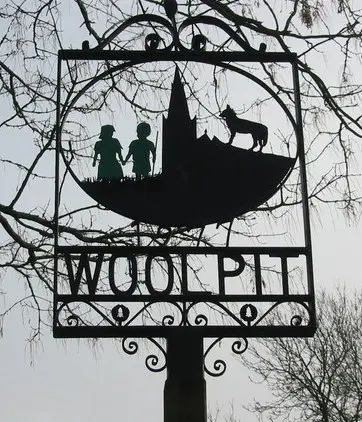
- 1977 Woolpit puts up its wrought-iron village sign for the Queen's Silver Jubilee: a wolf, the church, and the two green children. The legend becomes the village's official image of itself.
- 1990 The Green Children, an opera by Nicola LeFanu with a libretto by Kevin Crossley-Holland, is written for St George's Guildhall, King's Lynn, with the Baylis Programme of English National Opera and Gemini. In it the girl is given a name — Ehra — that no medieval source provides.
- 1998 Paul Harris publishes his Flemish hypothesis in Fortean Studies: the children as orphans of the 1173 massacre, speaking Flemish, coming from Fornham St Martin. It remains the most cited rational explanation — and the one most obviously at odds with William's dating.
- 2020 Michał Madej publishes a full comparison of the two chronicles in Res Historica, concluding that neither chronicler copied the other, that both must share a common source, and that the story served two entirely different purposes in the two works.
- 2026 Woolpit and District Museum extends its Green Children display "as so many visitors are interested in the legend", and adds a new display on wolves. The season opens on Saturday 4 April; admission is free.
Is there a rational explanation for The Green Children of Woolpit?
The first thing to be honest about is that neither text is a witness. William names no informant whatsoever — the story is "asserted by many". Ralph names exactly one: a knight repeating, decades later, what a woman in his household had told him. Beyond those two chapters nothing survives. No charter, no manorial roll, no third chronicle, no burial. Everything else ever written about the green children is commentary on eight or nine hundred words of Latin.
The best-known rational explanation is that the children were Flemish. Paul Harris set it out in Fortean Studies in 1998, and as Michał Madej summarises it, the argument runs like this: the children were orphans of Flemish immigrants, left destitute when a Flemish force was destroyed near Bury St Edmunds in 1173; the language nobody could understand was Flemish; and "St Martin's Land" is Fornham St Martin. The massacre itself is not in doubt. On 17 October 1173 the Earl of Leicester's largely Flemish infantry was caught in the Lark valley north of Bury St Edmunds, near Fornham St Genevieve, by a royal army under Richard de Lucy and Humphrey de Bohun; the Battlefields Trust's account records that "of the Flemings the greater part were killed, a certain number were drowned", with over three thousand dead in the battle and the rout. Fornham St Martin is the next village along. The problem is arithmetic. William dates the children firmly to Stephen's reign, which ended in 1154, nineteen years before the battle — and William was alive and writing about the period in which the battle happened. Madej declines to write that off as a chronicler's slip, and the objection has never been answered.
The second explanation is medical. Chlorosis, the "green sickness", was named by Jean Varandal at Montpellier in 1615 and finally identified as hypochromic, iron-deficiency anaemia after the work of Patek and Heath at Harvard in 1937, after which it quietly left the textbooks. It has an obvious appeal here: it is a colour that comes from malnutrition and goes when the diet improves, which is exactly the one thing both chroniclers agree on. A child living on nothing but broad beans is a plausible candidate. Madej's objection is the blunt one. If ordinary hunger turned children that colour, green children would not have been a prodigy in twelfth-century England; the entire force of both accounts is that nobody present had ever seen anything remotely like it.
The third reading does not try to find real children at all. The cave that opens into another country was a stock story in exactly that generation and, remarkably, in exactly that circle. Gervase of Tilbury — one of Ralph of Coggeshall's own informants — tells of a Derbyshire swineherd who followed a lost pig into Peak Cavern and came out in a land where the seasons were reversed. Walter Map has King Herla reaching the country of the dwarfs through a cave. Gerald of Wales, in the Itinerarium Cambriae, has a boy called Elidor taken to an underground people whose land was poorly lit and whose speech resembled Greek. Anne Witte's suggestion, relayed by John Clark and by Madej, connects "St Martin's Land" to the dead: Martinmas falls on 11 November, immediately after All Saints and All Souls. Broad beans, the only food the children would touch, carried their own ancient association with the dead. None of that proves the story was invented. It does mean it arrived pre-shaped, in a form its audience already knew how to hear.
One claim can be checked directly against the sources and fails. The girl has no name. Read both chapters and she is never called anything at all: William says only that she married at Lynn, Ralph that she stayed in the knight's service. The widely repeated "Agnes Barre", supposedly married to the royal justice Richard Barre, appears in neither medieval text; it is a modern addition. Even William's confident etymology is contested. He glosses the pits as "Wolfpittes, that is, in English, Pits for wolves" — but Woolpit Parish Council notes that the name is recorded as Wlfpet in 1005 and considers derivation from the personal name Ulfketel more likely than a literal wolf trap.
What the reception history shows is that every age has read the children as its own kind of stranger. Madej traces it: William Camden's Britannia (1586) treated the tale as a hoax; Robert Burton, in the Anatomy of Melancholy (1621), decided the children had fallen from the Moon, and Bishop Francis Godwin repeated it in The Man in the Moone. In 1850 Thomas Keightley printed Ralph's version in English for the first time, in The Fairy Mythology, and filed the children under fairies. The twentieth century made them extraterrestrials. The eight hundred words of Latin have not changed once; only the available explanation has.
Can you visit The Green Children of Woolpit?
Woolpit lies in mid-Suffolk just off the A14, about 12 km (7.6 miles) east of Bury St Edmunds and 8.5 km (5.3 miles) north-west of Stowmarket, measured in a straight line between centres. The parish council's own account of the legend gives no location for the pits in which the children were found, and none is marked in the village. The story is on view in three places a short walk apart.
The village sign was put up in 1977 for the Queen's Silver Jubilee and is made of wrought iron. According to Suffolk Village Signs it has the wolf of the village name on the right, St Mary's church in the middle and the green children on the left.
Woolpit and District Museum occupies the upper floor of an early-16th-century cottage and is entered through the Woolpit Institute. It began in 1983, when the parish council gave the local history group a store-room there to show the finds from its field-walking. Its page for 2026, read on 24 September 2026, gives opening on Saturdays, Sundays and bank holiday Mondays from April to the end of October, from 14:00 to 16:30, and on Wednesdays in August from 13:00 to 15:30, with free admission. The 2026 season opened on Saturday 4 April, and the volunteers will open at other times by appointment ([email protected]). This year the Green Children display has been extended "as so many visitors are interested in the legend", and a new display on wolves has been added because a wolf features on the village sign.
St Mary's church (postcode IP30 9QP), which Ralph of Coggeshall calls St Mary's of the Wolf-pits, has been listed Grade I since 15 November 1954 (list entry 1181376). The listing dates the double-hammerbeam nave roof, in ten bays, to about 1439-51, and the south porch to the same years; it calls the porch, with its upper chamber and chequered flushwork, "one of the finest in Suffolk". The tower fell in 1702 and again in 1852, after which R. M. Phipson rebuilt it with the present spire. The Church of England's "A Church Near You" page lists the church as open daily for quiet prayer and records wheelchair access and toilet facilities.
The nearest railway station is Elmswell, about 2 km (1.3 miles) north-east of the church on the line between Ipswich and Bury St Edmunds; Thurston, on the same line, is about 6 km (3.8 miles) to the west-north-west. Both are straight-line distances from the church.
Sources consulted
- William of Newburgh, «Historia rerum Anglicarum, Book I, ch. 27: 'Of the Green Children' (with the preface against Geoffrey of Monmouth)» — Trans. Joseph Stevenson, The Church Historians of England, vol. IV pt. 2 (Seeleys, 1856); digitised in the Internet Medieval Sourcebook, Fordham University, 1198 book
- Radulphus de Coggeshall (Ralph of Coggeshall), «Chronicon Anglicanum: 'De quodam puero et puella de terra emergentibus', pp. 118–120 (Latin text)» — Ed. Joseph Stevenson, Rolls Series 66, Longman, London — digitised by the Internet Archive, 1875 book
- Michał Madej (Jagiellonian University, Kraków), «The Story About the Green Children of Woolpit According to the Medieval Chronicles of William of Newburgh and Ralph of Coggeshall (pp. 117–132, DOI 10.17951/rh.2020.49.117-132)» — Res Historica, 49, 2020 academic
- Thomas Keightley, «The Fairy Mythology: 'The Green Children' (pp. 281–283) — the first English printing of Ralph of Coggeshall's version» — George Bell & Sons, London — digitised by the Internet Archive, 1878 book
- The Battlefields Trust, «The Battle of Fornham St Genevieve, 17 October 1173» — UK Battlefields Resource Centre, 2026 report
- Woolpit Parish Council, «A short history of Woolpit — the place-name, Ulfketel and the 1005 grant» — Woolpit village website, 2026 archive
- Woolpit Parish Council, «Green Children — the village's own account and the village sign» — Woolpit village website, 2026 archive
- Woolpit and District Museum / Woolpit Parish Council, «Woolpit Museum — opening times and displays for 2026» — Woolpit village website, 2026 archive
- Novello & Co., «The Green Children — opera by Nicola LeFanu, libretto by Kevin Crossley-Holland» — Wise Music Classical catalogue, 1990 web
- Rob Maslen (University of Glasgow), «The Surrealist Fantasy of Herbert Read, Part 2: The Green Child (1935)» — The City of Lost Books, 2018 web
- Church of England, «Woolpit, St Mary — visitor information, opening and access» — A Church Near You, 2026 web
- Suffolk Village Signs, «Woolpit — the village sign of 1977» — Suffolk Village Signs, 2026 web
- Historic England, «Church of St Mary, Woolpit (list entry 1181376, Grade I, first listed 15 November 1954) — double-hammerbeam nave roof and south porch c.1439-51, the porch 'one of the finest in Suffolk'; tower fell 1702 and 1852, rebuilt by R. M. Phipson with a spire» — National Heritage List for England, 1954 archive
Reviewed by V. Serrano on 2026-07-29 · How we verify our content
📎 Source: Enigma Atlas
💬 Field testimonies (0)
No testimonies yet. Add the first.
Add your testimony
🔒 Log in to add a testimony