👻 HAUNTED PLACE · EXP. Nº9046
ACTIVE
Ancient Ram Inn
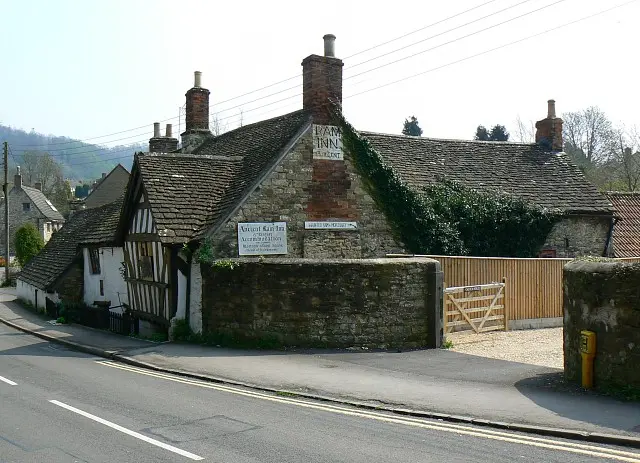
A Grade II* listed former inn at Potters Pond in Wotton-under-Edge, Gloucestershire, sold today as ghost hunts at "England's most haunted building".
Where is Ancient Ram Inn?
- Location
- Gloucestershire, United Kingdom
- Type
- Hotel / inn
- Coordinates
- 51.638, -2.348
- Last updated
LOCATION
Why is Ancient Ram Inn said to be haunted?
Its documented history is better than its legend. Tree-ring dating puts the standing house at timbers felled in the winter of 1495-96. Deeds at Gloucestershire Archives, catalogued as the Tan House and later the Ram Inn, run from 1350, and one of 1532 hands the building to eight named men holding it for the parishioners: the shape of a late-medieval church house. Tenter hooks in the service bay tie it to the Cotswold wool trade. The famous claims have traceable authors rather than sources. The year 1145 is the year of Wotton's first recorded rector; the pagan burial ground was reported by dowsers; the ley line was John Humphries' own. Humphries, a former train driver, bought a condemned, beetle-eaten building in 1968 and ran it as a family guesthouse, and his daughter Caroline says the paranormal side began "by accident". The Ghost Club, investigating in 2003, could find no record of a haunting before he arrived. Humphries died in December 2017; the venue now sells afternoon and overnight vigils.
What is the history of Ancient Ram Inn?
The Ancient Ram Inn is a real late-medieval building whose documented history is unusually well established — which is what makes the story told about it so odd.
The bundle of deeds now catalogued at Gloucestershire Archives as D1193/16/1 is titled, in the archive's own words, "Deeds of a messuage in Sinwell, near the Cloud Mill, later called the Tan House and subsequently the Ram Inn, 1350-1724". Its earliest document, of 1350, transfers a tenement from Maurice de Bathe to Peter le Couk. Neither man's occupation is given, and the tenement cannot be the house that stands today: the timbers of the primary phase of the present building were felled in the winter of 1495-96, a date recorded in the Vernacular Architecture Group's national index of tree-ring dated buildings and published in Vernacular Architecture 45 (2014), page 118.
What the 1495-96 house was for is legible in its fabric. The listing describes three units — service bay, hall and parlour — with a jettied, close-studded timber gable to the parlour end, and it notes two things that matter: the presence of tenter hooks, used to stretch cloth, and the complete absence of the soot that a medieval open hall always leaves on its roof timbers. Historic England reads the second as a sign that this was a first-floor hall, and the first as "proof of its significance to the local wool trade". Wotton-under-Edge grew rich on that trade, and the deed of 1532 confirms the connection: it records that the house had belonged to clothmakers.
That same 1532 deed carries the building's other documented function. Thomas Hycks of Tortworth granted it to eight Wotton yeomen — John Gower, George Simondes, Thomas Byshuppe, John Hewes, William Coldwell, Richard Smyth, Thomas Colman and Galfred Bruton — "on behalf of and in the name of all the parishioners". Eight trustees holding a house for a parish is the standard shape of a church house: the late-medieval parish's hall, court room, school and drinking venue, the building where church ales were held. A church house turning into a pub is a well-worn path, and by 1820 a deed calls this one The Ram.
Its last stretch is brewery property. In 1905 the Trustees of Wotton-under-Edge General Charities — possibly the descendants of that same parish trust — sold it to the Coombe Valley Brewery; in 1912 it passed to Arnold Perrett and Co. Ltd, later part of West Country Breweries. It was listed in 1952, and the beer stopped in the mid-1960s.
In 1968 the brewery sold a building eaten by death-watch beetle, with collapsing dry-stone walls and a demolition order hanging over it for a road-widening scheme, to John Humphries, a former train driver, who moved his wife and three young daughters into a house with no running water. Keeping it standing cost him, in the Ghost Club's summary, "his marriage, his money and (for a while) close contact with his children". It became a guesthouse within a couple of years, and the paranormal business grew out of that. Humphries died on 12 December 2017, aged 89, and his daughter Caroline has run the place since.
Timeline: the documented record of Ancient Ram Inn
- 1350 The earliest deed in the bundle now catalogued as D1193/16/1 at Gloucestershire Archives transfers a tenement in Sinwell, near the Cloud Mill, from Maurice de Bathe to Peter le Couk. Neither man's trade is recorded, and the tenement is not the building that stands today.
- Winter 1495-96 The timbers of the primary building phase are felled. The Vernacular Architecture Group's index of tree-ring dated buildings records the felling date as 1495/96 for 'The Ancient Ram Inn, Potters Pond', published in Vernacular Architecture 45, page 118, with the dating laboratory given as Nottingham.
- 1532 Thomas Hycks of Tortworth grants the property to eight Wotton-under-Edge yeomen — John Gower, George Simondes, Thomas Byshuppe, John Hewes, William Coldwell, Richard Smyth, Thomas Colman and Galfred Bruton — 'on behalf of and in the name of all the parishioners'. The same deed records that the house had previously belonged to clothmakers.
- 1820 A deed refers to the building as The Ram. The listing takes this as the point by which it was in clear use as a public house.
- 1905 The Trustees of Wotton-under-Edge General Charities transfer the building to the Coombe Valley Brewery; in 1912 it passes to Arnold Perrett and Co. Ltd, later absorbed into West Country Breweries.
- 23 June 1952 The building is listed, then under the name Ram Inn. The entry is amended on 16 May 1996 and describes it as an inn, 'Late medieval, remodelled in mid/late C16', noting tenter hooks and 'no traces of the smoke blackening characteristic of medieval open halls'.
- 1965 According to the Ghost Club's 2003 report, the Ram pulled its last pint this year, after losing custom and sliding into dereliction. The venue's own website later dated the last landlord's last pint to 1967.
- 1968 The brewery sells the building — riddled with death-watch beetle and slated for demolition in a road-widening scheme — to John Humphries, a former train driver, who moves in with his wife and three young daughters. The photographer Brian Robert Marshall, shown round in 2008, recorded Humphries' price as £2,600.
- 12 July 2003 The Ghost Club investigates with fourteen people and three vigils. Lance Railton's report, signed 7 August, records that Humphries attributes the pagan burial ground to dowsers and the ley line to his own account, and concludes: 'I have not been able to find any record of hauntings at the Ram before he moved in.'
- 2007 Humphries' own website, copyright 2007, states that the inn was 'built in around 1145 over a 5000 year old pagan burial ground', housed the masons of St Mary's and stands 'on a crossing of ley lines'. Its list of resident spirits names a Bishop's Room, an incubus and a succubus. It nowhere calls the building the most haunted in England.
- 24 November 2009 That website text is pasted into the English Wikipedia article. It is deleted on 26 March 2010 as a copyright violation, the editor naming theancientraminn.com as its ultimate source. Later editors strip the remaining claims: in 2022 one notes the 'most haunted' billing can 'only [be found] in some tabloid stories'.
- 12 December 2017 John Humphries dies, aged 89. His daughter Caroline takes over the building.
- 6 May 2023 Caroline Humphries tells the Stroud Times that her father bought the Ram in 1968 as a project and a family guesthouse: 'It became a paranormal event location by accident, really.' In the same interview she dates the building to the 15th century, 'possibly even older'.
- 13 November 2023 The buildings archaeologist James Wright publishes a point-by-point analysis: the standing building is of 1495-96, there is no evidence for a 12th-century mason's lodge or vicarage, and none of five archaeological registers he searched records a cemetery in the vicinity.
Is there a rational explanation for Ancient Ram Inn?
Almost every famous claim about the Ram can be traced to a named person, a datable document, and in several cases to a method its own investigators described.
Start with 1145. The Ghost Club's 2003 report explains where the year comes from: it is the year William FitzRobert, son of the first Lord Berkeley, was installed as the first recorded Rector of Wotton. It is a date in the history of the parish, not of a building. The pagan burial ground has an equally specific provenance in the same report: "dowsers have told him that the Ram stands on top of a pagan burial ground". The ley line is Humphries' own — Railton records him tracing one from Ley Farm to Hetty Pegler's Tump and on through the Witch's Room, the church and Stonehenge. The murdered woman buried in a sealed cellar came from a diviner, and Railton, standing in a building where digging strikes water at four feet, wrote that he "remain[ed] to be convinced" the cellar existed at all. The child skeletons that circulate on tourist sites appear in the 2003 report as one grave, of a woman and a child, said by Humphries to have yielded iron shards that Bristol Museum "admitted could have been a dagger".
Railton also noticed that the resident demon did not match its name: what Humphries called an incubus he described as "a 7ft tall dark shadow", and Railton added drily that he "had always understood incubi to be parasitic female sexual demons". The Ram's own website, in 2007, printed a textbook definition of incubus and succubus and then deflated it, arguing the spirits were merely "a nasty person in real life" who had not moved on.
The strongest negative in the file is Railton's, and it is properly done. He looked for the Ram in the standard early-20th-century county guides and in the ghost and inn literature — Christina Hole's Haunted England (1940), Katherine Briggs's Folklore of the Cotswolds (1974), A. E. Richardson's The Old Inns of England (1934), Marc Alexander's Haunted Inns (1973), Guy Lyon Playfair's The Haunted Pub Guide (1985) among others — and found nothing. His conclusion: "I have not been able to find any record of hauntings at the Ram before he moved in", with the observation that Humphries' long, consistent tour was "a two-edged sword, priming investigators' perceptions". On the night itself, fourteen investigators over three vigils recorded almost nothing; the orbs photographed in the Bishop's Room stopped appearing after the team deliberately stirred up dust to test them.
For the archaeology, the buildings archaeologist James Wright searched the Archaeology Data Service, the National Heritage List, the National Monument Record Excavation Index, Historic England Research Records and the Gloucestershire Historic Environment Record in November 2023: none records a cemetery in the vicinity. That negative is dated, and someone should redate it before repeating it.
Finally, the billing. "The most haunted building in England" is not John Humphries' phrase. It does not appear anywhere on his own website in the snapshots archived between 2006 and 2011 — index, history, hauntings and ghost-hunt pages alike, where the word "haunted" itself appears five or six times per page — and the Guardian's 2007 top ten did not use it either. It leads the current site, first archived in December 2020, whose title reads "Ghost Hunts at England's Most Haunted Building". The incentive is not hidden: afternoon hunts are advertised at £39 and overnight hunts at £59, and Caroline Humphries has said that two years of COVID losses were only offset by taking film crews. In 2003 the superlative was still modest and local — the Bishop's Room was "considered the most haunted part of the Ram".
Can you visit Ancient Ram Inn?
The Ancient Ram Inn is at Potters Pond, Wotton-under-Edge, Gloucestershire GL12 7HF, at national grid reference ST 76014 93297. It has been listed since 23 June 1952 and is Grade II* (list entry 1088885, last amended on 16 May 1996). The Vernacular Architecture Group's index of tree-ring dates puts the felling of its roof timbers in 1495/96. John Humphries bought it in 1968 and, as his daughter Caroline told the Stroud Times in 2023, "it was a guesthouse within a couple of years"; the website read on 24 September 2026 sells ghost hunts, open days and vouchers, with no room bookings among them.
Entry is by ticket. That day the site listed overnight ghost hunts from 9pm to 3am at £59, reduced from £95, and afternoon hunts at £39, reduced from £75, both for over-18s. Junior ghost hunts run from 2pm to 6pm for ages 10 to 18, and a ticket-holding adult may bring up to six juniors. A four-hour voodoo-doll-making session is also for over-18s, and a live-streamed option lets people follow a hunt from home. The open-days page describes visits without a ghost hunt, but on 24 September 2026 it gave no dates, only "New dates coming soon". Contact is 07394 633 807 or [email protected], and the event pages mention secure parking on site.
Brian Robert Marshall, who photographed the inn for Geograph on 22 April 2008 and was invited in by the owner, wrote that it "looks as if it has been abandoned. Not so" and that "structurally the building is in a poor state". Caroline Humphries told the Stroud Times in 2023 that "every single penny gets invested into maintenance", that she needed "all new windows" and that "all the walls really need to be repointed inside and out". When the Ghost Club investigated on 12 July 2003, the party used the lavatories of the Full Moon pub, "just along Potters Pond from the Ram", because there were none at the inn. The event pages read in 2026 include the location of the toilets in the safety briefing and note "narrow, winding staircases leading to the upper rooms".
The parish church of St Mary, Culverhay, listed Grade I since 30 June 1961 (list entry 1052363), stands about 120 m north of the inn by the grid references of the two list entries. Historic England dates its arcades to the late 13th century and its tower to the 14th.
Sources consulted
- Historic England, «The Ancient Ram Inn, Wotton-under-Edge — List Entry 1088885 (official list entry, first listed 23 June 1952, amended 16 May 1996)» — National Heritage List for England, 1996 report
- Vernacular Architecture Group, «Index of Tree-ring Dated Buildings in England — County List: Gloucestershire (revised to Vernacular Architecture 51)» — Vernacular Architecture Group, 2021 report
- Gloucestershire Archives, «Deeds of a messuage in Sinwell, near the Cloud Mill, later called the Tan House and subsequently the Ram Inn, 1350-1724 (D1193/16/1)» — Gloucestershire Archives catalogue, 1350 archive
- James Wright, «Mediaeval Mythbusting Blog #26: The Ancient Ram Inn» — Triskele Heritage, 2023 web
- Lance Railton, «Report of an Investigation led by Lance Railton at The Ram Inn, Potters Pond, Wotton-under-Edge, Saturday 12 July 2003» — The Ghost Club, 2003 report
- John Humphries (theancientraminn.com), «The Ancient Ram Inn — 'History' and 'Hauntings' pages of the owner's own website (archived 6 September 2008)» — Internet Archive Wayback Machine, 2008 archive
- The Ancient Ram Inn, «Ram Inn — Ghost Hunts at England's Most Haunted Building (current official website)» — ancientraminn.co.uk, 2026 web
- Matt Bigwood, «Owner of Ancient Ram Inn speaks of plans for the iconic former pub» — Stroud Times, 2023 newspaper archive
- Matt Bigwood, «Owner reveals plans for Ancient Ram Inn» — Stroud Times, 2022 newspaper archive
- The Guardian, «Top ten haunted places in the UK» — The Guardian, 2007 newspaper archive
- Brian Robert Marshall, «Ram Inn, Potters Pond, Wotton under Edge — photograph and photographer's note, taken 22 April 2008» — Geograph Britain and Ireland, 2008 web
- Wikipedia contributors, «Ancient Ram Inn — revision history (copyright violation removed 26 March 2010; unsourced superlatives and ghost material removed 2022-2025)» — English Wikipedia, 2026 web
- Find a Grave, «John Humphries (1928-2017), Wotton Under Edge Cemetery — memorial 193844719 (user-contributed)» — Find a Grave, 2017 web
- Historic England, «Church of St Mary, Culverhay, Wotton-under-Edge — National Heritage List for England, list entry 1052363 (Grade I, listed 30 June 1961)» — National Heritage List for England, 1961 report
- The Ancient Ram Inn, «The Ancient Ram Inn — Overnight Ghost Hunts (event page: 9pm-3am, over-18s, secure parking)» — ancientraminn.co.uk, 2026 web
- The Ancient Ram Inn, «Ancient Ram Inn — Junior Ghost Hunts (event page: ages 10 to 18, 2pm-6pm)» — ancientraminn.co.uk, 2026 web
- The Ancient Ram Inn, «The Magic Craft of Voodoo Doll Making (event page: four hours, over-18s, toilets and staircases)» — ancientraminn.co.uk, 2026 web
- The Ancient Ram Inn, «Open Days — The Ancient Ram Inn (no dates listed: "New dates coming soon", 24 September 2026)» — ancientraminn.co.uk, 2026 web
Reviewed by V. Serrano on 2026-08-17 · How we verify our content
💬 Field testimonies (0)
No testimonies yet. Add the first.
Add your testimony
🔒 Log in to add a testimony