👻 HAUNTED PLACE · EXP. Nº8141
ACTIVE
Edinburgh Castle
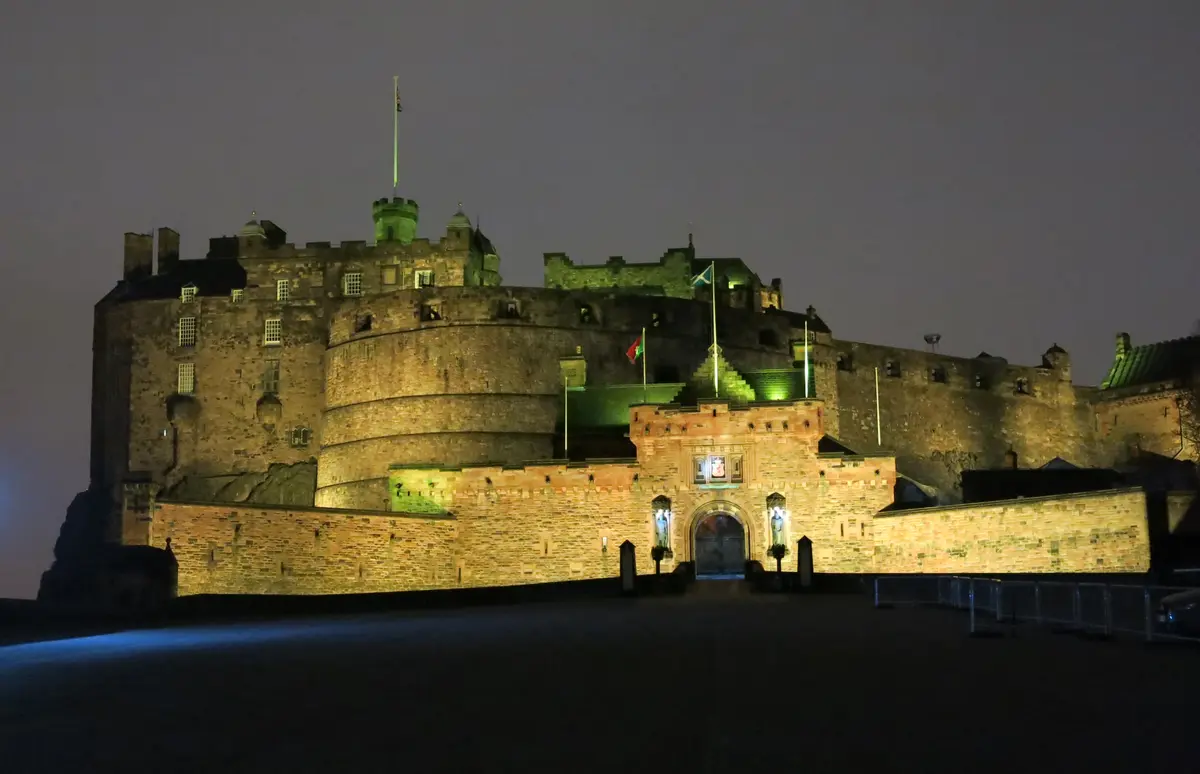
Edinburgh Castle stands on Castle Rock at the head of the Royal Mile, and its ghost stories gather in the vaults beneath the Great Hall, stone-vaulted cellars reached from Crown Square by a steep dog-legged passage called the Devil's Elbow.
Where is Edinburgh Castle?
- Location
- Edinburgh, United Kingdom
- Type
- Castle
- Coordinates
- 55.949, -3.2
- Last updated
LOCATION
Why is Edinburgh Castle said to be haunted?
For fifty-seven years, from 1757 to 1814, those vaults held prisoners of war. The first recorded arrivals were the 78 crewmen of a French privateer from Dunkirk, marched up from Leith in April 1757; the worst crowding came during the American War of Independence, when, by the historian Chris Tabraham's count, almost a thousand men were packed into the vaults in July 1781. Most were sailors, many of them Americans, and they left graffiti: a door from vault 5 carries a gibbet dated 1781 and one of the earliest known depictions of the Stars and Stripes, and Tabraham matched names carved on it with crew lists in the French National Archives. The controlled haunting experiment usually attached to the castle, Richard Wiseman's study of April 2001 with 218 participants, was run in the South Bridge Vaults, about 800 metres to the east, and no study of that design has been published for the castle's own vaults.
What is the history of Edinburgh Castle?
The ghost stories of Edinburgh Castle gather in the vaults beneath the Great Hall, a set of stone-vaulted cellars reached from Crown Square by a steep dog-legged passage. The drop from the square is over four metres, and Chris Tabraham, in his study of the prisons for the Book of the Old Edinburgh Club (2008), suggests it may explain the passage's name, the Devil's Elbow.
For fifty-seven years, from 1757 to 1814, the vaults held prisoners of war. On 28 April 1757 the Edinburgh Evening Courant reported that the 78-strong crew of a French privateer, the Chevalier Barte of Dunkirk, had been put ashore at Leith and marched up to the castle; Historic Environment Scotland's own page dates the first French privateers to 1758. The worst crowding came in the War of American Independence: had the prison reformer John Howard, who counted 64 men in July 1779, visited in July 1781 instead, Tabraham writes, "he would have found not 64 but almost 1000 men crammed into the vaults". By July 1799 there were around 750, against an optimum maximum put at 450. A mass breakout of 49 men in April 1811 ended the castle's main role as a prison of war, and the last inmates were marched to Leith in the spring of 1814.
Tabraham lists the inmates as Americans, Danes, Dutch, French, Germans, Irish, Italians, Poles and Spaniards; HES says most were sailors, "many of them Americans fighting in the War of Independence". The door into vault 5 carries a gibbet dated 1781 with the words LORD NORD, and a "Stars and Stripes" flying from the stern of a brig, which Tabraham calls "one of the earliest known".
This is what makes the vaults unusual as a "haunted" site: some of the prisoners have names. Tabraham matched the graffiti names on that door with the crew lists in prison records kept in the French National Archives, and another carver, ABRAHAM, cut his name three times into the stonework, perhaps the Abraham Le Duc who came from the Dutch frigate Zephyr in 1796.
Timeline: the documented record of Edinburgh Castle
- 1757 The first prisoners arrive: the 78 crew of the French privateer Chevalier Barte of Dunkirk, put ashore at Leith and marched up to the castle, as the Edinburgh Evening Courant reported on 28 April. Fifty-seven years of use as a prison of war begin.
- 1770s–1780s Prisoners from the American War of Independence arrive. One of them scratches an early depiction of the Stars and Stripes into a door, which survives.
- July 1781 The worst overcrowding: almost 1,000 men in the vaults in the War of American Independence, against the 64 John Howard counted in July 1779.
- 1814 The vaults' use as a prison of war ends, after well over a thousand men have passed through them in fifty-seven years.
- 2001 Richard Wiseman's Science Festival experiment on haunted and unhaunted vaults takes place in April, in the South Bridge Vaults, about 800 m east of the castle, and not in the castle as later press accounts say: 218 participants, 95 of whom (43.58%) report at least one unusual experience, more of them in the vaults with a reputation.
Is there a rational explanation for Edinburgh Castle?
The controlled experiment usually attached to Edinburgh Castle was run somewhere else.
An Edinburgh Evening News article, first published by its sister title the i, says that in 2001, during the Edinburgh International Science Festival, the psychologist Richard Wiseman worked for ten days with 240 volunteers chosen for having "no prior knowledge of Edinburgh Castle's alleged hauntings", and led them "through the castle vaults, cellars and dungeons". Wiseman's own account of the study, and the paper he published with Caroline Watt, Paul Stevens, Emma Greening and Ciarán O'Keeffe in the British Journal of Psychology (vol. 94, 2003, pp. 195-211), place that Edinburgh experiment in the South Bridge Vaults, the chambers built into the arches of a late eighteenth-century bridge about 800 metres east of the castle.
The published results are specific. The experiment ran in April 2001, in 24 sessions over four days, with 218 participants who had signed up from the festival programme. 95 of them (43.58%) reported at least one unusual experience. The number of experiences in each of the ten vaults tracked the vaults' reputation for being haunted (rho = .76), and more closely once the 31 participants who said they might know that reputation were excluded (rho = .87). The vaults with the stronger reputation were also those with more light at the entrance, more floorspace and higher ceilings. Wiseman's summary is that the number of experiences was related to environmental factors "such as air movement and the size of the vault".
No study with that design has been published for the castle's own vaults. What the castle has instead is the documentary record of the men held there: almost a thousand at once in the summer of 1781, by Chris Tabraham's count.
Can you visit Edinburgh Castle?
Edinburgh Castle stands on Castle Rock at the head of the Royal Mile and is run by Historic Environment Scotland (HES). The Association of Leading Visitor Attractions counted 2,044,963 visits in 2025, a 3 per cent rise that kept it the most visited paid-for attraction in Scotland.
HES's opening-times page, read on 23 September 2026, gives 09:30 to 18:00 from 1 April to 30 September, with last entry at 17:00, and 09:30 to 17:00 from 1 October, with last entry at 16:00. The castle closes at 16:00 on 24 December, does not open on 25 or 26 December, and opens from 11:00 to 17:00 on New Year's Day. The ticket page, read the same day, prices an adult ticket (16-64) at £23.50 online and £26.00 on the day, a child (7-15) at £14.00 and £15.50, and a concession (65 and over, or unemployed) at £19.00 and £21.00. The same page says tickets "often sell out far in advance, especially over the summer months", and that once they have sold out online none are sold at the castle. HES suggests "at least 2 hours" for the main attractions.
The Prisons of War are the vaults below Crown Square. HES presents them as "a recreation of the vaults as they would have looked around 1800" and notes that "an early depiction of the 'Stars and Stripes' flag is scratched into a door". The 2008 study of the prisons in the Book of the Old Edinburgh Club records that three timber doors covered in graffiti survive from the vaults, "though they are no longer in situ". On the door into vault 5 it describes a gibbet with the date 1781 and the words LORD NORD, the flag flying from the stern of a brig, and the names of three seamen of the French frigate Rohan Soubise, captured in April 1781: Peter Garrick, Pierre Jean Lefèvre and Jean Jacques Ducatez, who also appear on the ship's crew lists of May 1781.
HES's access guide gives the approach across the Esplanade as 110 m at an uphill gradient of 5 degrees, and says the vaults are reached by "numerous short flights of steps, with handrails on both sides". A courtesy vehicle carries visitors with limited mobility up to Crown Square, but not between 12:15 and 13:15, because of the One O'Clock Gun; the opening-times page says the gun is fired "every day at 1pm, except on Sundays, Good Friday, and Christmas Day".
One exhibit has left. The Stone of Destiny, long shown at the castle, has been on display at Perth Museum since the museum opened in March 2024.
Sources consulted
- Historic Environment Scotland, «Prisons of War — historia documentada de las bóvedas y sus prisioneros» — Edinburgh Castle, 2026 archive
- The Old Edinburgh Club, «The Prisons of War in Edinburgh Castle» — Book of the Old Edinburgh Club, New Series 7, 2008 academic
- Richard Wiseman, «The psychology of ghosts and hauntings — Wiseman's summary of his studies, including the Edinburgh Vaults experiment of 2001 (South Bridge Vaults)» — University of Hertfordshire, 2001 academic
- Edinburgh Evening News, «When a scientist tried to prove Edinburgh Castle was haunted (press account, first published by the i, that places Wiseman's 2001 experiment in the castle)» — Edinburgh Evening News (National World), reprinted from the i, 2018 newspaper archive
- Retrospect Journal, «Napoleonic prisoners and Edinburgh Castle: a brief examination» — University of Edinburgh, 2017 academic
- Richard Wiseman, Caroline Watt, Paul Stevens, Emma Greening and Ciarán O'Keeffe, «An investigation into alleged 'hauntings' (Experiment 2: South Bridge Vaults, Edinburgh, April 2001)» — British Journal of Psychology, vol. 94, pp. 195-211, 2003 academic
Reviewed by V. Serrano on 2026-07-28 · How we verify our content
💬 Field testimonies (0)
No testimonies yet. Add the first.
Add your testimony
🔒 Log in to add a testimony