👻 HAUNTED PLACE · EXP. Nº1190
ACTIVE
Ottawa Jail Hostel
Ottawa Jail Hostel is a location reputed to be haunted in Ottawa, Ontario, CA. Its reputation comes from reported apparitions, unexplained phenomena and eyewitness accounts gathered over time.
Where is Ottawa Jail Hostel?
- Location
- Ottawa, Ontario, CA
- Type
- Prison
- Coordinates
- 45.425, -75.689
- Testimonies
- 0
- Last updated
LOCATION
Why is Ottawa Jail Hostel said to be haunted?
The Ottawa Jail Hostel is the former Carleton County Gaol, built between 1860 and 1862 on Nicholas Street and used as the county jail until 1972. Guests sleep in its cells, and a free daily tour reaches the death-row floor and the gallows doors, which Heritage Ottawa records as still intact and fully functional. Three men were hanged here. The first was Patrick James Whelan, a tailor convicted of assassinating Thomas D'Arcy McGee, a Father of Confederation, and hanged before thousands on 11 February 1869 in what the Canadian Register of Historic Places calls Canada's last public execution. Whelan denied firing the shot to the end, and his own biographer wrote in the Dictionary of Canadian Biography that there is room for doubt about his guilt. Both of the things that convicted him happened inside this building: an identification made at the cells under the sheriff's direction, and a jailhouse confession overheard by two men standing outside cell No. 7 with their boots off, and denied on oath by a third prisoner. The ghost tours that ran here for more than twenty-five years ended on 31 December 2023.
What is the history of Ottawa Jail Hostel?
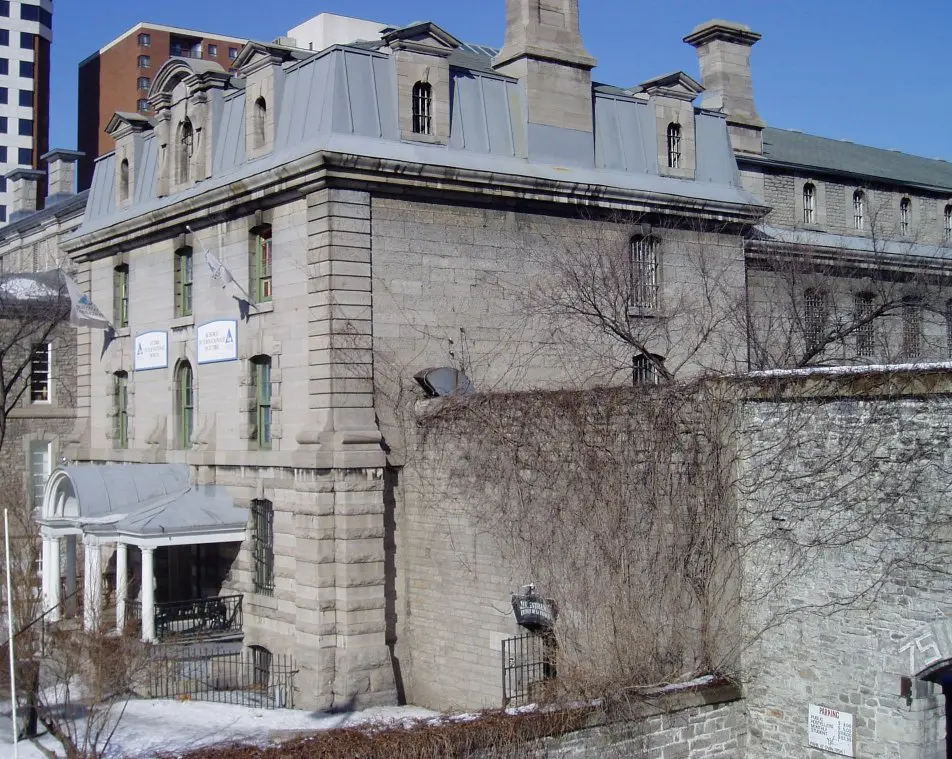
The Carleton County Gaol was built between 1860 and 1862 on Nicholas Street, next door to the county courthouse and joined to it by an underground tunnel. Its architect was Henry Hodge Horsey of Kingston, and the Canadian Register of Historic Places describes what he put up as "a three-and-a-half-storey stone structure in the Italianate style", the first jail house built in the Ottawa area. Heritage Ottawa records that the new gaol was received as a "spacious, airy building" and that it replaced "the wretched and poisonous basement" which had served the town for twenty years. The block facing the street held the prison governor's apartments. Behind it the cell wing followed a simplified version of the Auburn plan, with an exercise yard closed by a six-metre stone wall and the gallows doors set into that wall, where Heritage Ottawa notes they "remain intact and fully functional".
Six years after it opened, the gaol took in the prisoner it is remembered for. Thomas D'Arcy McGee, member of parliament and one of the Fathers of Confederation, was shot on Sparks Street on 7 April 1868. Patrick James Whelan, a tailor born in Ireland about 1840 and working in Ottawa for Peter Eagleson, was arrested within twenty hours with a loaded .32 calibre Smith and Wesson revolver in his pocket, and charged on 9 April.
Much of what decided his case happened inside this building, and it is printed in the trial report George Spaight took down for the Ottawa Times. On the evening of 16 April 1868 the detective Andrew Cullen and a prisoner named Robert Hess stood on the landing outside the corridor with their boots off, at a spot where a man could get "within two and a half or three feet of the prisoner". Cullen swore he had heard Whelan say "I shot that fellow like a dog" and add that "my name will go down to posterity". A prisoner held in the same corridor, Slattery, swore the reverse: Whelan "never said he had shot McGee like a dog, nor anything like it", and could not have said it without the witness hearing it. Six days later the one eyewitness, Jean-Baptiste Lacroix, was brought up to the cells to identify the man he had seen on Sparks Street. Whelan's account, given from the dock, was that at the cell door Lacroix "said he never saw me", and that at the line-up downstairs Sheriff Powell "deliberately pointed me out to that man".
The jury was locked up all night and answered the court with a single word, "Guilty!", on 15 September 1868. Whelan told the bench he was "standing on the brink of my grave" and declared himself "innocent, that I never committed this deed"; he complained of being charged "with being an accursed, foul assassin" and answered it with "I never took that man's blood". Led out a few minutes after sentencing, brushing his hat with his coat sleeve, he turned back once more: "All that sentence, My Lord, cannot make me Guilty." The sentence had fixed the hanging for "Thursday, the tenth day of December". Two appeals postponed it, and in both of them Chief Justice William Buell Richards, who had presided over the trial, cast the deciding vote against the man appealing his own rulings. Whelan was hanged in the yard on 11 February 1869, in a snowstorm, before a crowd the Dictionary of Canadian Biography puts at "more than 5,000 spectators" and James Powell, reading the Globe of the following morning, at some 8,000 by half past ten. Within five months the law was changed to ban public hangings in Canada.
Two more men were hanged there: William Seabrooke, in early 1933, for killing the service-station attendant Paul-Emile Lavigne, and Eugene Larment, aged 24, at 12.32 in the morning of 27 March 1946, after playing checkers with his guards. A provincial Royal Commission on Public Welfare had condemned the gaol as far back as 1930 and called for its immediate replacement; tenders for the building that took over went out in March 1970. The gaol closed in 1972 and the City of Ottawa leased it to the Ottawa Youth Hostel Committee. Prince Philip opened the hostel on 2 August 1973 by the operator's own account, though R.A.J. Phillips, who had led the campaign to save the building, remembered it in 1981 as 1974. The City designated the gaol on 15 November 1978 under by-law 380-78.
Timeline: the documented record of Ottawa Jail Hostel
- 1862 The Carleton County Gaol, begun in 1860 to Henry Horsey's design, is completed beside the county courthouse: the first jail house built in the Ottawa area.
- 7-9 April 1868 Thomas D'Arcy McGee is shot on Sparks Street. Patrick James Whelan is arrested within twenty hours with a loaded .32 revolver and charged with the murder on 9 April.
- 16 April 1868 Detective Andrew Cullen and the prisoner Robert Hess, standing outside cell No. 7 with their boots off, swear they hear Whelan say "I shot that fellow like a dog". A prisoner in the same corridor, Slattery, swears the words were never spoken.
- 22 April 1868 The eyewitness Jean-Baptiste Lacroix is brought to the cells. Whelan tells the court that Lacroix "said he never saw me" and that the sheriff then "deliberately pointed me out to that man" at the line-up downstairs.
- 15 September 1868 The jury, locked up overnight, answers "Guilty!". The sentence fixes the hanging for "Thursday, the tenth day of December"; Whelan's last words to the bench are "All that sentence, My Lord, cannot make me Guilty."
- 11 February 1869 Whelan is hanged in the gaol yard in a snowstorm. Powell, reading the Globe of the next morning, counts some 8,000 people by half past ten; the heritage register calls it Canada's last public execution.
- By July 1869 Within five months of the hanging the law is changed to ban public hangings in Canada, according to Whelan's biographer T. P. Slattery.
- 1930 A provincial Royal Commission on Public Welfare condemns conditions in the gaol and calls for its immediate replacement. It stays open another forty-two years.
- Early 1933 William Seabrooke is hanged for killing Paul-Emile Lavigne, a service-station attendant: the second of the three executions carried out at the gaol.
- 27 March 1946 Eugene Larment, aged 24, is hanged at 12.32 in the morning for the murder of Detective Thomas Stoneman, after playing checkers with his guards. It is the last execution at the gaol.
- 1972 The gaol closes and its prisoners move to a new detention centre. The City of Ottawa leases the building to the Ottawa Youth Hostel Committee.
- 2 August 1973 The hostel opens, with Prince Philip on the guest list, in a conversion finished hours before the ceremony according to the operator's own account.
- October 1973 Whelan's revolver turns up after a century lost. Ballistics experts test it against the bullet that killed McGee and the results are inconclusive.
- 15 November 1978 The City of Ottawa designates the gaol under the Ontario Heritage Act by by-law 380-78, for its historical, architectural and contextual value.
- 10 May 2007 The National Post prints the earliest dated ghost report traced here, quoting Jim Dean, manager of the Haunted Walk in Ottawa, on the figure guests see at the foot of the bed: he "looks kind of like Will Farrell, only with a fake beard."
- 19 September 2023 Glen Shackleton announces the end of the jail tours after more than twenty-five years and "over $1 million raised for the preservation of the building". The last tour runs on 31 December 2023.
Is there a rational explanation for Ottawa Jail Hostel?
The ghost of this building was a commodity with a named seller. The Haunted Walk of Ottawa, founded in 1995, ran evening tours inside the gaol for more than twenty-five years; its homepage promised in April 2000 that "None of the stories on our tours have been made up or exaggerated and several years of research have gone into each tour." The sales page for the jail tour, as it stood in May 2023, asserted nothing at all. It asked: "In 1869, was an innocent man executed for the murder of Thomas D'Arcy McGee, a popular Canadian politician? Does he still haunt the hallways of the jail to this day?" Adults paid $24.99 for seventy-five minutes. On 19 September 2023 the company's founder, Glen Shackleton, announced the end of the partnership, "This takes effect as of December 31st", and put a figure on what the ghost had bought: "over $1 million raised for the preservation of the building."
The hostel itself says nothing about ghosts. Three of its own pages read for this entry - the hostel page, the guided-tour offer and the operator's list of ten things about the building, published on 18 September 2023 - carry no occurrence of ghost, haunted, spirit or paranormal, against seventeen of "jail" and twelve of "prison" on the hostel page alone. What Saintlo sells is the masonry: "we haven't touched the most distinctive elements, like the stone walls and iron doors in cells that are over 150 years old".
The earliest dated report in print traced here is a National Post travel feature of 10 May 2007, and it names its source rather than a collective. Jim Dean, then manager of the Haunted Walk in Ottawa, described the figure guests reported at the foot of the bed: he "looks kind of like Will Farrell, only with a fake beard." The detail of cold spots and disembodied footsteps on the death-row floor, repeated across travel listings, appears in none of the tour operator's own material read here and in none of the sources located for this entry.
On sound in the cellblock the oldest evidence is the trial itself. In April 1868 two men standing outside cell No. 7 with their boots off followed a whole conversation through the iron and stone, and a third prisoner then swore on oath that the words had never been spoken there. Voices carry in that corridor, and they were already being disputed in 1868. No instrumented investigation of the building has been published, and a search of Google Books for earlier printed appearances of the ghost returned HTTP 429, daily quota exhausted, on 7 September 2026, so that check is left open.
One claim survives the scrutiny and belongs to the history rather than to the folklore. The Dictionary of Canadian Biography, whose entry on Whelan was written by his biographer T. P. Slattery, states that "There is room for doubt that Whelan was actually the assassin", that "The identification made of him at the scene of the crime can be discredited", and that "The case is still shrouded in mystery." Ballistic tests on the recovered revolver in October 1973 were inconclusive.
Can you visit Ottawa Jail Hostel?
Saintlo Ottawa Jail occupies the whole building at 75 Nicholas Street, Ottawa, ON K1N 7B9; the heritage register files the address as 75-77. Arrivals are taken from 15:00 and departures asked for before 11:00. Beds run from sleeping pods and four-, six-, eight- and ten-bed dorms to private cells, single, double or twin, plus one deluxe double with its own bathroom; the operator puts the capacity at 160 people. Breakfast, linen, towels and the jail tour add nothing to the bed rate. That rate is quoted inside the booking engine by date and has no published list price; for scale, the National Post printed the 2007 tariff as $24.15 for a dormitory bed and $57.75 for a private room for Hostelling International members, $28.15 and $61.75 for everyone else.
The tour is what brings in people who are sleeping elsewhere. Saintlo sells it at $25 for adults, $20 for students, $17 for youth aged 12 to 18 and $12 for children aged 5 to 12, and marks it "Free for hostel guests", on an offer page stamped "Valid until: June 30, 2027". The English tour goes at 11:00 AM Monday to Sunday and the French one at 7h30 PM on Friday and 9:00 AM on Sunday; for anyone with a bed there, "A free tour is available every day, just sign up at the front desk." Prices and times as published on 7 September 2026.
The ghost tour is gone. The Haunted Walk stopped operating inside the jail on 31 December 2023, and its outdoor Original Haunted Walk of Ottawa now leaves from 46 1/2 Sparks Street. Neither route suits a wheelchair: of the jail tour the company wrote that it "regrettably isn't accessible as there are a number of stairs along the route". Parking and laundry cost extra. From Nicholas Street the visible parts are the limestone administration block with its columned portico, dormered mansard roof and rusticated corner piers, the barred cell wing behind it, and the high yard wall that still carries the gallows doors.
Sources consulted
- George Spaight, «Trial of Patrick James Whelen for the murder of the Hon. Thomas d'Arcy McGee, reported for the Ottawa Times by George Spaight, and revised by a Barrister in attendance» — G. E. Desbarats, Ottawa (CIHM microfiche 23543, full text at archive.org), 1868 book
- T. P. Slattery, «WHELAN, PATRICK JAMES» — Dictionary of Canadian Biography, vol. 9, University of Toronto/Universite Laval, 1976 academic
- Canadian Register of Historic Places, «Carleton County Gaol - statement of significance (City of Ottawa By-law 380-78, recognition date 15 November 1978)» — Parks Canada / Historic Places (consulted 7 September 2026), 2026 report
- Heritage Ottawa, «5. Carleton County Gaol» — Heritage Ottawa 50 Years series, quoting R.A.J. Phillips in Ottawa Magazine, December 1981, 2023 web
- James Powell, «The Hanging of Patrick Whelan» — Ottawa Stories, The Historical Society of Ottawa (consulted 7 September 2026), 2026 web
- James Powell, «Eugene Larment: The Last Man Hanged in Ottawa» — Today in Ottawa's History, 23 June 2018, 2018 web
- Glen Shackleton, «Haunted Ottawa Jail Tour Ending» — The Haunted Walk, 19 September 2023, 2023 web
- National Post, «Unusual places to lay down your weary head» — National Post, 10 May 2007, republished on canada.com (Wayback capture of 6 February 2010), 2007 newspaper archive
- The Haunted Walk, «Haunted Ottawa Jail Tour - sales page» — hauntedwalk.com, Wayback capture of 28 May 2023, 2023 archive
- Haunted Walks of Canada, «Haunted Walks of Canada - homepage» — hauntedwalk.com, Wayback capture of 8 April 2000, 2000 archive
- Saintlo Hostels, «Welcome to Saintlo Ottawa Jail hostel» — saintlo.ca (consulted 7 September 2026), 2026 web
- Saintlo Hostels, «Explore Ottawa's historic jail hostel: exclusive guided tours» — saintlo.ca, offer page valid until 30 June 2027 (consulted 7 September 2026), 2026 web
- Kathleen, «10 things you didn't know about the Saintlo Ottawa Jail Hostel» — Saintlo Hostels blog, 18 September 2023, 2023 web
Reviewed by V. Serrano on 2026-09-07 · How we verify our content
💬 Field testimonies (0)
No testimonies yet. Add the first.
Add your testimony
🔒 Log in to add a testimony