📜 LEGEND · EXP. Nº0270
ACTIVE
Momotaro, the Peach Boy
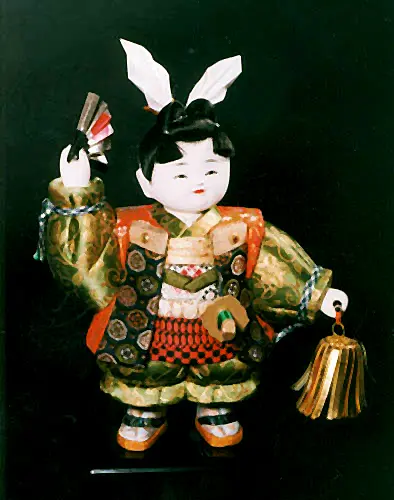
Every Japanese child knows Momotaro: the boy who came out of a peach, hired a dog, a monkey and a pheasant with millet dumplings and sailed to the Island of Demons.
Where does the legend of Momotaro, the Peach Boy come from?
- Location
- Okayama, Japan, Japan
- Kind of legend
- Folk tale
- Coordinates
- 34.671, 133.851
- Last updated
LOCATION
What is the legend of Momotaro, the Peach Boy?
Okayama has claimed him as a local son for so long that the claim itself looks ancient. It is not. It was argued in a book self-published in 1930 by an amateur historian, Namba Kinnosuke, who identified Momotaro with Kibitsuhiko, a general whom the chronicle of 720 sends west to the province of Kibi — and that chronicle contains no ogre, no island and no peach.
The tale itself is older and stranger than the school version. In a miniature book illustrated by Utagawa Hiroshige around 1830, now in the National Diet Library, Momotaro is not born from the peach at all: his aged parents eat it, turn young again and conceive him. He sails to Ogre Island for the loot, haggles for bigger dumplings because small ones look miserly, and tells the surrendering ogre king that he may live if he hands over everything he has. Courage, generosity and teamwork arrived later — with the school readers of 1887 onwards, and then with the war.
What is the history of Momotaro, the Peach Boy?
Momotaro is the most retold tale in Japan and one of the very few that reached Europe in the nineteenth century. What it is not is an old Okayama story. The tale is far older than its link to Okayama, and that link can be dated to the year.
The oldest name in the chain belongs to a real chronicle. In the Nihon Shoki, completed in 720, Emperor Sujin complains that outlying peoples — "the distant savages", in Aston's rendering — "do not receive our calendar", and on the ninth day of the ninth month of his tenth year, despatches four generals: Oho-hiko to the north, Take-nunakaha-wake to the Eastern Sea, Tamba-no-michi-nushi to Tamba, and Kibi-tsu-hiko "to the Western road" -- which W. G. Aston's 1896 translation footnotes as Bizen, Bingo and Bitchu, the province of Kibi, today's Okayama. The chronicle gives Kibitsuhiko a subjugation campaign and nothing else. There is no ogre called Ura, no Island of Demons and no peach. Searched term by term, the 156,559 words of Aston's first volume return 46 hits for "Kibi" and 255 for "Yamato" but zero for "Momotaro" and zero for "Onigashima"; all ten hits for "Ura" belong to other words (Ura-yasu, Matsu-ura, ashi no ura).
The tale proper is an Edo-period one, and reading an actual Edo copy is startling. The National Diet Library holds a miniature edition, Momotaro takara no kurairi ("Momotaro and the Ogres' Treasure House"), text by Ifuku Sanjin, illustrated by Utagawa Hiroshige, printed by Sanoya around 1830-1840 and measuring 120 by 87 millimetres. In it Momotaro is not born from the peach at all: the old couple split the fruit and eat half each, the husband returns to about thirty-five and the wife to about twenty-eight, she conceives, and the child takes three years to arrive. At sixteen he announces his plan in words the library translates as "I have decided to go to Ogre Island to conquer the ogres and bring back all the treasures they have." He haggles for bigger dumplings because small ones "look miserly". The dog, the monkey and the pheasant are already waiting along the road. And when the ogre king kneels and offers his treasury, Momotaro answers: "Is that all? If you give up everything you have I'll let you live."
The first version most Westerners read agrees. A. B. Mitford's "The Adventures of Little Peachling", in Tales of Old Japan (1871), runs to 594 words of story and opens on a wood-cutter and his wife; the boy sets out saying "I am going to the ogres' island to carry off the riches that they have stored up there", recruits an ape, then a pheasant, then a dog, takes the ogre king prisoner and goes home laden with riches to keep his foster-parents in plenty.
The version now told to children was standardised by the state. According to a reference case answered by Okayama Prefectural Library in April 2021, Momotaro was first adopted as school material in the Ministry of Education's Jinjo shogakko tokuhon of 1887, and then appeared in every national textbook from 1910 through 1918 and 1932 to the wartime Kokumin gakko kokugo tokuhon of 1941, almost always in the first year of schooling. Klaus Antoni's translation of the 1933-38 textbook shows what school did to the story: the sequence is fixed as dog, monkey, pheasant, and the defeated demons promise "never again will we torture humans and steal things" before handing over the treasure "out of gratitude".
Timeline: the documented record of Momotaro, the Peach Boy
- 720 The Nihon Shoki, compiled in 720, records that Emperor Sujin sent four generals to the four quarters, Kibi-tsu-hiko "to the Western road" -- annotated by W. G. Aston as Bizen, Bingo and Bitchu, the province of Kibi. No ogre, no island and no peach appear anywhere in the chronicle.
- 1425 The main and worship halls of Kibitsu Shrine, dedicated to Kibitsuhiko, are rebuilt in Oei 32 in the unique Kibitsu-zukuri style; they are today a National Treasure. The shrine long predates any connection with Momotaro.
- 1811 Takizawa (Kyokutei) Bakin includes Momotaro in his Enseki zasshi, described by Klaus Antoni as Japan's earliest folktale collection. In that version Momotaro goes out to acquire the demons' treasures; three are named, among them the uchide-no-kozuchi or wish-granting mallet.
- ca. 1830-1840 Sanoya prints the miniature Momotaro takara no kurairi, text by Ifuku Sanjin and pictures by Utagawa Hiroshige, now in the National Diet Library. The old couple eat the peach, are rejuvenated and conceive; the boy demands larger dumplings; and he tells the surrendering ogre king, "Is that all? If you give up everything you have I'll let you live."
- 1856 In Ansei 3 the Okayama pottery shop Hiroseya becomes the confectioner Koeido and, guided by the domain retainer Iki San'ensai, turns the local millet dumpling into a tea-ceremony sweet licensed to bear the Bizen crest.
- 1871 A. B. Mitford publishes "The Adventures of Little Peachling" in Tales of Old Japan, the version that introduced the tale to English readers. In its 594 words of story Momotaro sets out to "carry off the riches" of the ogres, meets an ape, a pheasant and a dog in that order, and keeps the treasure.
- 1887 Momotaro is adopted as school material for the first time, in the Ministry of Education's Jinjo shogakko tokuhon. It then appears in every national reader of 1910, 1918, 1932 and 1941, normally in the first year of primary school.
- 1930 Namba Kinnosuke self-publishes Momotaro no shijitsu, arguing that the tale is a memory of Kibitsuhiko's campaign against the ogre Ura. The National Diet Library catalogues a draft in May, the book in August and a sequel in November. The Okayama claim dates from here.
- 1945 Momotaro: Divine Troops of the Ocean reaches Japanese screens in the final months of the war. Klaus Antoni, quoting John Dower, describes the hero as "the great commander (and essence) of Japan" and the enemy as pale figures with demons' horns who stutter British English.
- 18 November 1960 The first Momotaro statue is unveiled at Okayama Station, donated by the Okayama Junior Chamber for its tenth anniversary. Replaced in the early 1970s, it spent decades in storage and was moved to Okayama Momotaro Airport in May 2021 after a crowdfunding campaign raised 1.1 million yen.
- 2018 Japan's Agency for Cultural Affairs certifies Okayama's Japan Heritage story built on Kibitsuhiko's defeat of Ura, taking in Kinojo, Kibitsu Shrine and Kibitsuhiko Shrine -- the official seal on a claim first argued in 1930.
Is there a rational explanation for Momotaro, the Peach Boy?
Nothing in Momotaro needs a paranormal explanation. What does need explaining is why so much of what is said about it cannot be found in any text older than the twentieth century.
The identification of Momotaro with Kibitsuhiko, and of the Island of Demons with the ancient hill fort of Kinojo, was argued in a self-published book by an amateur local historian: Namba Kinnosuke, Momotaro no shijitsu ("The Historical Facts of Momotaro"), whose three parts the National Diet Library catalogues as a draft in May 1930, the book itself in August 1930 and a sequel in November 1930. The folklorist Kahara Nahoko, who has studied how Okayama made the tale its own, dates the Okayama Momotaro legend from that proposal: it began, she writes, when Namba argued in the early Showa period that the prototype of the folktale was the local legend of Kibitsuhiko's defeat of Ura. The prefecture's own Japan Heritage promotion site, asked point blank where the tale comes from, answers only that the defeat of Ura by Kibitsuhiko "has been told in this area since ancient times" -- and names no document, no century and no author.
The dumplings are the hinge, and they turn on a pun. In the tale the dumplings are millet: "millet dumplings" in Mitford, "millet dumplings" in the wartime school textbook, kibidango in the Hiroshige booklet. Millet is kibi, and so is Kibi Province, written with different characters. Okayama's kibi dango is a real and older thing in its own right: according to Okayama Prefecture's tourism service, the confectioner Koeido was a pottery shop called Hiroseya for seven generations and turned to sweets in 1856, refining the local dumpling into a tea-ceremony confection under the guidance of Iki San'ensai, a chief retainer of the domain, who obtained the lord's permission to use the Bizen crest. Kahara points out that the kibi dango now offered as evidence for an Okayama Momotaro is this souvenir confection, dated by its makers to 1856, and that it won its national fame as the present soldiers carried home from the Sino-Japanese and Russo-Japanese wars.
The moral has a date as well. "Courage, generosity and teamwork" is not in the Edo book, where the hero extorts a surrendering king, nor in Mitford, where he goes for loot; it arrives with the school textbooks. Klaus Antoni's study of those textbooks argues that the tale was placed at the head of a deliberate sequence ending in Yamato Takeru, and quotes the historian John Dower's account of the wartime "Momotaro paradigm": in the 1945 animated feature Momotaro: Divine Troops of the Ocean the hero's companions liberate southern Asia and the enemy speak stuttering British English with horns on their heads. A story whose oldest recoverable form is a treasure raid was made into a lesson in national virtue, and then into a recruiting poster.
The Ura legend that Namba joined to the tale is older than his book and has its own paper trail. According to Kahara, drawing on the historian Fujii Shun (1973), it was handed down in the foundation narratives of Kibitsu Shrine and in local oral tradition; its oldest dated record is the Bitchu Kibitsu-no-miya kanjincho of 1583, and it had roughly its present form by the end of the Muromachi period at the latest. Texts older than Kaya Tametoku's Bitchu O-Kibitsuhiko-gu ryakki, thought to date from around 1810, do not use the name Ura at all: the ogre is called Kibi-no-kanja or Kibitsu-kanja. The Kojiki and the Nihon Shoki, Kahara adds, show Kibitsuhiko conquering Kibi and say nothing about Ura.
Can you visit Momotaro, the Peach Boy?
There is no single place to visit: what Okayama offers is the itinerary that the 1930 identification created, and it is a good day out on its own terms.
Kibitsu Shrine, dedicated to Kibitsuhiko, is at 931 Kibitsu, Kita-ku, Okayama (postcode 701-1341). From Okayama Station take the JR Kibi line to Kibitsu, about 17 minutes, then walk roughly 10 minutes. The honden and haiden were rebuilt in Oei 32 (1425) in a form found nowhere else, called Kibitsu-zukuri or hiyoku irimoya-zukuri; they are a National Treasure, and the shrine gives the main hall a footprint of about 14.6 by 17.7 metres, some 255 square metres, with a ridge about 12 metres high. Its most photographed feature is the roofed gallery running downhill from the shrine, given as roughly 360 metres by Japanese sources and as 398 metres by the prefecture's English tourism site. The precincts are walked freely; the office that issues amulets and seals keeps its own hours, which the shrine's access page does not publish.
Kinojo, the ancient mountain fortress cast as the Island of Demons, is in Soja, north-west of the city. The Kinojozan Visitor Center at 1101-2 Kuroo, Soja 719-1105 (tel. 0866-99-8566) opens 9:00 to 17:00 with last admission at 16:30, closes on Mondays -- opening instead when the Monday is a public holiday and closing the next working day -- and over the New Year period from 29 December to 3 January. The centre lists no admission charge and has parking for about 70 cars. Note the access warning on Soja City's own page: the final approach admits only vehicles up to 2.1 metres wide and 7 metres long with low clearance, so full-size coaches cannot reach it. The castle itself is a walking route from the centre, uphill.
In the city, the Momotaro statue outside Okayama Station is the obvious photograph. The first one was installed on 18 November 1960, donated by the Okayama Junior Chamber for its tenth anniversary; it was replaced in the early 1970s, spent decades in a basement store and was moved in May 2021 to Okayama Momotaro Airport after a crowdfunding campaign raised 1.1 million yen. Kibi dango is sold everywhere, and Koeido -- the 1856 shop -- still trades under two successor brands.
Sources consulted
- W. G. Aston (trans.), «Nihongi: Chronicles of Japan from the Earliest Times to A.D. 697, vol. I (Book V, Sujin)» — Japan Society, London, 1896 book
- A. B. Mitford, «The Adventures of Little Peachling, in Tales of Old Japan» — Macmillan, London, 1871 book
- National Diet Library of Japan, «Momotaro takara no kurairi (Momotaro and the Ogres' Treasure House), mame-hon, text by Ifuku Sanjin, illustrated by Utagawa Hiroshige, published by Sanoya ca. 1830-40 -- catalogued, translated and exhibited by the International Library of Children's Literature» — Picture Book Gallery (exhibition closed December 2025; archived copy), 2019 archive
- Klaus Antoni, «Momotaro (The Peach Boy) and the Spirit of Japan: Concerning the Function of a Fairy Tale in Japanese Nationalism of the Early Showa Age» — Asian Folklore Studies 50, pp. 155-188, 1991 academic
- Namba Kinnosuke, «Momotaro no shijitsu (The Historical Facts of Momotaro), self-published, Okayama -- catalogue record» — National Diet Library Search, 1930 archive
- Okayama Prefectural Library, «Reference case: prewar and wartime school textbooks containing Momotaro (1887, 1910, 1918, 1932, 1941)» — Collaborative Reference Database, National Diet Library (answered 1 April 2021), 2021 report
- Okayama Prefecture, «Okayama Prefecture's Japan Heritage Story (certified 2018)» — Explore Okayama official tourism guide, 2018 web
- Okayama Prefecture, «Speaking of Okayama souvenirs, Kibi Dango is the one: the long-established shop Koeido» — Explore Okayama official tourism guide, 2023 web
- Kibitsu Shrine, «Kokuho honden haiden (National Treasure main and worship halls) and access» — kibitujinja.com, official site, 2026 web
- Soja City, Okayama, «Kinojozan Visitor Center: hours, access and parking» — City of Soja official site, 2026 web
- Okayama Japan Heritage promotion council, «Momotaro: the story, and the Kibitsuhiko-Ura legend as Okayama tells it» — momotaro-ura.jp, official site, 2026 web
- Town Joho Okayama, «The first Momotaro statue, asleep in a warehouse, becomes the new symbol of Okayama Momotaro Airport» — tjokayama.jp, 2021 web
- Kahara Nahoko (加原奈穗子), «「伝説のふるさと」の創造 — 岡山県の「吉備路」と桃太郎伝説 (Creating the 'home of the legend': Okayama's Kibiji and the Momotaro legend) — dates the Okayama Momotaro legend to Namba Kinnosuke's early-Showa proposal; gives the Bitchu Kibitsu-no-miya kanjincho (1583) as the oldest dated record of the Ura legend, after Fujii Shun (1973); note 5 on kibi dango's fame as a soldiers' souvenir of the Sino-Japanese and Russo-Japanese wars» — Waseda Shogaku (早稲田商学) 427, pp. 147-177 (archived copy), 2011 academic
Reviewed by V. Serrano on 2026-08-16 · How we verify our content
📎 Source: Enigma Atlas
💬 Field testimonies (0)
No testimonies yet. Add the first.
Add your testimony
🔒 Log in to add a testimony