📜 LEGEND · EXP. Nº3657
ACTIVE
Okiku and the Nine Plates
Okiku and the Nine Plates is a legend from Hyōgo, JP — a folk story passed down over generations. This file collects its origins, its meaning and how it has been retold.
Where does the legend of Okiku and the Nine Plates come from?
- Location
- Hyōgo, JP
- Kind of legend
- Ghost story
- Coordinates
- 34.839, 134.694
- Testimonies
- 0
- Last updated
LOCATION
What is the legend of Okiku and the Nine Plates?
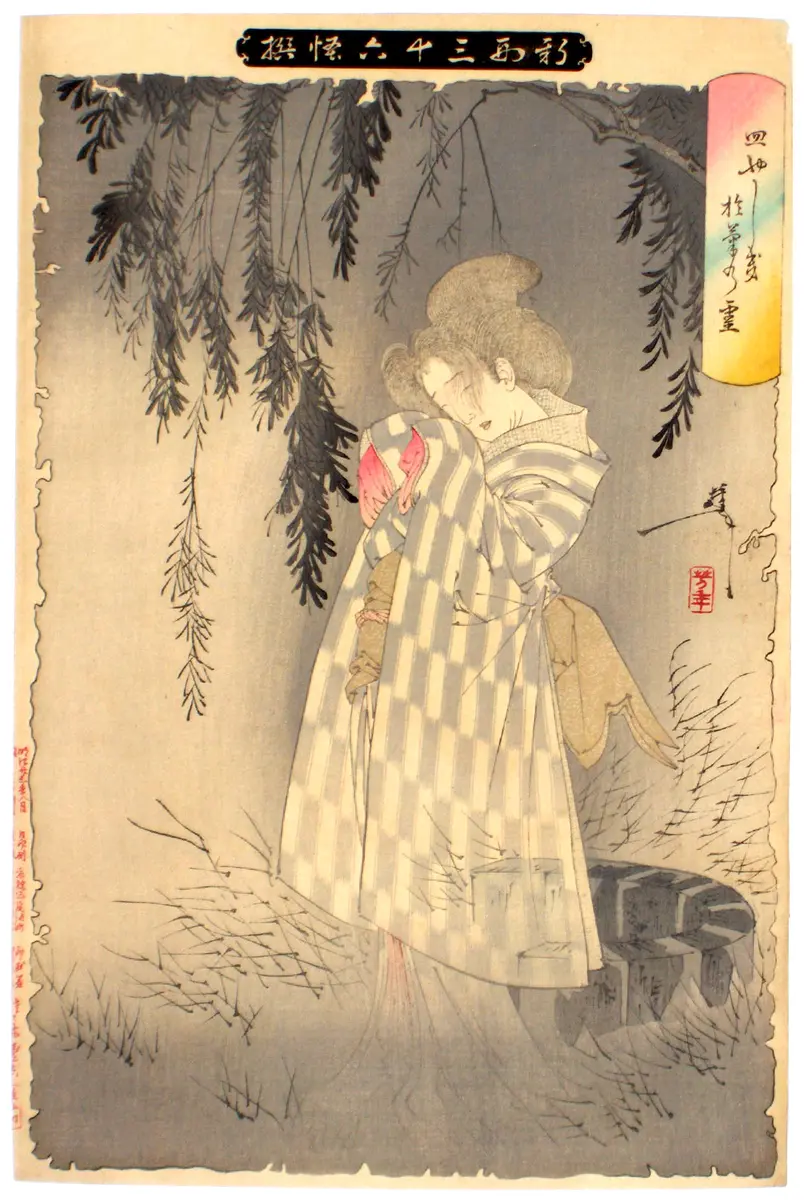
Two levels below the keep of Himeji Castle there is an old well shown to visitors as Okiku's Well, where a servant accused of losing one of ten heirloom plates is said to have been thrown, and from which her ghost counted the plates night after night. As a story it could hardly be stronger: it is one of Japan's great ghost tales, and the town keeps a shrine to her where people still offer plates with wishes written on them. What does not survive contact with the sources is the single tidy version. There are two rival branches, and they are not variants of each other. The Harima branch is older on paper — its earliest known text, dated 1577, has five abalone-shell cups, a heroine called Hanano and no well at all. The Edo branch was written in 1758 by a named author who moved the affair to Banchō, dated the broken plate to 1653, explained that the house was called a sarayashiki because it was an empty lot rather than because of any plates, and ended the tale by having a priest call out "ten" so that the ghost could rest. Even the well was called something else until about a century ago.
What is the history of Okiku and the Nine Plates?
Okiku's Well sits in the Kami-yamazato enclosure of Himeji Castle, two levels below the great keep, and it anchors a ghost story that Japan tells in two incompatible versions. The two branches have different villains, different objects, different cities and different endings.
The oldest text. The earliest known written form of the Harima Sarayashiki is a tale in Chikusō Yawa, a collection whose colophon names Nagara Chikusō and gives the date Tenshō 5 (1577). The Hyōgo Prefectural Museum of History, which keeps the prefecture's standard account, notes that if that colophon is genuine this is the oldest book to carry the story, and that recent opinion leans on it to make the Harima branch older than the Edo one. Its plot differs from the modern story at almost every point. The setting is late Muromachi, when the Yamana held Harima as military governors. The house is that of Odagaki Shumenosuke, a Yamana retainer based at Aoyama, and the heroine is called Hanano. The objects are a set of five abalone-shell cups granted by the Yamana lord. The villain is a young samurai, Kasadera Shin'emon, who wants her, hides one cup, tortures her and kills her. She is hung from a pine thereafter called "the hanging pine", and the tale has no well. The museum states flatly that when Okiku's name and the ten plates joined this plot "is currently unclear".
The Harima local record, and its compiler already doubted it. Banshū Zoku Koshō Shūkō, by the Himeji antiquarian Miki Michinori, survives inside Banyō Manpō Chiebukuro, the great Harima miscellany assembled by Amakawa Tomochika and printed in 1918. It carries two Sarayashiki entries back to back. In the first, the plates are ten, imported ware received as a gift; "Kiku" is a samurai's concubine; a lowly man about the house sends her a love letter, gets no answer, and engineers the breaking of a plate; it is the master who hears the crack, seizes her by the hair, tramples her, tortures her with the rope and drowns her in a well. The well is at Kiri-no-baba, in the castle town. From that night the voice counts "one, two…" and cries at the tenth, and she is enshrined at Jūnisho. The second entry adds that the affair is "recent, after the Keichō era" — that is, after 1615. And Miki adds a note of his own that no later teller repeats: the household, he says, came to Himeji on a transfer, "it does not appear to be a Himeji matter", the year is unknown, "many places in Himeji are pointed to as the mansion", and it is "only hearsay".
The stage, and then the reciter. On the fifteenth day of the seventh month of Kanpō 1 (1741), per the Jōruri Gedai Nenkan as read by Fujisawa Morihiko, the puppet theatre Toyotakeza in Naniwa first staged Banshū Sarayashiki, a three-act jōruri by Tamenaga Tarōbei and Asada Icchō. It grafted the plate legend onto the Hosokawa succession dispute, supplied the name everyone now uses for the villain — Aoyama Tessan — and already places Okiku's shrine at Jūnisho-jinja. Seventeen years later, in Hōreki 8 (1758), the Edo kōdan reciter Baba Bunkō signed the preface of Sarayashiki Bengiroku and moved the whole affair to Banchō in Edo. The preface carries the famous formula: "counting eight, nine — one short: the tale of Kiku." His master is Aoyama Shuzen, the plates are ten Nanking dishes, and the breaking has an exact date, the second day of the first month of Jōō 2 (1653). Shuzen cuts off the middle finger of her right hand so that her ten fingers should also be short by one; she dies, and the well glows and counts. Then the priest Ryōyo answers her. When the voice reaches "eight, nine", he calls out "ten"; the ghost cries "oh, joy!" and is laid to rest, and Bunkō explains that she was one plate and one finger short and that the word made both whole.
Bunkō also explains the name. Before Okiku, before the plates, his Banchō plot was a 2,500-tsubo lot at Ushigome with no buildings on it, "and because it was vacant ground it was called sarayashiki" — 更屋舗, "bare-lot mansion". Its earlier occupant was Tenjuin, that is Senhime, and two women, Hanai Iki and Takeo, were already killed and thrown down its well; blue flames rose from it at night and nobody would accept the plot. Bunkō closes the Okiku episode by pointing at the pun himself: the house first "acquired the name sara-yashiki" as an empty lot and only later, after another woman went into the same well, "made its name for later ages as sara-yashiki" — plate mansion; the homophone came second. Fujisawa Morihiko reached the same conclusion independently in 1918, from sara-chi, bare ground.
What the modern canon actually is. The Himeji story reached its full novelistic form in the late-Edo Banshū Sarayashiki Jitsuroku, summarised in Himejijō-shi (1952) and retold from there by the prefectural museum: Kodera Norimoto, the traitor Aoyama Tessan, the poisoned blossom-viewing at Zuiganji, and the henchman Chōnotsubo Danshirō — and it is Danshirō who covets Okiku, hides the plate and kills her. The Edo branch meanwhile was rewritten twice for the modern stage: Kawatake Mokuami's Shin Sarayashiki Tsuki no Amagasa (Ichimuraza, May 1883), which survives under the nickname Sakanaya Sōgorō, and Okamoto Kidō's one-act Banchō Sarayashiki (Hongōza, February 1916), the version most Japanese picture today. In Kidō the master is Aoyama Harima, Okiku breaks the plate herself to test whether he loves her, he forgives her, learns she did it deliberately, and kills her for having doubted him. Neither Himeji nor Tessan appears in the play.
Which branch came first was already disputed in the Edo period: the Unkin Zuihitsu, as quoted by Fujisawa, reports an old manuscript claiming the Banchō story was the one reworked into a Banshū one, the opposite of today's view. By 1934 the castle's own management office was printing "55. Okiku's Well" in its guidebook, with the legend dated to Eishō 2 (1505). Itō Atsushi's 2002 survey counts forty-eight places in Japan, from Iwate to Kagoshima, that keep a Sarayashiki of their own.
Timeline: the documented record of Okiku and the Nine Plates
- Eishō 2 (1505) The date the legend gives itself in its fullest Himeji form: Aoyama Tessan's poisoned blossom-viewing party against Kodera Norimoto. It is a date inside a story, not a document — the castle's own 1934 guidebook prints it as 28 March, Eishō 2.
- Tenshō 5 (1577) The colophon date of Chikusō Yawa, attributed to Nagara Chikusō. Per the Hyōgo Prefectural Museum of History it holds the oldest known form of the story: five abalone-shell cups, a heroine named Hanano, the young samurai Kasadera Shin'emon, a pine — and no well, no Okiku, no ten plates.
- After Keichō (post-1615) The Himeji antiquarian Miki Michinori records the Sarayashiki as something 'recent, after the Keichō era', and adds that it does not appear to be a Himeji matter and is only hearsay. That is a century later than the date the legend claims for itself.
- 2nd day, 1st month, Jōō 2 (1653) The exact date Baba Bunkō gives for the breaking of the plate in the Edo version: Kiku drops one of Aoyama Shuzen's ten Nanking dishes. Shuzen then cuts off the middle finger of her right hand so that her ten fingers should also be one short.
- 15 July, Kanpō 1 (1741) The Toyotakeza puppet theatre in Naniwa first stages Banshū Sarayashiki, a three-act jōruri by Tamenaga Tarōbei and Asada Icchō. It names the villain Aoyama Tessan, grafts the tale onto the Hosokawa succession dispute, and already places Okiku's shrine at Jūnisho-jinja.
- Hōreki 8 (1758) Baba Bunkō, an Edo kōdan reciter, signs the preface of Sarayashiki Bengiroku and moves the story to Banchō in Edo. He also records that the plot was called sarayashiki, 'bare-lot mansion', because it was vacant ground — the plates came to the name later. In his ending the priest Ryōyo answers the ghost with 'ten' and it is laid to rest.
- Hōreki 12 (1762) The Harima Kagami records the 'rains pine' of Senba and says a Himeji domain samurai planted it in the Genna era (1615–24). It does not mention Okiku: the marvel existed before the legend annexed it.
- Kansei 7 (1795) Swallowtail pupae appear in numbers around the Himeji castle town and the townspeople hail them as okiku-mushi, Okiku returning on her anniversary. The episode is recorded, and immediately dismissed, in the Harima gazetteer of 1804.
- Bunka 1 (1804) Harima Meisho Junran Zue, the illustrated Harima gazetteer, prints both debunkings at once: the Sarayashiki tale 'survives only in the mouths of women and children… and certainly looks like a fabrication', and the okiku-mushi is 'the grossest nonsense' — a pupa, common everywhere, and no one should be deceived.
- May 1883 Kawatake Mokuami's Shin Sarayashiki Tsuki no Amagasa opens at the Ichimuraza in Tokyo with Onoe Kikugorō V. It survives in the repertoire under the nickname Sakanaya Sōgorō — the Sarayashiki frame is not what kept it alive.
- 1898 The entomologist Matsumura Shōnen uses okiku-mushi in Nihon Konchūgaku as his textbook illustration of a pupa: the thing on the hedge that binds itself with silk thread, he writes, is an insect asleep.
- February 1916 Okamoto Kidō's one-act Banchō Sarayashiki premieres at the Hongōza in Tokyo, with Ichikawa Sadanji II as Aoyama Harima and Ichikawa Shōchō II as Okiku. Okiku breaks the plate herself to test his love; there is no Himeji, no Tessan, and on stage no ghost at all.
- 1934 The Historic Site Himeji Castle Management Office prints 'Okiku's Well' as item 55 of its guidebook, with the legend as item 56. The prefectural museum dates the renaming of the well — Tsurube-tori-ido in Edo documents — to around the start of the Taishō era, when the castle opened to the public.
- 1989 Himeji adopts Byasa alcinous as the city butterfly for its municipal centenary, citing three reasons: the swallowtail crest on the castle's roof tiles, the fact that the okiku-mushi is this species' pupa, and that its caterpillars eat Aristolochia rather than crops.
- 2002 Itō Atsushi's Nihon no Sarayashiki Densetsu maps forty-eight places in Japan, from Iwate to Kagoshima, that keep a Sarayashiki of their own. Himeji's is not the only one, and it may not be the first.
- 1 March 2026 Himeji's new two-tier admission takes effect: ¥2,500 for non-resident adults, ¥1,000 for city residents, free for everyone under 18. Okiku's Well is inside the paid area.
Is there a rational explanation for Okiku and the Nine Plates?
The best sceptic is the guidebook that put the legend on the map. Harima Meisho Junran Zue, the illustrated Harima gazetteer of 1804, is the book that made the story a tourist matter — and, quoted by Fujisawa Morihiko in 1918, it dismisses it: the Sarayashiki tale "survives only in the mouths of women and children, with nothing written down; the occasional written version resembles a clumsy stage contrivance and certainly looks like a fabrication". The gazetteer that records the local marvel is the same gazetteer that calls it invented.
The castle town in the story had not been built yet. The Hyōgo Prefectural Museum of History makes the cleanest objection available, and it is topographical. The Banshū Sarayashiki Jitsuroku stages the torture at Danshirō's mansion near the Kurumamon gate, hangs Okiku from a pine between the middle moat and the Senba river, and puts Aoyama Tessan's own house in the Kiri-no-baba district. Kurumamon and Kiri-no-baba are place names of the castle town Ikeda Terumasa built at the start of the Edo period — they did not exist in the Sengoku decades the story claims for itself. The museum's conclusion is printed on its own page: the story is better enjoyed "as Edo-period gesaku, without confusing it with fact".
The name came before the plates, and the man who wrote the founding text says so. Baba Bunkō spells the Edo mansion 更屋舗 — sarayashiki, "bare-lot mansion" — and explains that a 2,500-tsubo plot with no buildings on it "was called sarayashiki because it was vacant ground". Only at the end of the Okiku episode does he point at the pun: the place had already earned the name as an empty lot, and after a second woman went into the same well it "made its name for later ages" as sarayashiki, plate mansion. He also has an earlier haunting there, of two women killed by Senhime's household, with blue flames over the well before Okiku existed. Fujisawa Morihiko arrived at the same etymology independently in 1918. A ghost story that has to explain its own name twice is a story built on a word.
The well was renamed within living memory. Himeji City's own official castle site describes the well as the one where Okiku "is said to have been" thrown, and adds that it "was originally called the Tsurube-tori well". The prefectural museum dates the change: the well is Tsurube-tori-ido in Edo-period documents, and the name Okiku's Well is thought to have taken hold around the beginning of the Taishō era, when the castle opened to the public. By 1934 the castle management office's own guidebook was printing it as item 55. The name visitors read at the well is about a century old; the legend dates itself to 1505.
The pine was famous before it was Okiku's. The legend ends with the "rains pine", which withered every rainy season out of sympathy. The prefectural museum reports that until the middle of the Edo period such a pine really stood outside the Kurumamon gate, between the middle moat and the Senba river, and that the Harima Kagami of 1762 says a Himeji domain samurai planted it in the Genna era (1615–24); the Harima Kagami presents it purely as a natural curiosity and does not mention Okiku. Miki Michinori's notes in the Harima miscellany even preserve the planter: a foot-soldier captain of about seventeen koku, surnamed Suzuki, set it there during building works at Senba. A local marvel existed first, and the story annexed it.
The count does not agree with itself. In the Edo text of 1758 the ghost stops at nine and laments the missing one; in the Harima entry recorded by Miki Michinori she reaches the tenth and cries there; in Chikusō Yawa there are five cups and no counting ghost at all. A remembered event does not change its arithmetic between provinces. A stage effect does.
Three provinces claim to have invented it. Fujisawa collected the rivals. One tradition traces the whole thing to Aizu and Katō Yoshiaki, who on hearing that a servant had broken one of ten Nanking plates smashed the remaining nine himself so that no one could ever be named. Another, in Sekisui Kanwa, sets it in Kōzuke with twenty plates and a rice-pounder who breaks the surviving nineteen to save the maid. Both are stories about a master preventing the tragedy, which is what the Sarayashiki tale is the inversion of.
The insect is real, and it is older than its ghost. Himeji does have an "Okiku bug": the pupa of the swallowtail Byasa alcinous, which hangs trussed in silk and looks unnervingly like a small woman bound behind the back. In Kansei 7 (1795) they appeared around the Himeji castle town in numbers and were hailed as Okiku returning on her anniversary. The debunking is not modern: the same 1804 gazetteer answers that this is "the grossest nonsense", that the thing is the pupa a caterpillar becomes before turning into a butterfly, exactly as a silkworm does, that it is "common everywhere", and that one should on no account be deceived. Yamazaki Yoshinari, quoted by Miyatake Gaikotsu, wrote that the naturalists identified it as the ikujo — the "hanged woman" insect of the Chinese Erya — and that its appearance on a particular grave-tree was "mere coincidence". That grave was not Okiku's: in Ōmi the very same pupa carries a rival legend, the Jōgen-mushi, named for a bandit beheaded tied to a persimmon tree, and in Iwami a third. One insect, three ghosts, three provinces. Akatsuki Kanenari, who actually got hold of a specimen and examined it, measured it at a little over one sun two bu and concluded that calling it strange was fair enough, but that it was the form taken before becoming a butterfly. Matsumura Shōnen used okiku-mushi in 1898 as his textbook definition of a pupa. Miyatake, in 1914, noted that the resemblance people saw was to Okiku as she is tied up on stage. Himeji adopted the butterfly as its city emblem in 1989, listing the okiku-mushi among its three reasons.
In the founding text the counting ends. In the Edo text of 1758 the counting stops: the priest Ryōyo shouts "ten" and the ghost is released. The rakugo version, still performed as "Okiku's Plates", turns the same scene into a joke. Versions in which the ghost counts forever stop before Bunkō's last scene.
What the sources leave open. Miki Michinori, the Himeji antiquarian who wrote down the local tale, gave it no year, said the household had come to Himeji on a transfer of domain and that "it does not appear to be a Himeji matter", and called the account "only hearsay". The prefectural museum, for its part, writes that the moment when the name Okiku and the ten plates joined the older Chikusō Yawa plot "is at present unclear". The oldest text in the chain calls the woman Hanano.
Can you visit Okiku and the Nine Plates?
Okiku's Well, Himeji Castle. The well is inside the paid area of the castle. The Hyōgo Prefectural Museum of History places it in the Kami-yamazato enclosure, two levels below the great keep, and notes that Edo-period documents call it the Tsurube-tori well; the museum thinks the name Okiku's Well came into use around the start of the Taishō era, when the castle was opened to the public. The castle's official page on touring routes, updated on 12 June 2026, lists an Okiku's Well route among its short circuits, alongside the direct route to the keep and the Nishi-no-maru route.
Office, hours and fees. The Himeji Castle Administration Office is at 68 Honmachi, Himeji 670-0012, on the north side of the Sannomaru plaza, telephone 079-285-1146. The city's pages, consulted on 24 September 2026, give opening hours of 9:00 to 17:00 with the gates closing at 16:00, and list 29 and 30 December as closing days. Since 1 March 2026 admission has cost ¥2,500 for visitors aged 18 or over who do not live in Himeji and ¥1,000 for Himeji residents, who prove residence with a My Number card (the notification card is not accepted), a driving licence or another official document with photograph, name and address. Groups of 30 or more pay ¥2,000 and ¥800 respectively. Admission is free under 18, which the city explains as a way of widening young people's contact with the castle. A combined ticket with the Kōkoen garden costs ¥2,600 and an annual pass ¥5,000, and digital tickets are sold separately for residents and non-residents. The same pages state that drones may not be flown over the castle.
Okiku Shrine. Okiku is enshrined in the Okiku-jinja, a small shrine inside the precinct of Jūnisho-jinja at 120 Jūnishomae-chō, Himeji 670-0911. The city tourism bureau's page puts it about ten minutes on foot from the JR and Sanyō Himeji stations and records that Okiku was formerly worshipped there as Mikiku Daimyōjin. The prefectural museum reports a notice board in the precinct explaining that people in the restaurant trade write wishes on plates and offer them. The museum also cites the Son'ō Yawashū, written by the Himeji domain samurai Fukumoto Yūji at the end of the Edo period, which says that the shrine had been set up only recently; because the puppet play Banshū Sarayashiki, staged in Osaka from 1741, already places Okiku in the Jūnisho precinct, the museum concludes that the shrine goes back at least that far.
The other sites. The legend puts the villain Aoyama Tetsuzan's residence at Kiri-no-baba, which the museum locates behind today's Himeji Higashi High School and the National Hospital Organization Himeji Medical Center, while pointing out that the name belongs to the castle town laid out after Ikeda Terumasa, long after the period of the story. The Rokushin Tanpitsu, compiled by retainers of the Sakai lords around 1800, placed an "Okiku's grave" in the house of Obata Kurōemon in the Gokenyashiki district; the museum says that grave cannot be confirmed today. Elsewhere in Hyōgo it lists an Okiku grave at Kuchinagatani in Sayō, with a well in the ruins of Rikan castle behind it, and the site of a well at the Jinshōin temple in Daimotsu, Amagasaki. The Amagasaki version is set in the Genroku era, and the museum suggests it grew from the surname shared by the Aoyama lords of Amagasaki and the Himeji villain. Itō Atsushi's survey of 2002 records 48 Sarayashiki sites between Iwate and Kagoshima.
Banchō. Okamoto Kidō's Banchō Sarayashiki, in the Aozora Bunko text, opens at the steps of the Sannō shrine in Kōjimachi; its plot belongs to the Edo branch of the legend, set in the shogun's capital.
The Okiku bug. Himeji adopted Byasa alcinous, the jakō-ageha, as its city butterfly in 1989, the city's centenary. The liaison council that promotes it gives three reasons, among them the swallowtail crest of Ikeda Terumasa on the castle's roof tiles and the belief that the Okiku-mushi, Okiku's incarnation, is the pupa of this butterfly. The prefectural museum adds that the pupae were once sold at summer fair stalls in Himeji and elsewhere.
Sources consulted
- 三木通識 (Miki Michinori); ed. 天川友親 (Amakawa Tomochika), «播州続古所拾考 (Banshū Zoku Koshō Shūkō), las dos entradas «皿屋敷»» — 播陽万宝智恵袋 校訂・名跡之部, 播磨史談会, pp. 32-34, 1918 book
- 馬場文耕 (Baba Bunkō); ed. 河竹繁俊, «皿屋舗辨疑録 (Sarayashiki Bengiroku, 1758)» — 近世実録全書 第1巻, 早稲田大学出版部, 1929 book
- 兵庫県立歴史博物館 (Museo Histórico de la Prefectura de Hyōgo), «播州皿屋敷 姫路のお菊井戸 / 紀行文『播州皿屋敷』を訪ねて» — ひょうご伝説紀行 — 妖怪・自然の世界, 2020 report
- 岡本綺堂 (Okamoto Kidō), «番町皿屋敷 (Banchō Sarayashiki) — versión en prosa de la serie 綺堂読物, no el texto de la obra en un acto de 1916» — 怪奇・伝奇時代小説選集13, 春陽堂書店 / 青空文庫, 2000 book
- 史蹟姫路城管理事務所 (Oficina de Gestión del Castillo de Himeji), «姫路城案内, §55「お菊井戸」y §56「播州皿屋敷の伝説」» — 史蹟姫路城管理事務所, pp. 28-29, 1934 book
- 藤沢衛彦 (Fujisawa Morihiko), «日本伝説叢書 播磨の巻 —「皿屋敷お菊怪談」y「お菊蟲」, con citas de 播磨名所巡覧図会, 雲錦随筆, 積翠閑話 y 浄瑠璃外題年鑑» — 日本伝説叢書刊行会, pp. 76-87, 1918 book
- 松村松年 (Matsumura Shōnen), «日本昆虫学 (Nihon Konchūgaku)» — 裳華房, 1898 book
- 宮武外骨 (Miyatake Gaikotsu), «人面類似集 —「常元蟲・お菊蟲」, que cita 山崎美成『三養雑記』y 『塩尻』» — 半狂堂, 1931 book
- 小学館, «播州皿屋敷 — entradas de デジタル大辞泉 y 精選版 日本国語大辞典» — コトバンク, 2024 web
- 渡邊昭五 y otros, «皿屋敷 / 番町皿屋敷 / 新皿屋敷月雨暈 — 日本大百科全書 (ニッポニカ)» — 小学館 / コトバンク, 2024 web
- ジャコウアゲハが飛び交う街姫路連絡協議会, «ジャコウアゲハとは — 姫路市の市蝶制定 (平成元年) y sus tres razones» — jakouageha-himeji.jp, 2024 web
- 伊藤篤 (Itō Atsushi), «日本の皿屋敷伝説» — 海鳥社, 235 pp., ISBN 4-87415-402-6, 2002 book
- 姫路市 姫路城管理事務所, «城の楽しみ方 — お菊井戸:「もとは釣瓶取井戸と呼ばれていました」» — 姫路城公式サイト, 2026 web
- 姫路市 観光経済局, «3月1日以降の姫路城縦覧料等について» — 姫路城公式サイト, 2026 web
- 姫路市観光コンベンションビューロー, «十二所神社・お菊神社» — 姫路観光ナビ ひめのみち, 2026 web
Reviewed by V. Serrano on 2026-08-16 · How we verify our content
📎 Source: Enigma Atlas
💬 Field testimonies (0)
No testimonies yet. Add the first.
Add your testimony
🔒 Log in to add a testimony